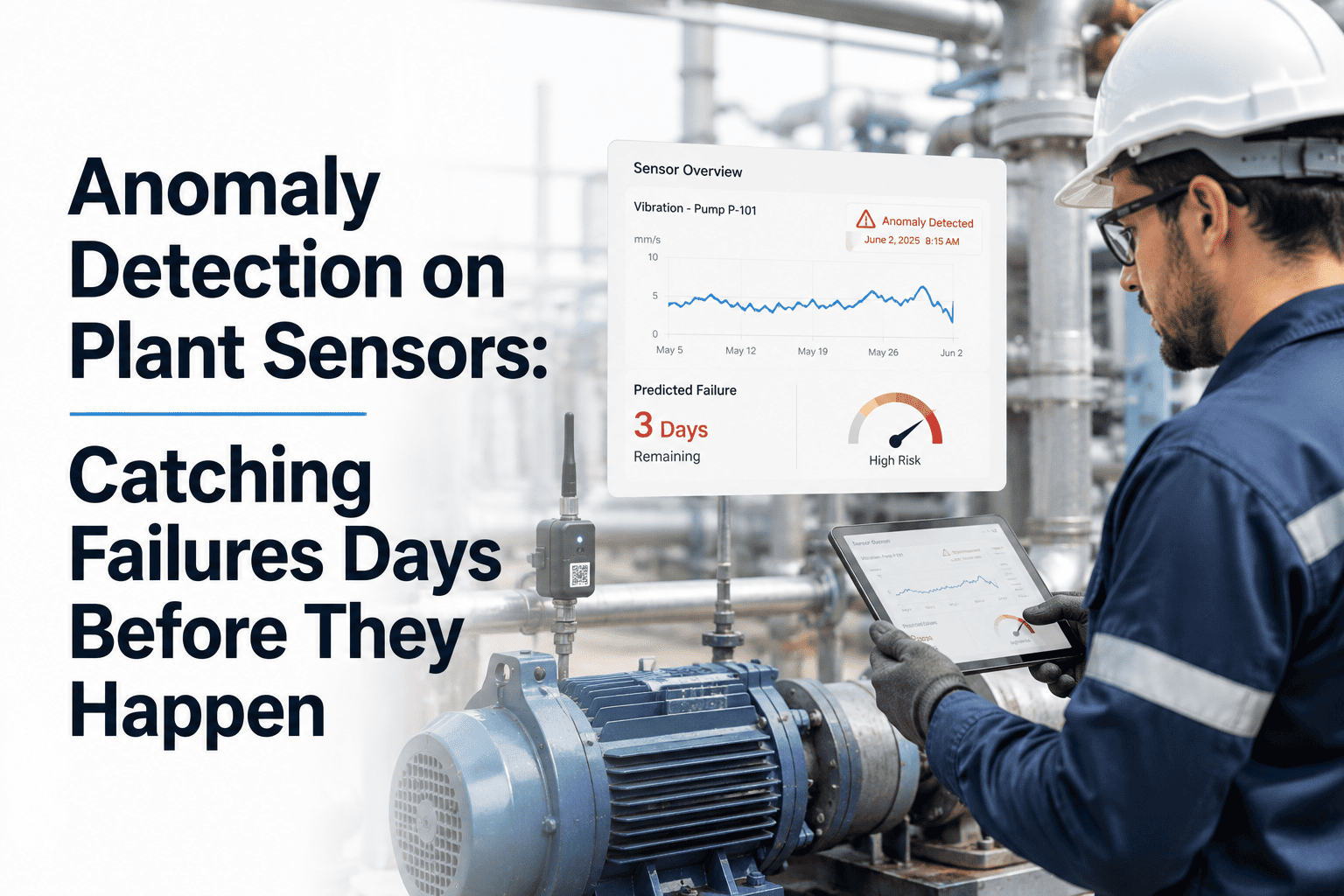
A bearing about to fail doesn't announce itself with a single dramatic spike. It announces itself ten to thirty days early, in a vibration signature that's just slightly different from normal — a pattern invisible to a fixed threshold alarm, but obvious to a model that actually knows what "normal" looks like for that specific machine. That gap between when the signature first appears and when the bearing actually seizes is the entire value of anomaly detection: it converts a 2am emergency callout into a work order scheduled for next Tuesday. A CMMS like OxMaint turns that early signature into a work order automatically, the moment it crosses a threshold that's actually been tuned to your equipment.
Turn Sensor Drift Into Days of Warning, Not a Surprise Failure
Vibration, temperature, and current monitored against a rolling baseline — anomalies flagged and turned into a work order automatically, before the breakdown happens.
Why a Fixed Threshold Alarm Misses the Early Signal
A traditional alarm fires when a reading crosses one static number — vibration above X, temperature above Y. The problem is that "normal" for a compressor running at full load on a hot afternoon is not the same as "normal" for the same compressor idling overnight. A fixed threshold can't tell the difference, so it either fires constantly on ordinary operational variation, or gets set so loose that it only catches a failure once it's already obvious.
Anomaly detection replaces the fixed number with a rolling statistical baseline — typically built from 60 to 90 days of normal operating data per sensor, per asset — that accounts for load, ambient conditions, and routine cycles. A reading is only flagged when it deviates from what's normal for those specific conditions, not from an arbitrary line drawn once and never revisited.
Three Sensor Types, Three Different Warning Windows
Vibration
Bearing failure signatures typically emerge 10-30 days before failure, detected with 80-90% accuracy on mature deployments. The most established sensor type for rotating equipment.
Temperature
Thermal anomalies precede mechanical failure by 2-8 weeks in many cases, catching winding overheating, lubrication failure, and cooling system faults early.
Current Draw
Electrical signature deviations often confirm a developing mechanical fault already flagged by vibration or temperature, adding confidence rather than standing alone.
No single sensor tells the whole story. The most reliable deployments require multiple signals to deviate together — a compressor anomaly confirmed when vibration, current, and temperature all shift at once — rather than acting on one noisy channel in isolation. Book a demo to see this multi-sensor confirmation running against your own equipment.
How Long Is the Warning, Realistically?
| Time Horizon | Reliability | What This Means in Practice |
|---|---|---|
| 5-15 Days | Reliable | The sweet spot — enough time to plan a repair, order parts, schedule downtime |
| 15-30 Days | Useful but softer | Good for planning purposes, with growing uncertainty the further out you look |
| 30+ Days | Not reliably better than scheduled PM | At this range, a well-run calendar-based PM programme performs comparably |
Predictive accuracy decays with distance, the same way a weather forecast gets less reliable the further into the future it reaches. Setting expectations at 5-15 days of genuinely actionable warning is realistic. Promising 90-day forecasts on every asset is the kind of claim that leads to disappointment once the system is actually running. Sign up free to see what lead time your own sensor history can actually support.
Why False Positives Happen — and How to Actually Fix Them
Rigid Fixed Thresholds
A static limit applied to raw sensor data can't distinguish a genuine fault signature from ordinary load variation, so it fires on both equally.
Require Corroboration
Demanding two independent signals deviate together before declaring an anomaly — not just one noisy channel — substantially cuts false alarms from statistical noise.
Build a Feedback Loop
Every alert a technician marks "false alarm" or "missed anomaly" should adjust the threshold slightly, so the system calibrates itself against your specific equipment over time.
Alert fatigue is not a minor annoyance — it's the single biggest reason predictive maintenance programmes get quietly abandoned. Once a team learns to ignore the alerts, the entire investment in sensors and software stops paying back, regardless of how accurate the model technically is.
Deploying Without Wasting the First Six Months
Start With Critical Assets
Instrument the equipment where failure is most expensive first, validate the approach there, then expand once it's proven rather than blanketing the whole plant on day one.
Build the Baseline Before Judging It
A model needs 60-90 days of normal operating data before its anomaly calls are trustworthy. Judging accuracy before that window closes measures noise, not performance.
Connect the Alert to a Work Order
An anomaly flagged in a separate dashboard that nobody checks delivers zero value. The alert needs to land directly inside the workflow your team already uses.
What Plants Running This Are Actually Seeing
How OxMaint Turns an Anomaly Into Action
Rolling Dynamic Baseline
A per-sensor, per-asset baseline built from your own operating history, accounting for load and ambient conditions rather than one fixed number.
Multi-Signal Confirmation
Anomalies are confirmed when vibration, temperature, and current deviate together, cutting false positives from single-sensor noise.
Automatic Work Order Creation
A confirmed anomaly creates a work order directly, with fault classification, asset history, and recommended action attached.
Self-Calibrating Thresholds
Technician feedback on each alert refines the threshold over time, so the system gets quieter and more accurate the longer it runs.
Catch the Failure Signature Days Before It Becomes a Breakdown
Dynamic baselines, multi-sensor confirmation, and automatic work orders — built so your team trusts the alert instead of learning to ignore it.
Frequently Asked Questions
How many days of warning does anomaly detection actually give before a failure?
Reliably, 5 to 15 days for most rotating equipment failure modes. Predictions beyond 30 days are typically not more accurate than a well-run scheduled maintenance programme, so that's a realistic ceiling for planning purposes.
Why does my anomaly detection system generate so many false alarms?
Usually because it's relying on a fixed threshold rather than a dynamic baseline, so it can't distinguish genuine fault signatures from normal operational variation like load changes or ambient temperature swings.
How much historical data is needed before the system can be trusted?
Most models need 60 to 90 days of normal operating data to build a reliable baseline per sensor, per asset. Judging the system's accuracy before that baseline period completes will measure noise rather than real performance.
Should I trust an anomaly flagged by a single sensor?
Treat single-sensor anomalies with caution. The most reliable detections require two or more independent signals — such as vibration and temperature — to deviate together before confirming a genuine developing fault.
What's the biggest reason predictive maintenance programmes get abandoned?
Alert fatigue. Once a team learns to distrust or ignore alerts because too many turned out to be false alarms, the entire investment in sensors and analytics stops delivering value regardless of the underlying model's technical accuracy.