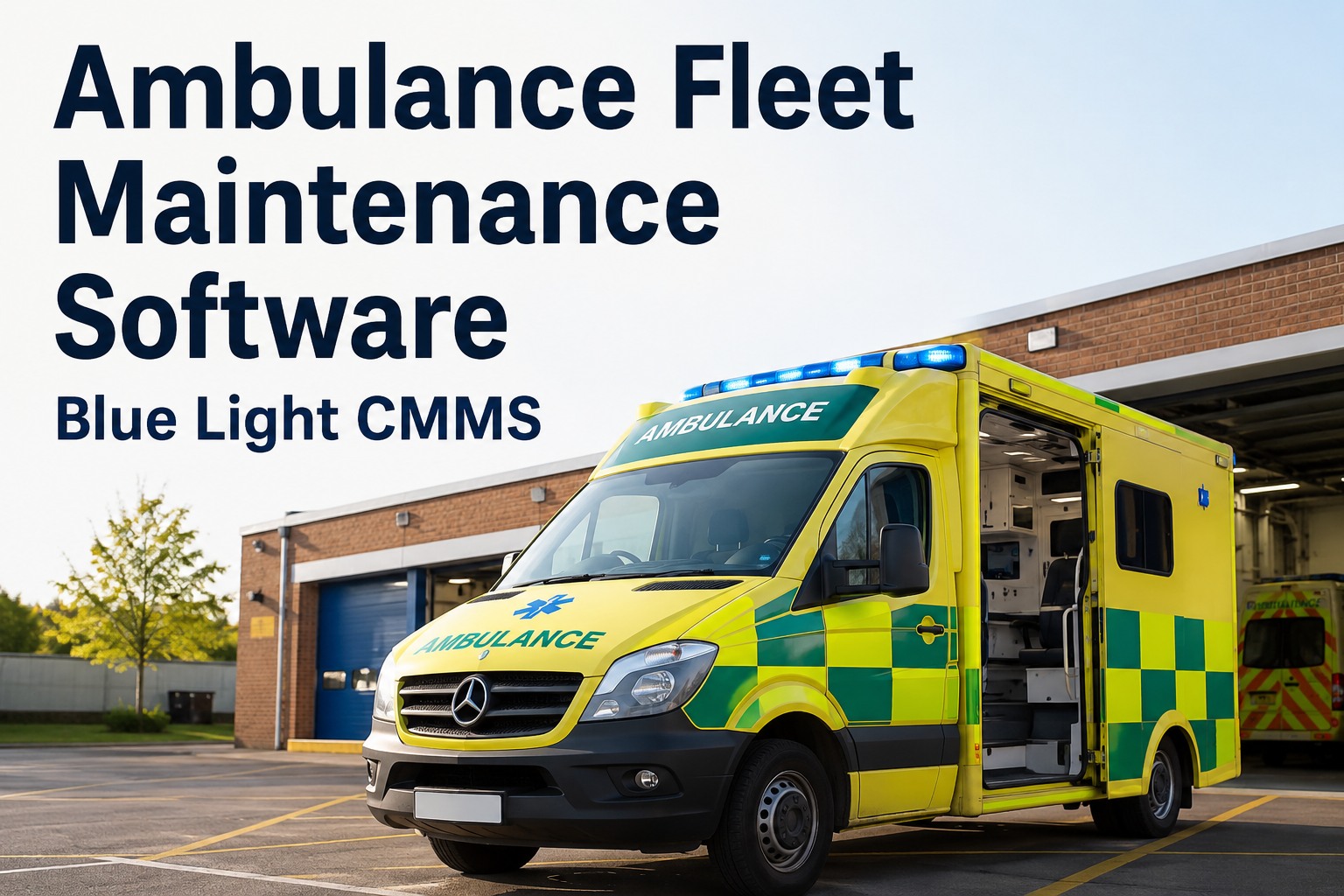
An ambulance is two assets in one vehicle. The chassis, engine and blue-light equipment must meet PMI, MOT and Traffic Commissioner obligations. The defibrillator, oxygen system, suction unit and drug cabinet inside must meet clinical device standards under MHRA guidance and NHS clinical engineering protocols. Both must be verified before the vehicle rolls out on any shift. Trusts and private operators keeping availability high aren't running two systems; they're running one that treats the vehicle and the equipment as a single deployable unit. Book a demo to see fleet workflows in action.
◆ EMERGENCY FLEET · PMI · CLINICAL ENGINEERING · VOR
Every ambulance is a vehicle and a mobile treatment room. Availability means both are shift-ready — every shift, without exception.
Every chassis, every defibrillator, every oxygen bottle, every controlled drug cabinet — under one deployment-ready maintenance system.
DUAL-TRACK ASSET MODEL · ONE DEPLOYABLE UNIT
VEHICLE
Chassis · Engine · Blue-lights · Sirens · Livery
PMI · MOT · Traffic Commissioner
+
MEDICAL EQUIPMENT
Defib · Oxygen · Suction · Monitor · CD cabinet
MHRA · Clinical Engineering
=
SHIFT READY
Vehicle available · Equipment tested · Consumables complete
Deployment cleared
6wk
Statutory PMI interval for PSV-classified units
100%
Equipment tested before every shift handover
24/7
Availability target · Every day of the year
The Vehicle Track — PMI, MOT and the Traffic Commissioner
Ambulances registered under an Operator Licence (whether NHS trust or private provider) fall under the same road-transport compliance regime as any PSV or HGV — statutory PMI intervals, annual MOT, driver defect reporting under DVSA guidance, and Traffic Commissioner scrutiny. Missing an interval isn't a paperwork slip; it's grounds for O-licence action that reduces the fleet size an operator is permitted to run. Sign up free to run PMI cycles per vehicle with statutory alerts.
VEHICLE COMPLIANCE TIMELINE
Statutory Cadence · Per Vehicle · Per Shift
DAILY
Driver Walk-Around Check
DVSA-aligned first-use check · Tyres · Lights · Fluid levels · Warning devices · Body condition · Driver signs off
Driver
6 WEEKS
Preventative Maintenance Inspection
Statutory PMI at declared frequency on O-licence · Full brake test with roller brake tester · Underside · Steering · Suspension · Emissions
Authorised Examiner
SERVICE
Manufacturer Interval Service
Manufacturer schedule against mileage or hours · Oil · Filters · Timing components · Blue-light system function verification
Approved workshop
ANNUAL
MOT / DVSA Annual Test
Statutory annual test at DVSA site or Authorised Testing Facility · Full test regime · Certificate issued · Defects resolved before return to service
DVSA / ATF
The Medical Equipment Track — Clinical Engineering Under MHRA
The kit inside the vehicle is life-critical, and its maintenance regime is entirely separate from the chassis. Defibrillators need service against manufacturer schedule and battery cycle. Oxygen bottles need pressure testing on their statutory cycle. Suction units need function verification. Controlled drug cabinets need registered content management. Each item has its own asset record, its own inspection cycle, and its own recall awareness under MHRA field safety notices. Book a demo to see clinical equipment workflow live.
01 · DEFIBRILLATOR
Life-Critical · Manufacturer Cycle
Shift-start self-test · Battery cycle tracking · Electrode expiry · Manufacturer PPM per interval · MHRA alert awareness
Regime · MHRA registration · Clinical engineering PPM
02 · OXYGEN & MEDICAL GASES
Statutory Pressure Regime
Bottle statutory pressure test cycle · Regulator function · Delivery flow test · Cylinder-content tracking · Content-vs-need reconciliation
Regime · PSSR · BOC/gas supplier cycle
03 · MONITOR / SUCTION
Function & Calibration
Shift-start function verification · Suction pump PPM · Monitor calibration to manufacturer standard · Cable and lead condition check
Regime · Clinical engineering PPM
04 · CD CABINET & CONSUMABLES
Controlled Drug & Stock
CD register reconciliation each handover · Cabinet integrity · Consumable expiry rolling · Restock trigger workflow · Waste stream compliance
Regime · MDA · Trust CD policy
Vehicle Off Road — When the Fleet Can't Deploy
Every operator hopes their VOR rate stays low. The reality is that critical defects happen, and when they do, the workflow that gets the vehicle back on the road quickly is what protects deployment cover. A properly configured CMMS classifies the VOR reason, escalates to the right workshop or clinical engineering resource, and gives fleet managers realistic ETA visibility for planning shift cover.
01
Cosmetic / Non-Critical
Livery damage, non-safety cosmetic issue, minor bodywork · Vehicle deployable but flagged for repair batch
IN SERVICE · Scheduled repair
02
Equipment Substitutable
Single equipment item faulty but spare available · Swap-in from clinical engineering hub · Vehicle deployable
IN SERVICE · Equipment swap
03
Serviceability Reduced
Vehicle available but degraded (spare wheel used, single blue-light failed, one radio channel) · Documented decision · Restricted deployment
CONDITIONAL · Restricted deployment
04
VOR · Vehicle Off Road
Any safety-critical defect, PMI overdue, MOT expired, critical equipment failure without spare, or MHRA alert requiring hold
VOR · No deployment until cleared
◆ AMBULANCE FLEET DEMO
See the Full Fleet Workflow in 30 Minutes
Dual-track vehicle and medical equipment asset registers, PMI/MOT statutory calendars, clinical engineering PPM cycles, VOR classification and escalation, shift-start readiness workflow, MHRA alert distribution.
Shift Handover — The Workflow That Protects Availability
Every shift change is a hand-off risk. What was working when the outgoing crew booked in might not be working when the incoming crew books out. A structured handover workflow — captured on mobile, timestamped, with defect capture and equipment sign-off — is what keeps availability data honest and stops issues from disappearing between shifts. Sign up free to structure handover as a workflow, not a conversation.
01
Book In
Outgoing crew logs shift end · Defects raised during shift capture with severity · Consumables used
→
02
Vehicle Check
Walk-around check · Fluid levels · Tyres · Body condition · Blue-lights function · Radio and comms verified
→
03
Equipment Test
Defibrillator self-test · Oxygen pressures · Suction function · Monitor calibration check · CD cabinet reconciliation
→
04
Consumable Restock
Stock replenishment against par level · Expiry check · Restock work orders auto-raise for hub · Ready log
→
05
Book Out
Incoming crew accepts vehicle · Outstanding defects flagged · Sign-off timestamped · Vehicle status green · Deploy
Expert Perspective — Why Ambulance Fleets Reward Structural Discipline
"
The two things that make ambulance fleets uniquely difficult are the split responsibility and the availability pressure. Fleet engineering sits with the transport function under Traffic Commissioner oversight; clinical engineering sits with the medical directorate under MHRA and trust clinical governance; consumables sit somewhere else again. Historically that meant three systems, three inventories, three sets of PPM calendars, and endless friction at shift handover when the crew couldn't tell whose problem a particular defect was. The trusts and private providers who have solved availability aren't doing anything technically exceptional — they've moved everything onto a single asset record where the vehicle and its onboard equipment are managed as one deployable unit. When the defibrillator fails, the same platform that raises the clinical engineering work order also flags the vehicle as VOR and triggers the equipment-swap workflow. When the PMI comes due, the same platform reminds fleet and prompts the resource plan. That's the entire trick — structural clarity about what makes a unit deployable, and disciplined workflow around the handovers.
— NHS Ambulance & Private Emergency Fleet Practice
01
Dual-track asset model
Vehicle and onboard medical equipment held as one deployable unit with per-item PPM cycles and compliance.
02
Statutory calendars
PMI, MOT, PSSR gas cycles, clinical PPM all in one calendar with alerts and Traffic Commissioner evidence.
03
Shift handover workflow
Book-in → check → test → restock → book-out with mobile capture and timestamped sign-off per crew change.
04
MHRA alert distribution
Field safety notices route to affected equipment records with hold-and-action workflow to protect deployment.
Who Uses Oxmaint for UK Emergency Fleets
The platform is used by the UK roles that keep emergency vehicles rolling day-to-day: NHS ambulance trust fleet engineering and clinical engineering directors, private ambulance and patient transport providers running blue-light and non-emergency fleets, fire and rescue service fleet workshops managing pumping appliances and rescue vehicles, mountain and coastal rescue operators with 4x4 and specialist vehicle populations, event medical cover providers, blood service and organ transport fleet managers, and industrial emergency response teams at CNI sites where on-site ambulance provision is part of major-hazard mitigation. Sign up free to configure emergency fleet workflow for your operation.
Getting Ambulance Fleet Maintenance Live in 30-60 Days
Deployment starts with the dual-track asset register — every vehicle with make/model, O-licence data, PMI frequency and MOT schedule; every onboard medical equipment item with make/model, MHRA registration, manufacturer PPM schedule and battery/consumable lifecycle. PPM cycles configure per asset type. Shift handover workflow templates deploy on mobile for book-in, vehicle check, equipment test, restock and book-out. VOR classification chain configures with escalation routing. MHRA alert intake structural with field-safety-notice distribution to affected equipment records. Statutory calendars populate for PMI, MOT, PSSR gas testing and clinical engineering. Most emergency fleet operations see dual-track register, handover workflow and PPM cycles live within 30-60 days.
◆ EVERY SHIFT. EVERY VEHICLE. EVERY DEVICE VERIFIED.
One Fleet. One System. Every Deployment Ready.
Oxmaint gives UK emergency fleet operators the full vehicle and clinical engineering cycle in one platform — dual-track asset register, statutory PMI/MOT calendars, MHRA-integrated equipment PPM, shift handover workflow and VOR classification with escalation.
Frequently Asked Questions
What is ambulance fleet maintenance software?
Ambulance fleet maintenance software is a CMMS configured specifically for emergency-service vehicles that carry life-critical medical equipment. It holds each unit as a dual-track asset — the vehicle track covering chassis, engine, blue-lights, sirens and livery under PMI, MOT and Traffic Commissioner obligations; the medical equipment track covering defibrillator, oxygen system, suction unit, monitor and controlled drug cabinet under MHRA and clinical engineering PPM. Shift handover workflow structures book-in through book-out with mobile capture, VOR classification protects deployment discipline, and MHRA field safety notices route directly to affected equipment records with hold-and-action workflow.
How does it handle PMI and Traffic Commissioner compliance?
Every vehicle holds its Operator Licence data with declared PMI frequency (typically 6 weeks for ambulances operating under PSV or restricted O-licence). PMI cycles schedule automatically with alerts at T-14 days for booking and T-0 for execution. PMI inspection reports upload against the vehicle record with roller brake test data, defect classification and remedial actions tracked to closure. Traffic Commissioner audit packs export directly — the platform holds the complete evidence chain from PMI schedule through inspection through defect resolution through re-test. Missing intervals surface as prominent alerts before they lapse. Duty ownership remains with the transport manager on the O-licence; the platform provides the structural evidence system.
Does it manage medical equipment PPM alongside vehicles?
Yes. Every medical equipment item registers as an asset — defibrillator with battery cycle count and electrode expiry, oxygen bottles with statutory pressure test dates and content tracking, suction units and monitors with calibration cycles, CD cabinets with reconciliation logs. Each item has its own PPM cadence per manufacturer or regulatory requirement. Equipment allocates to vehicles and moves with equipment swaps (when a spare defibrillator swaps in from the hub, both records update). MHRA field safety notices ingest per manufacturer and equipment class, routing hold-and-action work orders to every affected asset. Clinical engineering teams get their own view of equipment health across the fleet independent of vehicle scheduling.
Can it manage the shift handover workflow?
Yes. Shift handover deploys as a mobile 5-stage workflow — Book In (outgoing crew logs shift end with any defects), Vehicle Check (walk-around with fluid, tyre, body, blue-light verification), Equipment Test (defibrillator self-test, oxygen pressures, suction function, monitor calibration, CD reconciliation), Consumable Restock (par-level replenishment with expiry check and restock work orders), Book Out (incoming crew accepts vehicle with sign-off timestamp). Each stage captures on mobile with photograph where relevant. Any defect found routes through the VOR classification chain before deployment can proceed. Complete handover evidence retains per shift per vehicle, giving trust clinical governance and Traffic Commissioner a searchable record rather than a paper logbook.
How long does deployment typically take on a UK emergency fleet?
A single fleet with 20-200 vehicles typically goes live within 30-60 days — dual-track asset register import (vehicles with O-licence, PMI and MOT data; medical equipment items with MHRA registration, manufacturer PPM schedules and lifecycle tracking), PPM cycle configuration per asset type, shift handover mobile workflow with book-in through book-out sign-off, VOR classification chain with escalation routing, MHRA field safety notice intake, and statutory calendar population for PMI, MOT, PSSR gas testing and clinical engineering. NHS trust deployments and multi-region private ambulance provider rollouts typically complete within a quarter. Existing fleet management or clinical engineering system data migration is the largest single scoping variable, particularly where trusts are consolidating from separate transport and clinical engineering platforms.