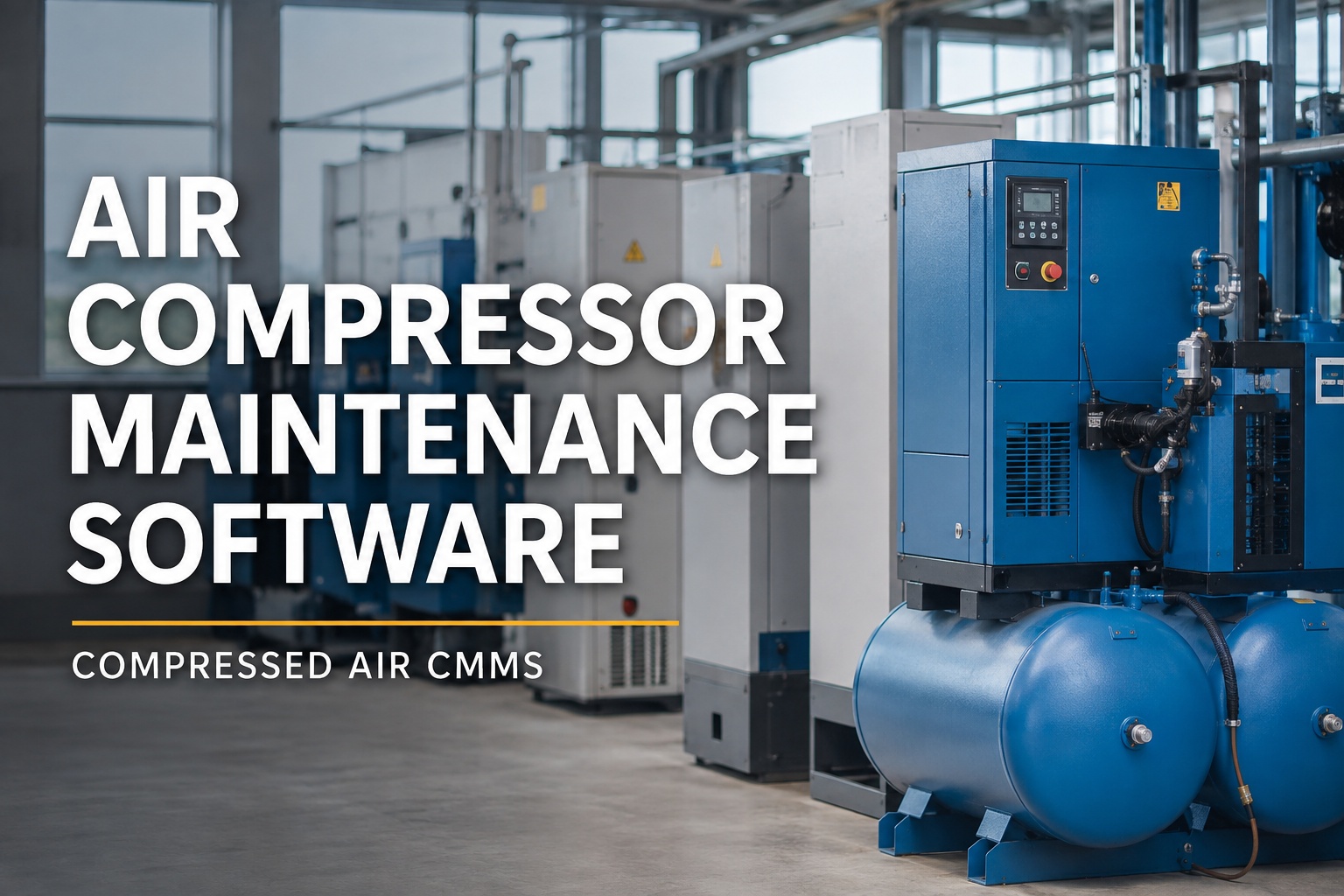
Compressed air is the most expensive utility in your factory and the one nobody watches. A single 6mm leak on a 7-bar system leaks over £3,000 of electricity per year — and the average industrial site has dozens of them. Add unloaded run-time, poor sequencing, wrong pressure setpoints, and undersized dryers, and compressed air routinely consumes 10-30% of a plant's total electricity bill delivering work that's already been paid for. Compressor maintenance is where that number either stops or keeps climbing. Book a demo to see compressed air workflows in action.
◆ COMPRESSED AIR · ENERGY · LEAK MANAGEMENT
The most expensive utility in your plant is the one nobody hears leaking. Every hiss is a payslip going out the door.
Every screw, every reciprocating, every dryer, every filter and every drain — one maintenance system, one energy story.
*At 7 bar · 8760 hrs · £0.28/kWh · specific power 6 kW/100 l/s
10-30%
Of a UK factory's electricity is compressed air
20-40%
Of generated air lost to unfixed leaks · typical
1 bar
Pressure drop = ~7% more compressor kW
The Compressor Room — What Actually Lives on the Asset Register
A compressed air system is not one asset. It's a plant-within-a-plant: generation, treatment, storage, distribution, drainage. The register a working CMMS has to hold is more layered than most engineers realise on day one, and each element has its own PPM cadence.
COMPRESSED AIR SYSTEM
Generation → Treatment → Storage → Distribution
GENERATION
Compressors
Screw · Reciprocating · Centrifugal · VSD · Fixed-speed
PPM · Daily / 500 / 2000 / 8000 hr
→
TREATMENT
Dryers & Filters
Refrigerant · Desiccant · Coalescing · Particulate · Oil-removal
PPM · ΔP-driven filter change · Regen cycles
→
STORAGE
Air Receivers
Wet receiver · Dry receiver · Buffer tanks · Safety valves
PPM · PSSR TExT · Drain function check
→
DISTRIBUTION
Pipework & Points
Ring main · Drop legs · FRLs · Flow meters · Point-of-use isolation
PPM · Leak survey · Ultrasonic detection
CROSS-SYSTEM · Always on
Condensate drainsOil-water separatorAftercoolerCooling water loopVent silencers
The PPM Interval Anatomy — Where Time Actually Matters
Rotary screw compressor manufacturers publish maintenance intervals that are simultaneously the compliance floor and the reliability ceiling. Miss them and the warranty voids; stretch them and the machine ages fast. The CMMS job is to make the intervals invisible — they happen, on time, with the right parts on the truck, before the meter clocks up the hours that trigger them. Sign up free to hold hour-cycle PPM across your compressor fleet.
ROTARY SCREW PPM · TYPICAL OEM SCHEDULE
Hour-based Intervals · Cascading Cadence
24
DAILY / 24 HR
Visual walk-around · Ambient temp · Oil level · Condensate drain test · Alarm log check
500
500 HR / QUARTERLY
Air intake filter · Oil filter change · Belt tension · Cooler inspection · Drain valve function
2K
2,000 HR / ANNUAL
Oil change · Oil separator · Air-oil cooler clean · Valve service · Motor bearings grease · Coupling
8K
8,000 HR / 3-4 YR MAJOR
Airend inspection · Bearing set · Full service · Vibration baseline · Discharge check-valve overhaul
The Pressure Story — Where Diagnostics Live
A compressor room has one big screen worth watching — pressure. Not just the setpoint, but the differential across every treatment stage. Rising ΔP across a filter means it's approaching change-out. Cavitating pressure at a point of use means a distribution restriction. Persistent inability to reach setpoint at load means an internal problem in the machine. The pressure map below is the diagnostic reading of a compressed air system.
PRESSURE DIAGNOSTICS
Every ΔP Tells a Story
ΔP · Intake Filter
Normal < 0.2 bar
Rising · Change filter
ΔP · Coalescing Filter
Normal < 0.35 bar
ALERT · Filter change overdue
ΔP · Refrigerant Dryer
Normal < 0.3 bar
Watch · Approaching limit
Setpoint at Machine
Target · 7.0 bar
1 bar over-pressure = 7% wasted kW
◆ COMPRESSED AIR MAINTENANCE DEMO
See the Full System Workflow in 30 Minutes
Compressor hour-cycle PPM, dryer and filter ΔP tracking, receiver PSSR scheduling, leak survey management, kW per m³ energy monitoring, and evidence packs ready for energy audits and warranty submissions.
Leak Management — The Discipline That Pays for Itself Twice
Leak management is the single highest-ROI compressed-air activity in most factories, and the one least likely to be running as structured workflow. A one-time leak survey identifies the leaks; a leak-tag-and-repair workflow closes them; a scheduled re-survey stops them coming back. Sites that run this three-step discipline typically recover 15-25% of their compressor energy inside 12 months — and then hold the gain instead of watching it drift away over the following two years. Sign up free to run structured leak workflow across your site.
01
Ultrasonic Leak Survey
Ultrasonic detector walk-around during off-shift when the plant is quiet. Every leak logged with location, size estimate, tagged with a numbered tag.
→
02
Leak Tag → Work Order
Every tag becomes a tracked work order with parts, priority (based on estimated £/year loss) and target closure date. No leak sits in a survey report unactioned.
→
03
Scheduled Re-Survey
Quarterly or semi-annual re-survey catches new leaks before drift returns. Historical trend visible per zone to identify chronic problem areas.
Expert Perspective — Why Compressor Rooms Reward Structural Discipline
"
Every industrial site I walk into has a compressor room, and almost every one has money leaking out of it. Not because the engineers don't know what to do — because the maintenance workflow around compressed air treats it as background utility rather than as a monitored energy asset. Filter change-out happens when someone remembers to look at the ΔP gauge, which is often never. Leak surveys get done once when a new energy manager arrives and then quietly stop three years later when they leave. Setpoints get bumped up 0.5 bar every time a production department complains, and never bumped down again. What a properly configured CMMS changes is that the compressor room stops being a black box on the electricity bill and starts being a measurable, managed asset. The interventions aren't complex — they're the same interventions engineers have always known — but the difference between knowing them and doing them consistently is exactly what a structured maintenance system provides.
— Compressed Air & Industrial Energy Practice
01
Hour-cycle PPM per unit
Every compressor holds its OEM interval schedule. 500/2000/8000 hr work orders auto-raise before the machine crosses the threshold.
02
ΔP-driven filter change
Filter differential pressure feeds trigger work orders on rise. Filters change when they need to, not on the calendar.
03
Leak tag workflow
Every leak tag becomes a tracked action. Overdue tags surface. Re-survey scheduled structurally.
04
Receiver PSSR integration
Air receivers held under Written Scheme of Examination. TExT scheduling ties to statutory frequency.
Who Uses Oxmaint for Compressed Air in the UK
The platform is used by the UK roles that own compressor room reliability day-to-day: maintenance engineers running compressed-air systems across manufacturing sites, energy managers tracking kW per m³ against baseline for ISO 50001 and carbon reporting, facilities managers with compressed air across mixed-use estates, engineering managers running multi-machine screw compressor arrays, food and beverage engineers where clean-air quality classes matter, pharmaceutical and semiconductor engineers with strict ISO 8573 class requirements, and directors of energy at multi-site industrial groups looking to standardise compressor maintenance discipline across their portfolio. Sign up free to configure compressed air maintenance for your site.
Getting Compressor Maintenance Live in 30-45 Days
Deployment starts with the compressor system register — every machine (screw, reciprocating, centrifugal) with make/model/hours, dryers and filters, air receivers with PSSR schedules, distribution zones and point-of-use monitoring. PPM cycles configure per machine on hour-cycle triggers. ΔP thresholds set per filter for automated change-out work orders. PSSR schedules link to Written Scheme of Examination per receiver. Leak survey templates and tag-to-work-order workflow deploy. Energy monitoring integrates where kW metering or compressor telematics are available. Most UK industrial sites see compressor register, PPM cycles and leak workflow live within 30-45 days; multi-site portfolios inside a quarter. Book a walkthrough to see a UK compressor room deployment.
◆ STOP HEARING THE HISS · START READING THE METER
Every Compressor. Every Filter. Every Leak.
Oxmaint gives UK industrial operators the full compressed air system in one platform — hour-cycle PPM, ΔP-driven filter changes, PSSR-integrated receiver scheduling, leak tag workflow, energy KPI tracking and evidence packs ready for audits.
Frequently Asked Questions
What is air compressor maintenance software?
Air compressor maintenance software is a CMMS configured for the specific asset mix of a compressed air system — compressors (rotary screw, reciprocating, centrifugal, VSD and fixed-speed), air treatment (refrigerant and desiccant dryers, coalescing/particulate/oil-removal filters), air receivers, condensate management (drains, oil-water separators) and distribution pipework. It holds hour-cycle PPM per compressor tied to OEM intervals (typical 500/2000/8000 hr cadence), tracks filter differential pressure to trigger change-outs when they're needed rather than on the calendar, manages air receivers under PSSR Written Scheme of Examination requirements, runs leak survey workflow with tag-to-work-order flow, and holds energy KPIs (kW per m³, specific power, unloaded run time) against baseline.
How does compressed air leak management work in practice?
The three-step workflow — survey, tag-and-repair, re-survey — is what turns leak management from a one-off exercise into a lasting energy saving. Ultrasonic leak surveys walk the system off-shift when ambient noise is low, logging every leak with location, estimated flow rate and a physical tag number. Each tag creates a tracked work order in the CMMS with priority based on estimated annual £ loss (a 6mm leak at 7 bar costs ~£3,340/year, so it prioritises above a 1mm leak). Repair closure requires evidence of the fix. Scheduled re-surveys (quarterly or semi-annual) catch new leaks before drift returns. Sites running this discipline typically recover 15-25% of compressor energy inside 12 months and hold the gain.
Does it handle PSSR compliance for air receivers?
Yes. Air receivers containing air above 0.5 bar with stored energy exceeding 250 bar·litres fall under PSSR 2000. The platform holds a Written Scheme of Examination per receiver, schedules Thorough Examinations at the maximum interval specified by the competent person, tracks CP appointment records and ingests CP examination reports directly against the receiver asset. Category A/B/C defects from CP reports auto-create tracked work orders with statutory action windows. Regulation 8 record retention builds automatically from workflow — receiver records available on demand for HSE inspection or insurer audit. Ownership of the PSSR duty remains with the operator; the platform provides structural evidence and scheduling.
Can it track energy KPIs like kW per m³?
Yes. Where compressor kW draw and flow metering (or telematics from Atlas Copco, Kaeser, Ingersoll Rand, ABAC or similar) are available, the platform tracks specific power (kW per 100 l/s), kW per m³ of delivered air, unloaded run time percentage, pressure setpoint, and daily/weekly/monthly energy totals against baseline. Deviations flag work orders — persistent rise in specific power indicates degradation or leak drift; high unloaded run time indicates sequencing or sizing issues. This data feeds ISO 50001 energy management reporting and carbon (Scope 2) reporting. Sites without telematics can start with periodic manual kW logging and add automated feeds phase two.
How long does deployment typically take on a UK compressor room?
A single industrial site with 2-8 compressors typically goes live within 30-45 days — compressor system register import (machines with hours and OEM data, dryers, filters with baseline ΔP, receivers with PSSR data), PPM template configuration on OEM hour cycles (500/2000/8000 hr for typical rotary screw), ΔP filter thresholds set, PSSR schedule for receivers, leak survey templates and tag workflow, mobile deployment to plant room technicians, and F-Gas records for refrigerant dryers. Multi-site portfolio deployments complete within a quarter. Telematics or kW metering integration for continuous energy tracking adds to timeline where those feeds are being brought online in parallel with the CMMS rollout.