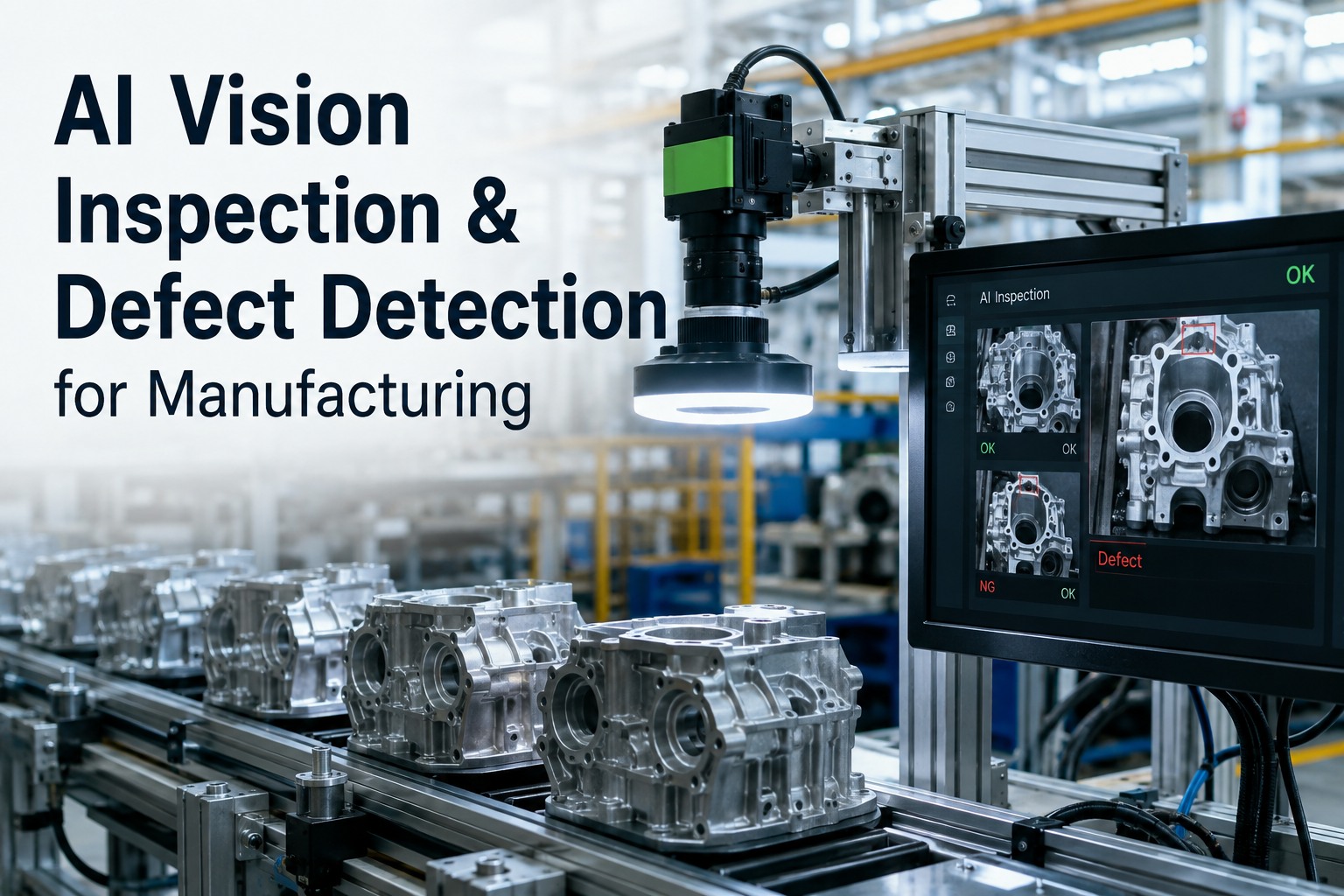
AI Vision Inspection & Defect Detection for Manufacturing
By Riley Quinn on August 25, 2026
Sandia National Labs measured it — human inspectors miss 20-30% of manufacturing defects. Best-case, trained humans peak around 85% accuracy. On the sixth hour of a shift, that falls. AI vision systems hit 99%+ detection and don't tire. Yet 77% of AI manufacturing pilots never make it past prototype — because getting a camera to spot a defect is the easy part. Turning that detection into a work order and an evidence record is where deployments fail. Oxmaint AI Vision is built for that connection. Book a demo to see AI vision workflows in action.
AI VISION INSPECTION · WHAT THE NUMBERS ACTUALLY SAY
Human inspectors peak at 85%. AI vision runs at 99%+ — but only 23% of pilots reach production.
99%+
AI vision detection accuracy vs 85% peak for trained humans
15×
Faster than manual inspection — thousands per hour vs 2-3 per minute
58%
Of production deployments run on edge — sub-100ms latency, on-premise
Human vs AI Inspection — Where the Gap Actually Sits
The performance gap between human and AI visual inspection isn't a rounding difference — it's measured, documented and consistent across manufacturing contexts. The dimensions that matter aren't just accuracy; they're consistency across shifts, defect size sensitivity and the audit trail each intervention produces. The comparison below shows where AI vision genuinely earns its place on a UK production line.
HUMAN INSPECTOR
Trained Manual Inspection
Peak accuracy85%
Accuracy after 2hrsDrops 15-25%
Throughput2-3/min
Min defect sizeVariable
Cross-shift consistencyLow
Audit trailManual notes
AI VISION SYSTEM
Trained Computer Vision Model
Peak accuracy99%+
Accuracy after 2hrsUnchanged
Throughput10,000+/hr
Min defect size0.1mm
Cross-shift consistency100%
Audit trailEvery frame logged
The Detection Categories That Actually Matter on UK Lines
AI vision isn't a single capability — it's a family of models each trained for a specific defect category. UK manufacturers typically deploy against a subset of the categories below depending on their process. The value multiplier comes when detection events flow directly into a maintenance workflow rather than sitting in a separate quality system.
Surface Defects
Scratches, dents, porosity, colour deviation, coating faults. Highest deployment category — 41% of AI vision installations.
Leak Detection
Fluid, gas and steam leaks via thermal or optical gas imaging. Immediate maintenance work order trigger.
Corrosion & Wear
Pitting, rust, coating breakdown on structural and asset surfaces. Trends over time for predictive scheduling.
PPE Compliance
Helmet, hi-vis, safety glasses and glove detection at zone entry points. HSE evidence for CDM 2015 sites.
Thermal Anomalies
Bearing hot spots, electrical connection heating, refractory failure. IR camera integration for asset condition.
Assembly Verification
Missing components, incorrect orientation, wrong part variants. Second-highest deployment category at 26%.
Why 77% of AI Vision Pilots Never Reach Production
The market data is stark — machine vision is a £23bn+ global market growing at 22% CAGR, yet 77% of AI manufacturing pilots stall at prototype. The technology works; the deployment doesn't. Three patterns cause most failures. First, detection events sit isolated from maintenance workflows — the model spots a defect but nobody does anything about it. Second, edge-vs-cloud architecture is wrong for the site — sending frames to cloud servers at 100ms latency doesn't work for line-speed inspection. Third, model retraining cycles aren't planned — models degrade as products evolve, and no one owns the ongoing tuning. Oxmaint AI Vision addresses all three by design. Sign up free to move past the pilot-fail statistic.
Detection events auto-generate work orders in Oxmaint with image evidence, severity, timestamp and asset link.
LAYER 3 · REVIEW
Human-in-the-Loop Verification
Every detection reviewable by qualified operator before workflow trigger. Human judgement retained at decision point.
LAYER 2 · INFERENCE
Edge Processing (Sub-100ms)
NVIDIA Jetson or comparable edge hardware runs detection on-premises. No cloud round-trip. Data stays on-site.
LAYER 1 · CAPTURE
Imaging Hardware
Existing IP cameras (ONVIF/RTSP) or purpose-installed high-resolution / thermal imaging. Integrates with what you have.
See AI Vision Reach Production, Not Just Pilot
Walk through the full stack — edge inference deployment, human-in-the-loop review queue, detection-to-work-order automation, defect category configuration and on-premises data control. Thirty minutes with the Oxmaint team.
Documented deployments show typical payback within 6-12 months and around 374% three-year ROI per Forrester analysis. For a mid-sized UK line running 1,200 parts per day, per-line annual savings of £250k-£550k are typical — combining labour cost reduction, scrap reduction and warranty claim prevention. Escape cost prevention alone (defects reaching customers) typically runs £300k-£1.5m per production line per year across UK manufacturing. The economics assume the pilot actually reaches production, which is where the workflow integration, edge deployment and model tuning discipline matter more than raw model accuracy. Sign up free to model AI vision ROI on your line.
Expert Perspective — Why AI Vision Should Augment Inspectors, Not Replace Them
"
The strongest argument for AI vision on a manufacturing line isn't that it fires the inspectors. It's that it makes them 10× more effective by handling the boring, repetitive catches while human judgement gets applied to edge cases, novel defects and production variants the model hasn't seen. Any vendor promising fully autonomous inspection on day one of deployment is misrepresenting how the technology actually works. Every production AI vision system worth deploying has a human-in-the-loop review layer — because models drift, new defect types emerge, and false-positive rates need ongoing tuning. Sites that treat AI vision as a partnership between the model and the inspector get to 99%+ accuracy and stay there. Sites that treat it as replacement typically end up in the 77% pilot-failure statistic.
01
Human-in-the-loop by default
Every detection reviewable before workflow trigger. Human judgement retained at the decision point.
Every verified detection creates a linked work order with image evidence, severity and asset context.
04
Model tuning as service
Model retraining planned per product variant and defect category. Ongoing accuracy maintenance, not one-time deployment.
Who Uses Oxmaint AI Vision in UK Manufacturing
The platform is used by the specific UK operational roles that own inspection quality and maintenance response: quality managers running production-line defect detection against defined defect libraries per product variant, maintenance managers linking condition-based detections to preventive workflow triggers, plant managers overseeing PPE compliance monitoring at CDM 2015-controlled zone entries, reliability engineers using thermal anomaly detection for early-warning asset condition, HSE managers producing safety compliance evidence from PPE and behavioural detection, engineering managers coordinating leak detection response across process plant, and operations directors tracking scrap reduction and yield improvement per production line. Each role sees the detection stream filtered to their view — quality queue, PPE compliance dashboard, thermal anomaly list or work order flow. Sign up free to configure AI vision for your production line.
Getting AI Vision Live in 60-90 Days
Deployment follows a measured path deliberately different from the failed-pilot pattern. Scoping starts with two or three defect categories that carry the highest current escape cost — typically surface defects or assembly verification, sometimes leak or PPE depending on site. Existing IP cameras integrate via ONVIF/RTSP; purpose-installed imaging deploys where required. Edge inference hardware (NVIDIA Jetson or comparable) provisions per inspection station at typical £30k-£200k per station depending on complexity. Model training uses on-site defect image sets, with diffusion-based synthetic augmentation available where labelled defect volumes are thin. Human-in-the-loop review queue configures for site inspectors. Detection-to-work-order automation deploys inline. Typical UK deployments see first defect category live within 60 days; full multi-category production in 90-120. Book a walkthrough to see live UK AI vision deployments.
Turn Every Inspection Into a Data Point
Oxmaint AI Vision gives UK manufacturers edge-first defect detection with human-in-the-loop review and direct work order integration — surface defects, leaks, corrosion, PPE compliance and thermal anomalies handled through one platform with on-premises data control.
AI vision defect detection uses computer vision models — typically convolutional neural networks or vision transformers — trained on labelled defect images to identify quality issues on manufactured parts in real time. Modern systems achieve 99%+ detection accuracy on trained defect categories with sub-100ms inference times, compared to 85% peak accuracy for trained human inspectors under ideal conditions. Sandia National Labs research shows humans miss 20-30% of manufacturing defects even before accounting for fatigue effects on the sixth hour of a twelve-hour shift. AI vision handles the boring, repetitive catches; human inspectors apply judgement to edge cases and novel defects the model hasn't seen.
Why do 77% of AI vision pilots fail to reach production?
Three patterns cause most failures. First, detection events sit isolated from maintenance workflows — the model spots a defect but nobody acts on it because it appeared in a separate system. Second, architecture is wrong for the deployment — cloud-based inference doesn't work for line-speed inspection where sub-100ms decisions are required. Third, model retraining cycles aren't planned — accuracy degrades as products evolve, false-positive rates drift, and no one owns the ongoing tuning. Oxmaint AI Vision addresses these by design — detection-to-work-order automation, edge-first deployment with on-premises inference, and structured model tuning as an ongoing service.
What defect categories can AI vision detect?
Common deployed categories include surface defects (scratches, dents, porosity, colour deviation) at 41% of installations, assembly verification (missing components, wrong orientation, incorrect variants) at 26%, packaging inspection at 19%, plus leak detection (fluid, gas, steam via thermal or optical gas imaging), corrosion and wear tracking, PPE compliance (helmet, hi-vis, safety glasses at zone entry), and thermal anomaly detection (bearing hot spots, electrical heating, refractory failure). Each category uses a model trained on its specific detection task — a single deployment typically covers two or three categories initially, with expansion as the platform matures.
Does AI vision inspection require replacing our existing cameras?
Not necessarily. Oxmaint AI Vision integrates with existing IP cameras via ONVIF and RTSP protocols where the camera specification suits the detection task. Where higher resolution, structured lighting, or specialist imaging (UV, IR, telecentric) is required, purpose-installed hardware deploys to those stations. Edge inference typically runs on NVIDIA Jetson or comparable GPU hardware per inspection station, at £30k-£200k per station depending on complexity. This modular approach allows sites to start with existing infrastructure on lower-complexity categories and add specialist imaging only where detection accuracy requires it.
What ROI can UK manufacturers expect from AI vision inspection?
Documented deployments show typical payback within 6-12 months and three-year ROI figures around 374% in Forrester analysis. For a mid-sized line running 1,200 parts per day, per-line annual savings of £250k-£550k are typical from combined labour cost reduction, scrap reduction and reduced warranty claims. Escape cost prevention alone (defects reaching customers) typically runs £300k-£1.5m per production line per year across UK manufacturing. These figures assume the pilot actually reaches production — sites need to plan for the workflow integration, edge deployment and model tuning discipline that separates the 23% who succeed from the 77% who stall at prototype.