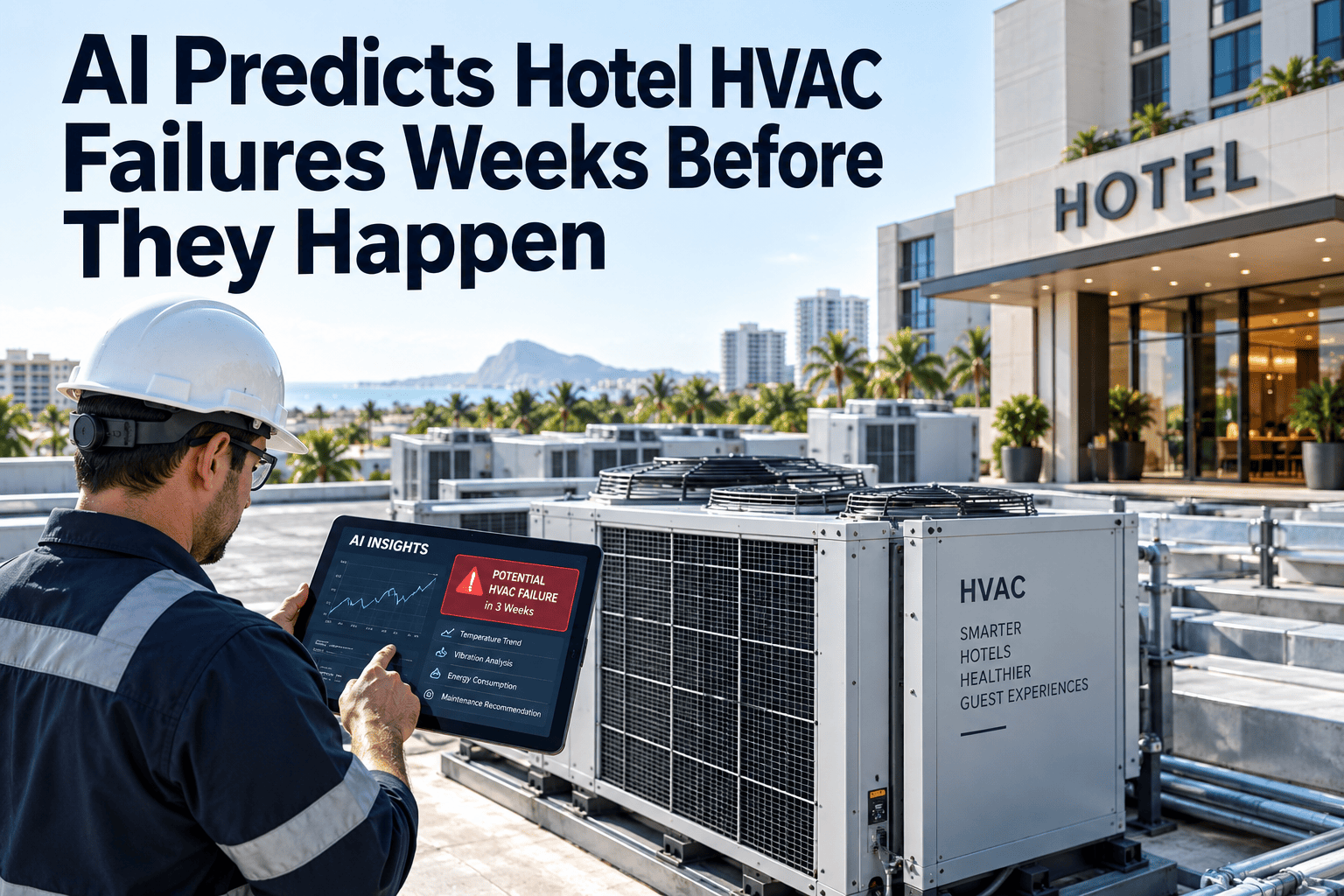
Hotel HVAC systems rarely fail without warning. Long before a chiller trips or a corridor air handler grinds to a stop, the equipment shows rising compressor current, falling cooling efficiency, and pressure readings drifting outside their normal range weeks in advance. Most engineering teams never catch these signals because nobody is watching the data continuously, so the first sign of trouble is a guest calling the front desk about a warm room. AI-powered predictive maintenance changes that timeline by flagging degrading HVAC assets before they break down, turning emergency callouts into scheduled repairs. Start a free trial or book a demo to see predictive HVAC monitoring built for hospitality operations.
Hospitality · Predictive Maintenance · AI Monitoring
AI Predicts Hotel HVAC Failures Weeks Before They Happen — Not Hours
Rising amperage, falling efficiency, and pressure drift are early warning signs your HVAC assets already give off, weeks before a compressor or fan motor actually gives out. Oxmaint's AI reads those signals continuously across every chiller, AHU, and PTAC unit on your property, and schedules the repair before a single guest ever feels the heat.
40–60%
Of a hotel's total energy spend is consumed by HVAC systems alone
41%
Of maintenance-related negative reviews mention temperature, air quality, or humidity
$38K
Peak-season chiller failure cost in repair, comps, and lost revenue within 72 hours
73%
Of HVAC failures show detectable warning signals 2–8 weeks before breakdown
The Hidden Pattern
Why Hotel HVAC Failures Always Seem to Happen at the Worst Time
It rarely feels random. Chillers give out during a heatwave weekend at full occupancy. PTAC units in guest rooms fail the night before a big group check-in. That is not bad luck — it is the natural result of equipment that has been degrading quietly for weeks while nobody was tracking the data. By the time a unit actually stops working, it has usually been operating outside its normal range for a while, working harder, drawing more current, and losing efficiency with every cycle. Engineering teams without continuous monitoring only find out when a guest calls the front desk, and by then the cheapest window for fixing the problem has already closed.
Room temperature is consistently one of the most cited comfort issues in hotel guest reviews, and a single negative review mentioning climate control can influence booking decisions for months after it is posted.
After-hours HVAC service, whether it is a PTAC swap or an emergency chiller callout, typically runs several times higher than the same repair scheduled during normal working hours with parts already on hand.
A unit running outside its setpoint tolerance because of a dirty coil or a drifting thermostat can burn noticeably more energy than a properly calibrated one, and across a full property that waste rarely gets noticed until the utility bill arrives.
Every room taken out of service for an HVAC repair is lost room revenue for that night, and unplanned outages tend to land during the exact high-occupancy periods a property can least afford to lose a room.
Stop Reacting to HVAC Failures After Guests Already Feel Them
Oxmaint's AI-powered CMMS watches every chiller, air handler, and PTAC unit across your property continuously, catching the early signals human inspection rounds miss and turning them into scheduled work orders before anything breaks down.
How Prediction Actually Works
The Four Signals AI Monitoring Watches Before a Chiller or PTAC Fails
HVAC equipment does not fail silently. Compressors draw more current as bearings wear. Cooling output falls before a full breakdown occurs. Discharge pressure drifts outside its designed band as refrigerant charge or airflow changes. Vibration patterns shift as mechanical parts loosen. Individually, none of these signals is dramatic enough for a technician doing a quick visual check to notice. Together, tracked continuously over time, they form a pattern that AI can flag with real confidence — usually weeks before a guest would ever notice a problem.
01
Rising Compressor Current
A compressor working harder than its baseline draws more amperage. Oxmaint logs this automatically from connected sensors and flags any unit trending upward outside its normal operating window.
02
Falling Cooling Efficiency
As coefficient of performance drops, a unit needs longer run times to hit the same setpoint. That extra runtime is tracked automatically and compared against the asset's historical performance baseline.
03
Discharge Pressure Drift
Pressure readings moving outside the manufacturer's designed range often point to refrigerant loss, airflow restriction, or a failing valve — all repairable long before a full shutdown occurs.
04
Vibration Pattern Change
Loosening mounts, worn bearings, and fan imbalance all show up as changes in vibration signature well before the noise becomes audible to a guest or passing engineer.
Reactive vs Predictive
What Changes When Your HVAC Programme Moves From Reactive to Predictive
The difference between a property firefighting HVAC breakdowns and one running a predictive programme is not effort — engineering teams in both cases work hard. The difference is when the work happens and how much it costs when it does.
| Operating Area |
Reactive Maintenance |
Oxmaint AI Predictive Monitoring |
| Failure Detection |
Found when a guest reports a warm room or a unit stops entirely |
Flagged 2–8 weeks earlier through amperage, COP, and pressure trends |
| Repair Timing |
Emergency, after-hours, whenever a technician can respond |
Scheduled during normal hours with parts already on order |
| Repair Cost |
Emergency callout rates plus rush parts and overtime labour |
Standard planned maintenance rates and stocked components |
| Guest Impact |
Room compensation, relocation, and a live guest complaint |
Repair completed with the room still available or briefly offline |
| Energy Efficiency |
Degraded units run longer and consume excess energy unnoticed |
Drift corrected early, keeping units near their rated efficiency |
| Asset Lifespan |
Units run to failure, shortening service life significantly |
Components repaired before catastrophic wear, extending service life |
Equipment Coverage
Which HVAC Assets Benefit Most From Predictive Monitoring
A typical property is running several different HVAC systems at once, and each one degrades in its own way. A central chiller shows stress differently to a guest room PTAC unit, and a corridor fan-coil behaves differently again. Predictive monitoring only becomes useful when it accounts for these differences, tracking each asset class against its own realistic failure pattern rather than applying one generic rule across an entire property.
The highest-cost failure point on any property. Amperage draw, discharge pressure, and coefficient of performance are tracked continuously, since a chiller failure during peak occupancy is the single most expensive HVAC event a hotel can face.
AHUs serving lobbies, ballrooms, and corridors are monitored for filter loading, fan performance, and coil efficiency, catching restricted airflow long before it forces the unit to work harder than it should.
Tracked individually per room using runtime cycles and thermostat calibration data, since these units generate the guest-facing complaints that show up directly in review scores and comp requests.
Lower profile but still costly when they fail in a public space. Vibration and runtime pattern tracking flags mechanical wear before it becomes an audible, guest-visible issue.
Inside the Platform
How Oxmaint Turns HVAC Data Into a Scheduled Repair, Automatically
Predictive maintenance only works if the data leads somewhere. Oxmaint connects the monitoring layer directly to the maintenance workflow, so a detected anomaly does not sit in a dashboard waiting for someone to notice it — it becomes an assigned, tracked work order on its own.
Chillers, AHUs, and PTAC units are tracked individually against their own historical baseline, so a unit that is naturally a little noisier or a little less efficient than its neighbour is not flagged unnecessarily.
The AI model looks for sustained trends across multiple signals rather than a single reading spike, which keeps false alerts low and gives engineering teams confidence in every flag they receive.
Once a unit crosses its risk threshold, Oxmaint generates a work order with the asset's history, the specific signal that triggered it, and the recommended action, ready for a technician to pick up.
Technicians receive the job on the Oxmaint mobile app, complete the repair, and sign off with parts used and time logged, closing the loop from detection to resolution in one system.
The Numbers
What Predictive HVAC Monitoring Typically Changes for a Property
85%
Fewer Temperature Complaints
Properties running structured preventive and predictive HVAC programmes see the large majority of climate-related complaints prevented before a guest ever notices.
4–5x
Lower Repair Cost Per Event
Planned repairs completed during standard hours consistently cost a fraction of emergency callouts requiring rush parts and after-hours labour.
28%
Average Energy Cost Reduction
Correcting drift early — dirty coils, miscalibrated thermostats, restricted airflow — keeps units running near their rated efficiency rather than compensating for hidden losses.
14 days
Typical Rollout Timeline
Asset registers, PM schedules, and monitoring connections are commonly live across a property within two weeks of starting implementation.
Scaling Across Portfolios
Built for Hotel Groups Running HVAC Across Multiple Properties
A single-property engineering team can often keep track of a handful of chillers and a couple of hundred PTAC units through experience and memory alone. That approach breaks down fast once a group is running the same challenge across ten, thirty, or a hundred properties, each with its own equipment age, climate, and occupancy pattern. Regional facilities directors need one place to see which properties are trending toward risk, not thirty separate spreadsheets updated at different intervals by different engineers.
Regional and group-level views roll up asset health across every property, so a facilities director can see which sites have units trending toward failure without visiting each one individually.
The same preventive maintenance templates, inspection checklists, and escalation rules apply across every property in the portfolio, removing the variation that comes from each site building its own process from scratch.
Comparing energy performance and failure rates across similar properties surfaces which sites are running efficiently and which ones need attention before the next peak season arrives.
New properties joining the portfolio, whether through acquisition or new development, can be brought onto the same monitoring and maintenance framework in days rather than months.
Common Questions
AI Predictive HVAC Maintenance — What Hotel Engineering Teams Ask
How far in advance can AI actually predict an HVAC failure?
+
Most HVAC failures give off detectable warning signals — rising compressor current, falling efficiency, pressure drift — for roughly two to eight weeks before a full breakdown occurs. Oxmaint tracks these continuously, giving engineering teams enough lead time to schedule the repair rather than react to it.
Start a free trial to see how prediction windows look for your own equipment mix.
Does predictive monitoring work for older PTAC units, or only new equipment?
+
Predictive monitoring works well on older units too, since the value comes from tracking each asset's own performance trend over time rather than comparing it to a factory-new baseline. Ageing equipment often benefits the most, since it tends to show clearer degradation signals earlier.
Book a demo to walk through your current PTAC fleet.
How does a detected anomaly actually turn into a completed repair?
+
When a unit crosses its risk threshold, Oxmaint automatically generates a work order containing the asset's history and the specific signal that triggered it. A technician receives the job on the mobile app, completes the repair, and logs parts and time, closing the loop end to end.
What does a typical implementation timeline look like for a full property?
+
Most properties get their asset register built, PM schedules configured, and monitoring connections live within about two weeks of starting. Multi-property portfolios usually roll out one site at a time using the same configuration template.
Start a free trial to begin mapping your own property.
Does this replace the engineering team, or just change how they work?
+
It changes the workload rather than replacing the team. Instead of spending time on manual inspection rounds and responding to guest complaints after the fact, engineers spend their time on scheduled repairs flagged by the system, which tends to reduce total callouts while catching problems earlier and keeping the whole team ahead of the schedule instead of behind it.
Your HVAC Equipment Is Already Telling You What's Coming Next
Oxmaint reads the signals your chillers, air handlers, and PTAC units generate every day and turns them into scheduled repairs before guests ever feel a difference. Bring predictive maintenance to your property and stop finding out about failures from the front desk.