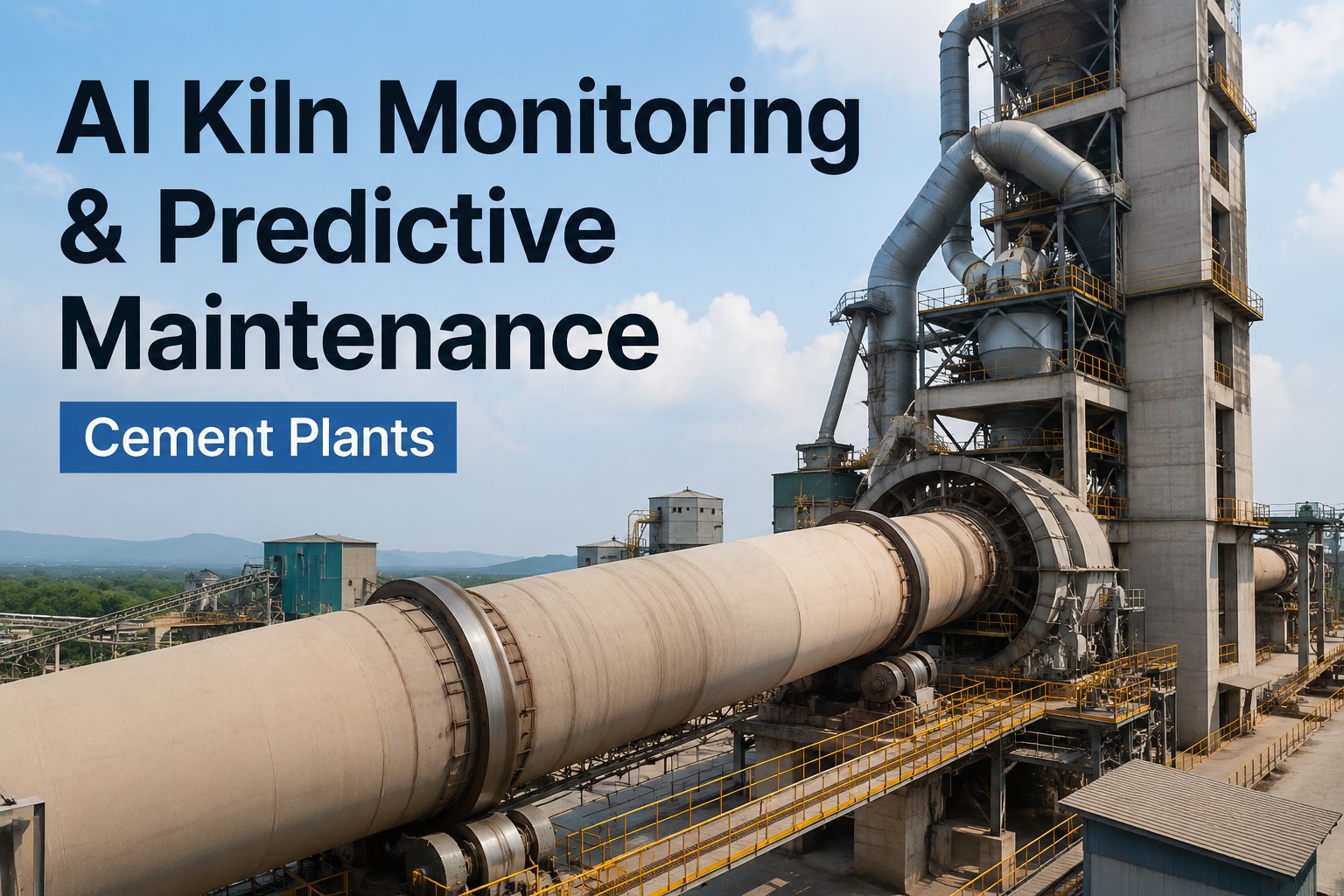
A cement kiln runs at 1,450°C continuously for months between planned outages. A single unplanned trip costs £60,000-£120,000 per day in lost clinker. A "red kiln" refractory failure — where the shell heats past 400°C because coating loss went undetected — is a £1.5m event with 5-14 days downtime. A ball mill gearbox failure caught late is £400k-£800k plus 12-16 weeks for replacement. Every one of these failures gives 2-10 weeks of warning in vibration, shell temperature and motor current data most plants already collect. Book a demo to see cement plant workflows in action.
CEMENT PLANT PdM · WHY UNPLANNED DOWNTIME IS THE DOMINANT COST
The kiln, mill and crusher account for 85% of unplanned stoppages — and every hour of warning is worth £5-15k in preserved production.
£60-120k
Per-day cost of an unplanned kiln trip in lost clinker output
2-10wk
Typical advance warning window for kiln, mill and gearbox failures
85%
Of unplanned cement plant stoppages traceable to detectable failure modes
The Downtime Cost Ladder — Why Every Warning Hour Matters
Cement plant downtime economics are non-linear. The first hour of an outage is expensive; the fifth day is catastrophic. A gearbox failure caught by vibration monitoring three weeks in advance means a planned outage during a scheduled shutdown window. The same failure caught after the fact means an emergency stop with replacement lead time driving 12-16 weeks of half-plant capacity. The ladder below shows why PdM ROI in cement is so heavily front-loaded on early warning.
Per-Zone Sensor Stack — What Actually Needs Monitoring on a Kiln
The rotary kiln itself is the highest-consequence asset in cement, and it's not one asset — it's a stack of subsystems each with its own failure modes and its own detection technology. Shell temperature scanning catches refractory issues. Bearing vibration catches roller and trunnion problems. Motor current signature catches drive train degradation. Oil analysis catches gearbox wear. A cement CMMS that treats the kiln as one asset can't drive predictive work orders per subsystem — you need per-zone visibility.
01 · SHELL
Shell & Refractory
Kiln shell + refractory brick lining protecting the shell from 1,450°C burning zone temperatures. Coating loss → shell overheat → deformation.
Sensors · Infrared shell scanners (full-length) · Zone-by-zone temperature mapping · Coating thickness inference
02 · SUPPORT
Tyres, Rollers & Bearings
Kiln tyres bearing on support rollers under enormous load. Roller and thrust roller bearings the single largest source of catastrophic drive failure.
Sensors · Bearing vibration · Bearing temperature · Axial movement / thrust monitoring · Ovality tracking
03 · DRIVE
Girth Gear, Pinion & Motor
Kiln drive train transferring torque to the shell. Girth gear and pinion wear from misalignment or inadequate lubrication generates weeks of warning.
Sensors · Motor current signature analysis (MCSA) · Gear mesh vibration · Gearbox oil analysis · Lube temperature
04 · SEAL
Inlet & Outlet Seals
Kiln seals preventing false air ingress that disrupts combustion and drives fuel cost. Seal wear is gradual but measurable through combustion analysis.
Sensors · CO content monitoring · False air calculation · Visual inspection at shutdown
The Refractory Campaign Discipline — Where Most Plants Still Guess
Cement kiln refractory campaigns typically run 6-18 months between full relines depending on fuel mix, throughput and coating stability. Most plants still schedule relines on calendar — replacing good brick or missing failing zones because they don't know per-zone remaining life. AI-driven shell temperature history combined with throughput data can calculate refractory remaining life per zone, predicting reline requirements 8-12 weeks ahead. That single capability typically cuts refractory consumption by 12-18% while eliminating mid-campaign collapses. Sign up free to structure refractory campaign tracking.
See Cement Plant PdM Live
Walk through kiln shell temperature trending, bearing vibration alerting, mill gearbox condition workflows, refractory campaign tracking, and sensor-to-work-order automation — configured against your plant asset register. Thirty minutes with the Oxmaint team.
Where the Data Actually Lives — And Why Integration Is the Whole Point
Most cement plants already have the data — vibration probes on mill gearboxes, shell scanners on kilns, motor current from the DCS, oil analysis reports from the lab, temperature trends in the historian. The problem isn't sensor coverage; it's fragmentation. Data sits in one system, alerts in another, work orders in a third, and the shift operator who sees the deviation on SCADA dismisses it as a sensor glitch because the trend view isn't in front of them. The single highest-value capability of cement plant PdM software isn't the AI — it's the integration layer that pulls DCS, SCADA, historian and lab data into the same maintenance workflow. Sign up free to unify cement plant sensor data.
Expert Perspective — Why Cement PdM Pays Back in Months, Not Years
"
The economics of cement plant predictive maintenance are more extreme than almost any other industry. A single avoided kiln red-shell event pays for years of monitoring investment across the entire plant. A single avoided ball mill gearbox seizure pays for the sensor rollout across every rotating asset. What holds most plants back isn't the ROI case — it's the belief that they need to invest in expensive new sensor infrastructure before the platform delivers value. The truth is most plants already have 70-80% of the sensor data they need sitting in the DCS, historian, and vibration monitoring systems already installed. Integration and workflow are the missing pieces, not more probes. Sites that recognise this get to predictive operation in one to two quarters. Sites that plan a five-year sensor programme first typically never finish.
01
DCS + historian integration
Existing vibration, temperature, current and pressure data flows into the maintenance workflow. Sensor investment stays low.
02
Per-zone kiln monitoring
Shell, support, drive and seal subsystems tracked separately with the right detection technology per zone.
03
Refractory life prediction
Per-zone remaining life calculated from temperature history + throughput. Relines scheduled to actual condition.
04
Sensor to work order
Anomaly detection auto-creates work orders with severity, time-to-failure and asset context. No manual chase.
Who Uses Oxmaint in UK & European Cement
The platform is used across the specific operational roles that own cement plant reliability: plant managers running kiln, mill and crusher availability targets against production budgets, maintenance managers coordinating planned outages against condition-based intervention timing, reliability engineers configuring vibration and shell temperature thresholds per asset class, refractory specialists tracking campaign life per kiln zone, contractor managers coordinating specialist third-party service work during planned outages, energy managers targeting fuel and power savings from healthier combustion and better mill efficiency, and operations directors reporting plant-wide OEE against group benchmarks. Each role sees the same asset data filtered to their view — kiln health dashboard, refractory campaign scorecard, gearbox condition queue or outage planning view. Sign up free to configure cement workflows for your team.
Getting Cement PdM Live
Deployment starts by importing your plant asset register — raw mill, kiln (with per-zone breakdown), preheater, cooler, cement mill, crushers, conveyors, fans, compressors — and current maintenance schedule. Existing DCS, SCADA, historian and vibration monitoring platforms integrate via OPC-UA, MQTT and direct APIs. Edge gateways where needed collect data from PLCs and shell scanners typically at 12,000+ points per hour. AI condition models train on plant-specific baselines and historical failure events. Predictive alerts configure per asset class with severity scoring and time-to-failure estimation. Most plants see kiln and primary mill condition monitoring live within 30-45 days on core assets; full plant coverage across crushers, preheaters and BOP typically inside two quarters. Book a walkthrough to see live cement plant deployments.
Turn Kiln Data Into Prevented Downtime
Oxmaint gives cement plant operators one platform for AI-driven condition monitoring across kilns, mills and crushers — DCS and historian integration, per-zone kiln subsystem tracking, refractory campaign life prediction and sensor-to-work-order automation with the evidence trail your reliability programme needs.
Frequently Asked Questions
What are the most common kiln failure modes cement PdM addresses?
Four failure families dominate rotary kiln downtime. Shell and refractory: coating loss or brick spalling exposes the shell to burning zone temperature; shell heats from 200°C past 400°C in hours; permanent deformation begins. Support rollers and bearings: kiln tyres bear on support rollers under massive load — thrust roller bearing failure is the single largest catastrophic drive failure source. Girth gear and pinion: drive train wear from misalignment or lubrication issues generates weeks of vibration signature warning. Kiln seals: inlet and outlet seal wear allows false air ingress, disrupts combustion, drives fuel consumption. All four are detectable through the sensor stack most plants already have installed.
How much does unplanned kiln downtime actually cost?
Industry benchmarks put unplanned cement plant downtime at £8,000-£100,000+ per hour depending on plant size and product mix. A single rotary kiln trip runs £60,000-£120,000 per day in lost clinker output alone. A "red kiln" refractory failure requiring emergency reline is a £1.5m+ event with 5-14 days of downtime for cool-down, brick replacement and re-heat. Ball mill and VRM gearbox failures run £400,000-£800,000 for the gearbox itself with 12-16 week replacement lead times during which the mill runs at reduced capacity or not at all. The economics make PdM payback in cement typically inside 2-6 months on any properly-scoped programme.
Can Oxmaint work with our existing DCS, SCADA and vibration monitoring?
Yes. Most cement plants already have DCS platforms (Siemens, ABB, Emerson, Honeywell), historian systems (OSIsoft PI, AVEVA), continuous vibration monitoring (Bently Nevada, SKF, Emerson AMS) and kiln shell scanners (HGH, Land Instruments, Thermoteknix). Oxmaint's integration layer supports OPC-UA, MQTT and direct APIs to pull vibration spectra, shell temperature streams, motor current, gearbox oil condition and process telemetry into the maintenance workflow in real time. Most plants have 70-80% of the required sensor data already in place — the integration and workflow layer is the missing piece, not additional sensor investment.
How does AI shell temperature monitoring work?
Continuous infrared shell scanners along the kiln length produce a full-length temperature profile updated in real time. AI models trained on the plant's specific kiln, rotation speed, refractory zones and historical coating behaviour recognise abnormal temperature patterns — a 2-3°C per day rise rate in a specific zone indicates coating loss weeks before catastrophic brick shedding. Zone-by-zone remaining refractory life gets calculated from shell temperature history combined with throughput and fuel data. Maintenance planners then schedule zone-specific gunning or brick replacement during planned outages rather than reacting to mid-campaign collapses — typically cutting refractory consumption 12-18% while eliminating red-kiln emergencies.
How quickly can a cement plant expect ROI from PdM?
The economics are unusually favourable. A typical two-kiln plant investing £70,000-£120,000 in sensor connections, AI platform licensing and CMMS integration in year one typically sees payback inside 2-4 months on the first prevented catastrophic event — one kiln red-shell avoided (£1.5m) or one gearbox seizure prevented (£800k) recovers the full programme cost several times over. Year-two economics improve further because the ongoing platform cost is licence-only. Plants extending the model to mills, crushers, preheaters and BOP see ROI multiply as the same integration approach delivers value across every additional asset class without proportional cost increase.