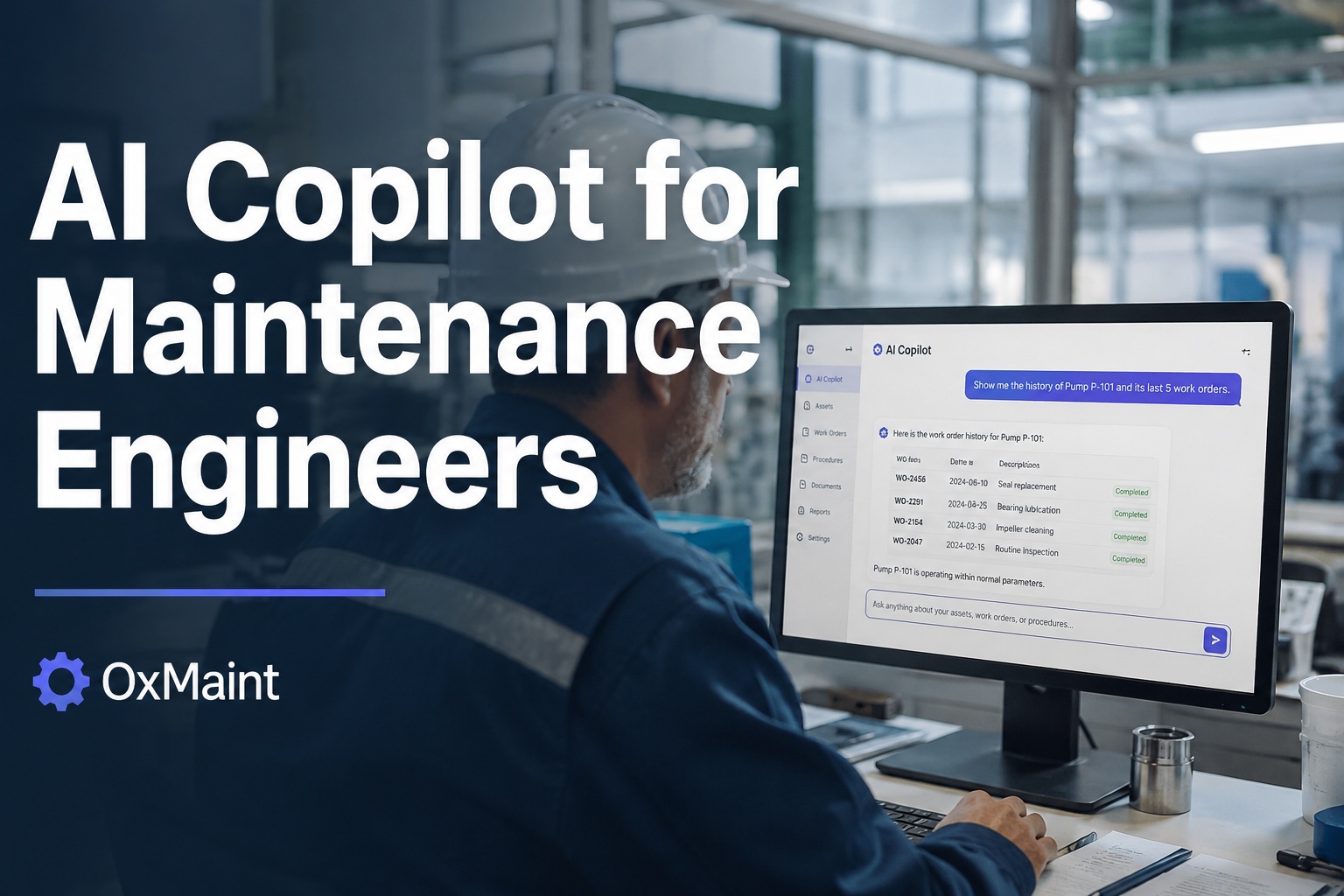
A UK plant maintenance engineer spends roughly a third of their day not fixing things — they spend it searching. Searching the CMMS for when this pump was last serviced. Searching the shared drive for the correct SOP. Searching WhatsApp for the OEM's firmware note. All that hunting happens before any real work begins. An AI copilot built for maintenance changes that shape — the engineer asks a natural-language question, the copilot pulls the answer from across CMMS and asset history in seconds, and work starts immediately. Book a demo to see AI Copilot live.
◆ AI COPILOT · NATURAL LANGUAGE CMMS · CONTEXT-AWARE · GROUNDED
Engineers don't burn shifts turning spanners. They burn shifts hunting for the information they need before they can turn a spanner.
Ask in plain English. Get the answer, the source and the next action — grounded in your CMMS, procedures and asset history.
A REAL QUERY · A REAL ANSWER · IN UNDER FIVE SECONDS
ENGINEER · MOBILE APP
"When was pump P-204 last overhauled and what did we change?"
AI COPILOT · GROUNDED IN CMMS
Pump P-204 was overhauled 14 March 2026 by engineer M. Patel over 6.2 hours. Mechanical seal and bearings replaced. Vibration reading post-work 2.1 mm/s, within tolerance. Next scheduled inspection 14 September 2026.
WO-2026-4471
Asset Register
SOP PM-047
30%
Of engineer time typically spent searching for information
5sec
Typical natural-language query response with grounded answer
100%
Answers cite source records — asset, work order or SOP
The Time-Drain Problem — Where Engineer Hours Actually Disappear
Before we talk about the copilot, worth being honest about the shape of the problem it solves. The average UK maintenance engineer's shift isn't dominated by physical work — it's dominated by information gathering that precedes the work. The breakdown below shows where the hours typically go on a mid-complexity fault call, and it's why AI-assisted search returns measurable time back to the engineer inside week one. Sign up free to see where AI Copilot returns hours to your team.
08%
Travel to Asset Location
Walking to the plant zone · Signing in · Getting to the machine · Necessary but unavoidable time
32%
Information Hunting
Search CMMS for asset history · Find SOP version · Locate wiring diagram · Check WhatsApp for OEM guidance · Read prior work order notes · Longest single time sink on nearly every job
40%
Actual Maintenance Work
Diagnosis · Repair · Testing · Documentation · The work the engineer was actually trained for
14%
Work Order Admin
Filling in the closeout · Attaching photos · Updating asset status · Assigning follow-up · Handover notes
06%
Coordination & Handoff
Talking to next-shift engineer · Briefing supervisor · Confirming spares ordered · Small but essential
What the AI Copilot Actually Does — Six Query Patterns Engineers Use Every Day
The copilot isn't a chatbot answering trivia — it's a purpose-built maintenance retrieval layer that reads your CMMS, procedures and history, and returns grounded answers with source citations. The six query patterns below cover roughly 80 percent of what UK engineers actually ask on-shift. Book a demo to see AI Copilot handle your own query patterns.
Q1
Asset History Lookup
"When did we last service compressor C-12 and what did the tech find?"
Returns last service date, engineer, findings and next scheduled work · Pulls from work order history and asset register
Q2
Procedure Retrieval
"Show me the correct isolation SOP for the ammonia refrigeration plant."
Returns the current-version SOP with revision date and approver · Never surfaces superseded versions · Direct link to full document
Q3
Similar-Fault Search
"Has this fault code appeared on any of our machines before?"
Searches historical work orders for matching fault codes and symptoms · Returns similar prior cases with the fix that worked · Institutional memory unlocked
Q4
Spare Parts Availability
"Do we have a spare gasket kit for the P-204 pump in stores?"
Checks live inventory, reservations, alternative part numbers and supplier lead times · Answers instantly without opening the parts module
Q5
Compliance & Cert Status
"When is the LOLER exam next due on crane CR-03?"
Returns next statutory exam date, prior exam certificate reference and competent-person body · Compliance context on demand
Q6
Next-Action Summary
"What should I check first on this fault?"
Suggests diagnostic sequence based on symptom, asset type and similar historic cases · Always framed as guidance not instruction · Engineer decision remains final
Grounding, Sources and Safeguards — Why This Copilot Isn't a Chatbot
Consumer chatbots make things up. That failure mode is unacceptable in maintenance — a fabricated torque figure, a hallucinated SOP or an invented service date creates real safety and compliance risk. The Oxmaint AI Copilot is architected around a strict grounding and safeguard model that stops the copilot from ever inventing information. Sign up free to explore the grounding model against your data.
SG 01
Answers Grounded in Your Records
Copilot draws only from your CMMS, procedures, asset history and work orders · Never from public internet · Never from general training knowledge · If the data isn't in your system, the copilot says so
SG 02
Every Answer Cites Its Sources
Work order references, asset IDs and SOP versions attached to every response · Engineer can click through and verify the underlying record · Trust built through visibility not blind faith
SG 03
Human-in-the-Loop Always
Copilot suggests · Engineer decides · No autonomous work order creation · No unattended action taken on safety-critical assets · Engineer retains full decision authority and duty of care
SG 04
Your Data Stays Your Data
Copilot processing scoped to your tenant · Not used to train shared models · UK data residency options · SOC 2 and ISO 27001 aligned
◆ AI COPILOT DEMO
See the Copilot Answer Your Team's Real Questions
Live demo showing natural-language query across asset history, work orders, procedures, spares and compliance — with source citations, grounding safeguards and human-in-the-loop workflow throughout.
The Adoption Curve — How Copilot Value Actually Compounds
AI copilot value doesn't arrive in a single moment — it builds as engineers learn what to ask, as the underlying data quality improves through use, and as query patterns extend from lookup into diagnostic support. The curve below shows how UK operators typically experience the adoption arc.
WEEK 1-2
Curiosity & First Wins
Engineers test the copilot on questions they already know the answer to · Trust builds when responses match reality · Early adopters start using it for real lookups by end of week two
Baseline
MONTH 1-3
Routine Query Habit
Asset lookups, procedure retrieval and spare-parts checks become copilot-first · Engineers stop opening 4-5 different tabs for information they used to hunt for
2× faster lookups
MONTH 3-9
Diagnostic Support Emerges
Similar-fault search catches on · Institutional memory becomes searchable · Junior engineers gain access to senior-engineer patterns · First-time-fix rate begins climbing measurably
FTF rate climbs
MONTH 9+
Institutional Memory Compounds
Retiring engineers' knowledge lives in searchable history · New starters onboard in weeks not months · Copilot becomes primary interface for maintenance information · Time-to-competence transformed
Knowledge dividend
Expert Perspective — Why AI Copilot Rewards Data Discipline
"
Every UK maintenance director who has deployed AI copilot successfully has learned the same unglamorous lesson. The copilot is only as good as the data it grounds against. If the CMMS holds structured asset records with clean work order history and current-version procedures, the copilot returns transformational value from day one. If the CMMS holds three years of half-completed work orders, superseded SOPs still marked current and asset records with the wrong sub-class, the copilot returns wrong answers with confidence and destroys engineer trust in the technology inside a fortnight. The technology part is now genuinely mature — natural-language understanding is reliable, source citation works, grounding safeguards prevent hallucination in scoped domains. That isn't the variable anymore. The variable is data readiness. Programmes that succeed do a genuine six-week data-hygiene pass before switching the copilot on — verify asset records, clean up work order history, deprecate superseded procedures, close open loops. Programmes that skip that step deploy against noisy data and blame the technology when engineers stop using it. The copilot rewards discipline the same way every generation of enterprise software has rewarded discipline, and the operators that internalise that lesson early are the ones that unlock the value.
— UK Maintenance AI & Digital Transformation Practice
01
Natural language first
Engineers ask questions the way they'd ask a colleague · No query language · No form filling · Works on mobile and desktop.
02
Grounded in your data
Answers drawn from your CMMS, procedures and history · Never invented · Says so when the answer isn't in the system.
03
Sources always cited
Work order IDs, asset references and SOP versions attached · Engineer can verify · Trust built through visibility.
04
Engineer stays in control
Copilot suggests, engineer decides · No autonomous action on safety-critical work · Duty of care unchanged.
Who Uses Oxmaint AI Copilot Across UK Industry
The copilot is used by UK roles that spend meaningful shift time searching for maintenance information: plant maintenance engineers on manufacturing floor and process operations, field service engineers covering distributed asset bases, reliability engineers investigating recurring faults across historical work orders, apprentice and junior engineers accelerating onboarding through query-based learning, maintenance planners scheduling work against real asset history and spares availability, HSE managers verifying compliance status on regulated assets, engineering directors tracking programme performance across sites, and third-party service providers differentiating through faster information access on customer sites.
Getting AI Copilot Live in 45-60 Days
Deployment starts with a data-readiness assessment — asset record structure, work order history quality, procedure library version control. Six weeks of targeted data hygiene follow where needed (this is where programmes succeed or fail). Copilot connects to the CMMS with tenant-scoped data access. Query patterns train against your terminology and asset naming conventions. Pilot user group activates with structured feedback capture. Query coverage expands from asset lookup to procedure retrieval to similar-fault search over the first 90 days. Compliance scope confirms UK data residency, SOC 2 alignment and audit logging. Most operators reach fleet-wide adoption within 45-60 days on top of the data-hygiene foundation. Sign up free to scope your data-readiness assessment.
◆ ASK IN ENGLISH. GET THE ANSWER. GET BACK TO WORK.
The Maintenance Information Layer Your Team Has Been Waiting For.
Oxmaint AI Copilot gives UK maintenance teams natural-language access to CMMS, procedures, asset history and work orders — grounded in your data, sources always cited, engineer always in control.
Frequently Asked Questions
What is an AI copilot for maintenance engineers?
An AI copilot for maintenance is a natural-language interface layered over your CMMS, procedures, asset history and work orders that lets engineers ask questions the way they'd ask an experienced colleague — and get answers in seconds instead of after minutes of tab-switching and record-hunting. Instead of navigating to the asset module, filtering work order history and reading through prior notes, the engineer types or speaks "when did we last service compressor C-12 and what did the tech find" and the copilot returns the service date, engineer name, findings and next scheduled work with source citations to the underlying records. The copilot handles six core query patterns that cover roughly 80 percent of what UK engineers ask on-shift: asset history lookup, procedure retrieval, similar-fault search, spare parts availability, compliance and certification status, and next-action guidance. It works on mobile and desktop and integrates with the CMMS as a native capability, not a bolt-on chatbot.
How does the copilot avoid hallucinating or making up answers?
Four architectural safeguards. First, grounding — the copilot draws only from your CMMS, procedures, asset history and work order records, never from public internet or general training knowledge. If the data isn't in your system, the copilot says so rather than filling the gap with a plausible-sounding guess. Second, source citation — every answer attaches work order references, asset IDs and SOP versions so the engineer can click through and verify the underlying record within seconds. Third, human-in-the-loop — the copilot suggests, the engineer decides. There is no autonomous work order creation, no unattended action on safety-critical assets, no bypass of the engineer's judgement or duty of care. Fourth, tenant scoping — copilot processing is scoped to your data only, not shared across customers, with UK data residency options and SOC 2 plus ISO 27001 alignment. This architecture is what separates a purpose-built maintenance copilot from a consumer chatbot pointed at industrial data.
What kind of ROI do UK operators see from AI copilot deployment?
UK deployments consistently report ROI in four dimensions accumulating over the first 12 months. Immediate time recovery (weeks 1-4): engineers stop opening four to five different tabs for information they used to hunt for, and typical time-per-lookup drops from minutes to seconds. Routine query habit (months 1-3): asset lookups, procedure retrieval and spare-parts checks become copilot-first, freeing up hours per engineer per week that flow into actual maintenance execution. Diagnostic support emerges (months 3-9): similar-fault search unlocks institutional memory, junior engineers gain access to patterns that senior engineers built over careers, and first-time-fix rate begins climbing measurably. Knowledge dividend compounds (month 9+): retiring engineers' knowledge lives in searchable history, new starters onboard in weeks not months, time-to-competence transforms. Operators typically see payback within two to three quarters, with returns compounding indefinitely as the underlying data foundation matures.
Does the copilot need clean data to work, or will it help clean the data?
Both, but the sequence matters. The copilot is only as good as the data it grounds against — if the CMMS holds structured asset records with clean work order history and current-version procedures, the copilot returns transformational value from day one. If the CMMS holds three years of half-completed work orders, superseded SOPs still marked current and asset records with wrong sub-classes, the copilot returns wrong answers with confidence and destroys engineer trust in a fortnight. The successful UK pattern is a genuine six-week data-hygiene pass before switching the copilot on: verify asset records, clean up open work orders, deprecate superseded procedures, close out orphaned records. Once the copilot is live, it surfaces data-quality issues as a byproduct — when an engineer asks a question that should have an answer and doesn't, that gap becomes visible and gets fixed. The copilot then reinforces data discipline going forward because engineers see the value directly and start capturing better information at source.
What about data security, UK residency and compliance?
Oxmaint AI Copilot is architected for UK enterprise deployment. Data residency options include UK-region hosting so tenant data remains in the UK for GDPR and UK GDPR alignment. Copilot processing is scoped strictly to your tenant — your data is not used to train shared models, is not visible to other customers, and is not passed to public LLM services in unscoped form. Security accreditations align with SOC 2 Type II and ISO 27001. Audit logging captures every copilot query and response for compliance review and internal audit. Role-based access control ensures engineers only see records they'd have permission to view through the CMMS itself — the copilot inherits the CMMS permission model rather than bypassing it. For regulated environments (rail under ROGS, pharma under GxP, energy and utilities under sector regulators), the audit trail supports evidence requirements. Full technical detail available under NDA during procurement.