When a facilities director asks "can you prove the switchgear was inspected on schedule?" and the answer is a search through email attachments and a paper file in a cupboard, the gap between having maintenance records and having maintenance evidence becomes very real. UK facility teams are under growing pressure from BS 7671 Amendment 4, tighter EICR remedial timelines and rising tenant expectations, while many still run planned maintenance on spreadsheets that nobody fully trusts. AI-powered CMMS platforms close that gap by turning every inspection, work order and compliance record into a live, searchable asset history. Teams exploring this shift can sign up for OxMaint free to see how a connected maintenance system removes the guesswork from compliance.
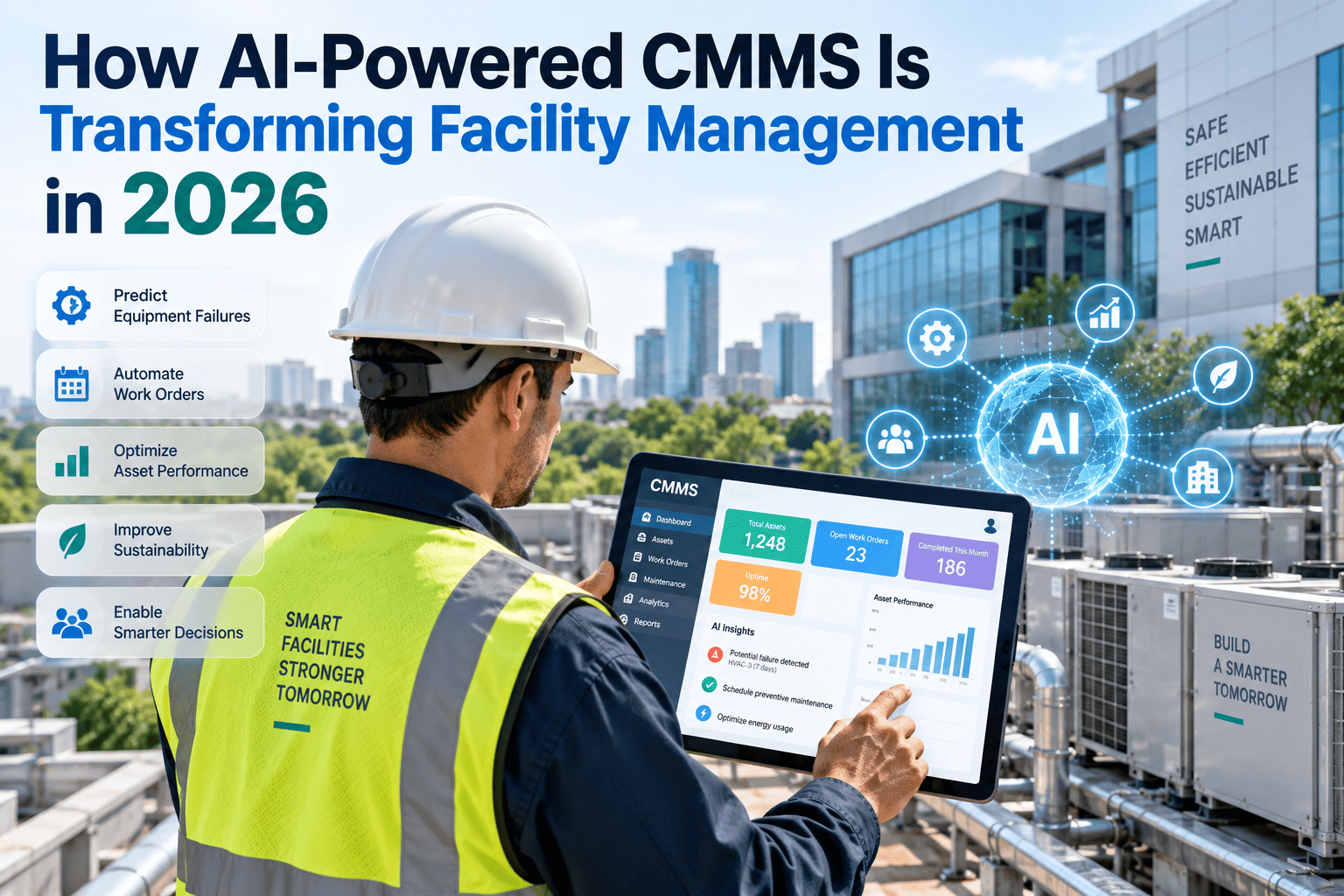
How AI-Powered CMMS Is Transforming Facility Management in 2026
A practical look at how planned maintenance, work order tracking and electrical compliance evidence are moving from paperwork to a single connected system for UK facility teams.
Why UK Facility Teams Are Rethinking Planned Maintenance
The pressure is not just regulatory. Tenants, boards and insurers are all asking sharper questions about how buildings are maintained, and "we believe so" is no longer an acceptable answer when the evidence should already exist in a system.
BS 7671 Amendment 4 came into force in April 2026, with the previous edition withdrawn from October 2026, and it reaches further than new installations — it also covers periodic inspection and testing of existing electrical systems. At the same time, the "experience-only" route for EICR inspectors closes on 1 October 2026, meaning every inspection now needs a traceable qualification record sitting alongside the certificate. Facility teams that still manage this manually are carrying real risk without realising it, because a regulation change is only as useful as the system that can prove it was actually followed on every asset, on every site, on the date it was due.
Compliance Evidence On Demand
Every EICR, remedial action and Amendment 4 certificate is logged against the asset it belongs to, so an auditor's question never turns into a week of searching.
No More Shadow Spreadsheets
When engineers log work from a mobile device on site, the spreadsheet copies that used to drift out of date across departments simply stop existing.
Fewer Missed Inspections
Recurring PM schedules for switchgear, UPS systems, generators and EV chargers trigger automatically, so statutory intervals are never left to memory.
Faster Remedial Close-Out
C1 and C2 coded observations from an EICR convert directly into tracked work orders instead of sitting in a PDF waiting to be actioned.
Portfolio-Wide Visibility
Multi-site operators see asset condition and compliance status across every building from one dashboard, instead of one property at a time.
Lower Reactive Spend
Facility operations that shift from calendar-based to condition-based maintenance consistently report a sharp drop in emergency call-outs.
Core Capabilities Built for Compliance-Heavy Estates
A CMMS built for facility management needs to do more than log tickets. It has to hold the electrical asset register, remember statutory inspection intervals, and give engineers a way to record findings from the plant room without going back to a desk. These are the capabilities that matter most for UK teams managing regulated buildings, and the difference between a generic ticketing tool and a purpose-built maintenance platform usually shows up first in how compliance records are handled.
Work Order Management
Requests, approvals, parts and labour tracked from raise to close-out, with a full timestamped history for every job.
Planned Maintenance Schedules
Recurring PM tasks for switchgear, lighting, generators and life-safety systems generated automatically from set intervals.
Electrical Asset Register
A structured record of every circuit, board and item of fixed equipment, linked to its inspection and test history.
EICR Remedial Tracking
Observations and classification codes from an inspection are turned into assigned, trackable remedial work automatically.
Mobile Inspections
Engineers complete checklists, attach photos and record readings on site, updating the central record the moment work is done.
Reporting & Dashboards
Live views of open work, compliance status and cost trends, built for both engineers on the floor and directors in the boardroom.
Built for the Industries Carrying the Heaviest Compliance Load
AI-powered CMMS software is not a one-size-fits-all tool. The estates that gain the most are the ones juggling statutory inspection intervals across dozens or hundreds of assets, where a missed record is not just an inconvenience but a genuine safety and legal exposure. Here is how the shift plays out across the sectors OxMaint supports most, each with its own mix of regulatory pressure, asset complexity and reporting expectations from tenants, regulators or funding bodies.
Facility Management Companies
Multi-site FM providers managing mixed portfolios need one system that standardises PM schedules and compliance evidence across every client building, rather than a different spreadsheet per contract.
Commercial Real Estate
Landlords and asset managers use connected maintenance records to protect asset value, satisfy insurers, and give tenants confidence that life-safety and electrical systems are properly maintained.
Healthcare Estates
Hospitals and clinics run equipment where downtime is not an option. Traceable inspection records for electrical, medical gas and life-safety systems support both patient safety and regulatory audits.
Education Campuses
Schools, colleges and universities manage large, ageing estates on tight budgets, making automated PM scheduling and remedial tracking essential for staying ahead of statutory inspection deadlines.
Government & Public Sector
Public buildings answer to strict procurement and audit standards, where a complete digital chain of custody for every inspection and repair is often a condition of continued funding.
Electrical Contractors
Contractors delivering EICRs and periodic testing for multiple clients use a shared system to issue reports, log classification codes and hand over remedial actions without losing the paper trail.
See Your Maintenance Data in One Place
OxMaint brings work orders, planned maintenance and compliance records for UK facility teams into a single connected system. Try it with your own asset list and see how much time your team gets back.
From Reactive Fixes to Predictive Maintenance: The Maturity Curve
Facility operations tend to sit somewhere on a five-level maturity curve, moving from paper-based firefighting toward a fully predictive, AI-supported operation. Most UK teams sit between levels two and three today, and closing that gap is where the largest cost savings live. The move up the curve rarely happens in one leap — it happens by removing one manual step at a time, starting with the records that carry the most compliance risk, such as electrical inspection evidence and remedial action tracking.
The Real Cost of Delayed Maintenance
A missed inspection interval rarely stays cheap. What starts as a small data gap compounds quickly into rush call-outs, tenant complaints and, in the worst case, unplanned downtime that shuts down part of a building. The pattern below shows how the cost of a single overlooked issue grows the longer it goes unaddressed, and it is the same pattern facility directors see repeated across electrical, mechanical and life-safety assets whenever a planned maintenance interval slips past its due date.
Catching an issue at the point of inspection is consistently the cheapest place to fix it — every stage of delay after that adds cost and risk.
Rolling Out AI-Powered CMMS: A 5-Phase Journey
Moving an estate from spreadsheets to a connected maintenance system does not need to be disruptive. A structured rollout keeps engineers on side and protects data quality from day one, and most UK facility teams find that the biggest gains come not from the software itself but from finally agreeing, in one place, what "up to date" actually means for every asset on the register.
Asset & Data Cleanup
Consolidate asset lists, remove duplicate records and confirm which equipment carries a statutory inspection requirement.
Schedule Mapping
Set planned maintenance intervals for electrical, mechanical and life-safety assets based on manufacturer and regulatory guidance.
Mobile Rollout
Equip engineers with mobile access so inspections, readings and remedial work are captured on site, not after the fact.
Baseline Audit
Run a full walk-through against the new system to confirm records match physical reality before going live.
Go-Live & Refinement
Monitor adoption, tighten schedules based on real data, and move toward condition-based, predictive maintenance.
Before we moved to a connected system, an EICR remedial item could sit in an inbox for weeks before anyone actioned it. Now the moment a report is uploaded, the coded items become work orders assigned to a named engineer with a due date. Our last audit took an afternoon instead of a fortnight.
Estates Manager, Multi-Site UK Commercial PortfolioSpreadsheets vs AI-Powered CMMS
The difference becomes clearest when the two approaches sit side by side. A spreadsheet can hold data, but it cannot chase a missed inspection, flag an expiring qualification, or turn a coded EICR observation into an assigned task on its own. It also cannot tell a director, in real time, whether a building is currently compliant or quietly overdue on a statutory check — which is exactly the question a connected system is built to answer instantly.
| Capability | Spreadsheet Tracking | AI-Powered CMMS |
|---|---|---|
| Inspection reminders | Manual, easy to miss | Automatic, recurring |
| Remedial action tracking | Separate document | Linked work order |
| Mobile site updates | Not available | Real-time entry |
| Audit preparation | Days of searching | Instant asset history |
| Multi-site visibility | One file per site | Single dashboard |
Bring Your Compliance Records Into One System
Stop chasing spreadsheets across sites. OxMaint gives your facility team one place to manage work orders, planned maintenance and inspection evidence, built for how UK compliance actually works.
Frequently Asked Questions
What does BS 7671 Amendment 4 mean for facility teams?
Amendment 4 applies to new installations, alterations and periodic inspection and testing alike, with the previous edition withdrawn from October 2026. Facility teams need every EICR and certificate issued after that date to reference the updated standard, which is far easier to prove with a system that timestamps records automatically. You can sign up free to see how this is tracked.
Can a CMMS track EICR remedial actions automatically?
Yes. Coded observations from an inspection report can be converted into individual work orders, each assigned to an engineer with a due date and priority. This removes the risk of a C1 or C2 finding being left unactioned in a filed PDF.
Is a mobile-first CMMS difficult for engineers to adopt?
Most teams see faster adoption with mobile tools than with desktop software, since engineers update records where the work actually happens. Reported processing time for work orders typically falls sharply within the first few months of use.
How long does it take to move from spreadsheets to a CMMS?
A single-site rollout can be live within a few weeks once the asset register is cleaned and schedules are mapped. Larger, multi-site portfolios typically phase the rollout building by building to protect data quality throughout.
What industries benefit most from AI-powered CMMS software?
Facility management, commercial real estate, healthcare estates, education campuses and government-managed buildings all carry heavy statutory inspection loads, making them the clearest beneficiaries. Book a demo to discuss your sector's requirements.
Does a CMMS replace the need for a qualified electrician?
No. A CMMS organises and stores the work, but every EICR and periodic inspection still has to be carried out by a suitably qualified person under BS 7671. What the system changes is how reliably that work gets scheduled, evidenced and actioned afterward.
Can OxMaint handle multi-site portfolios across the UK?
Yes. Portfolio dashboards let estates and facility directors compare compliance status, open work and maintenance spend across every building from one screen, rather than logging into a separate system per site. Sign up on OxMaint to explore a multi-site setup.
Ready to Modernise Your Facility Maintenance?
Join UK facility teams already using OxMaint to manage work orders, planned maintenance and compliance evidence from one connected platform, built for the standards your buildings are held to.