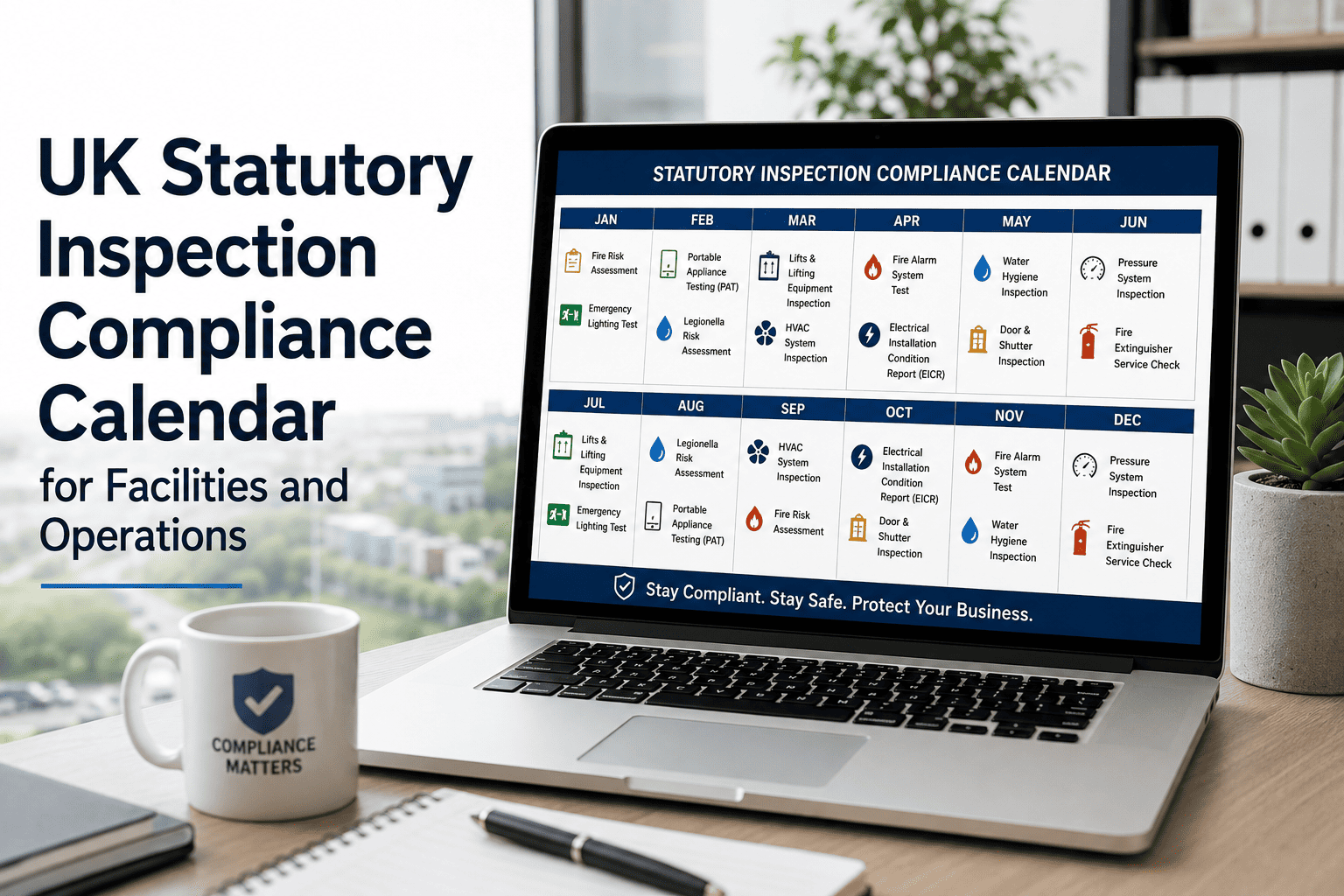
UK Statutory Inspection Compliance Calendar for Facilities and Operations
By Mark strong on May 27, 2026
Facilities and operations managers across the UK carry a legal duty to maintain a working statutory inspection programme — not just on paper, but with verifiable records, correct frequencies, and competent person sign-off. Missing a single inspection window is not an administrative oversight. It is a legal breach. Sign up free to run your statutory compliance calendar digitally, or book a demo to see how OxMaint manages every inspection type in one place.
Facilities ManagementStatutory Compliance
UK Statutory Inspection Compliance Calendar for Facilities and Operations
Every inspection type, correct legal frequency, and what happens when you miss one — a complete reference for UK duty holders
LOLERPUWERGas SafetyFire SafetyElectricalPressure Systems
6+
Major statutory frameworks every UK FM must track simultaneously
Annual
Minimum frequency for gas safety and most pressure system inspections
6 months
LOLER frequency for lifting equipment used to lift people
Unlimited
HSE fine potential for duty holders who cannot evidence compliance
What This Guide Covers
01 The Six Core Statutory Frameworks
02 Inspection Frequency Calendar
03 What Auditors Look For
04 The Cost of Missing an Inspection
05 Compliance Readiness Check
06 FAQ
Section 01
The Six Core Statutory Inspection Frameworks UK Facilities Managers Must Operate
Each framework below carries its own legal authority, its own inspection frequency rules, and its own competency requirements. They do not overlap — a compliant LOLER record does not satisfy PUWER, and a valid gas safety certificate does not cover electrical fixed wiring. Every one must be tracked independently.
LOLER
Lifting Operations and Lifting Equipment Regulations 1998
Governs all lifting equipment and accessories — passenger lifts, hoists, cranes, MEWPs, and fork trucks. Thorough examinations must be carried out by a competent person at defined intervals. LOLER and PUWER both apply to most lifting equipment at the same time.
Provision and Use of Work Equipment Regulations 1998
Applies to virtually all workplace machinery — from hand tools and power drills to complex manufacturing systems. Equipment must be suitable, maintained in safe condition, and used only by trained personnel. Operator daily checks with recording are required under PUWER.
FrequencyOngoing — with formal periodic examinations per risk assessment
Regulation: PUWER 1998 — HSE enforced
Gas Safety
Gas Safety (Installation and Use) Regulations 1998
All gas appliances, boilers, and mechanical plant must be inspected and certified annually by a Gas Safe registered engineer. Records of the inspection, engineer registration number, and any defects identified must be held and available on request.
FrequencyAnnually — no exceptions for commercial premises
Regulation: Gas Safety Regs 1998, Reg 36(3)(a)
Fire Safety
Regulatory Reform (Fire Safety) Order 2005
Requires regular fire risk assessments, fire alarm testing, and emergency lighting inspections. Fire alarm systems under BS 5839 require at minimum six-monthly formal inspections, plus monthly sound testing. Emergency lighting requires quarterly and annual checks under BS 5266.
Regulation: RRO 2005 — Fire and Rescue Authority enforced
Electrical
Electricity at Work Regulations 1989 / EICR
Fixed electrical installations must be inspected and tested at intervals determined by installation type and risk. Commercial premises typically require an EICR every 3 to 5 years. PAT testing for portable appliances is required annually under the Electricity at Work Regulations 1989, Regulation 4.
FrequencyFixed wiring: every 3–5 years / PAT: annually
Regulation: Electricity at Work Regs 1989, Reg 4
PSSR
Pressure Systems Safety Regulations 2000
Applies to pressure vessels, steam systems, compressed air systems, and fixed LPG systems. A written scheme of examination must be produced by a competent person and define inspection frequency per system. Boiler servicing falls here as an annual statutory requirement.
FrequencyPer written scheme — boilers typically annual
Regulation: PSSR 2000 — HSE enforced
Section 02
UK Statutory Inspection Frequency Calendar at a Glance
This is what a correctly structured compliance calendar looks like for a typical UK commercial or public sector estate. Every row is a legal obligation — not a recommendation.
Statutory Inspection Calendar — UK Commercial Estate
Minimum legally required frequencies for each inspection type
Inspection Type
Regulation
Minimum Frequency
By Whom
Gas appliances and boilers
Gas Safety Regs 1998
Annual
Gas Safe registered engineer
Passenger lifts (LOLER)
LOLER 1998
Every 6 months
Competent person (independent)
Lifting equipment — non-people
LOLER 1998
Annual
Competent person
Fire alarm system
RRO 2005 / BS 5839
Every 6 months
Competent fire engineer
Emergency lighting
BS 5266 / RRO 2005
Quarterly + Annual
Competent person
Fixed electrical wiring (EICR)
Electricity at Work Regs 1989
Every 3–5 years
NICEIC / qualified electrician
PAT testing (portable appliances)
Electricity at Work Regs 1989
Annual
Competent person
Pressure systems / boilers (PSSR)
PSSR 2000
Annual (per scheme)
Competent person per written scheme
Lightning conductors
BS EN 50164
Annual
Specialist contractor
Ventilation duct cleaning
Workplace Regs 1992
Annual
Specialist contractor
Electricity-operated doors
Workplace Regs 1992
Quarterly
Competent person
Stop Tracking This in Spreadsheets
OxMaint auto-triggers every statutory inspection on the correct schedule, assigns to competent engineers, and generates your compliance evidence pack in minutes. Sign up free and see your entire inspection calendar live from day one.
What Auditors and HSE Inspectors Actually Look For
A statutory inspection that happened but cannot be evidenced is treated the same as one that never happened. Auditors do not accept verbal confirmation. These are the four evidence requirements that appear consistently across HSE, Fire and Rescue Authority, and FM contract audits.
01
Timestamped Completion Record
Every inspection must have a record showing the exact date of completion — not the date it was scheduled. Auditors compare scheduled frequency against actual completion dates to identify missed or late inspections.
02
Competent Person Identification
The record must name the person who carried out the inspection and confirm their relevant competency — registration number for gas engineers, NICEIC number for electricians, or equivalent. A name without qualification evidence is insufficient.
03
Defect Tracking to Resolution
Any defect identified during an inspection must be formally recorded and tracked through to confirmed resolution with a closure date. Open defects with no resolution record are an immediate audit finding — and in some cases a prohibition notice.
04
Continuous Frequency Compliance
Auditors check the gap between consecutive inspections, not just whether the most recent one occurred. A 14-month gap between annual inspections is a breach — even if both inspections happened and were properly recorded.
Section 04
The Real Cost of a Missed Statutory Inspection
The consequences of non-compliance are not theoretical. They fall into three categories that compound each other rapidly once an incident or audit triggers investigation.
Regulatory Enforcement
HSE and Fire and Rescue Authorities can issue improvement notices, prohibition notices stopping operations, and unlimited fines for persistent or serious failures. Director-level personal liability applies where a failure is shown to be systemic.
Unlimited financial exposure
Contract Breach
Most public sector FM contracts and PFI agreements reference statutory compliance as a contract condition. A single evidenced compliance gap can trigger performance penalty deductions, contract termination clauses, or loss of renewal eligibility.
Contract termination risk
Insurance Invalidation
Commercial property and public liability insurance policies typically require statutory inspections to have been completed at the correct frequency as a policy condition. A claim arising from equipment that lacked a current inspection certificate can be rejected entirely.
Policy void on incident
Section 05
Compliance Readiness Check — Is Your Inspection Programme Audit-Ready?
Answer these five questions honestly. If any answer is "no" or "I would need to check," your programme has a gap an auditor will find before you do. Book a demo to see how OxMaint closes each one.
Scheduling
Can you confirm, right now, which statutory inspections across your estate are overdue — without manually searching a spreadsheet?
If no: every overdue inspection is a live legal breach accumulating undetected.
Evidence
Could you produce a complete inspection evidence pack for a specific asset in under 15 minutes if an auditor arrived today?
If no: your records exist but are not audit-ready — which auditors treat the same as records that do not exist.
Competency
Is there a live record confirming every engineer who carried out statutory inspections this month held the required competency at the time?
If no: you have liability exposure on every inspection completed without verified competency.
Defects
Are all defects identified during statutory inspections formally tracked through to confirmed resolution — with closure date and engineer recorded?
If no: open defects with no resolution record are an immediate audit finding.
Contractors
Are contractor-completed inspection records stored in the same system as in-house records — in the same evidence format?
If no: contractor work creates a documentation gap that auditors specifically look for.
With OxMaint
All five are met automatically — as a byproduct of daily operations, not a separate compliance task.
Does the duty holder have to carry out statutory inspections personally?
No — but the legal responsibility stays with the duty holder, which is typically the employer or building owner. Inspections must be carried out by a competent person, who may be an employee or an external contractor. The duty holder must ensure the correct person is used, inspections happen at the correct frequency, and records are retained. Appointing a contractor does not transfer legal liability.
What is the difference between a LOLER and a PUWER inspection — and why do both apply to the same equipment?
LOLER covers the specific risks of lifting operations — the structural integrity of lifting equipment, safe working loads, and the safety of lifting accessories. PUWER covers general work equipment safety — guarding, controls, maintenance records, and operator suitability. Nearly all lifting equipment is also work equipment, so both regulations apply simultaneously. A clean LOLER report does not satisfy PUWER obligations. The two must be tracked independently, though some examination providers produce combined reports for specific equipment types such as fork trucks under the CFTS standard.
How does OxMaint handle inspection frequencies that vary by equipment type within the same regulation?
OxMaint sets inspection frequencies at asset level — not just regulation level. A passenger lift and a goods hoist in the same building can have different LOLER intervals set independently. When a new asset is added to the register, the correct frequency is configured at setup. The system auto-triggers inspections on the correct schedule per asset and escalates overdue inspections automatically — no manual monitoring required. Sign up free to configure your asset register from day one.
Can OxMaint produce the evidence pack format that HSE and contract auditors ask for?
Yes. OxMaint generates per-asset compliance reports showing inspection history, frequency adherence, engineer competency records, and defect tracking through to resolution — exportable in a clean format. The report is built from live data, which means it reflects actual compliance rather than what was manually assembled before an auditor arrived. Book a demo to see the evidence pack output in practice.
UK Facilities Management — Free to Start
Your Statutory Inspection Calendar Should Run Itself
OxMaint automates every inspection frequency, assigns to competent engineers, tracks defects to resolution, and produces audit-ready evidence packs in minutes — across every regulation, every asset, every site.