Most facilities and industrial sites manage seasonal maintenance the same way they manage all maintenance — reactively. The boiler fails in January because nobody checked it in October. The drainage system backs up in spring because the autumn clearance never happened. The HVAC runs inefficiently all summer because the filters were last changed the previous year. Seasonal maintenance failures are not unpredictable events. They are scheduled neglect — and every one of them has a preventive task that should have been on the calendar weeks earlier. This guide gives facilities managers and engineering teams a practical seasonal PPM checklist for every quarter, plus a clear framework for making it stick. Sign up free to automate your seasonal PPM schedule in OxMaint, or book a demo with a UK specialist.
Facilities Management
Seasonal PPM
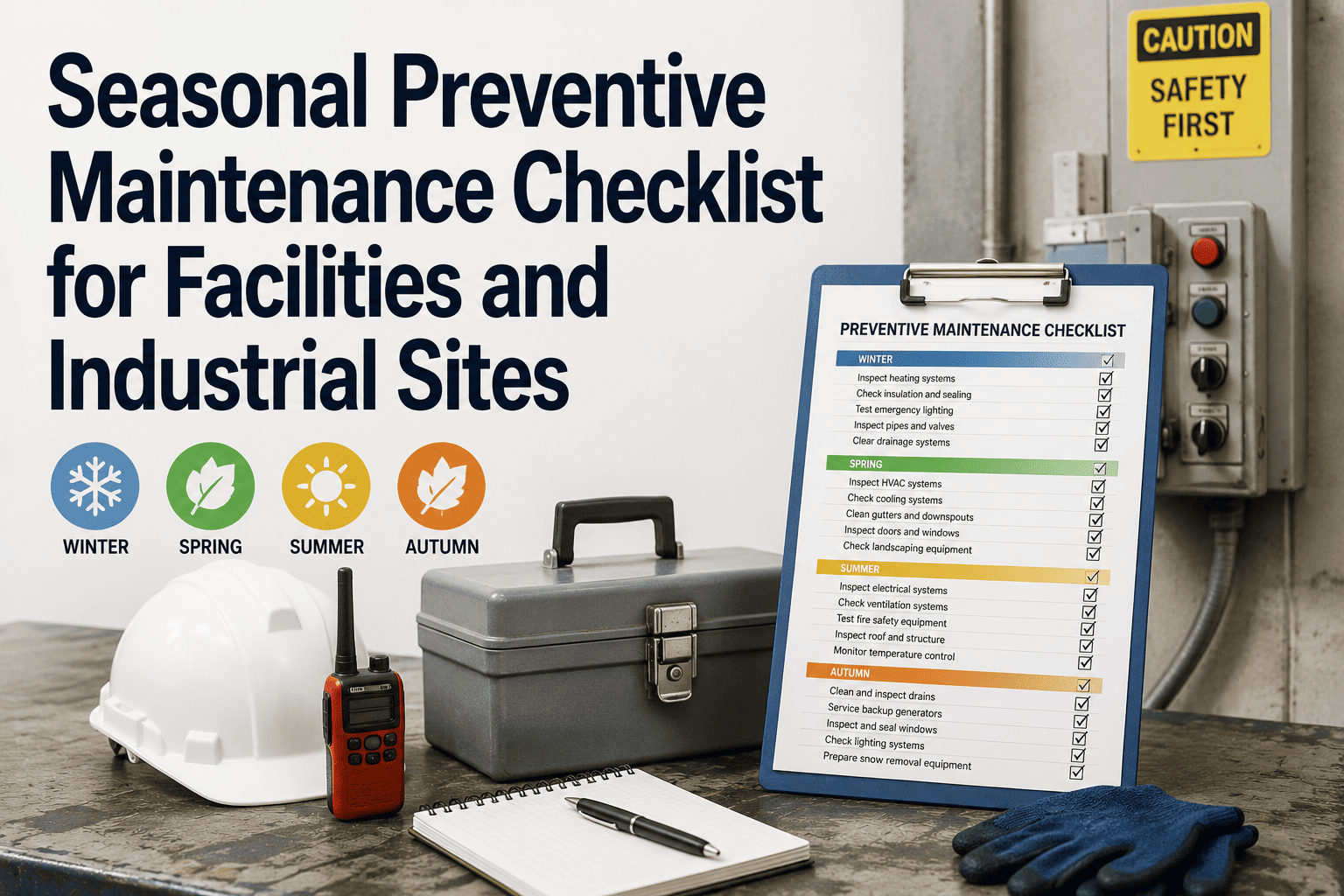
Seasonal Preventive Maintenance Checklist for Facilities and Industrial Sites
A quarter-by-quarter PPM framework covering HVAC, drainage, heating, cooling, and critical asset checks — built for facilities and industrial maintenance teams
41%
Fewer unplanned failures within 6 months of structured seasonal PPM
3–5x
Cost of reactive repair vs planned seasonal maintenance
23%
Of facility downtime linked to missed seasonal maintenance tasks
18%
Average maintenance cost reduction in year one of digital PPM deployment
What This Guide Covers
Q1Winter into Spring Checks
Q2Spring into Summer Checks
Q3Summer into Autumn Checks
Q4Autumn into Winter Checks
AllYear-Round Critical Assets
RunMaking the Schedule Stick
Why Seasonal Maintenance Fails — and What to Do About It
Seasonal maintenance fails for one of three reasons: the task was never scheduled, the task was scheduled but nobody checked whether it was done, or the task was done but not recorded. All three are systems problems, not people problems. A facilities team that knows exactly what needs doing, who is responsible for it, and can see in real time whether it has been completed will outperform any team relying on memory and wall planners — regardless of headcount. Book a demo to see how OxMaint automates seasonal PPM scheduling across all four quarters.
Never Scheduled
Seasonal tasks that live only in someone's memory are the first to be missed when that person is absent, overwhelmed with reactive work, or leaves the organisation.
Fix: Seasonal tasks configured in OxMaint trigger automatically at the right time — they cannot be forgotten because they never depended on being remembered.
No Visibility of Completion
A task assigned to a technician on a whiteboard or email thread has no reliable completion record. Managers have no way to verify whether seasonal tasks were actually done without physically checking.
Fix: OxMaint's live dashboard shows every seasonal task status in real time — scheduled, assigned, in progress, or completed — with a timestamped record at closure.
No Record Created
Seasonal maintenance done without documentation is legally and contractually equivalent to maintenance not done. Under PUWER, insurance terms, and FM contracts, the record is the proof.
Fix: Every OxMaint task closure generates a timestamped, named digital record automatically — the audit trail is built as the work is done, not assembled later.
Winter is the highest-risk season for reactive maintenance failures. Frost damage, heating system overload, and drainage blockages caused by autumn debris combine to create peak emergency repair volume. The Q1 checklist catches damage early and prepares systems for the increasing load of spring.
Heating Systems
Boiler servicing — combustion analysis, heat exchanger inspection, flue check
Pressurisation unit operation and expansion vessel pre-charge check
Thermostatic radiator valve function and zone control verification
Frost protection thermostat test — confirm set point and operation
Pipework insulation inspection — replace any damaged or missing sections
Drainage and Water
External drain inspection and clearance — remove winter debris accumulation
Gulley trap inspection and jetting if blockage present
Roof drainage and downpipe inspection following winter leaf fall
Cold water storage tank inspection — frost damage, cover integrity, water quality
HTM 04-01 temperature checks — confirm legionella control compliance
Building Fabric
Roof inspection — identify frost damage, cracked tiles, flashing failures
External cladding and glazing seal inspection for wind and frost ingress
Perimeter drainage and car park surface check for frost heave damage
Door seal and threshold condition — draught and water ingress check
Spring is the preparation window for peak cooling demand. HVAC systems that ran all winter without servicing face summer at reduced efficiency. Q2 is the right time to service cooling equipment, inspect external plant, and address any building fabric issues identified in the Q1 inspection before they worsen.
HVAC and Cooling
Air conditioning unit service — filter replacement, coil clean, refrigerant check
Chiller pre-season inspection — condenser clean, controls test, leak check
AHU filter replacement and damper operation check
Cooling tower inspection and water treatment programme review
Split system outdoor unit clearance — vegetation and debris removal
Electrical and Mechanical
Generator load test and fuel system inspection — pre-summer demand readiness
UPS battery condition check — heat degrades performance significantly
Electrical distribution board thermal imaging — identify hotspots before load increases
Motor starter and drive unit inspection on high-demand plant
Compressed air system — filter drain, desiccant check, pressure relief test
External and Grounds
External plant area inspection — winter damage, security, clearance from vegetation
Roof drainage re-check after spring rainfall — confirm Q1 repairs held
External lighting inspection — lamp replacement, housing seal integrity
Vehicle access and loading dock surfacing condition review
Every Seasonal Task. Automatically Triggered. Always on Record.
OxMaint configures your Q1 through Q4 seasonal PPM schedule before you go live — tasks triggered automatically, assigned to the right engineer, and recorded at closure without a separate admin step.
Sign up free and get your first seasonal schedule running today.
Q3 runs concurrently with peak cooling demand and begins the preparation window for autumn. The first half of this quarter focuses on monitoring performance under load; the second half shifts attention to pre-autumn checks that prevent the most common winter failures — starting early is what separates planned maintenance from last-minute scrambles.
Cooling Systems Under Load
Monthly filter inspection during peak cooling period — replace if loaded
Condenser coil re-inspection — outdoor units accumulate debris rapidly in summer
Chilled water system flow rate and temperature differential check
Server room and data cabinet cooling performance review under load
Cooling tower water quality test — Legionella risk increases significantly in summer
Autumn Preparation (August+)
Boiler pre-season inspection — arrange service before heating demand returns in October
Heating system initial pressure check and system flush if required
Roof and drainage pre-inspection before leaf fall season begins
Gritting and winter access management plan — arrange contractor if needed
External pipework and tap frost protection plan — identify exposed runs
Fire and Safety Systems
Fire alarm quarterly test and detector head inspection
Emergency lighting 3-hour discharge test — statutory requirement
Fire door self-closer and intumescent seal inspection
Suppression system inspection and discharge nozzle clearance check
Q4 is the highest-stakes quarter for facilities maintenance. A missed boiler service in October becomes an emergency breakdown in December. A drainage system not cleared in October backs up when the first heavy rain arrives. Q4 tasks have the highest consequence-of-failure rating — they must be scheduled, tracked, and completed before November.
Heating and Boilers
Full boiler service — burner, heat exchanger, controls, safety valve test
Heating system recommission — bleed radiators, balance zones, test controls
Frost protection thermostat commissioning and function test
Pipework insulation inspection — install before ground temperature drops
Trace heating system test on all external and exposed pipework
Drainage and Roof
Full roof drainage clearance — gutters, downpipes, hoppers, flat roof outlets
Gulley inspection and jetting — clear before peak rainfall period
Roof membrane and flat roof inspection — seal any identified breaches
Soil and waste pipework inspection — camera survey if previous blockages recorded
Interceptor and grease trap inspection for production or catering facilities
Critical Plant and Safety
Generator load bank test and cold-start check before winter demand
LOLER thorough examination — hoists, access equipment, lifting attachments
External lighting check — shorter days mean lighting operates longer under load
Gritting contractor confirmation and access route plan finalisation
Year-Round Critical Assets: What Cannot Wait for a Quarter
Some assets require maintenance at frequencies that fall between seasonal check points. These cannot be deferred to the nearest quarterly review — their failure interval is shorter than 13 weeks, and missing a scheduled task creates immediate risk. Every facilities PPM programme must include these alongside the seasonal schedule.
Monthly
Fire alarm test — weekly in higher-risk facilities
Emergency lighting function test
HTM 04-01 sentinel outlet temperature checks
Legionella risk system checks — shower and TMV operation
Compressed air filter drains
HVAC filter visual inspection
Quarterly
Fire alarm full test and detector inspection
Emergency lighting 3-hour discharge test
Sprinkler system quarterly inspection
Pressure system safety valve test (PSSR)
AHU damper and actuator check
Generator start and run test under load
Six-Monthly
LOLER thorough examination — all lifting equipment
Sprinkler system semi-annual inspection
Legionella risk assessment review
Fixed wire testing on high-risk circuits
Pressure vessel inspection (PSSR written scheme)
Lightning protection system continuity test
Annual
Full fixed wire test (EICR) — periodic inspection
Gas safety inspection — all gas appliances and pipework
Full building fabric survey
PSSR written scheme review and update
Thermographic survey — electrical panels and distribution
Water risk assessment full review
All of This — Automated, Tracked, and Audit-Ready
OxMaint runs your seasonal and year-round PPM schedule simultaneously — monthly, quarterly, six-monthly, and annual tasks auto-triggered, assigned, and recorded.
Sign up free and eliminate missed seasonal tasks permanently.
Making the Seasonal Schedule Stick: Five Operational Rules
Schedule Six Weeks Before the Season — Not When It Arrives
Boiler services need to be booked before October demand. Cooling services need to be done before July heat. The window for getting a contractor during peak demand is narrow and expensive. Seasonal tasks must be triggered and completed in advance — not reactively when the season arrives and every contractor is overbooked.
Assign Named Ownership — Not Department Responsibility
A task assigned to "the engineering team" is a task assigned to nobody. Every seasonal task needs a named owner with a named backup for absences. Automated assignment removes the ambiguity — the right person is notified directly, not the team inbox.
Record at the Point of Work — Not at the End of the Week
Documentation completed three days after the task is completed from memory is unreliable. It misses observations, misremembers findings, and creates a record that does not accurately reflect what was found. Mobile task completion means the record is created at the moment of inspection — when the information is accurate.
Convert Every Finding Into a Tracked Work Order
A seasonal inspection that identifies a defect must generate a corrective work order immediately — linked to the originating inspection, tracked to closure, with the resolution date recorded. Notes on a paper form that nobody follows up on are not maintenance. They are deferred risk.
Review Completion Before the Season Ends — Not After It
A Q4 seasonal checklist review conducted in January tells you what you should have done in November. The review must happen before the seasonal window closes — checking completion rates at the midpoint of each quarter allows time to reschedule anything that slipped before the risk window opens.
UK Facilities and Industrial Sites — Free to Start
Seasonal Maintenance Failures Are Predictable. That Means They Are Preventable.
OxMaint gives facilities and industrial maintenance teams a digital PPM platform that automates seasonal scheduling across all four quarters, tracks every task through to completion, and produces audit-ready records automatically — deployed in 5 to 7 working days, free to start.
Frequently Asked Questions
How does OxMaint handle seasonal task scheduling across multiple sites with different asset profiles?
OxMaint supports multi-site management from a single account — each site has its own asset register and seasonal PPM schedule, but all sites are visible from a central dashboard. Seasonal schedules can be configured per site to reflect different asset inventories, local contractor arrangements, and climate exposure. Portfolio-level seasonal compliance reporting is available across all sites simultaneously.
Sign up free to configure your first site today.
Can OxMaint track contractor-completed seasonal tasks in the same system as in-house work?
Yes. Contractor task records — boiler services, chiller servicing, drainage jetting, and any other seasonally contracted work — are captured in OxMaint in the same format as in-house records. Contractor qualification and insurance certificates are stored per contractor with expiry alerts. The seasonal maintenance record is consistent regardless of who completed the work.
Book a demo to see contractor management in practice.
What happens when a seasonal inspection identifies a defect — how does OxMaint handle the follow-up?
When a technician records a defect or observation during a seasonal inspection task in OxMaint, a corrective work order is raised directly from the inspection record — linked, tracked, and assigned for resolution. The originating inspection and the corrective action are connected in the asset history, so the full sequence is visible: defect found, corrective action raised, resolution recorded, date closed. This is the closed-loop record that satisfies insurance, compliance, and FM contract audit requirements.
Does OxMaint work offline for technicians working in areas without Wi-Fi or mobile signal?
Yes. OxMaint's mobile app operates fully offline — technicians access their seasonal PPM tasks, complete checklists, and record observations in plant rooms, on rooftops, and in basement areas without needing an active connection. All data syncs automatically when the device reconnects to the network. This is essential for facilities maintenance across older buildings and industrial sites with limited wireless coverage.