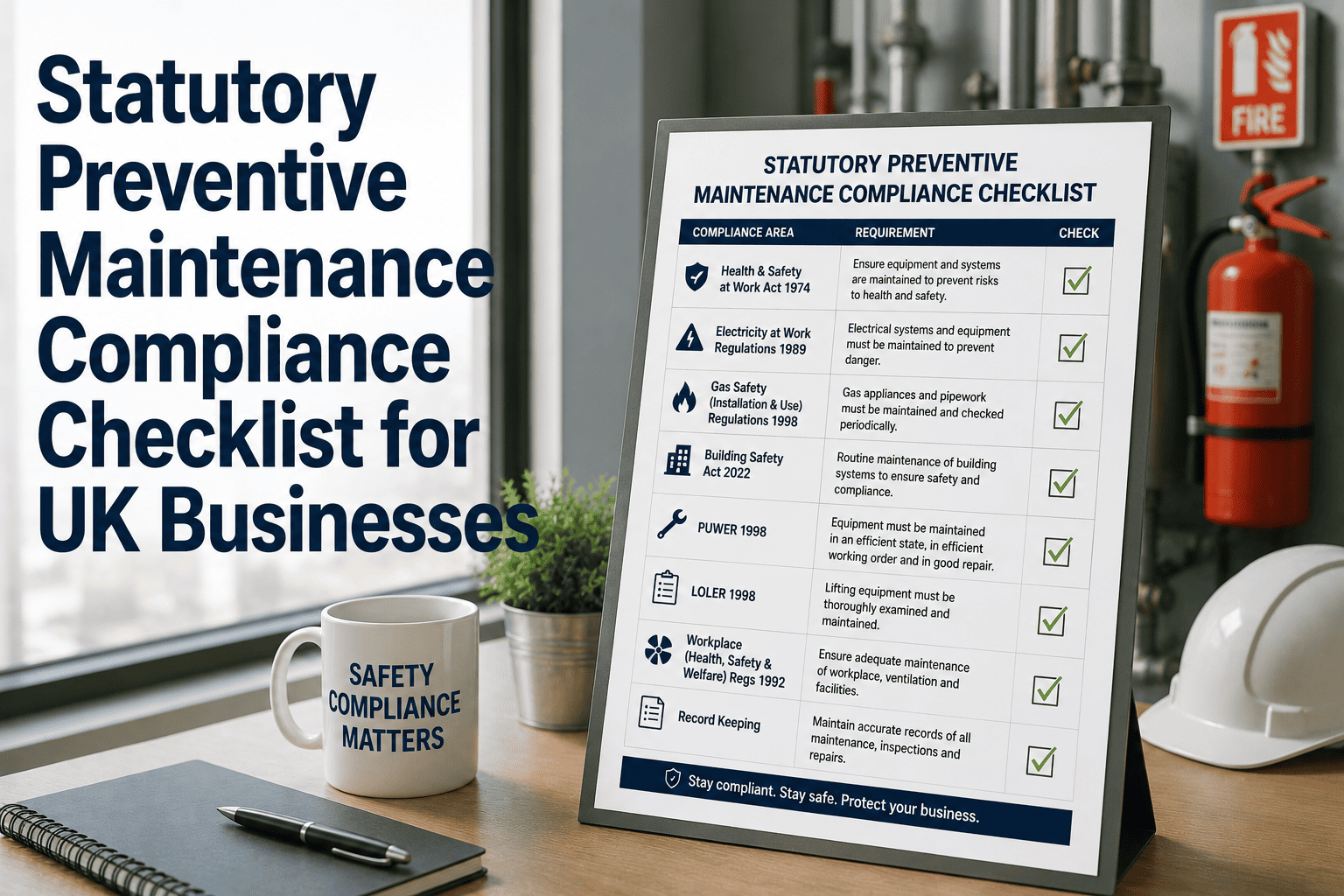
Statutory Preventive Maintenance Compliance Checklist for UK Businesses
By Mark strong on May 26, 2026
Statutory preventive maintenance compliance is not optional in the UK. Under PUWER, LOLER, COSHH, and fire safety regulations, facility managers and business owners have a legal obligation to maintain equipment, installations, and building systems to prevent harm. Yet most organisations manage compliance reactively — waiting for an inspection notice, rushing to book contractors, or discovering violations during audits. This guide provides a complete statutory compliance checklist, explains the regulations behind each requirement, and shows how to move from reactive compliance to proactive, documented preventive maintenance.
UK ComplianceStatutory Maintenance
Statutory Preventive Maintenance Compliance Checklist for UK Businesses
PUWER, LOLER, COSHH, Fire Safety, and Electrical Inspection Requirements — Complete with Timelines and Audit Trails
87%
Of UK businesses cite compliance complexity as their biggest maintenance challenge
£10,000+
Average cost of a single non-compliance fine under Health and Safety Executive enforcement
52%
Reduction in compliance violations with structured preventive maintenance
100%
Audit-ready documentation with automated compliance tracking
What This Guide Covers
1PUWER Compliance
2LOLER Inspections
3COSHH Maintenance
4Fire Safety Checks
5Electrical Testing
6Implementation Guide
Why Statutory Compliance Fails — The Cost of Missed Maintenance
Regulatory compliance fails for two reasons: either the obligation is unknown, or it is known but the processes are not documented and enforced. Both create legal and financial exposure. An HSE inspector who discovers that lifting equipment has not been examined under LOLER does not care whether you forgot the task or simply did not record it — the violation is the same. Under the Health and Safety at Work Act, responsibility sits with the business owner and facilities manager, not with external circumstances.
A documented, automated compliance programme changes this. When every statutory task is scheduled, assigned, completed with evidence, and recorded in a system that produces audit-ready reports, the legal burden is satisfied. The record exists. The timeline is clear. The responsible person is identified.
Unknown Obligations
Different regulations apply to different facilities. A manufacturing plant needs COSHH compliance that an office may not. Equipment and machinery create LOLER and PUWER requirements that portable items do not. Without clarity on which regulations apply to your site, compliance gaps are inevitable.
Solution: OxMaint's compliance configurator maps your facility type, asset inventory, and applicable regulations — highlighting exactly which statutory tasks your site must schedule and document.
No Evidence Trail
A verbal instruction to check a piece of equipment, completed and forgotten to document, has the same legal standing as work not done at all. Compliance is only compliance when it is recorded. Email threads, WhatsApp messages, and handwritten notes do not satisfy audit requirements or regulatory expectations.
Solution: Every statutory task completion in OxMaint generates a timestamped, named record with evidence attachments — producing the audit trail that satisfies HSE, insurers, and FM contract audits.
No Enforcement
A statutory maintenance schedule written on a wall planner is a schedule in name only. Without real-time visibility of task status, without automated reminders, and without consequences for missed deadlines, the schedule degrades into a wish list. Compliance requires enforcement.
Solution: OxMaint's dashboard shows every statutory task status in real time — scheduled, assigned, overdue, or completed — with automatic escalation for tasks approaching deadline and manager oversight built in.
REGULATION 1
PUWER: Provision and Use of Work Equipment
PUWER requires that all work equipment — machinery, tools, lifts, pressure vessels, and any item used to accomplish work — is maintained in a safe condition and does not deteriorate to create risk. Maintenance must be preventive, not reactive. The owner or operator must ensure it is safe before use and that deterioration is managed through scheduled checks.
Machinery and Powered Equipment
Pre-use inspection of all powered machinery — daily or per manufacturer guidance
Lubrication and oil level checks on pumps, motors, compressors — monthly
Guard and safety device function check — quarterly
Emergency stop function test on all machinery — monthly
Vibration analysis or noise monitoring — annual on high-vibration equipment
Spare parts inventory and availability — ensure parts can be sourced without delays
Hand Tools and Portable Equipment
Visual inspection of power tools — damage, fraying, defects — monthly
PAT testing on electrical hand tools — annual or per insurance requirements
Ladder and access equipment condition check — before each use
Pressure test on pressure vessels and hoses — annual
Chain and sling inspection for lifting applications — every 6 months
Documentation and Records
Maintenance manual and manufacturer guidance filed and accessible
Planned maintenance schedule documented per equipment
Maintenance history record — all work completed, findings, repairs
Contractor records — qualifications, insurance, work scope, sign-off
Track Every PUWER Requirement Automatically
OxMaint configures PUWER compliance for your asset inventory before go-live — every machine, tool, and item is assigned a maintenance schedule with timelines, responsible persons, and documented evidence. Sign up free to start your statutory compliance calendar today.
LOLER mandates that all lifting equipment — cranes, hoists, chain blocks, slings, shackles, lifting beams, and any item used to lift a load — is inspected by a competent person at defined intervals. The frequency depends on equipment type and use intensity. A thorough examination by a competent engineer is not optional; it is a legal requirement with strict timelines and documentation standards.
Equipment Classification
Manual lifting aids — 6-monthly inspection minimum
Chain hoists and block and tackle — 6-monthly thorough examination
Electric chain hoists and wire rope hoists — 12-monthly thorough examination
Mobile cranes — 12-monthly thorough examination plus visual pre-use inspection
Pallet trucks and powered lifting devices — 12-monthly thorough examination
Shackles and eyebolts — certified SWL marking verification before each use
Spreader bars and lifting beams — 12-monthly thorough examination
Competent Examiner and Records
Examiner must be LOLER-competent or hold engineering qualification
Thorough examination report must be signed and dated by examiner
Certificate of thorough examination issued — retained for audit
Defects and remedial actions recorded — signed off before re-use
Examination records available at site during HSE inspection
REGULATION 3
COSHH: Control of Substances Hazardous to Health
COSHH requires that businesses manage chemical and hazardous substance exposure through control measures, training, and maintenance of engineering controls. Maintenance is critical: local exhaust ventilation systems must be tested, storage containers inspected for leaks or deterioration, and containment systems verified. Without preventive maintenance, COSHH compliance becomes reactive — discovering failures when exposure has already occurred.
Ventilation and Extraction
Local exhaust ventilation (LEV) system inspection — quarterly minimum
Air velocity and extraction effectiveness testing — annual or per exposure circumstances
Hood condition and seal integrity check — monthly
Ductwork and filter condition — monthly visual, replacement per schedule
Fan operation and vibration check — monthly
Storage and Containment
Chemical storage container inspection — no visible corrosion, leaks, or sealing failures
Secondary containment system condition — monthly check for cracks or degradation
Spill kit location and contents — monthly inventory and replacement of expired items
Gas cylinder storage and restraint — verify stability and valve protection
Pressure relief systems on storage tanks — annual pressure test
Training and Documentation
COSHH assessment up-to-date for each hazardous substance in use
Safety Data Sheets (SDS) available for all substances — accessible to workers
Employee training records — proof of COSHH induction and competency
Exposure monitoring records — where exposure circumstances warrant air testing
REGULATION 4
Fire Safety: Prevention and Detection Equipment
The Fire Safety Order 2005 and Building Safety Act impose strict maintenance requirements on fire detection and suppression systems. Fire alarms, emergency lighting, fire doors, and suppression equipment must be tested regularly and records maintained. Failure is not only a regulatory violation — it represents the most serious breach of duty to occupants.
Fire Detection and Alarm
Fire alarm system weekly test — bell/sounder operation and indicator lights
Detector head inspection and cleaning — quarterly, more frequent in dusty environments
Addressable detector function test — annual by competent technician
Control panel battery and backup power test — monthly
Manual call point operation — monthly function test
Emergency Lighting and Exits
Emergency light bulb and lens condition — monthly visual check
3-hour discharge test on emergency lighting — quarterly statutory requirement
Exit route signage integrity and illumination — monthly
Fire door self-closer and latch function — quarterly check
Intumescent seal and fire-resistance rating verification — annually
Suppression Systems
Fire extinguisher visual inspection — monthly pressure and tamper seal check
Fire extinguisher maintenance and hydrostatic pressure test — annually per type
Sprinkler system quarterly inspection and flow test
Suppression nozzle and discharge path clearance — ensure unobstructed
Water supply and pressure verification — quarterly minimum
Compliance Across All Regulations. One Platform.
OxMaint manages PUWER, LOLER, COSHH, fire safety, and electrical compliance simultaneously. Every task is scheduled, assigned, and recorded with evidence — producing the audit trail that satisfies HSE inspection without the administrative overhead. Book a demo with a UK compliance specialist to see how it works for your site.
Electrical installations and portable appliances must be tested at defined intervals. An Electrical Installation Condition Report (EICR) is required at periodic intervals — typically every 5 years for workplaces, sooner for higher-risk environments. PAT testing on portable appliances and hand tools must be scheduled and records retained. Failure to test creates immediate risk of electrical shock, fire, or equipment failure.
Fixed Wiring and Installation
Full EICR (periodic inspection) — every 5 years for standard workplace
EICR for high-risk environments — 3 years for public buildings, more frequent for manufacturing
Visual inspection for damage, deterioration, water exposure — annually minimum
RCD (residual current device) function test — quarterly
Earthing and bonding continuity verification — per EICR schedule
Portable Appliances and Tools
PAT testing on all electrical hand tools — annual or per risk assessment
Portable extension reels and cables — annual PAT and visual inspection
Office equipment and plugs — annual PAT or per manufacturer guidance
Inspection cable history — records retained and linked to equipment asset register
Failed equipment immediately removed from service — no exceptions
Testing and Records
EICR report signed and dated by qualified electrician
PAT test results recorded with equipment ID, test date, and tester name
Defects and remedial actions tracked — corrected before equipment re-use
Records available during HSE or insurance audit without delay
Making Statutory Compliance Stick: Five Essential Rules
01
Map Your Applicable Regulations First
Not every regulation applies to every facility. A warehouse needs different compliance than a manufacturing plant. Define which regulations apply to your site, document the reasoning, and share it with your team. This becomes the foundation of your compliance calendar.
02
Assign Tasks to Named, Competent Persons
A LOLER thorough examination must be performed by a competent engineer. A fire safety check must be done by someone trained and authorised. Assign statutory tasks to individuals with relevant qualifications and verify their credentials are current. Record it.
03
Schedule Every Task Six Weeks Before Deadline
Statutory deadlines are not guidelines. Schedule inspections, tests, and servicing far enough ahead that contractors can be booked and work completed without rushing. Last-minute scheduling creates missed deadlines and incomplete work.
04
Collect Evidence at the Point of Completion
Signed reports, photos of inspection findings, test results, and remedial action evidence must be captured on site when the work is done. Mobile forms and photo attachments ensure the record is complete and contemporaneous — not reconstructed days later from memory.
05
Review Compliance Status Monthly
A monthly compliance dashboard review shows which tasks are approaching deadline, which are overdue, and which have evidence gaps. Early visibility prevents violations and gives time to reschedule before the legal deadline passes.
Building an Audit-Ready Compliance System in Five Steps
1
Asset Inventory and Regulation Mapping
Document every asset that has a statutory maintenance requirement — machinery, lifting equipment, electrical installations, fire systems, chemical storage. Against each asset, identify which regulations apply.
2
Schedule Configuration
For each asset and regulation, define the maintenance task, required frequency, competent person qualifications, and deadline. Build this into a digital calendar so tasks trigger automatically.
3
Assignment and Notification
When a statutory task is triggered, automatically assign it to the responsible person with required qualifications. Send a notification with task details, deadline, and submission requirements. No task should rely on someone remembering.
4
Completion and Evidence Capture
The assigned person completes the task and submits findings, photos, and signed evidence directly in the system. The record is created at the moment of completion — it is accurate and contemporaneous.
5
Audit Trail and Reporting
Every task completion generates a timestamped record linked to the asset, regulation, and responsible person. Compliance reports are generated on demand — showing completion rate, evidence quality, and any defects or remedial actions.
Statutory Compliance Doesn't Require Complexity. It Requires System.
OxMaint runs your statutory compliance calendar automatically — all regulations, all frequencies, all timelines, all evidence. Deployed in 5 to 7 working days. Audit-ready from day one. Free to start for UK facilities and industrial sites.
What happens if we miss a statutory deadline — will we be fined?
Non-compliance is typically treated as a breach of the Health and Safety at Work Act, which carries enforcement action by the HSE ranging from improvement notices (mandatory correction within a timeframe) to prohibition notices (operation halted until compliance is restored) to prosecution with fines of up to £20,000 per breach. The violation is made worse if an incident occurs — then the regulator will scrutinise whether the missed maintenance contributed. A documented, automated compliance system demonstrates due diligence and significantly reduces regulatory and insurance exposure. Sign up free to bring compliance into system rather than leaving it to chance.
Does OxMaint track contractor-completed statutory inspections and certifications?
Yes. Contractor LOLER thorough examinations, EICR reports, fire safety certifications, and any other externally-completed statutory work are captured in OxMaint in the same format as in-house records. Contractor qualifications, insurance certificates, and competency verification are stored per contractor with expiry alerts. The compliance record is continuous regardless of who performed the work.
How do we know if we're compliant across multiple sites?
OxMaint supports multi-site management with portfolio-level compliance reporting. A single dashboard shows compliance status across all sites simultaneously — which tasks are due, which are completed, which have evidence gaps. Site managers have their own views with site-specific assets and schedules. Senior management has portfolio visibility for governance and insurance reporting.
What if a statutory inspection discovers a defect — how is remedial work tracked?
When a technician records a defect during a statutory inspection, a corrective work order is raised directly from that inspection record. The defect, corrective action, and resolution are linked in the asset history. This closed-loop record satisfies compliance audits and shows the regulator that you identified and remediated the issue.
Can OxMaint work offline for inspectors in areas without good Wi-Fi?
Yes. OxMaint's mobile app operates fully offline — technicians can complete statutory inspection forms, capture photos, and record findings in plant rooms, on rooftops, or underground with no network connection. Data syncs automatically when the device reconnects. This is essential for older industrial facilities and buildings with poor wireless coverage.