SFG20 is the UK's authoritative standard for building services maintenance — and for facilities managers running statutory maintenance programmes across commercial, public sector, or mixed-use estates, it is simultaneously the most useful framework and the most difficult one to operate on paper. A standard that defines over 70,000 task lines across hundreds of asset categories cannot be managed reliably through spreadsheets and manual scheduling. The FM teams that get SFG20 compliance right are the ones that have stopped trying to run it manually. Sign up free to see how OxMaint automates your SFG20 programme end-to-end, or book a demo with a UK facilities specialist.
Facilities Management
SFG20 Compliance
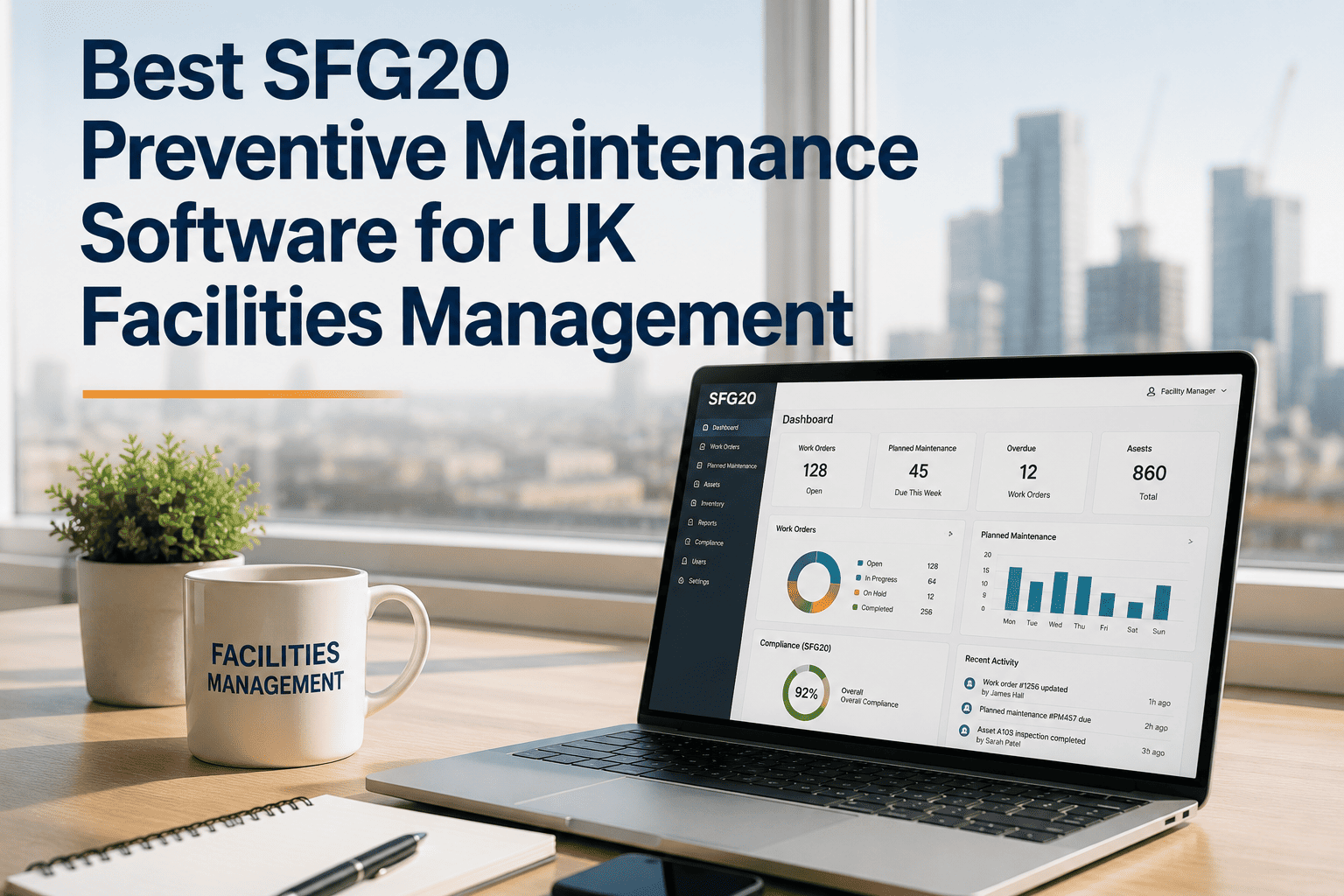
Best SFG20 Preventive Maintenance Software for UK Facilities Management
SFG20's 70,000+ task lines across hundreds of asset categories cannot be managed on spreadsheets — digital PPM platforms are the only way to deliver consistent statutory compliance at scale
70,000+
Task lines defined across all SFG20 asset categories
41%
Fewer equipment failures within 6 months of digital PPM deployment
10 min
To produce a full compliance audit pack — versus half a working day on paper
5–7
Working days to go fully live on OxMaint with onboarding support
What This Guide Covers
01What SFG20 Actually Demands
02Where Paper Systems Fail
03Key Software Features to Demand
04Before vs After Digital PPM
05Compliance Readiness Check
06FAQ
Section 01
What SFG20 Actually Demands From a Facilities Maintenance Programme
SFG20 — published by BESA — is the industry standard specification for building services maintenance in the UK. It defines the tasks, frequencies, and competency requirements for maintaining building services assets across commercial, industrial, healthcare, education, and public sector estates. Compliance with SFG20 is referenced in most major public sector FM contracts, PFI agreements, and increasingly in commercial lease obligations. Three things make SFG20 particularly difficult to operate on a manual basis.
Three Reasons SFG20 Breaks Manual Maintenance Systems
Each of these would be manageable in isolation — together they make spreadsheet-based compliance unreliable
Volume and Granularity
SFG20 specifies tasks at the individual asset and activity level — not just asset category level. A medium-sized commercial estate can have several thousand active task lines requiring tracking across daily, weekly, monthly, quarterly, and annual frequencies simultaneously.
No spreadsheet scales to this reliably
Living Standard Updates
SFG20 is updated regularly — task specifications, frequencies, and competency requirements change as legislation and best practice evolve. Manual systems cannot track these changes reliably, meaning FM teams frequently operate against outdated task schedules without realising it.
Outdated schedules create silent compliance gaps
Evidence Requirements at Audit
SFG20 compliance is not self-certified — it is evidenced. FM contracts, insurance requirements, and statutory audits require demonstrable proof that each task was completed, by a competent person, at the specified frequency. Paper records routinely fail this standard at audit.
Records that cannot be retrieved are no records at all
Section 02
Where Manual Systems Fail UK FM Teams Day-to-Day
The failure of paper and spreadsheet systems to support SFG20 compliance is not a theoretical risk — it shows up in specific, predictable ways across every understaffed FM team operating without digital tools.
Four Operational Failure Points That Create SFG20 Compliance Risk
Each one is a predictable consequence of running a volume compliance standard on a manual system
Quarterly and annual SFG20 tasks are the most commonly missed in manual systems — they fall outside the daily routine, are easy to defer once, and the deferral is rarely flagged until a contract audit identifies the gap. A missed quarterly task is typically not noticed until it has been missed two or three times running.
Silent contract breach risk
SFG20 specifies competency requirements for many task categories. Manual systems track technician qualifications in separate HR spreadsheets that are not linked to work order assignment — meaning tasks requiring specific competencies are regularly assigned to engineers who do not hold them, creating liability the FM team does not know exists.
Undetected liability exposure
When a contract audit or statutory inspection requires SFG20 compliance evidence, manual systems require FM managers to manually collate task completion records from multiple sources — paper files, email confirmations, spreadsheet logs. This process typically takes one to two days and still produces incomplete evidence packs.
Days of manual assembly per audit
Manual FM teams have no real-time view of their SFG20 compliance position. They cannot tell — without a manual audit of their own records — what percentage of scheduled tasks have been completed on time, which assets have overdue tasks, or what their exposure is before a client audit arrives.
Flying blind on compliance position
SFG20 Compliance Should Not Require Two Days of Pre-Audit Scrambling
OxMaint automates SFG20 task scheduling, tracks competency against assignment, and produces compliance evidence packs in minutes — not days.
Sign up free and see your compliance position in real time from day one.
Section 03
Key Features to Demand From SFG20 PPM Software in 2026
Not every CMMS platform delivers genuine SFG20 capability. Many offer work order management but lack the scheduling depth, competency tracking, and evidence generation that SFG20 compliance specifically demands. These are the features that separate platforms that work for UK FM from those that merely claim to.
Multi-Frequency PPM Scheduling
SFG20 tasks span daily, weekly, monthly, quarterly, six-monthly, and annual frequencies — often on the same asset. The platform must handle all frequency tiers simultaneously, trigger tasks automatically, and escalate missed tasks without manual monitoring.
Automatic task generation across all SFG20 frequency tiers
Calendar load balancing to prevent task pile-up
Missed task escalation — automatic manager notification
Offline mobile access for engineers in low-connectivity areas
Zero
Manually monitored frequency tiers — all automated once configured
Core SFG20 Capability
Timestamped Digital Audit Trail
Every SFG20 task closure must carry a timestamped record tied to a named, competency-verified engineer. This is the evidence layer that satisfies contract auditors, insurance requirements, and statutory inspections — and it must be generated automatically at task closure, not assembled separately.
Timestamped engineer sign-off on every task closure
Checklist completion record attached to each work order
Photo and observation capture at point of work
Tamper-evident record — no retrospective editing
10 min
To export a complete SFG20 audit evidence pack per asset
Competency-Linked Assignment
SFG20 specifies competency requirements at task level. The platform must store engineer qualifications with expiry dates and check them against task requirements before assignment — flagging competency gaps rather than silently routing tasks to unqualified engineers.
Engineer qualification profiles with expiry tracking
Competency check before task assignment confirmation
Expiry alerts before qualification lapses
Contractor qualification management for third-party work
0
Tasks assigned to unqualified engineers — flagged before confirmation
Section 04
Same Estate. Two Systems. Two Completely Different Compliance Outcomes.
Before and After: What Changes When Digital PPM Replaces Manual SFG20 Management
Same estate, same FM team — different tools, completely different compliance position
Area
Manual System
OxMaint Digital PPM
SFG20 Scheduling
Tasks manually entered into spreadsheets — quarterly and annual tasks frequently missed without anyone noticing until audit
All frequency tiers auto-triggered per asset — missed tasks flagged immediately, never silently overdue
Audit Evidence
1–2 days manually compiling records from paper files, emails, and spreadsheets — still produces incomplete evidence packs
Complete per-asset compliance pack exported in 10 minutes — timestamped, signed, and audit-ready
Competency Check
Qualifications tracked in HR spreadsheets, not linked to work orders — competency gaps undetected until incident or audit
Engineer qualifications checked against task requirements before assignment — gaps flagged before work begins
Compliance View
No real-time compliance position — FM manager cannot know overdue task exposure without a full manual audit of records
Live dashboard showing compliance rate, overdue tasks, and upcoming due dates across the entire estate
Contractor Work
Contractor completion records received by email, stored inconsistently — often missing from audit packs entirely
Contractor task records captured in the same system — consistent evidence format regardless of who performed the work
Section 05
SFG20 Compliance Readiness: Is Your FM Programme Audit-Ready Today?
These questions map directly to the evidence requirements that appear in SFG20 contract audits and statutory inspections. If the honest answer to any of these is no — or "I would need to check" — book a demo to see how OxMaint closes each gap.
Scheduling
Can you confirm, right now, which SFG20 tasks across your estate are overdue — without manually cross-referencing a spreadsheet?
If no: every missed task is a silent contract breach accumulating undetected.
Evidence
Could you produce a complete SFG20 compliance evidence pack for a specific asset in under 15 minutes if an auditor asked today?
If no: your records exist but are not audit-ready — which is treated the same as records that do not exist.
Competency
Is there a live record confirming that every engineer who carried out SFG20 tasks this month held the required competency at the time?
If no: you have liability exposure on every task completed by an unverified engineer.
Contractors
Are contractor-completed SFG20 task records stored in the same system as your in-house records — in the same evidence format?
If no: contractor work creates a documentation gap that auditors specifically look for.
Defects
Are all defects identified during SFG20 inspections formally tracked through to confirmed resolution — with the closure date and engineer recorded?
If no: open defects with no resolution record are an immediate audit finding.
With OxMaint
All five of these requirements are met automatically — as a byproduct of normal daily maintenance operations, not as a separate compliance administration task.
Frequently Asked Questions
Does OxMaint include pre-built SFG20 task schedules, or does the FM team have to build them from scratch?
OxMaint's onboarding team configures your SFG20-aligned task schedules during setup — your asset register and frequency requirements are translated into your live PPM programme before you go live. Most UK FM teams are running their first automated SFG20 tasks within 5 to 7 working days.
Sign up free to start the configuration process today.
How does OxMaint handle SFG20 tasks completed by third-party contractors rather than in-house engineers?
Contractor task records are captured in OxMaint in the same format as in-house records — with qualification verification, timestamped completion, and the same digital audit trail. Contractor qualifications, insurance certificates, and competency records are stored per contractor with expiry alerts. The audit evidence pack is consistent regardless of whether work was done in-house or contracted out.
Book a demo to see contractor management in practice.
Can OxMaint produce the compliance evidence format that contract auditors and clients specifically ask for?
Yes. OxMaint generates per-asset compliance reports showing task completion history, frequency adherence, engineer records, and any defects raised and resolved — in a clean exportable format. The report is built from live data rather than manually assembled, which means it reflects the actual compliance position rather than what someone had time to collate before the auditor arrived.
How does OxMaint work for FM teams managing multiple sites under a single contract?
OxMaint supports multi-site management from a single account — each site has its own asset register, SFG20 schedule, and compliance record, but is visible to FM managers across sites from a central dashboard. Portfolio-level compliance reporting is available across all sites simultaneously, which is particularly useful for producing evidence packs for multi-site FM contracts at audit.
UK Facilities Management — Free to Start
SFG20 Compliance Is Not a Paperwork Problem. It Is a Systems Problem.
OxMaint gives UK FM teams the digital PPM platform that automates SFG20 scheduling, generates compliant audit evidence automatically, and gives facilities managers real-time visibility over their compliance position — across every site, every asset, every frequency tier — from day one of deployment.