LOLER Inspection Checklist and Compliance Guide for UK Businesses
By Mark strong on May 27, 2026
If your business uses lifting equipment — cranes, hoists, forklifts, passenger lifts, slings, or any device that raises a load — LOLER 1998 applies to you. The question is not whether you need to comply. It is whether you can prove you have. A company in Wrexham was fined £90,000 for overdue LOLER examinations on just 14 items. A car manufacturer paid £200,000 for running defective vehicle lifts. The HSE does not accept busy schedules as a defence. This guide gives you the complete LOLER inspection checklist, the exact frequencies, the documentation you must hold, and the system that makes compliance automatic. Sign up free to manage your LOLER schedule in OxMaint, or book a demo with a UK compliance specialist.
2024 Regulatory Update — Monitor for Changes
The HSE opened a formal Call for Evidence on LOLER 1998 in 2024. The consultation closed November 2025 with outcomes expected in 2026. UK duty holders should monitor for regulatory updates that may affect inspection intervals and record-keeping obligations.
LOLER Inspection Frequency — Know Your Obligation at a Glance
Every 6 Months
Equipment used to lift people
All lifting accessories
Slings, chains, shackles
Clamps, eyebolts, hooks
Patient hoists and slings
Every 12 Months
Cranes and hoists (load only)
Forklifts and pallet trucks
Overhead lifting equipment
Vehicle tail lifts
Scissor lifts (load use)
Written Scheme
Custom intervals by competent person
High-use or high-risk equipment
Equipment in harsh environments
May be more frequent than standard
Supersedes default 6/12 month rules
Before First Use
Any new lifting equipment
Unless UKCA declaration less than 1 year old
Equipment assembled on-site always
After major repair or modification
After incident or suspected overload
Equipment Covered by LOLER — The Complete Asset List
LOLER applies far more broadly than most businesses assume. If it lifts a load — a person, an object, a vehicle — it falls under this regulation. Use this reference to identify every asset in your business that requires a thorough examination schedule.
Lifting Equipment — 12 Month Default
Mobile cranes
Overhead cranes
Tower cranes
Forklifts and reach trucks
Pallet trucks (powered)
Vehicle tail lifts (goods)
Goods lifts
Scissor lifts (load use)
Chain blocks and lever hoists
Electric hoists
Vehicle lifts (workshop)
Dock levellers
People + Accessories — 6 Month Mandatory
Passenger lifts
MEWPs / cherry pickers
Bath and patient hoists
Stair lifts
Lifting slings (all types)
Chains and shackles
Hooks and swivels
Eyebolts and rings
Clamps and grabs
Spreader beams
Forklift work platforms
Tail lifts (people use)
Build Your LOLER Asset Register in OxMaint — Before the Next Examination Is Due
Every piece of lifting equipment, every accessory, every examination interval — tracked automatically in OxMaint. Overdue alerts sent before the deadline. Records created at closure without a separate admin step. Sign up free and get your LOLER schedule running today.
LOLER Thorough Examination Checklist — What the Competent Person Must Assess
A thorough examination is not a visual check or a service visit. It is a formal, systematic, independent assessment of whether lifting equipment is safe to continue in service. The competent person must complete a Schedule 1 written report covering every item below. Use this checklist to verify your examination records are complete and legally valid.
Structural and Mechanical Integrity
Structural members — cracks, deformation, corrosion, weld condition
Safe working load (SWL) marking — clearly visible and correct
Load-bearing pins, bearings, and bushings — wear and play assessment
Rope, chain, and wire — measure for stretch, kinking, broken wires, and corrosion
Hooks — distortion, throat opening measurement, safety catch function
Brake systems — function test under load conditions
Safety Devices and Controls
Overload protection — test at rated capacity
Upper and lower limit switches — function and setting
Emergency stop devices — operation and reset
Anti-collision systems (where fitted) — sensor and response test
Load indicator and rated capacity indicator — accuracy check
Control system — dead-man function, pendant condition, labelling accuracy
Eyebolts — thread and shank condition, angle loading suitability
Identification marking — SWL, WLL, CE/UKCA marking present and legible
Colour coding — current examination period tag in place
Schedule 1 Report — Mandatory Record Content
Equipment description, unique identifier, and location
Date of thorough examination
Competent person name, qualification, and organisation
Condition found — defects identified with severity classification
Date of next required thorough examination
Declaration of safe-to-use or out-of-service decision with reasons
Standard 12-month item
6-month mandatory item
Pre-Use Check vs Thorough Examination vs Routine Maintenance
These three types of check are legally distinct. Conflating them is one of the most common LOLER compliance mistakes — and the one most likely to result in enforcement action when an HSE inspector asks to see your records.
Before Every Use
Pre-Use Check
Who: Operator or slinger — adequately trained
What: Visual and functional check that equipment is safe to operate. Not a detailed inspection — a confirmation that nothing obvious has changed since last use.
Record: Job sheet or running log. Keep until next record made.
Does NOT count toward LOLER thorough examination obligation
6 or 12 Months (Statutory)
Thorough Examination
Who: Competent person — independent, with sufficient practical and theoretical knowledge
What: Systematic, detailed examination of all safety-critical parts. Formal Schedule 1 report produced. Result is a legal record of compliance.
Record: Schedule 1 written report. Keep minimum 2 years — longer recommended.
This is the LOLER legal requirement — the document the HSE will ask for
As Required
Routine Maintenance
Who: Maintenance engineer or contractor
What: Lubrication, part replacement, fluid levels, routine adjustments to keep equipment operating as intended. Prevents deterioration but is not an examination of safety-critical condition.
Record: Work order records. Part of PUWER compliance — separate from LOLER.
Does NOT substitute for thorough examination under LOLER Regulation 9
LOLER Record Retention — What You Must Hold and For How Long
Examination Type
Retention Period
Notes
Thorough examination before first use
Until equipment ceases use
Lifting accessories — 2 years minimum
Examination after installation / assembly on site
Until equipment no longer in use at that location
New location or reinstallation triggers new examination
In-service thorough examinations (6 or 12 monthly)
Minimum 2 years
Longer retention strongly recommended for audit trail purposes
Pre-use inspection records
Until next record made
Recommend retaining 4 most recent records minimum
Defect reports and corrective actions
Alongside examination record
Must show defect found, action taken, date closed
All LOLER Records in One Place — Instant Access for Any HSE Inspection
OxMaint stores every thorough examination record, defect report, and corrective action linked to the asset — searchable, timestamped, and audit-ready in seconds. No paper files. No scattered spreadsheets. Book a demo to see the compliance record in practice.
If the 6-month or 12-month interval has passed and equipment is still in use, the duty holder is in breach — regardless of the equipment's actual physical condition. Overdue examinations are an automatic enforcement trigger. A company was fined £90,000 for this on just 14 items of equipment.
Failure 02
No Written Schedule 1 Report Held on File
The thorough examination itself, without the corresponding Schedule 1 written report, has no legal standing. The report is the compliance evidence. An examination conducted without producing and retaining the report is treated as an examination not conducted.
Failure 03
Defect Found — Equipment Continued in Service
When a competent person identifies a defect that affects safety, the equipment must be taken out of service immediately. Continuing to operate it — even briefly while awaiting repair — is a serious breach. The HSE's position is that known risk that was not acted on is significantly worse than missed inspection.
Failure 04
Examiner Not Sufficiently Independent or Competent
LOLER requires the examining person to be sufficiently independent of those responsible for maintenance — meaning in-house maintenance engineers generally cannot self-certify thorough examinations on equipment they also maintain. Competency must also be demonstrable. Both independence and qualification records must be held.
UK Lifting Equipment Compliance — Free to Start
LOLER Compliance Is Not a Paperwork Exercise. It Is a System.
OxMaint gives UK businesses a digital LOLER compliance platform — asset register, automated examination scheduling, overdue alerts, mobile inspection records, and full audit trail — deployed in 5 to 7 working days, free to start.
Does a forklift require a LOLER examination even though it is also covered by PUWER?
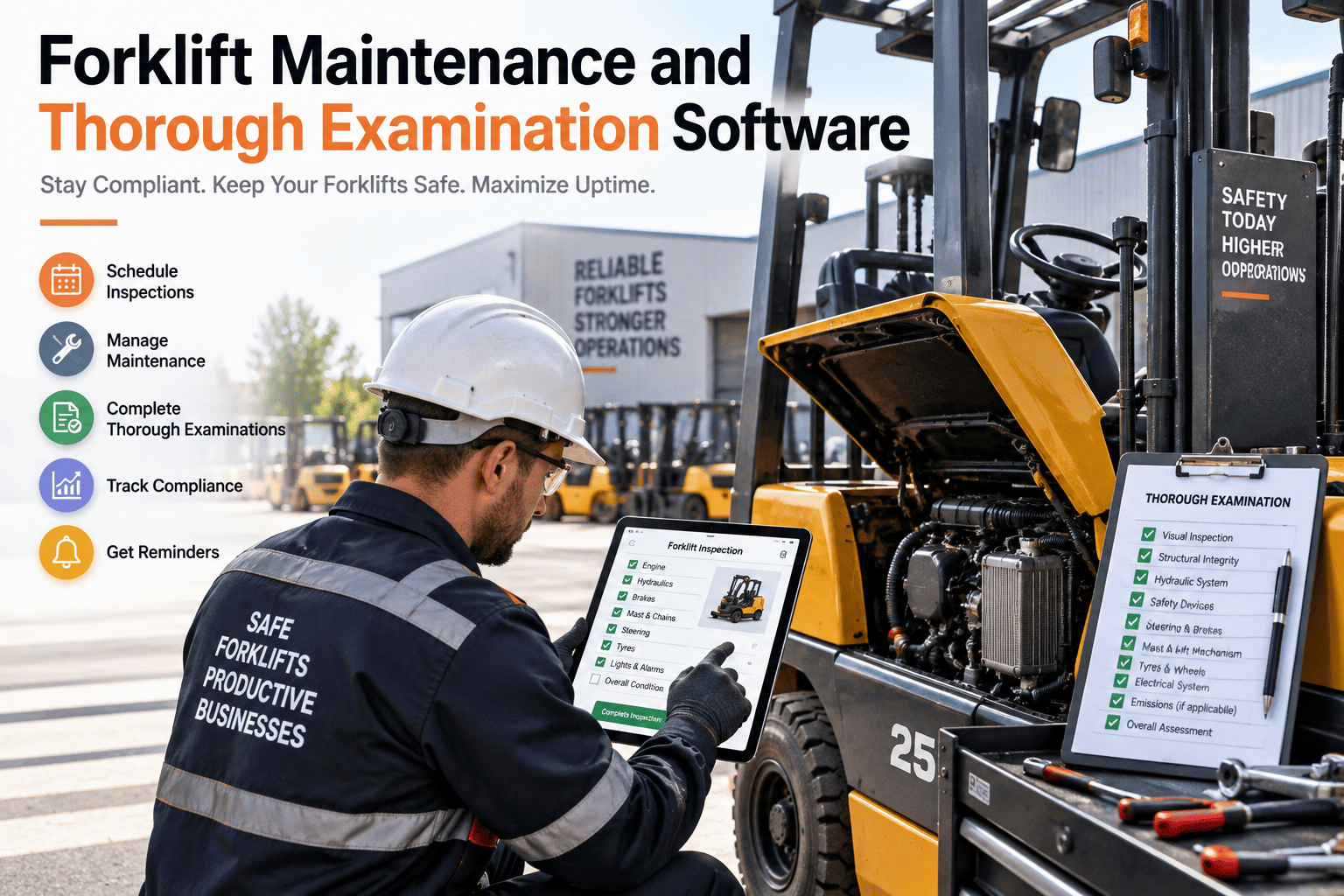
Yes. Forklifts require thorough examination under both LOLER and PUWER. LOLER applies to the lifting elements — the mast, forks, and hydraulic system. PUWER applies to the non-lifting elements — brakes, steering, tyres, and operator controls. In practice, most thorough examination contractors cover both regulations in a single inspection visit, but both records must be produced. Sign up free to track both LOLER and PUWER records per asset in OxMaint.
Can an in-house maintenance engineer conduct the LOLER thorough examination?
Only if they are sufficiently independent of those responsible for maintenance and have the required practical and theoretical knowledge. In most organisations, the engineer who maintains a piece of equipment cannot also conduct its LOLER thorough examination — the independence requirement is not met. Most UK businesses use an accredited third-party examiner such as an insurance engineer or LEEA member company. Book a demo to see how OxMaint manages contractor examination records alongside in-house records.
What is a Written Scheme of Examination and when is it needed?
A Written Scheme of Examination is a document prepared by a competent person that specifies the examination intervals for a specific piece of lifting equipment — which may be more or less frequent than the standard 6 or 12-month defaults depending on the equipment's risk profile, usage intensity, and environment. It is mandatory for complex or high-risk lifting systems and can also be used where the standard intervals are not optimal. Once a Written Scheme is in place, its intervals supersede the statutory defaults.
What happens if the HSE finds overdue LOLER examinations during a site visit?
The HSE can issue an Improvement Notice requiring examinations to be brought up to date by a set date, a Prohibition Notice stopping use of the equipment immediately, or pursue prosecution. Fines are unlimited in the Crown Court — one real example saw a business fined £90,000 for 14 overdue examination items. Company directors can face personal prosecution for gross negligence. Equipment in use with an overdue examination should be taken out of service immediately pending the examination.
.png)