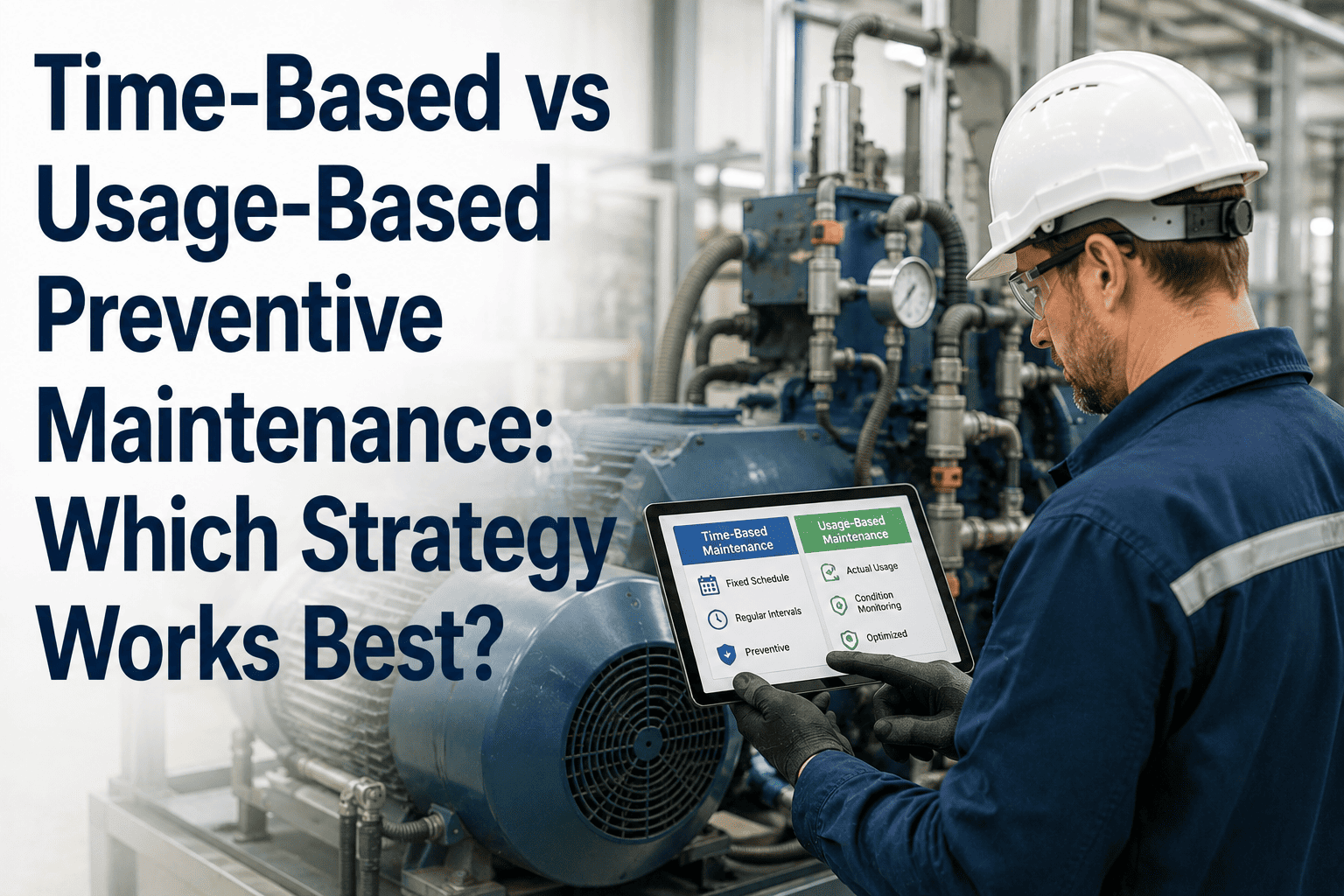
Time-Based vs Usage-Based Preventive Maintenance: Which Strategy Works Best?
By Mark strong on May 23, 2026
Every maintenance team eventually faces the same question: should you service equipment on a fixed calendar schedule, or based on how hard it has actually been working? The answer shapes your costs, your downtime exposure, and your asset lifespan. Sign up free to see how OxMaint supports both strategies in one platform, or book a demo with a maintenance specialist today.
12–18%
Cost savings from preventive maintenance vs reactive — U.S. Department of Energy
88%
of manufacturing companies use preventive maintenance as part of their strategy
66%
of facilities use a combination of preventive strategies rather than one method alone
40%
reduction in machinery repair costs possible with a structured preventive maintenance approach
What Is Time-Based Preventive Maintenance?
Time-based maintenance, also called calendar-based maintenance, schedules work at fixed intervals regardless of how much the equipment has actually been used. Every 30 days, every quarter, every six months — the trigger is the date, not the machine's workload. It is the most widely adopted starting point for businesses new to preventive maintenance, and for good reason: it is simple to plan, easy to communicate to the team, and straightforward to track. Sign up free and set your first time-based PM schedule in OxMaint today.
Time-Based Maintenance — How It Works
Real-World Example
An HVAC system is serviced every three months — filters changed, coils cleaned, refrigerant checked — whether the building has been at full occupancy or half-empty. The calendar date triggers the job, not the system's running hours.
Works Well When
Equipment usage is consistent and predictable
Seasonal maintenance tasks are required
Regulations specify fixed inspection intervals
Team is new to structured maintenance programmes
Limitations to Know
May over-maintain lightly used assets
May under-maintain heavily used assets
Does not account for workload variation
Intervals based on estimates, not actual wear
What Is Usage-Based Preventive Maintenance?
Usage-based maintenance, also called meter-based or runtime-based maintenance, triggers service when equipment reaches a defined usage threshold — operating hours, production cycles, kilometres driven, or units manufactured. The job is not due on the 1st of next month; it is due when the machine hits 500 hours. This approach aligns maintenance far more precisely with actual asset wear. Book a demo to see how OxMaint tracks usage triggers in real time.
Usage-Based Maintenance — How It Works
Real-World Example
A production line compressor requires an oil change every 1,000 operating hours. During peak season the machine runs three shifts and hits that threshold in six weeks. In the off-season it may take five months. The usage trigger ensures it is serviced at the right time in both scenarios.
Works Well When
Equipment usage fluctuates significantly by season or demand
Wear is directly tied to runtime or cycle counts
Downtime costs are high and over-maintenance wastes budget
Meters or hour-counters are already installed on assets
Limitations to Know
Harder to predict exact maintenance dates in advance
Requires meter readings to stay current and accurate
More complex to set up without the right CMMS
Not suitable for time-sensitive regulatory inspections
OxMaint Supports Both — Simultaneously
Set calendar-based and usage-based triggers on the same asset. OxMaint fires whichever comes first, so no maintenance window is missed regardless of how workload fluctuates. Sign up free and configure your first hybrid PM schedule today.
Wear is directly caused by operating hours or production cycles
Over or Under
Best Fit
Team is new to preventive maintenance and needs a simple start
Best Fit
More Complex
You want to eliminate both over-maintenance and under-maintenance
Partial
Partial
Maximum protection — trigger whichever threshold arrives first
Use Both Together — Hybrid Approach
The Hybrid Approach: Why Most Facilities Use Both
Research consistently shows that 66% of facilities use a combination of preventive maintenance strategies rather than committing to one alone. The hybrid approach sets both a calendar interval and a usage threshold on the same asset — whichever is reached first triggers the work order. This eliminates the core weakness of each individual method: calendar-only schedules miss heavy-use scenarios, and usage-only schedules cannot guarantee compliance deadlines are met. Book a demo to see how OxMaint manages hybrid triggers across your asset register.
How a Hybrid Trigger Works on a Single Asset
Calendar Trigger
Due: 90 days
Usage Trigger
Due: 500 hrs
Work order fires at whichever threshold is reached first — in this case, 500 hours at 60 days, before the calendar date arrives.
Stop Choosing Between Calendar and Usage — Run Both
OxMaint lets you configure time-based, usage-based, or hybrid triggers on every asset in your register. Work orders fire automatically. Your team gets mobile alerts. Nothing slips through. Sign up free and build your first hybrid PM schedule this week.
Fire suppression and safety systems with fixed inspection intervals
Lifting equipment under LOLER six-monthly examination rules
Pressure systems requiring PSSR written scheme compliance
Electrical systems with fixed periodic inspection requirements
Usage-Based
Best asset types
Compressors and pumps measured by operating hours
Production line machinery with cycle or unit counters
Fleet and forklift vehicles tracked by mileage or engine hours
CNC machines and cutting equipment tracked by spindle hours
Conveyor systems measured by belt distance or load cycles
How OxMaint Manages Both Strategies in One Platform
01
Register Assets with Trigger Type
Assign each asset a time-based interval, a usage threshold, or both. OxMaint stores this against the asset permanently — no need to reconfigure with each maintenance cycle.
02
Automatic Work Order Generation
When a trigger fires — calendar date arrives or meter reading is hit — OxMaint creates the work order automatically, assigns it to the right technician, and sends a mobile alert. No manual intervention needed.
03
Mobile Completion with Full Record
Technicians complete checklists, add photos, and close work orders from their phone. Every closure generates a timestamped, signed digital record — ready for HSE inspection or internal audit instantly.
04
Performance Reporting Across Both Strategies
OxMaint tracks PM completion rates, planned-to-reactive ratios, and MTBF across your full asset register — letting you compare how time-based and usage-based approaches are performing side by side.
Time-Based, Usage-Based, or Both — OxMaint Handles It All
Configure the right maintenance strategy for every asset in your register. Automated scheduling, mobile work orders, and compliance-ready records — built for maintenance teams that want to spend less time chasing jobs and more time preventing failures.
Is time-based or usage-based maintenance better for compliance with UK regulations like LOLER and PSSR?
For regulatory compliance, time-based maintenance is the required approach. LOLER mandates six-monthly thorough examinations for lifting equipment on fixed calendar intervals, and PSSR requires written schemes of examination to be followed at defined time periods. Usage-based triggers alone cannot satisfy these obligations because regulators require evidence tied to calendar dates, not runtime hours. The best approach is to apply time-based scheduling for all compliance-driven inspections and layer usage-based triggers on top for operational wear-related servicing. Sign up free to configure both in OxMaint.
Can a small maintenance team manage usage-based triggers without complex sensor infrastructure?
Yes. Usage-based maintenance does not require IoT sensors or connected machines. In most cases, technicians or operators submit meter readings manually — hour counter readings, odometer readings, or cycle counts entered into the CMMS directly. OxMaint accepts manual meter inputs from mobile devices, making usage-based scheduling accessible to small teams without any hardware investment. The key is building the habit of updating readings consistently. Book a demo to see how the meter input workflow operates.
What happens if we set both a time trigger and a usage trigger on the same asset?
This is the hybrid approach, and it is the most protective configuration available. OxMaint monitors both thresholds simultaneously and fires the work order whichever is reached first. If a machine is scheduled for quarterly servicing but hits its hour threshold at week ten, the work order is generated at week ten. If the machine sits idle and the usage threshold is never reached, the calendar date ensures it is still serviced. Neither trigger blocks the other — both remain active after each maintenance cycle resets.
How do we know which strategy to start with if we have never had a formal PM programme before?
Start with time-based scheduling. It requires no meter infrastructure, is straightforward to communicate to your team, and gives you an immediate structure where none existed before. Once you have a stable baseline — assets registered, checklists in place, schedules running — you can layer usage-based triggers onto the assets where workload variability makes calendar-only scheduling imprecise. Most maintenance teams find this phased approach the most manageable path to a mature, hybrid PM programme. Sign up free and OxMaint walks you through the setup from day one.