An invoice arrives. Someone approves it. Payment goes out. Three months later, the audit finds you paid for goods that were never delivered — or paid the same invoice twice. This is not an edge case. It is what happens when invoice approval relies on memory, email threads, and manual cross-checking instead of a structured verification process. Three-way matching is the control that closes this gap. It is one of the most effective and underused tools in maintenance and procurement operations. This guide explains exactly how it works, what it catches, and how to implement it without creating a bottleneck. Sign up free on OxMaint to connect purchase orders, goods receipts, and invoices in one system, or book a demo to see it in action.
Stop Approving Invoices Without a Verified Receipt to Match Them Against
OxMaint links every purchase order to a goods receipt and supplier invoice in one place — so your AP team matches all three automatically, catches discrepancies before payment, and builds a complete audit trail on every transaction.
What Three-Way Matching Is — In Plain Terms
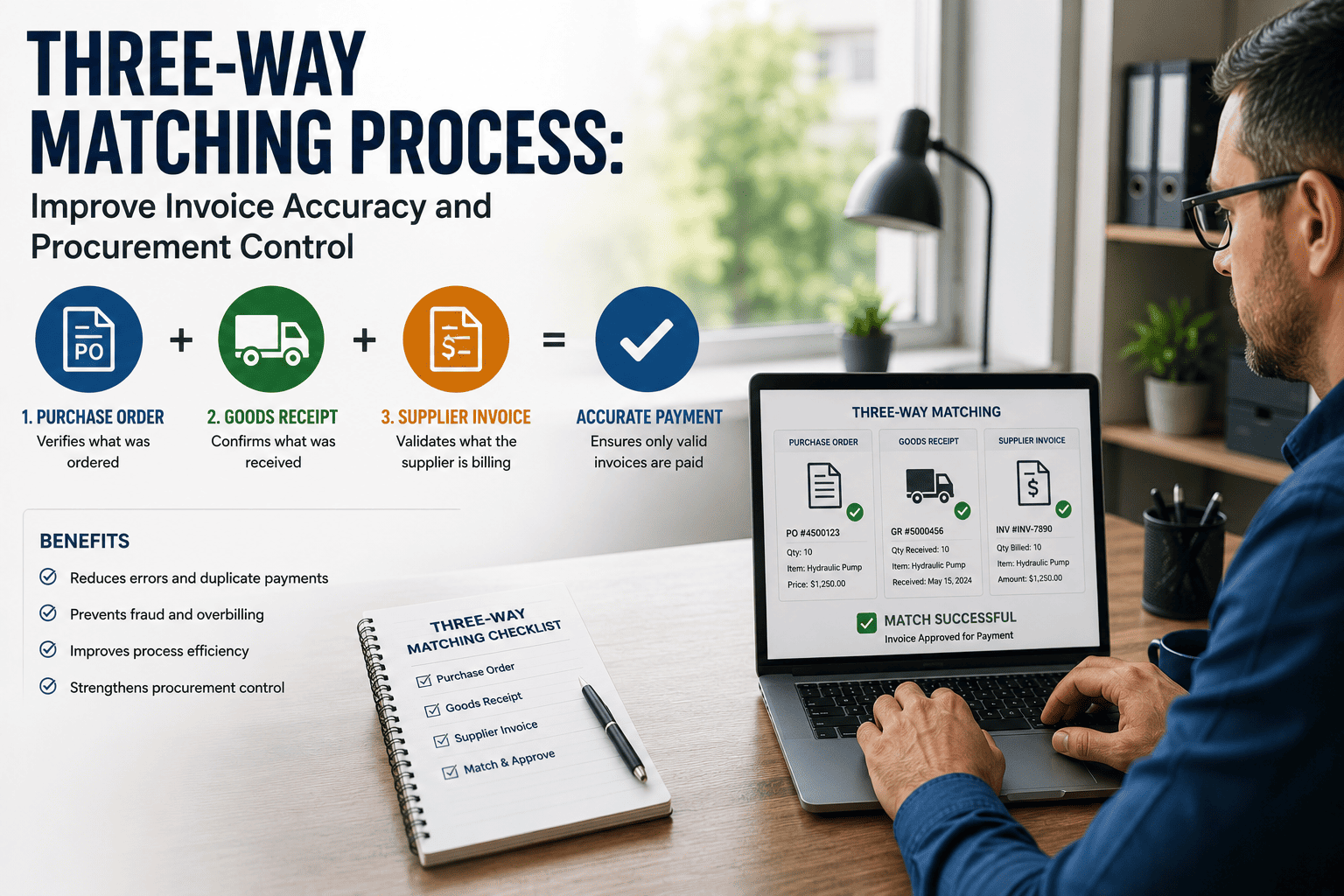
Three-way matching is an accounts payable verification process that cross-checks three documents before any supplier payment is approved. All three must agree on key details before the invoice is cleared for payment. If any one of them does not match, the invoice is flagged for review — not approved, not paid, not forgotten about.
1
Purchase Order
Created by your team when the order is placed. Defines what was authorized to be bought, at what quantity, and at what agreed price. Once accepted by the supplier, it is a binding baseline for the entire matching process.
Supplier name and details
Item descriptions and quantities
Agreed unit price and total
Delivery terms and date
→
2
Goods Receipt
Created when goods or services are delivered and accepted. Confirms what was actually received — quantities, condition, and date. This is the document that proves delivery happened before payment is released.
Items received and quantities
Date and location of receipt
Condition or acceptance notes
Receiving technician or manager sign-off
→
3
Supplier Invoice
Sent by the supplier requesting payment. Must reference the original PO number, match the quantities delivered, and charge the agreed price. Any deviation from the PO or receipt triggers a mismatch that holds the invoice.
Invoice number and date
PO reference number
Items, quantities, and unit prices
Total amount and payment terms
The matching rule: PO quantity = Receipt quantity = Invoice quantity AND PO price = Invoice price — within your defined tolerance. When all agree, payment is approved. When they do not, the invoice is held for review.
Two-Way vs. Three-Way vs. Four-Way Matching
Not every organization uses the same level of matching. Understanding the difference helps you choose the right control level for each spend category — and understand why three-way is the standard for maintenance and MRO procurement specifically.
Two-Way Match
PO + Invoice only
Low-value service invoices where delivery confirmation is impractical
Higher risk
Three-Way Match Standard
PO + Goods Receipt + Invoice
MRO parts, maintenance supplies, contractor services — any spend where receipt confirmation is achievable
Recommended
Four-Way Match
PO + Goods Receipt + Invoice + Inspection Report
High-value equipment, regulated industries, or purchases with formal quality inspection requirements
Maximum control
What Three-Way Matching Actually Catches
The most important reason to implement three-way matching is not administrative tidiness — it is the financial exposure it closes. Sign up on OxMaint to build this control into your maintenance procurement workflow from day one.
Payment for undelivered goods
A supplier invoices for 100 units. The goods receipt records 80 received. Without a three-way match, the full invoice may be approved and paid. With it, the 20-unit shortfall is caught before a single payment leaves your account.
Price discrepancies
A supplier invoices at a higher unit price than the PO specifies — sometimes due to price list changes, sometimes due to error, sometimes intentionally. The match catches the variance and holds the invoice pending resolution.
Duplicate invoices
The same invoice submitted twice — or an invoice with a reset number that duplicates a prior submission. Automated matching checks invoice numbers and PO references, preventing double-payment that manual review frequently misses at volume.
Unauthorized purchases
An invoice arrives with no corresponding PO. Without a PO to match against, the invoice cannot clear the three-way check — which surfaces the fact that someone made a purchase outside the approved process.
Billing entity and currency errors
For multi-site operations, invoices billed to the wrong entity or in the wrong currency cannot match a PO issued by a different legal entity. The mismatch is caught at matching, not discovered during consolidation months later.
Fraudulent supplier invoices
76% of organizations reported attempted or actual payment fraud in 2025. Invoice fraud — fake invoices, inflated amounts, Business Email Compromise — requires a PO that was never raised. Three-way matching structurally prevents payment without a matched PO.
Where Three-Way Matching Breaks Down in Maintenance Operations
Most invoice errors do not originate in accounts payable. They start earlier, in procurement or operations, and surface at matching. Understanding where the process fails is more useful than knowing the theory of how it should work. Book a demo to see how OxMaint keeps all three documents in one system, removing the gaps that cause matching failures.
01
PO lives in one system, receipt in another, invoice in email
The most common structural failure. When the purchase order is in the ERP, the goods receipt is a paper sign-off in the storeroom, and the invoice arrives by email, there is no automated match — just a manual cross-referencing exercise that misses things at volume and slows down every payment.
02
Emergency purchases made without a PO
A technician sources a part urgently and the invoice arrives before a PO is raised. Retroactive PO creation — "PO after the fact" — breaks the matching integrity entirely. The matching process needs the PO to exist before the purchase, not after the invoice arrives.
03
PO amendments not captured in the system
A change order is agreed verbally or by email. The invoice reflects the updated quantity or price. The system still holds the original PO. The legitimate invoice fails to match — and now AP has to manually resolve what was actually agreed, often without documentation.
04
Partial deliveries with single invoices
A supplier delivers 60 units of a 100-unit PO and invoices for 60. The goods receipt is raised for 60. But the original PO says 100. Without logic that handles partial receipts and partial invoicing, the match fails — even though the transaction is entirely legitimate.
05
Service purchases with no physical receipt
Contractor labour, preventive maintenance visits, inspection services — no physical goods are delivered, so there is no traditional goods receipt. Service confirmations, work order sign-offs, or attendance records must substitute as the "receipt" document for the three-way match to work.
Manual vs. Automated Three-Way Matching
The process is the same whether it is manual or automated. The difference is in speed, error rate, and the volume it can handle without requiring additional headcount. Sign up free on OxMaint to automate three-way matching for your maintenance purchasing from work order through to payment.
Manual Matching
AP team locates PO, receipt, and invoice separately from different systems or folders
Line-by-line comparison across printed documents or spreadsheets
Data entry errors introduced during manual comparison
5–10% of fraudulent invoices missed at volume — human reviewers do not catch everything
Processing delays cause late payment penalties and strained supplier relationships
Scales only by adding headcount — no leverage as invoice volume grows
Automated Matching
PO, receipt, and invoice captured in one system — matched automatically on arrival
98%+ match accuracy with automated systems — no manual comparison required
Exceptions flagged in real time — only discrepancies reach a human reviewer
Duplicate detection built-in — invoice numbers and PO references checked automatically
Faster approvals mean on-time payments, early payment discounts, and better supplier terms
Scales without additional headcount — 40–60% reduction in invoice exceptions
Tolerance Levels: The Practical Detail Most Guides Skip
A strict zero-tolerance matching rule produces a very high exception rate — most of which will be legitimate rounding differences, minor quantity variances, and currency conversion discrepancies rather than actual errors. Tolerance levels allow the system to auto-approve invoices that fall within an acceptable variance while flagging only genuine discrepancies.
Price variance
1–2% of unit price
Over 2% per unit or over $50 total
Hold for procurement review — confirm price change or raise dispute
Quantity variance
0% — quantities must match exactly
Any shortfall or excess vs. receipt
Hold for investigation — partial delivery or incorrect invoicing
Invoice total
Up to 1% rounding variance
Over 1% or over $100 total
Hold and request corrected invoice from supplier
Invoice date vs. receipt date
Invoice dated up to 30 days after receipt
Invoice pre-dates the receipt
Flag — invoice for goods not yet received is a control failure
Duplicate invoice number
Zero tolerance
Any duplicate reference
Automatic block — do not approve pending investigation
Implementing Three-Way Matching in Maintenance: Step by Step
The process does not have to go live across all spend categories at once. Starting with high-value and high-volume categories and expanding from there is the most practical path to full implementation without disrupting operations. Book a demo to see how OxMaint structures this rollout for maintenance teams.
1
Audit your current PO coverage
Three-way matching requires a PO to exist before the invoice arrives. Map which spend categories currently operate without POs — emergency purchases, standing orders, verbal agreements. These are the gaps that will prevent matching from working and need to be closed first.
2
Standardize goods receipt confirmation
Define who confirms receipt, when, and in what system — including for service purchases where there is no physical delivery. Work order completion, attendance sign-off, or service confirmation emails need to function as the formal receipt document that feeds the matching process.
3
Set tolerance levels before going live
Define price and quantity tolerance thresholds before the first invoice runs through the process. Setting tolerances too tight creates a high exception volume that overwhelms reviewers. Setting them too loose weakens the control. Define by category — tighter tolerances for high-value items, broader for low-value consumables.
4
Define the exception handling workflow
Every exception needs a clear routing path: who reviews it, within what timeframe, and what authority is needed to approve or reject. Predictable exception handling keeps invoices moving through the approval chain without weakening the control or creating bottlenecks that delay payment.
5
Roll out starting with highest-value categories
Begin with the spend categories where errors and fraud exposure are highest — typically MRO parts, maintenance contractors, and equipment purchases. Measure exception rates in the first 60–90 days, refine tolerances, and expand to lower-value categories once the process is stable.
The Numbers: What Three-Way Matching Delivers
76%
of organizations faced attempted or actual payment fraud in 2025 — three-way matching is the primary structural defence
40–60%
reduction in invoice exceptions when automated three-way matching replaces manual AP review
5%
of annual revenue lost to fraud on average in organizations without structured invoice verification controls
98%+
match accuracy achievable with automated three-way matching systems versus manual line-by-line comparison
How OxMaint Supports Three-Way Matching in Maintenance Operations
Three-way matching works when all three documents live in the same system. The breakdown happens when the PO is in one place, the receipt is somewhere else, and the invoice arrives by email. OxMaint connects the maintenance work order — where the purchase decision is made — to the PO, the goods receipt, and the supplier invoice in one place. Sign up free to build this control into your operation without hardware or complex setup.
PO
Purchase Orders From Work Orders
Purchase orders are raised directly from maintenance work orders — linking every PO to the job that generated it. The PO exists in the system before the supplier ships, giving the matching process a verified baseline before the invoice arrives.
GR
Goods Receipt Confirmation
Technicians confirm receipt of parts and materials from mobile — logging quantities received against the original PO at the point of delivery. Service completions are confirmed through work order sign-off, creating the receipt record that feeds the match.
MX
Invoice Matching and Exception Flagging
Supplier invoices are matched against the PO and goods receipt automatically. Quantity or price discrepancies are flagged for review before payment — not discovered during reconciliation after payment has already gone out.
AU
Full Audit Trail Per Transaction
Every purchase order, receipt confirmation, and invoice approval is logged with timestamp, user, and linked asset or work order. The complete audit trail is available for internal review, external audit, or supplier dispute resolution without manual reconstruction.
Connect Your Purchase Orders, Receipts, and Invoices in One System
OxMaint gives maintenance and finance teams the shared data foundation that makes three-way matching work — POs raised from work orders, receipts confirmed in the field, invoices matched automatically before payment. No spreadsheets. No email chains. No surprises at audit.
Frequently Asked Questions
What is three-way matching in accounts payable?
Three-way matching is an accounts payable verification process that cross-checks the purchase order, goods receipt, and supplier invoice before any payment is approved. All three documents must agree on the supplier, items, quantities, and prices — within defined tolerances — before the invoice is cleared for payment. If any one of the three documents does not match, the invoice is flagged for review and payment is held. The process protects organizations against overpayments, duplicate payments, invoice fraud, and payment for goods or services that were never actually received. Sign up on OxMaint to implement three-way matching within your maintenance purchasing workflows.
What are the three documents in a three-way match?
The three documents are the purchase order, the goods receipt or delivery confirmation, and the supplier invoice. The purchase order defines what was authorized to be purchased, at what quantity, and at what agreed price. The goods receipt confirms what was actually delivered and accepted. The supplier invoice is the billing document from the supplier requesting payment. All three must reference the same items, quantities, and prices — within tolerance — before payment is released. For service purchases where no physical goods are delivered, a work order completion record, service confirmation, or attendance sign-off typically functions as the receipt document.
What is the difference between two-way and three-way matching?
Two-way matching compares only the purchase order and the supplier invoice — it does not verify that the goods or services were actually received. Three-way matching adds the goods receipt as a third verification step, confirming delivery before payment is approved. Two-way matching is faster and works well for low-value service invoices where a physical receipt is impractical. Three-way matching is the recommended standard for any purchase where delivery confirmation is achievable — particularly MRO parts, maintenance supplies, and contractor services — because it prevents payment for undelivered goods, which two-way matching cannot catch. Book a demo to see how OxMaint handles both within one system.
Why does three-way matching fail in maintenance operations?
Three-way matching most commonly fails in maintenance operations for five reasons: the PO, goods receipt, and invoice exist in separate systems with no automated connection; emergency purchases are made without a PO before the invoice arrives; PO amendments agreed verbally or by email are not updated in the system; partial deliveries are not handled correctly by the matching logic; and service purchases have no physical receipt, so no receipt document is raised at all. Solving these failures requires either a single system that captures all three documents and links them to the originating work order, or tight integration between the systems that manage each document. When the process works correctly, automated matching achieves 98% or higher accuracy and eliminates 40–60% of invoice exceptions compared to manual review.