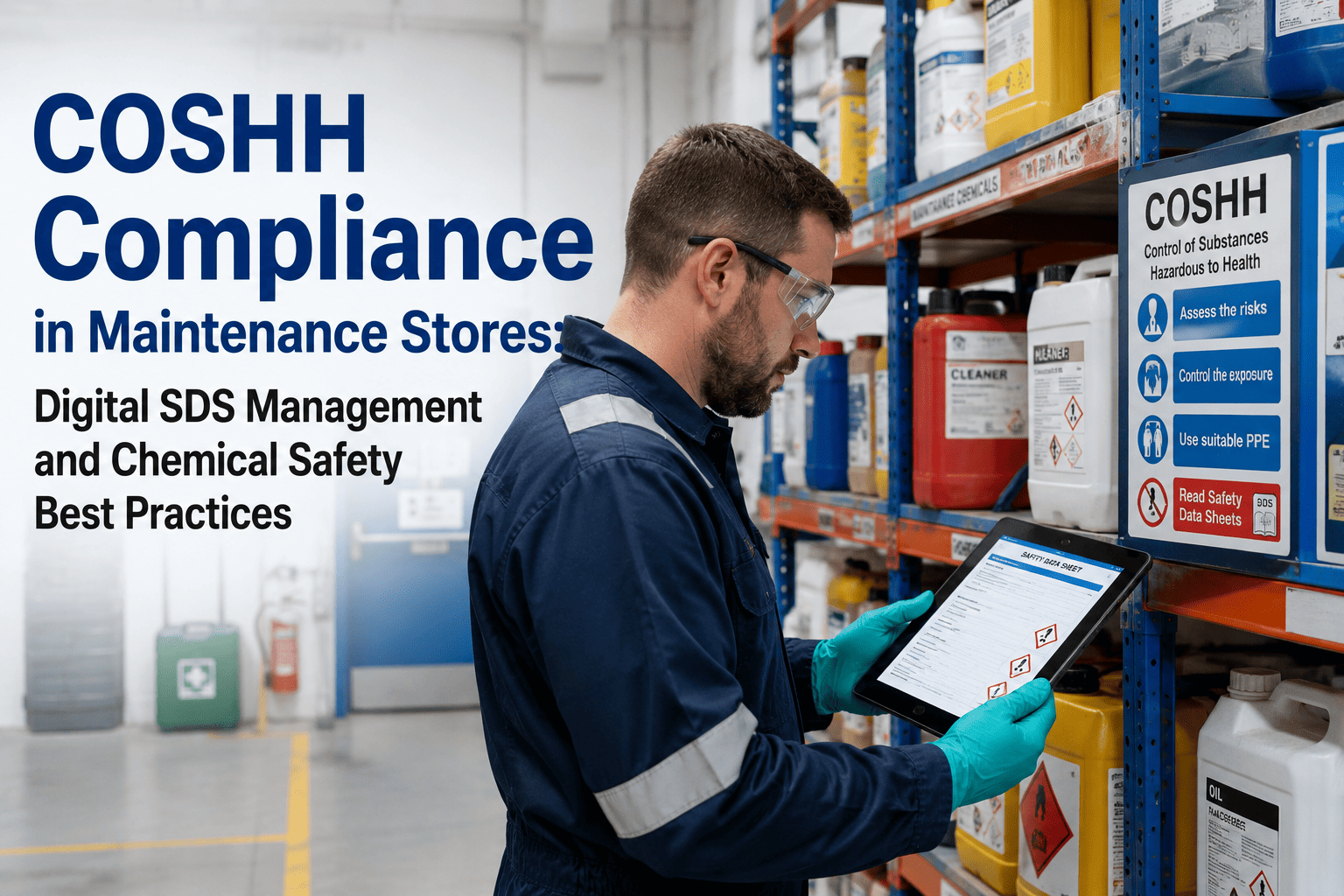
Walk into most maintenance stores and the chemical inventory tells two different stories. One is the SDS folder — sometimes a real binder, sometimes a shared drive nobody updates — supposedly covering every hazardous substance on the shelf. The other is the shelf itself: solvents, lubricants, degreasers, and adhesives that arrived long after that folder was last touched. COSHH doesn't ask for a folder. It asks for an accurate, accessible, and continuously maintained record tied to what's actually in the building. A CMMS like OxMaint keeps that chemical inventory and its safety data sheets attached to the maintenance workflow itself, so the record updates the moment the stock does.
Keep Every SDS Where the Work Actually Happens
OxMaint links your chemical inventory, safety data sheets, and COSHH assessments directly to maintenance work orders — accessible on the shop floor, not buried in a folder nobody opens.
COSHH in One Sentence: Control, Don't Just Document
The Control of Substances Hazardous to Health Regulations 2002 require employers to assess the risk from every hazardous substance on site, then prevent or control exposure — documentation is the evidence, not the goal. Yet COSHH assessments are consistently among the health and safety documents HSE inspectors find inadequate most often, usually because the paperwork has drifted away from the chemicals actually in use. Book a demo to see how OxMaint keeps the two in sync automatically.
Where Maintenance Stores Go Wrong
A maintenance store is a uniquely difficult place to keep COSHH current. Stock turns over constantly, substitute products arrive without warning when a supplier is out of stock, and the SDS that should accompany a new drum often doesn't make it past the loading bay. Sign up free and let OxMaint catch new hazardous substances the moment they're logged into inventory.
Shelf Doesn't Match File
New solvents, adhesives, or lubricants arrive and go straight into use while the SDS register stays exactly as it was last quarter.
Not Genuinely Accessible
An SDS locked in a manager's office or behind a login a technician doesn't have isn't "available" in any sense COSHH or an inspector will accept.
Stale Versions in Circulation
Suppliers revise SDSs when composition or hazard data changes, but the old printed copy often keeps circulating on the shop floor regardless.
The COSHH Assessment Sequence for Maintenance Work
Build the Substance Inventory
List every hazardous substance used, stored, or generated as a by-product — including dusts, fumes, and vapours created by the work itself, not just what arrives in a labelled drum.
Secure a Current SDS for Each One
Suppliers are legally required to provide a Safety Data Sheet for any substance classified as hazardous under CLP — confirm it's the current revision, not whatever shipped with the first order.
Assess Exposure, Not Just Hazard
Combine the SDS hazard data with how the substance is actually used on your site — mixing, application, cleanup — to judge real exposure, since an SDS alone is not a COSHH assessment.
Apply Controls in the Right Order
Eliminate the substance if possible, substitute with something less hazardous, then engineering controls, administrative controls, and PPE — in that order, never PPE alone.
Record, Train, and Review
Document the assessment in writing, train staff on the specific controls in place, and review at least annually or immediately after any new substance, process change, or incident.
SDS Retention: The Rule Most Stores Get Wrong
A current SDS must be genuinely accessible to every employee on every shift — not filed in a locked office or behind a login the shop floor can't reach.
Retain the SDS as an exposure record for 40 years from the last recorded date of use, regardless of when the product physically left the building.
Compare the new version against the old. If hazardous ingredients changed, keep both versions dated, since each covers a distinct period of employee exposure.
If a product was received but no employee was ever exposed to it, the 40-year exposure-record duty doesn't apply — but document that it was never used.
Where COSHH Sits Among the Frameworks That Touch It
| Framework | Governs | Relevant to Maintenance Stores |
|---|---|---|
| COSHH 2002 | Assessment and control of hazardous substance exposure | Core duty for every chemical used or stored on site |
| UK REACH | Registration and supply of chemical substances | Obliges suppliers to provide a current SDS on request |
| GB CLP Regulation | Classification, labelling, and packaging | Defines the hazard pictograms and statements on every label |
| RIDDOR 2013 | Reporting injuries, diseases, dangerous occurrences | Applies once a COSHH control failure causes harm |
| Control of Asbestos / Lead Regs | Substance-specific exclusions from COSHH | Govern asbestos and lead separately if encountered during work |
The Failures That Show Up First on Inspection
Treating the SDS as the Assessment
An SDS tells you what's hazardous about a substance. It doesn't replace the COSHH assessment, which has to judge how that hazard plays out in your specific workflow.
No Last-Use Date Logged
When a substance is withdrawn without a recorded last-use date, the 40-year retention clock has nothing to run from — and that gap is exactly what surfaces in a future exposure claim.
PPE as the Default Control
Reaching for gloves and a respirator before considering elimination, substitution, or engineering controls inverts the hierarchy COSHH actually requires.
Controls in Place but Not Maintained
Local exhaust ventilation and containment systems only work if they're tested and serviced on schedule — a control measure that's quietly failed is worse than no control at all.
How OxMaint Manages COSHH Inside Maintenance Workflows
Live Chemical Inventory
Every hazardous substance entering stores is logged against the inventory in real time, so the SDS register never falls behind what's actually on the shelf.
Digital SDS Register
Store current and superseded safety data sheets together, dated and version-tracked, accessible from any device on the shop floor without a login barrier.
COSHH-Linked Work Orders
Attach the relevant COSHH assessment and SDS directly to the work order for any task involving a hazardous substance, so controls travel with the job.
Retention & Review Tracking
Capture last-use dates automatically when a substance is withdrawn, and schedule review alerts so no assessment goes a year without revisiting.
Make Your COSHH Register Match Your Stores, Not Your Memory
OxMaint keeps chemical inventories, safety data sheets, and COSHH assessments connected to the actual maintenance work — current, accessible, and ready for the next inspection.
Frequently Asked Questions
Is a safety data sheet the same thing as a COSHH assessment?
No. The SDS is supplier-provided information describing a substance's hazards, handling, and storage requirements. A COSHH assessment uses that information as one input, then evaluates how the substance is actually used on your site, who's exposed, and what controls are needed. Relying on the SDS alone leaves the site-specific exposure question unanswered. Sign up free to keep both documents linked to the same asset and task record.
How long do we have to keep a safety data sheet after we stop using a substance?
Under COSHH Regulation 10, an SDS functions as an employee exposure record and must be retained for 40 years from the last recorded date of use — not from when the product was purchased or physically left the building. If the supplier issued a revised SDS due to a composition change, both versions need to be kept and dated, since each documents a distinct exposure period.
What counts as "accessible" for an SDS under COSHH?
Employees need to be able to retrieve the current SDS for any substance they're working with, on any shift, without obstacles. A paper folder works. A digital system works too, provided staff can bring it up without delay — including if the internet connection drops. An SDS locked in an office or behind credentials a technician doesn't hold isn't considered genuinely accessible. Book a demo to see how OxMaint makes SDS access part of the work order itself.
How often should a COSHH assessment be reviewed?
There's no fixed statutory interval, but Regulation 6 requires review whenever the assessment may no longer be valid — after a change in substance, process, or working method, or following an incident. HSE's Approved Code of Practice recommends reviewing at least once a year as good practice even where nothing has obviously changed.
What's the most common COSHH failure HSE inspectors find in maintenance environments?
COSHH assessments are among the most frequently inadequate documents found during inspections, and in maintenance settings the usual cause is drift: the substance inventory on the shelf has moved on while the SDS register and risk assessment haven't. New solvents, lubricants, or adhesives go into use before the paperwork catches up, leaving a gap between what's documented and what's actually present on site.