A facilities director overseeing operations in Manila, Munich, and Monterrey is not running one maintenance program three times — they are running three maintenance programs that need to look identical on a corporate dashboard and feel completely local on the shop floor. Get that balance wrong in either direction and the whole system fails: force every site into rigid corporate templates and local teams quietly route around the software, or let every site configure itself independently and corporate loses the ability to compare anything at all. A CMMS like OxMaint is built to hold both truths at once — standardized enough for global reporting, flexible enough for every site to actually run on it.
Run Global Maintenance Without Losing Local Nuance
OxMaint gives every site its own language, currency, and workflow while corporate gets one standardized view of performance across the entire portfolio.
The Central Tension in Every Global Maintenance Program
Each site needs to operate independently — creating, executing, and closing work orders in its own language and currency — while corporate needs standardized data for reporting and decision-making. Achieving both at once is the core challenge of multi-site CMMS deployment, and it is a balance, not a one-time configuration. Book a demo to see how OxMaint holds that balance without forcing a tradeoff.
- KPI definitions — MTBF, MTTR, PM compliance calculated identically everywhere
- Work order templates and PM checklists authored once, deployed everywhere
- Vendor governance and negotiated corporate procurement catalogs
- Consolidated financial reporting in one corporate currency
- Cross-site benchmarking dashboards for executive visibility
- Language of the work order interface for on-site technicians
- Local currency for transactions, parts purchases, and labor costs
- Site-specific asset hierarchy and physical location structure
- Regional compliance documentation and inspection intervals
- Day-to-day scheduling and technician assignment within the site
Four Capabilities a Global CMMS Cannot Operate Without
Dual Currency Handling
Local transactions post in the site's operating currency for accurate budgeting and audit. The same transaction automatically converts to one corporate currency for consolidated reporting — without losing the original local figure.
Language Localization
Technicians work in their own language without compromising the underlying data structure. Misunderstood instructions and inconsistent training are a direct, preventable source of maintenance errors at multilingual sites.
Fine-Grained Access Control
Not every user needs access to every site's data. Role-based permissions let a regional manager see their portfolio while a site technician sees only their own location's work orders and assets.
Site-Level Cost Centers
Treating each site as its own top-level cost center gives maintenance managers full visibility into their own performance, costs, and compliance, without losing the corporate-level rollup that finance and leadership require.
Template Governance: Build Once, Deploy Everywhere
When your best-performing site develops an excellent PM checklist for quarterly HVAC inspections, that checklist should be replicated at every site — not reinvented fifteen times at fifteen different quality levels. Sign up free and build your governance model once inside OxMaint.
Best practice identified at one high-performing site — a checklist, a PM interval, a failure code taxonomy
Standardized into a corporate template — authored once at the central level, version controlled
Deployed to every site simultaneously — no manual recreation, no quality drift between locations
Updated once at the source — every site inherits the change automatically, with no re-deployment effort
What Cross-Site Benchmarking Actually Unlocks
Benchmarking is only possible once data is standardized. The same KPIs measured consistently across every facility on comparable data make underperformance visible immediately, and best practices transferable with documented evidence rather than anecdote.
| Without Standardization | With a Standardized Multi-Site CMMS |
|---|---|
| "Site 3 says PM compliance is fine" — based on a different definition than Site 7 uses | Site 3 PM compliance is 67% against the same formula every other site uses — flagged for immediate investigation |
| Site A claims to be understaffed while Site B's actual utilization is unclear | Standardized wrench time and backlog metrics let leadership reallocate headcount on mathematical evidence |
| Expensive spare parts sit idle at one site while another expedites a duplicate order | Global parts visibility allows dynamic transfer between regional sites, cutting expedited shipping costs |
| Each site negotiates its own vendor pricing independently | All sites procure through negotiated corporate vendor catalogs, with corporate-level spend visibility |
How OxMaint Runs Global Maintenance from One Platform
Multi-Site Architecture
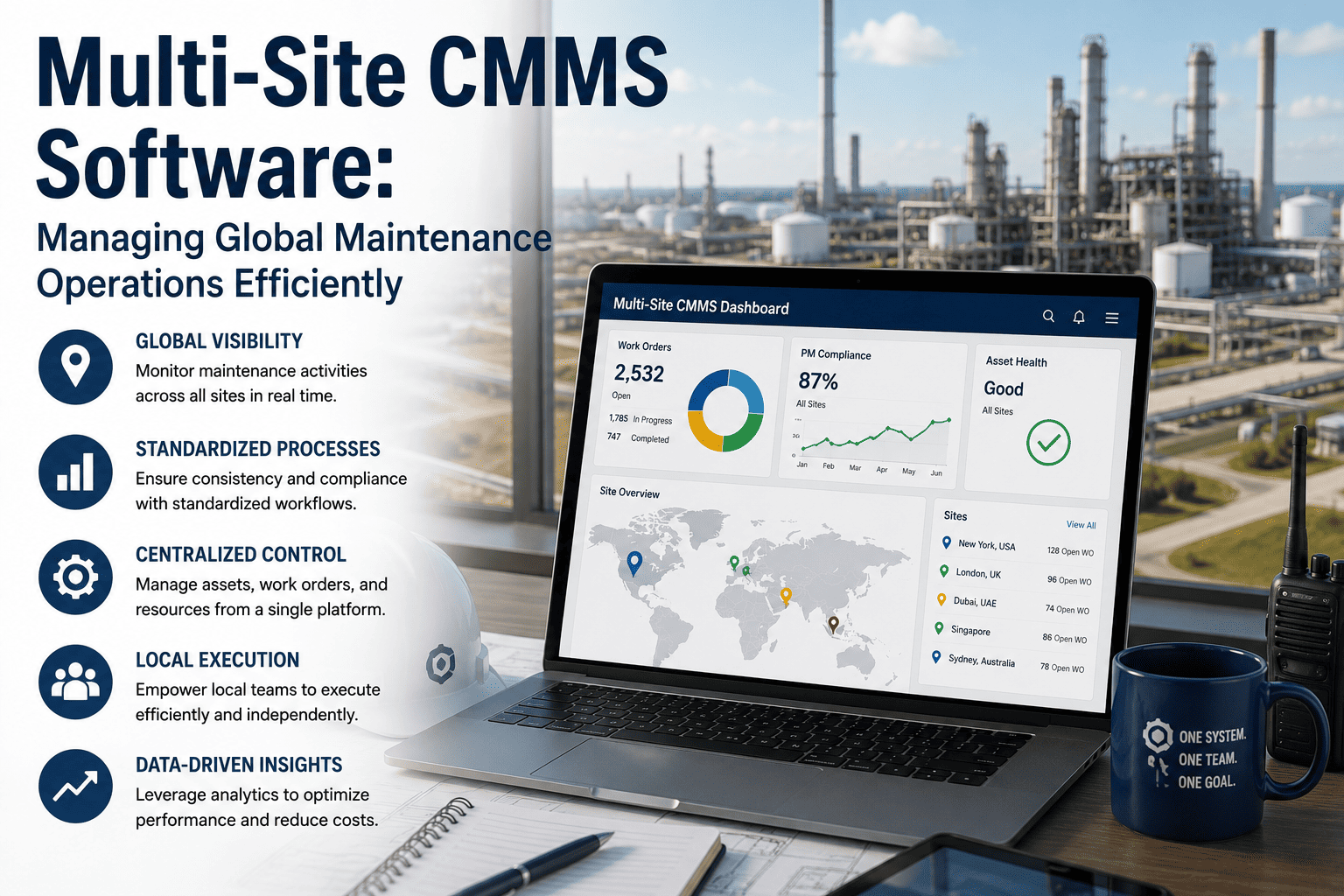
The same platform, same data structure, and same real-time dashboards scale from a single building to hundreds of facilities — no separate instance per region.
Template Governance
Author PM checklists, work order templates, and failure taxonomies once at the corporate level and push updates to every connected site automatically.
Currency & Language Support
Local technicians work in their own language and currency while corporate reporting automatically consolidates into one standardized financial view.
Cross-Site Benchmarking Dashboards
Compare any metric across any combination of sites in real time, surfacing underperformance immediately instead of waiting for a quarterly review.
Standardize Globally, Operate Locally — On One Platform
OxMaint gives every site its own language and currency while giving corporate the standardized, real-time visibility that turns maintenance into a strategic advantage instead of a reporting headache.
Frequently Asked Questions
How does a multi-site CMMS handle different currencies across global locations?
A properly built multi-site CMMS records each transaction in the site's local operating currency — preserving accurate figures for local budgeting and audit purposes — while automatically converting that same transaction into one corporate currency for consolidated financial reporting. This dual-currency approach means regional teams see numbers that make sense to them, and corporate sees one standardized rollup without manual conversion work. Sign up free to see this in action across your own sites in OxMaint.
Why does language support matter for global maintenance operations?
Without proper language localization, maintenance instructions can be misunderstood, technician training becomes inconsistent across sites, and the error rate on completed work rises as a direct result. A CMMS built for global operations allows technicians to work entirely in their local language without changing the underlying data structure that corporate uses for standardized reporting.
What is template governance and why does it matter at scale?
Template governance means PM checklists, work order templates, and failure code taxonomies are authored once at a corporate level and deployed identically to every site, rather than each location building and maintaining its own version. When a best-performing site develops a superior checklist, governance ensures it gets replicated everywhere rather than staying isolated at that one location. Updates made centrally also apply everywhere automatically, eliminating quality drift between sites. Book a demo to see how OxMaint manages template governance across a multi-site portfolio.
How much performance improvement does cross-site benchmarking actually deliver?
Organizations with mature cross-site benchmarking programs report 3 to 5% annual maintenance performance improvement that compounds year over year, since the same standardized KPIs applied consistently across every facility make underperforming sites visible immediately and allow best practices to transfer with documented evidence rather than anecdote. Some workflow optimization initiatives on unified multi-site platforms report PM compliance gains as high as 27%.
Should every site have its own independent CMMS instance?
No — running separate instances per site or region recreates the exact siloed, fragmented data problem a multi-site CMMS is meant to solve. The better approach is one platform with the same underlying data structure across every location, with role-based access control and local-language, local-currency support layered on top so each site still operates with full local autonomy day to day.