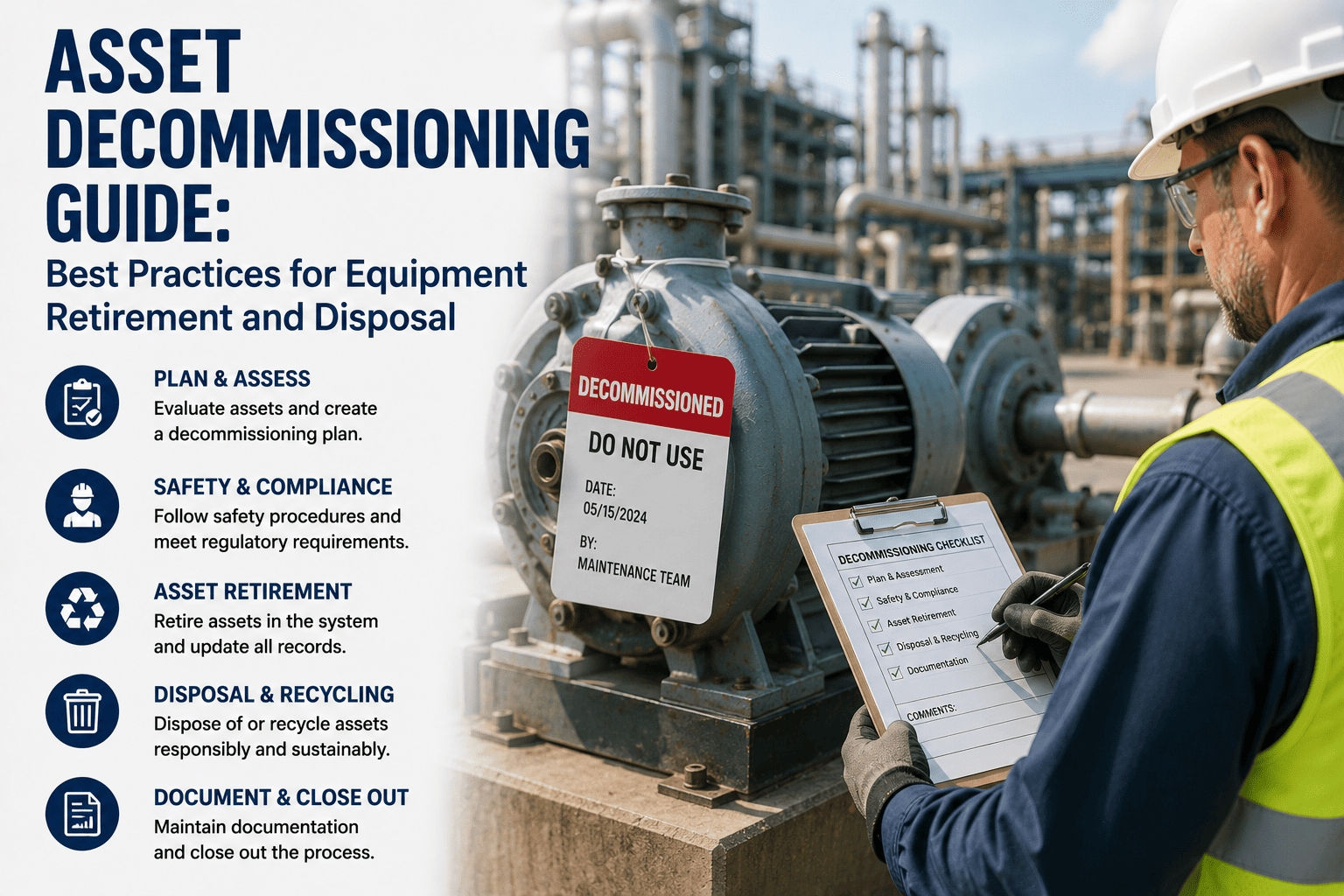
Equipment rarely announces that it's done. A machine doesn't fail catastrophically on a Tuesday and get retired on a Wednesday — it drifts. Repair costs creep up, downtime gets a little more frequent, and at some point someone just stops scheduling it for PM. Without a formal decommissioning process, that asset enters a gray zone: powered down or moved to a storeroom, but still sitting in the register as active, still depreciating, still occasionally getting worked on by someone who doesn't realize it was abandoned. A CMMS like OxMaint makes decommissioning a traceable, documented workflow instead of an informal drift that quietly corrupts your asset register.
Retire Equipment the Way Auditors Expect, Not the Way It Usually Happens
OxMaint turns decommissioning into a documented workflow — decision, shutdown, disposal routing, and register closure all tracked against the asset, with nothing left to informal drift.
Decommissioning Is a Process, Not an Event
Disposal is one step inside the larger decommissioning workflow — not a synonym for the whole thing. Scrapping equipment without going through the full process is how teams end up with hazardous waste violations, missing spare parts, and phantom assets still appearing on maintenance schedules months after they physically left the building. Book a demo to see how OxMaint keeps every stage connected to the original asset record.
When to Pull the Trigger: The Repair-to-Replace Threshold
The hardest part of decommissioning isn't the physical removal — it's knowing when to start. The most common benchmark is the repair-to-replace ratio: if annual maintenance spend on a single asset approaches 50% of its replacement value, retirement deserves serious consideration. Some teams use a tighter 30% threshold for critical production equipment, where downtime costs make ongoing failures far more expensive than the repair invoice alone suggests. Sign up free and let OxMaint track this ratio automatically from your existing work order cost history.
Financial Signal
Repair costs approaching 30–50% of replacement value, or a pattern of escalating part costs as the asset ages out of OEM support.
Operational Signal
Increasing frequency of unplanned downtime, or the asset no longer meeting current production or performance requirements.
Safety Signal
Structural degradation, obsolete safety systems, or a regulatory compliance gap that cannot be cost-effectively remediated.
The Decommissioning Sequence
Formalize the Decision
Document the retirement decision with an approver and a stated reason, even for low-value equipment. Informal retirement is the single largest cause of register inaccuracy.
Lockout/Tagout & De-Energize
Disconnect and de-energize the equipment following proper LOTO procedures before any physical work begins — this is the step that protects workers from electrical hazards and accidental startup.
Data Sanitization (IT & Embedded Systems)
For any asset with onboard data storage — servers, controllers, POS terminals — perform certified data destruction before physical removal. A decommissioned device that hasn't been sanitized remains a live security risk.
Hazardous Material Segregation
Identify and separately handle refrigerants, hydraulic fluids, batteries, and chemical residues. Never pour fluids into drains or general waste — that creates environmental liability that follows the organization for years.
Condition Assessment & Parts Salvage
Document the asset's final condition. Compare salvageable parts against the active fleet — interchangeable components go back into spares inventory; the rest go to buy-back programs or certified disposal.
Route to Final Disposition
Direct the asset to the appropriate end-of-life path — resale, donation, certified recycling, or scrap — and obtain documentation proving the method used.
Close the Register Record
Update the asset status to decommissioned, recording the date, reason, approver, and disposal reference. The record is not closed until every prior step has a logged completion.
Where Should This Asset Actually Go?
Functional equipment under 5 years old in good condition, where 15–25% of original value is commonly recoverable through dealer or marketplace channels.
Non-functional or obsolete equipment containing recoverable materials — precious metals, copper — processed through accredited recyclers rather than general scrap.
Any device that ever held data — servers, terminals, networked controllers — requiring verifiable destruction and a chain-of-custody certificate before leaving the building.
Refrigerants, oils, and chemical residues requiring certified handlers under RCRA, EPA Section 608, or applicable state environmental regulations.
Reserved for irreparable, non-hazardous items with no recovery or recycling pathway remaining — and still requires documentation of the decision.
Regulatory Frameworks That Commonly Apply
| Framework | Governs | Applies To |
|---|---|---|
| EPA RCRA | Hazardous waste generated during removal | Industrial equipment, chemical residues |
| EPA Section 608 | Refrigerant recovery and handling | HVAC, refrigeration, chillers |
| OSHA 1910.120 | Hazardous waste site worker safety | Decommissioning crews handling regulated materials |
| WEEE Directive / State E-Waste Laws | Electronic waste handling and reporting | IT hardware, electronics, networked devices |
| NAID AAA / R2v3 / e-Stewards | Data destruction and responsible recycling certification | ITAD vendor selection and verification |
The Most Common Mistakes — and Why They're Expensive
No Formal Decommissioning Decision
Assets drift into informal retirement — powered down but never closed out. They keep depreciating, keep appearing on PM schedules nobody completes, and keep showing up as "expected but absent" during physical audits.
Skipping Data Sanitization
Deleting files or reformatting a drive is not the same as certified destruction. Traces of sensitive data can remain recoverable long after a device leaves the building.
Improper Hazardous Material Disposal
Pouring hydraulic fluid or refrigerant into general waste creates environmental liability that can surface years later, regardless of how routine it felt at the time.
No Documentation Trail
Without certificates of destruction, weight receipts, and a closed register entry, there's no way to prove compliant disposal if a regulator or auditor ever asks.
How OxMaint Manages the Decommissioning Workflow
Structured Decommissioning Workflow
Route every retirement decision through a defined approval and documentation sequence, so no asset slips into informal retirement without a closed record.
Repair-to-Replace Tracking
Automatically calculate cumulative repair spend against replacement value per asset, flagging candidates for retirement before the next emergency repair makes the decision for you.
Parts Salvage Cross-Reference
Compare a retiring asset's components against your active fleet automatically, routing interchangeable parts straight back into spares inventory instead of letting them get scrapped.
Disposal Documentation & Audit Trail
Attach certificates of destruction, disposal references, and approver sign-off directly to the closed asset record — the documentation trail regulators and auditors actually look for.
Stop Letting Retired Equipment Haunt Your Asset Register
OxMaint turns every decommissioning into a traceable, compliant workflow — from the retirement decision to the final disposal certificate, all tied to the original asset record.
Frequently Asked Questions
What is the difference between asset decommissioning and asset disposal?
Decommissioning is the full process of retiring an asset from active service — covering the retirement decision, safe shutdown, data sanitization, hazardous material handling, and documentation. Disposal is just one step inside that larger process: the final routing of the asset to resale, recycling, donation, or scrap. Treating disposal as a synonym for the whole process is how teams end up with compliance gaps, since the steps before disposal — like LOTO procedures and data wiping — get skipped. Sign up free to manage the full workflow, not just the final disposal step, in OxMaint.
How do I know when an asset should be retired instead of repaired?
The most widely used benchmark is the repair-to-replace ratio: when annual maintenance spend on a single asset approaches 30 to 50% of its replacement value, retirement becomes the more cost-effective path. Critical production equipment, where unplanned downtime carries a high cost, often warrants the tighter 30% threshold, while less critical assets may reasonably run closer to the 50% mark before retirement makes financial sense.
What happens if data isn't properly destroyed before disposing of IT equipment?
Simply deleting files or reformatting a drive does not guarantee the data is unrecoverable — traces of sensitive information can remain accessible to anyone who acquires the device afterward. This creates direct data breach exposure and regulatory risk under frameworks like GDPR and HIPAA. Certified data sanitization, verified through a certificate of destruction from a NAID AAA-accredited provider, is the standard practice for closing that risk completely. Book a demo to see how OxMaint tracks sanitization certificates against decommissioned assets.
Can a company recover any value from equipment it's decommissioning?
Yes, often more than expected. Well-maintained equipment under five years old in good working condition can commonly recover 15 to 25% of its original purchase price through resale, OEM buy-back programs, or specialized equipment dealers. Components that don't have direct resale value but remain compatible with active equipment can be salvaged into spare parts inventory instead, avoiding a future purchase entirely.
Why do decommissioned assets often remain on the asset register as active?
Without a formal decommissioning process, equipment that's powered down, moved to storage, or handed back to a vendor frequently never gets a closing entry in the register. It continues depreciating, occupies insurance schedules, and shows up as an "expected but absent" discrepancy during physical verification audits — a problem commonly called a ghost asset. Closing the register record is the final, often-skipped step that prevents this drift.