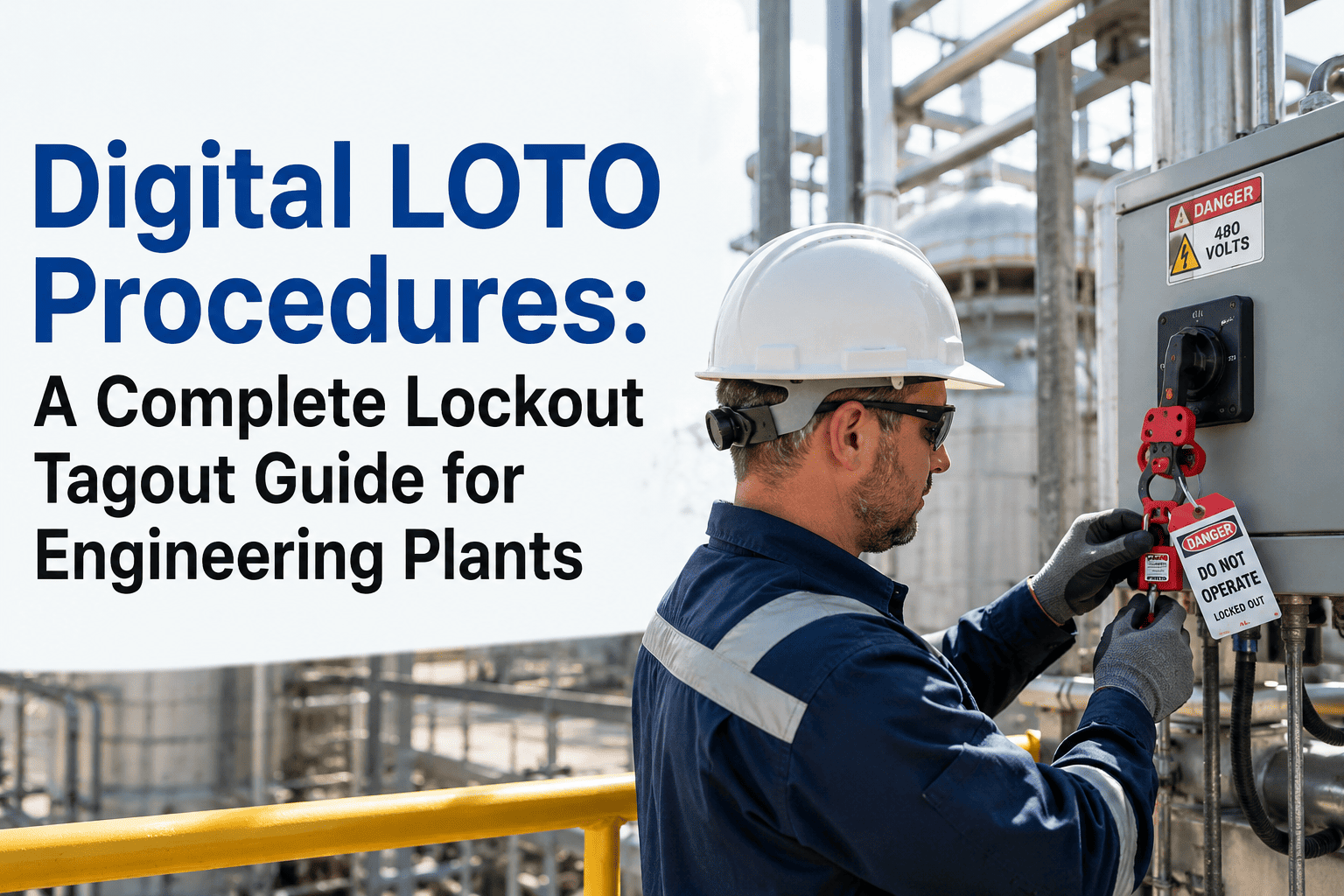
Every year, workers are killed or permanently disabled by equipment that was assumed to be safely shut down. LOTO failures account for approximately 10% of all serious industrial accidents — roughly 50,000 injuries and 120 fatalities annually. The mechanism is nearly always the same: a procedure was skipped, a step was done from memory, a shift changed without a proper handover, or an isolation point was added during a modification and not reflected in a paper procedure that was last updated three years ago. Digital LOTO procedures eliminate the failure modes that paper cannot — sequential step enforcement, real-time lock tracking, automatic procedure updates when equipment changes, and an audit trail that exists at every inspection point. This guide covers the complete LOTO framework for site engineers, from hazardous energy types through group lockout coordination and the specific compliance requirements that enforcement bodies check first. Sign up free on OxMaint to digitise your LOTO procedures, or book a demo to see how digital LOTO enforcement works in an engineering plant environment.
Machine-Specific LOTO Procedures, Digital Lock Tracking, and Audit-Ready Records — In One System
OxMaint enforces the full LOTO sequence digitally — technicians cannot skip steps, locks are tracked to named employees in real time, group handover is documented, and every isolation event generates the complete audit trail your inspection authority expects.
Hazardous Energy Types: What LOTO Must Control
LOTO applies to every form of hazardous energy — not only electrical. A common and dangerous misconception is that switching off the main isolator is sufficient. In most engineering plant environments, a single piece of equipment may have three, five, or more distinct energy sources requiring separate isolation and verification. Every energy source must be identified, isolated, and verified before any work begins. Sign up on OxMaint to build machine-specific LOTO procedures that document every isolation point for every asset.
Electrical
Service panels, motor control centres, capacitors that retain charge after isolation, variable speed drives with internal capacitance, and control circuit power supplies
Electrocution, arc flash, arc blast
Disconnect switch, circuit breaker, plug removal + lockable hasp
Mechanical
Rotating components, flywheels, springs under tension, gravity-driven assemblies (raised presses, suspended loads), counterweights, and stored kinetic energy in any moving part
Crush, amputation, caught-in injuries
Mechanical blocks, prop rods, spring tension release, gravity blocks
Hydraulic
Fluid under pressure in cylinders, accumulators, hoses, and manifolds — hydraulic accumulators in particular retain dangerous stored energy even after pump isolation
Injection injury, crush from unexpected cylinder movement
Hydraulic valve lockout, accumulator bleed-down, line blocking
Pneumatic
Compressed air systems, pneumatic actuators, air receivers, and any system with stored air pressure that can cause unexpected movement on release
Unexpected actuator movement, projectile from pressure release
Ball valve lockout, pressure gauge verification to zero, bleed ports
Thermal
Steam lines, hot water systems, heat transfer circuits, and cryogenic systems — thermal energy that persists after process isolation and requires time-based verification before work can begin
Scalding, burns, cold contact injury
Steam valve lockout, temperature verification, cool-down period
Chemical
Process lines containing acids, alkalis, solvents, or any hazardous substance where residual pressure or volume can cause exposure during maintenance access
Chemical burns, toxic exposure, fire
Valve lockout, line blinding, drain and purge verification
Every machine-specific LOTO procedure must identify ALL energy sources present — not just the most obvious one. Equipment modifications frequently add new energy sources that are not reflected in existing paper procedures. This is one of the primary causes of LOTO-related fatalities: the worker isolated the energy sources they knew about.
LOTO Roles: Authorised vs. Affected vs. Other Employees
LOTO compliance requires three distinct employee categories, each with different training requirements, different responsibilities, and different documentation needs. Conflating these categories — training all employees the same way, or failing to distinguish who is authorised versus affected — is one of the most commonly cited audit findings. Book a demo to see how OxMaint tracks authorisation status per employee, per machine.
Authorised
Technicians and engineers who physically perform the lockout — they apply and remove locks and tags on energy isolating devices
Identify all energy sources, perform isolation, apply personal lock, verify zero energy, perform work, restore energy in reverse sequence
Machine-specific training for every piece of equipment they are authorised to lock out. Annual retraining or after any procedural change.
Affected
Operators and other workers who normally operate the equipment — they are affected by the LOTO because the machine will be stopped and inaccessible
Not to attempt to start, energise, or use equipment under lockout. Must understand and recognise LOTO devices. Must not remove another person's lock under any circumstances.
Training on purpose of LOTO, how to recognise LOTO devices, and their specific prohibition during any lockout period.
Other
All other personnel who work in an area where LOTO is used — they are not directly involved but may be in proximity to locked-out equipment
Must not interfere with, attempt to bypass, or remove any LOTO device. Must understand that locked-out equipment may not be operated.
Awareness-level training: what LOTO devices look like, what they mean, and the prohibition on interference.
The 8-Step LOTO Procedure: Sequence Is Non-Negotiable
LOTO has a defined sequence. Skipping or reordering steps is not a shortcut — it is the mechanism by which workers are killed. The sequence must be followed in order, every time, for every machine. Digital LOTO enforcement prevents technicians from proceeding to the next step until the current step is verified and documented — which paper procedures cannot do. Sign up free on OxMaint to enforce this sequence digitally from mobile devices at the point of isolation.
1
Review the machine-specific procedure
Check the machine-specific LOTO procedure (MSLP) before beginning — never rely on memory. The procedure must identify all energy sources, all isolation points, and all verification steps for this specific machine. If the procedure does not exist or is not current, work cannot begin.
Common failure: No machine-specific procedure exists — workers rely on memory or a generic checklist. Memory is reliable until equipment is modified and the worker does not know the new energy source exists.
2
Notify all affected employees
Inform all operators and personnel who work near the equipment that maintenance is beginning, the machine will be shut down, and LOTO will be applied. Notification must reach everyone — including workers arriving on the next shift if work will continue.
Common failure: Verbal notification that does not reach the next shift. An operator on break is not told. Shift changes mid-lockout with no documented handover — incoming crew does not know LOTO is active on the system.
3
Shut down the machine using normal stopping procedure
Power down the machine using its normal stopping procedure — press the stop button, use the software interface, close the process valve in the correct sequence. This is an orderly shutdown to prevent equipment damage — it is not the isolation step. The machine still has hazardous energy at this point.
Common failure: Workers treat the stop button as the isolation — proceeding to work on a machine that is stopped but not isolated. Control circuits are not energy isolating devices.
4
Isolate ALL energy sources
Physically manipulate every Energy Isolation Device (EID) for every energy source identified in the machine-specific procedure. This means the main electrical disconnect, all hydraulic and pneumatic valves, all process line valves, and any other source. Control circuits — push buttons, selector switches, PLCs — are not energy isolating devices and must not substitute for isolation at the main supply.
Common failure: Only the electrical isolator is operated. Hydraulic accumulators, pneumatic pressure in actuators, and stored mechanical energy are not addressed — equipment moves unexpectedly when accessed.
5
Apply personal lockout and tagout devices
Each authorised employee applies their own personal padlock to every isolation device. Where multiple workers are involved, each applies their own lock to a hasp or group lockbox — no worker shares a lock or allows a supervisor to hold the key. Tags must display the employee name, date, and reason — tags supplement locks, they do not substitute for them.
Common failure: A single supervisor's lock is applied for a whole crew. If the supervisor leaves the site, the lock cannot be removed by others — or worse, it is removed and the remaining workers are unprotected.
6
Release or restrain all residual / stored energy
Release or restrain all residual stored energy: bleed down hydraulic accumulators to zero pressure, release mechanical spring tension, block or support gravity-loaded components, drain and purge process lines, allow thermal systems to reach safe temperature, and discharge capacitors. Verify that energy has been released — do not assume.
Common failure: Accumulators are not bled down. Springs are not released. Suspended loads are not blocked. Workers assume isolation is sufficient — residual energy releases when the system is accessed.
7
Verify zero energy state — test before touch
Verify that the equipment is completely de-energised before any work begins. Attempt to start the equipment using its normal operating controls — the machine must not respond. For electrical systems, use a calibrated test instrument to confirm zero voltage at the point of work. For pressure systems, confirm pressure gauges read zero. Document the verification — this step must be recorded, not assumed.
Common failure: This step is omitted because the technician watched the isolation happen and assumes it was effective. Verification catches incomplete isolation — assumptions do not.
8
Restore energy — in reverse sequence, with full notification
When work is complete: remove all tools and materials from the work area, confirm all workers are clear of the hazard zone, remove LOTO devices in reverse isolation sequence, notify affected employees before re-energisation, and restore energy. Each authorised employee removes only their own lock — only the person who applied a lock can remove it, with one narrowly defined exception requiring supervisor authorisation and documentation.
Common failure: Re-energisation before confirming all workers are clear. A lock is removed by someone other than the person who applied it, without following the documented emergency removal procedure.
Group Lockout: The Highest-Risk LOTO Scenario
Group LOTO — where multiple authorised employees work on the same isolated machine simultaneously, or across shifts — requires an additional layer of coordination that paper-based systems cannot reliably manage. Shift changes during an active group LOTO are one of the most documented causes of serious LOTO incidents in engineering plants. Sign up on OxMaint to manage group LOTO coordination and shift handover digitally.
How Group LOTO Works
01
A primary authorised employee is designated with overall responsibility for the group LOTO — they apply the first lock and coordinate the process
02
Each authorised employee in the group applies their own personal lock to a group lockbox or multi-hasp device — the machine cannot be re-energised until every individual lock is removed
03
Only the person who applied a lock may remove it — no supervisor may remove another worker's lock except under a documented emergency removal procedure
04
Shift changes require a documented handover — the off-going employee removes their lock only after the on-coming employee has applied theirs. There must be no gap in lockout protection during the handover period
The Shift Change Risk
Paper LOTO
Verbal briefing from outgoing shift. Incoming crew reviews paper log in control room. Active lock status requires physically walking to every isolation point. Communication gaps mean incoming workers may not know every lock that is active or which workers are still in the hazard zone.
Digital LOTO
Real-time dashboard shows every active lock, which employee applied it, which work order it is linked to, and how long it has been active. Incoming shift receives automated notification with full lock status. Handover requires digital sign-off by incoming supervisor before outgoing locks are removed.
Paper LOTO vs. Digital LOTO: Where the Failures Happen
Paper LOTO procedures are not inherently non-compliant — but they have structural failure modes that digital systems eliminate by design. Understanding where paper fails is the basis for understanding what digital LOTO is for. Book a demo to see how OxMaint eliminates each paper failure mode in a live engineering plant environment.
Procedure not current after equipment modification
Printed binder may not be updated for weeks or months after a change. Worker follows the old procedure and misses the new energy source.
Procedure updated in the system immediately. Every worker accessing it on mobile sees the current version. Old versions are archived, not in circulation.
Worker skips a step or works from memory
Paper procedure is available in the control room. Worker at the isolation point relies on memory. Steps are skipped, reordered, or combined.
Mobile device shows the current procedure at the isolation point. Sequential step enforcement prevents progression until each step is confirmed. Cannot skip or reorder steps.
No real-time visibility of active lockouts
Active lock status requires physically walking to every isolation point on the equipment. Nobody in the control room or office knows how many locks are active without going on site.
Live dashboard shows every active lock on every machine across the plant — employee name, time applied, work order reference, and estimated completion. Visible from any device.
Shift change communication gap
Verbal briefing plus paper log review. Incoming shift may not know which workers are still in the hazard zone or which lockouts are active across the full plant.
Automated notification to all incoming shift personnel. Handover requires digital acceptance before outgoing locks can be transferred. No gap in lockout protection during shift change.
Audit trail missing or incomplete
Paper permits may be unsigned, incomplete, or unfiled. Producing LOTO records for a specific machine for the last 12 months during an inspection requires manual searching through physical files.
Every LOTO event is automatically recorded with employee, timestamp, machine, steps completed, and verification result. Filterable by machine, date, or employee within seconds during inspection.
Compliance Requirements: What Enforcement Bodies Check
LOTO consistently ranks in the top-ten most cited safety standards by OSHA. Enforcement under UK regulations (PUWER, Electricity at Work Regulations, and HSE safe isolation guidance) carries equivalent expectations. Understanding what inspectors and auditors check is essential for both compliance and for structuring your LOTO programme. Sign up free on OxMaint to maintain all required LOTO compliance documentation in one system.
MS
Machine-Specific Procedures
Required: A written, machine-specific LOTO procedure for every piece of equipment where workers may be exposed to hazardous energy during maintenance. Generic checklists are not compliant. Each procedure must document all energy sources, isolation devices, magnitudes, and verification steps for that specific machine.
Inspectors ask: Show me the LOTO procedure for this machine — the one your technician actually used today.
TR
Employee Training Records
Required: Documented training for each worker per their role (authorised, affected, other). Authorised employees must be trained specifically on each machine they are permitted to lock out. Annual retraining or retraining after any procedural or equipment change must be documented with dates, trainer, and content covered.
Inspectors ask: Which employees are authorised to lock out this machine? Show me their training records.
AI
Annual Programme Audit
Required: Each LOTO procedure must be audited at least annually by an authorised employee who is not the person using the procedure being inspected — requiring at least two competent authorised persons present. The audit must confirm that procedure steps are being followed and must be documented with machine ID, date, inspector name, and employees audited.
Inspectors ask: When was this procedure last audited? Who conducted the audit? Show me the audit record.
AT
LOTO Event Audit Trail
Required: Records of each LOTO event sufficient to demonstrate that the procedure was followed. Records must show which machine, which employee, which steps were completed, and the verification result. For group LOTO, records must show each employee who applied and removed a lock. These records must be producible on demand.
Inspectors ask: Show me all LOTO events on this machine in the last 12 months. Were there any incomplete isolations or emergency removals?
10%
of all serious industrial accidents involve LOTO failures — OSHA
50,000
injuries per year attributable to inadequate hazardous energy control
$161,323
maximum penalty per willful or repeat LOTO violation (OSHA 2026)
Top 10
LOTO cited annually in OSHA's most-violated standards — every year without exception
Implementing Digital LOTO: A Practical Rollout for Engineering Plants
Transitioning from paper to digital LOTO is a phased process — not a system cutover. Starting with the highest-risk, most complex machines and running parallel systems during the validation period produces a compliant, trusted digital programme rather than a rushed deployment that your technicians work around. Book a demo to see how OxMaint structures this rollout for engineering plants.
Phase 1
Energy source audit and procedure writing
Walk every machine and document all energy sources — electrical, hydraulic, pneumatic, thermal, mechanical, chemical. Write or update machine-specific LOTO procedures for each. Photograph every isolation point with its location on the machine. This is the foundation — digital enforcement is only as good as the procedure it enforces.
→
Phase 2
Pilot on highest-risk machines
Deploy digital LOTO on your highest-complexity, highest-risk machines first — typically those with multiple energy types, the highest consequence of failure, or the most frequent LOTO events. Run digital and paper in parallel for 30 days. Validate that the digital procedure matches the physical isolation sequence before retiring paper.
→
Phase 3
Train all authorised employees on mobile workflow
Train all authorised employees to use the mobile LOTO workflow at the isolation point. Training must include: how to access the machine-specific procedure on device, how to confirm each step, how to record the zero-energy verification, and how to complete the group handover process. Document all training with date and attendees.
→
Phase 4
Integrate with permit-to-work and work orders
Link LOTO procedures to the work orders and permits that require them. A maintenance work order on an isolated machine should automatically trigger the LOTO workflow — not depend on the technician remembering to initiate it. Permit-to-work sign-off should confirm LOTO is active before authorising entry to the work area.
→
Phase 5
Expand to all machines and retire paper
Roll out to the full machine inventory. Once every machine has a validated digital procedure, retire paper LOTO binders — keeping them available only as a backup in the event of a system outage, not as a parallel process. Schedule annual procedure audits in the system and confirm inspection readiness is continuous, not event-driven.
How OxMaint Supports Digital LOTO in Engineering Plants
OxMaint connects LOTO procedures directly to your assets, work orders, and maintenance team — giving site engineers real-time lockout visibility, sequential step enforcement, and the compliance documentation that protects your workers at every maintenance event and withstands inspection scrutiny at every audit. Sign up free to start building your digital LOTO programme today.
MS
Machine-Specific Digital Procedures
Every LOTO procedure is stored against the specific asset it applies to — with isolation point photos, energy source documentation, and step-by-step verification requirements. When equipment is modified, the procedure is updated once and every technician instantly sees the current version on their mobile device.
SE
Sequential Step Enforcement
The digital workflow enforces the LOTO sequence — technicians cannot mark a step complete without confirming it, cannot proceed to the next step without completing the current one, and cannot skip verification. The procedure becomes the system, not a document that depends on memory and discipline.
LT
Real-Time Lock Tracking
Every active lock is logged to a named employee, a specific work order, and a timestamp. Managers and supervisors see live lock status across the entire plant — including group LOTO handover status during shift changes — without walking to every isolation point.
AU
Compliance Audit Trail
Every LOTO event generates a complete record: machine, employee, procedure version, steps completed, verification result, lock application and removal times. Annual programme audit records and employee authorisation records are maintained in the same system. Inspection-ready reports are produced in seconds, not assembled in hours.
Stop Managing LOTO on Paper Binders That Workers Leave in the Control Room
OxMaint puts the machine-specific LOTO procedure on the technician's mobile device at the isolation point — with sequential step enforcement, real-time lock tracking, group handover management, and automatic audit records on every event. Sign up free and deploy your first digital LOTO procedure today.
Frequently Asked Questions
What is a LOTO procedure and why is it required in engineering plants?
A LOTO (Lockout/Tagout) procedure is a documented safety process that ensures machinery and equipment is safely isolated from all hazardous energy sources before any maintenance, servicing, or repair work begins — and that it remains isolated until the work is complete and all workers are clear. In engineering plants, it is required because equipment contains multiple forms of hazardous energy — electrical, hydraulic, pneumatic, mechanical, thermal, and chemical — that can cause catastrophic injury or death if released unexpectedly during maintenance. LOTO failures account for approximately 10% of all serious industrial accidents. Under OSHA 29 CFR 1910.147 (US) and UK regulations including PUWER 1998 and the Electricity at Work Regulations 1989, employers are legally required to have a written energy control programme, machine-specific procedures, trained authorised employees, and annual programme audits. Sign up on OxMaint to build and enforce machine-specific digital LOTO procedures.
What is the difference between lockout and tagout — and when can tagout be used alone?
Lockout involves physically applying a padlock to an energy isolating device so it cannot be re-energised. Tagout involves applying a warning tag to the isolation device to indicate that it must not be operated. Tags alone provide substantially less protection than locks — a tag can be removed, blown off, ignored, or missed. A lock physically prevents re-energisation; a tag does not. Under OSHA 1910.147, lockout is required wherever the isolation device is capable of being locked — which covers the vast majority of engineering plant equipment. Tagout alone is only permissible in the rare cases where the isolation device cannot physically accept a lock, and where the employer can demonstrate that tagout provides equivalent protection. Using tagout as a routine substitute for lockout because it is faster is a violation that enforcement bodies actively look for and one that has directly caused deaths.
What are the most common LOTO violations found during inspections?
LOTO consistently appears in OSHA's annual top-ten most-cited standards. The most common specific violations are: no machine-specific procedure — workers rely on generic checklists or memory rather than a documented procedure specific to that machine; incomplete energy isolation — only the electrical isolator is operated while hydraulic, pneumatic, or stored mechanical energy is not addressed; tagout used instead of lockout where lockout is feasible; missing or outdated training records — no documentation that authorised employees were trained on the specific machines they lock out; no annual programme audit, or audit records that are incomplete; and shift change procedures not followed during group LOTO, leaving workers on an incoming shift without proper knowledge of active lockouts. Book a demo to see how OxMaint eliminates each of these failure modes digitally.
What is the difference between a paper LOTO system and a digital LOTO system?
Paper LOTO systems store machine-specific procedures in binders in the control room — which means they are not at the isolation point when the work is being done, are often outdated after equipment modifications, and rely entirely on workers reading and following the correct version. Digital LOTO systems store procedures linked to the asset in a CMMS and display them on a mobile device at the point of isolation — with photos of each isolation point, sequential step enforcement that prevents skipping steps, and automatic updating when equipment changes. Digital systems also provide real-time visibility of all active lockouts across the plant, automated shift handover records for group LOTO, and complete audit trails on every event that can be produced on demand during inspections. The core difference is that paper LOTO depends on human perfection at every step — digital LOTO enforces the procedure electronically and builds the compliance record as a natural byproduct of doing the work correctly.