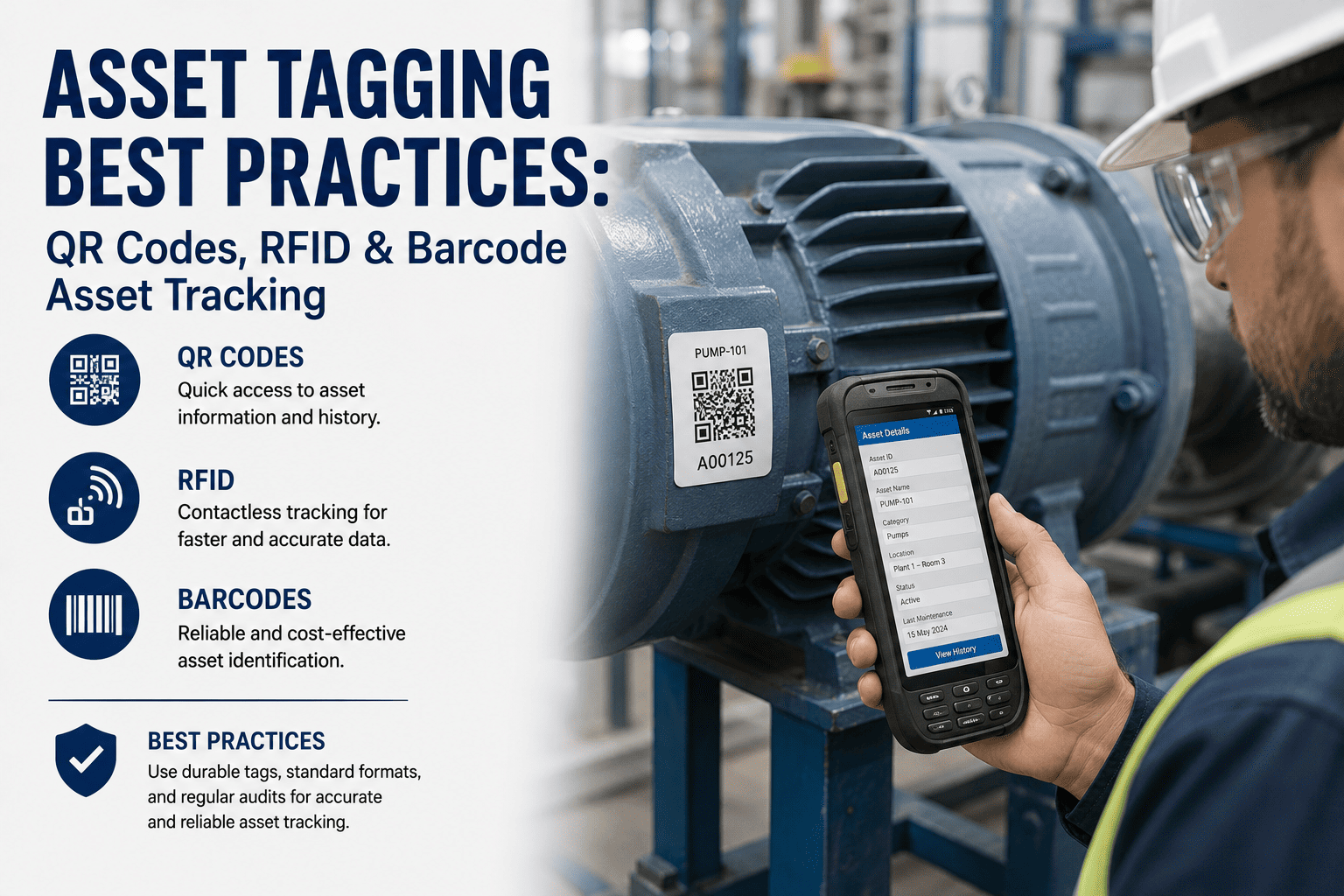
A maintenance manager digitizing asset tracking for the first time almost always starts with the wrong question — "which software should we use?" — when the real decision that determines everything downstream is which physical tagging technology actually fits the environment. A QR code that works perfectly on an office laptop will not survive a year on a foundry floor. An RFID system that delivers instant bulk-scanning in a warehouse becomes an expensive, unreliable mess on a factory floor full of steel beams and motors that distort radio signals. Asset tagging reduces physical inventory time by up to 70% — but only when the technology actually matches the environment it's deployed in. A CMMS like OxMaint works with all three major tagging technologies, so the decision is about your facility, not about which platform you happen to buy.
Tag Once, Track Forever — On the Technology That Fits
OxMaint supports QR codes, barcodes, and RFID side by side — generate labels, link them to full asset records, and scan from the field with any standard device.
Three Technologies, Three Fundamentally Different Mechanics
The core difference is not cosmetic — it changes what's physically possible. A barcode or QR code is a printed, visual label that a camera or scanner has to see directly. RFID uses radio waves to detect a tag automatically, with no camera and no line of sight required at all. That single mechanical difference cascades into everything else: cost, scanning speed, infrastructure needs, and where each technology actually makes sense. Book a demo to see how OxMaint handles all three inside one asset record.
Head-to-Head: Read Range, Speed, Cost, Durability
Which Technology Fits Your Environment
There is no single "best" tagging technology — only the one that fits your asset volume, environment, and budget. Sign up free and generate labels for any of the three directly inside OxMaint once you've matched the technology to your use case below.
- You have a high volume of low-value assets to tag cheaply
- Assets stay primarily indoors, away from heavy moisture or abrasion
- You need the absolute lowest cost per tag at scale
- One-at-a-time scanning is acceptable for your workflow
- Technicians need to scan with a phone they already carry, no scanner gun
- You want to link directly to a full asset record — history, manuals, work orders
- Your asset record changes over time, favoring dynamic QR codes that update without reprinting
- Equipment is spread across multiple job sites or outdoor locations
- You need to inventory hundreds or thousands of assets quickly, in bulk
- Assets are stored in ways that block line of sight — inside containers, behind racking
- Tags must survive harsh, abrasive, or wet industrial environments long-term
- Budget supports the higher per-tag and reader infrastructure cost
The RFID Trap in Heavy Industrial Environments
RFID's bulk-scanning advantage assumes clean radio conditions — a warehouse with clear aisles, not a factory floor packed with steel beams, motors, and metal fencing. In that environment, RFID signals bounce and distort, undermining the exact reliability the technology is chosen for. Passive RFID also requires handheld readers that most maintenance technicians don't carry day to day, while active RFID's battery requirement adds an ongoing maintenance task to the very system meant to reduce maintenance burden. For most stationary industrial equipment, this makes RFID overkill — a QR code read by a phone already in the technician's pocket solves the same problem more reliably and at a fraction of the cost.
Tag Durability by Environment
| Environment | Recommended Tag Material | Why |
|---|---|---|
| Office / indoor IT equipment | Standard adhesive polyester | Low abrasion and moisture exposure — no premium material needed |
| Outdoor fleet & field equipment | UV-resistant laminated vinyl | Resists fading and edge lifting from sun and weather exposure |
| Manufacturing floor, chemical exposure | Anodized aluminum or polyester with chemical-resistant laminate | Survives solvents, oils, and abrasive cleaning routines |
| High-heat / foundry / kiln-adjacent | Ceramic or metal-etched tags | Standard adhesives and polyester fail well below these operating temperatures |
Implementation Best Practices Across Any Technology
Use Dynamic, Not Static, Linking
A dynamic QR code or RFID tag linked to a live record lets you update the asset's data without reprinting a single label — critical since maintenance records change constantly.
Standardize Placement
Put tags in the same relative location on every asset class — a technician should never have to hunt for a label on equipment they've never serviced before.
Match Material to Environment, Not Budget Alone
A cheap tag that fails within six months costs more in re-tagging labor than a durable one would have cost upfront.
Mix Technologies Where It Makes Sense
Many facilities use QR codes for individual equipment lookup and RFID for high-volume bulk inventory counts — the two are not mutually exclusive.
How OxMaint Supports Every Tagging Technology
Generate & Print Labels Directly
Create QR codes and barcodes for any asset directly from its record, ready to print on durable label stock matched to the asset's environment.
Dynamic Linking by Default
Every tag links to a live asset record — history, work orders, and documents update automatically without ever needing to reprint a label.
Mobile Scan-and-Update
Technicians scan a QR code with the phone already in their pocket to instantly pull up full asset history and log completed work on the spot.
Bulk Inventory Workflows
Run rapid physical verification sweeps that reconcile scanned assets against the digital register, cutting traditional count time dramatically.
Pick the Right Tag for Every Asset, One Platform for All of Them
OxMaint generates, links, and tracks QR codes, barcodes, and RFID tags from the same asset record — so your tagging strategy can match reality, not a vendor's single-technology limitation.
Frequently Asked Questions
Is RFID always better than QR codes for asset tracking?
No. RFID offers faster bulk scanning and works without line of sight, but it costs significantly more per tag, requires dedicated reader hardware most technicians don't carry, and can suffer signal distortion in metal-heavy industrial environments. For most stationary equipment tracked by technicians who already carry smartphones, a QR code is the more practical and cost-effective choice. Sign up free to compare both technologies on your own asset register inside OxMaint.
What is the difference between a static and dynamic QR code?
A static QR code contains fixed information permanently encoded at creation and cannot be changed without printing a new label. A dynamic QR code links to a record that can be updated at any time without reprinting — meaning the asset's maintenance history, status, and documentation stay current even though the physical label on the equipment never changes. Dynamic QR codes are strongly preferred for asset tracking since maintenance records evolve constantly.
How much does each asset tagging technology cost?
Barcode and QR code labels typically cost $0.05 to $0.60 per tag, making them the most economical choice for high-volume tagging. Passive RFID tags range from $0.50 to $15.00 depending on read range and durability requirements, while active RFID tags with their own power source generally start around $20 and require ongoing battery maintenance. Book a demo to see total cost projections for your specific asset count.
Why do RFID tags sometimes fail in factory environments?
RFID relies on radio wave transmission, and large metal structures common in manufacturing — steel beams, motor housings, fencing — can reflect and distort those signals, causing inconsistent read rates. This is sometimes called the "RFID trap": the technology promises fast, automated bulk scanning, but in metal-dense environments the reliability that makes RFID valuable in a clean warehouse setting can break down significantly.
Can a facility use more than one tagging technology at once?
Yes, and many facilities do. A common approach uses QR codes for individual equipment lookup and maintenance logging by field technicians, while reserving RFID for high-volume bulk inventory counts in warehouse or storage areas where speed matters more than per-unit detail. The two technologies solve different problems and are frequently deployed together rather than as an either-or choice.