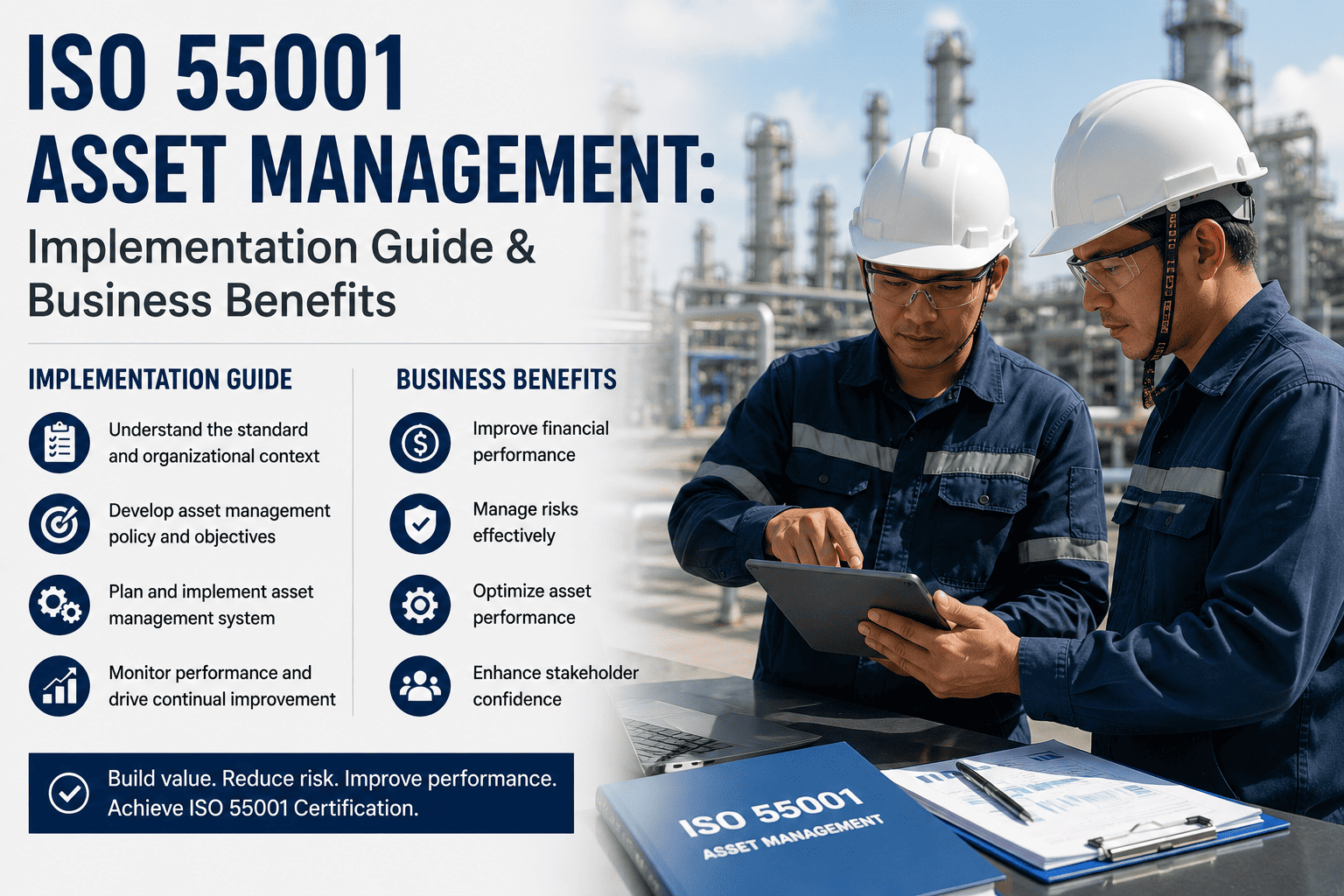
Most organizations already do most of what ISO 55001 requires — they have a maintenance program, a budget process, some form of risk thinking. What they don't have is documentation connecting those activities into a coherent system that an independent auditor can verify. ISO 55001 certification is rarely about building new capabilities from scratch; it's about formalizing and connecting practices that already exist into an auditable management system. A CMMS like OxMaint provides exactly that connective documentation — asset data, work order history, and risk records in one system an auditor can actually follow.
Build the Documentation Trail ISO 55001 Auditors Look For
OxMaint connects your asset register, work order history, and risk data into one system — the structured evidence base an ISO 55001 audit actually requires.
Three Documents, One Confusing Name
People often say "ISO 55000 certification," but that's technically the wrong document. The ISO 55000 series has three parts, and only one of them is actually auditable. Book a demo to see how OxMaint maps directly to the requirements in the document that matters for certification.
Overview & Terminology
The "what" and "why" of asset management — concepts, principles, and shared vocabulary. Not certifiable on its own.
The Requirements
The actual auditable standard. This is the document your organization is certified against — clauses 4 through 10 define every requirement.
Implementation Guidance
Practical examples and clarification on how to actually meet the 55001 requirements. Guidance, not a separate standard.
The Seven Clauses That Define the Standard
ISO 55001's requirements are organized into seven numbered clauses, each addressing a distinct part of the management system. Sign up free and use OxMaint to build the evidence trail for each clause as you go, rather than scrambling to assemble it before an audit.
Context of the Organization
Define the scope of your asset management system and identify internal and external issues, plus the needs of interested parties.
Leadership
Executive-level policy and directive — top management must visibly commit to the asset management policy and assign clear accountability.
Planning
The risk assessment process — setting asset management objectives that align with overall business goals and identifying risks to achieving them.
Support
Training and awareness programs, control of documented information, and ensuring the resources needed to run the system are actually available.
Operation
The policies, processes, and procedures that govern how assets are actually acquired, used, maintained, and eventually disposed of day to day.
Performance Evaluation
Monitoring and measurement against objectives, a structured internal audit program, and formal management review of the entire system.
Improvement
Corrective action on nonconformities found during audits or operation, and continual improvement of the system based on what those findings reveal.
The PDCA Cycle Behind the Standard
ISO 55001's seven clauses are built on the Plan-Do-Check-Act cycle — the same continuous improvement loop found across most ISO management system standards. Certification is not a one-time achievement; it's a commitment to keep moving through this cycle indefinitely.
Plan
Clauses 4–6: define context, secure leadership commitment, set objectives and assess risk
Do
Clauses 7–8: provide support resources and execute the operational policies and processes
Check
Clause 9: measure performance against objectives, audit, and conduct management review
Act
Clause 10: correct nonconformities and feed findings back into the next planning cycle
A Realistic Implementation Path
Gap Assessment
Compare existing practices against the seven clauses to see what's already in place and what genuinely needs to be built — most organizations find they're closer than they expected.
Leadership Engagement
Secure visible, active commitment from top management and governing bodies — Clause 5 requires more than a signed policy document filed away and forgotten.
System Design & Documentation
Formalize the asset management policy, objectives, and procedures, connecting them to existing systems like your CMMS rather than building parallel documentation nobody maintains.
Training & Rollout
Ensure every team member understands the objectives, their role in the system, and why compliance matters beyond satisfying an external auditor.
Internal Audit
Run your own audit against the standard before the external one. Findings here are far cheaper to fix than findings discovered by the certification body.
External Certification Audit
An accredited, independent certification body reviews the system and, if conformant, issues certification — typically followed by annual surveillance audits.
What Certification Actually Delivers
Structured Risk Management
Risk to asset performance gets identified and managed systematically, instead of being addressed reactively after something already failed.
Improved Financial Performance
Lifecycle-based decision-making typically reduces total cost of ownership compared to reactive, budget-cycle-driven asset spending.
Demonstrated Due Diligence
Independent certification satisfies regulatory and customer requirements that increasingly expect documented asset governance, not informal assurance.
Continual Improvement Built In
The PDCA structure means the system doesn't stagnate after certification — internal audits and management review keep it evolving.
How OxMaint Supports an ISO 55001 Asset Management System
Centralized Asset Register
A structured, auditable record of every asset's lifecycle status supports Clause 8's operational requirements directly from your existing maintenance data.
Risk & Criticality Records
Document criticality scoring and risk assessment per asset, building the evidence base Clause 6's planning requirements call for.
Performance Reporting
PM compliance, downtime, and cost dashboards give your team and external auditors the measurable performance data Clause 9 requires.
Audit Trail by Design
Every work order, inspection, and corrective action is timestamped and attributed automatically — the documentation trail an internal or external audit actually reviews.
Turn Existing Maintenance Practice Into Auditable Evidence
OxMaint connects asset data, risk records, and performance reporting into one documented system — the foundation an ISO 55001 certification audit is built to find.
Frequently Asked Questions
What is the difference between ISO 55000, 55001, and 55002?
ISO 55000 provides the overview, concepts, and terminology of asset management — the "what" and "why." ISO 55001 contains the actual auditable requirements — the "how" your organization must meet to be certified. ISO 55002 offers practical guidance and examples for implementing those requirements but is not itself a certifiable standard. When organizations talk about "ISO 55000 certification," they technically mean ISO 55001, since that's the only document with auditable requirements. Sign up free to start mapping your asset data against the 55001 clauses in OxMaint.
Does ISO 55001 only apply to physical assets?
No. ISO 55001 is written as a generic management system standard applicable to physical, financial, and intangible assets, and to organizations of any size, sector, or type — public, private, or not-for-profit. The standard is most commonly adopted by asset-intensive industries like manufacturing, utilities, and infrastructure, but its framework is not restricted to any single asset category.
How long does ISO 55001 certification typically take?
Timelines vary significantly based on how mature an organization's existing asset management practices already are. A gap assessment is the right first step, since many organizations discover that formalizing and connecting existing practices into a documented system takes considerably less time than building entirely new capabilities from scratch. Book a demo to see how OxMaint can accelerate the documentation-heavy parts of implementation.
Is ISO 55001 certification legally required?
No — ISO certification is a voluntary, internationally coordinated private system, and there is no government mandate requiring it in most jurisdictions. Its value comes from the independent, third-party verification it provides, which can satisfy customer requirements, support regulatory due diligence, and demonstrate asset governance maturity to stakeholders even without a legal obligation to pursue it.
What is the Plan-Do-Check-Act cycle in ISO 55001?
PDCA is the continuous improvement loop underlying ISO 55001's structure: Plan (Clauses 4–6) establishes context, leadership commitment, and risk-based objectives; Do (Clauses 7–8) provides the resources and executes operational processes; Check (Clause 9) measures performance and conducts audits and management review; and Act (Clause 10) corrects nonconformities and feeds those findings back into the next planning cycle. This means an ISO 55001 system is never "finished" — it's designed to keep improving indefinitely.