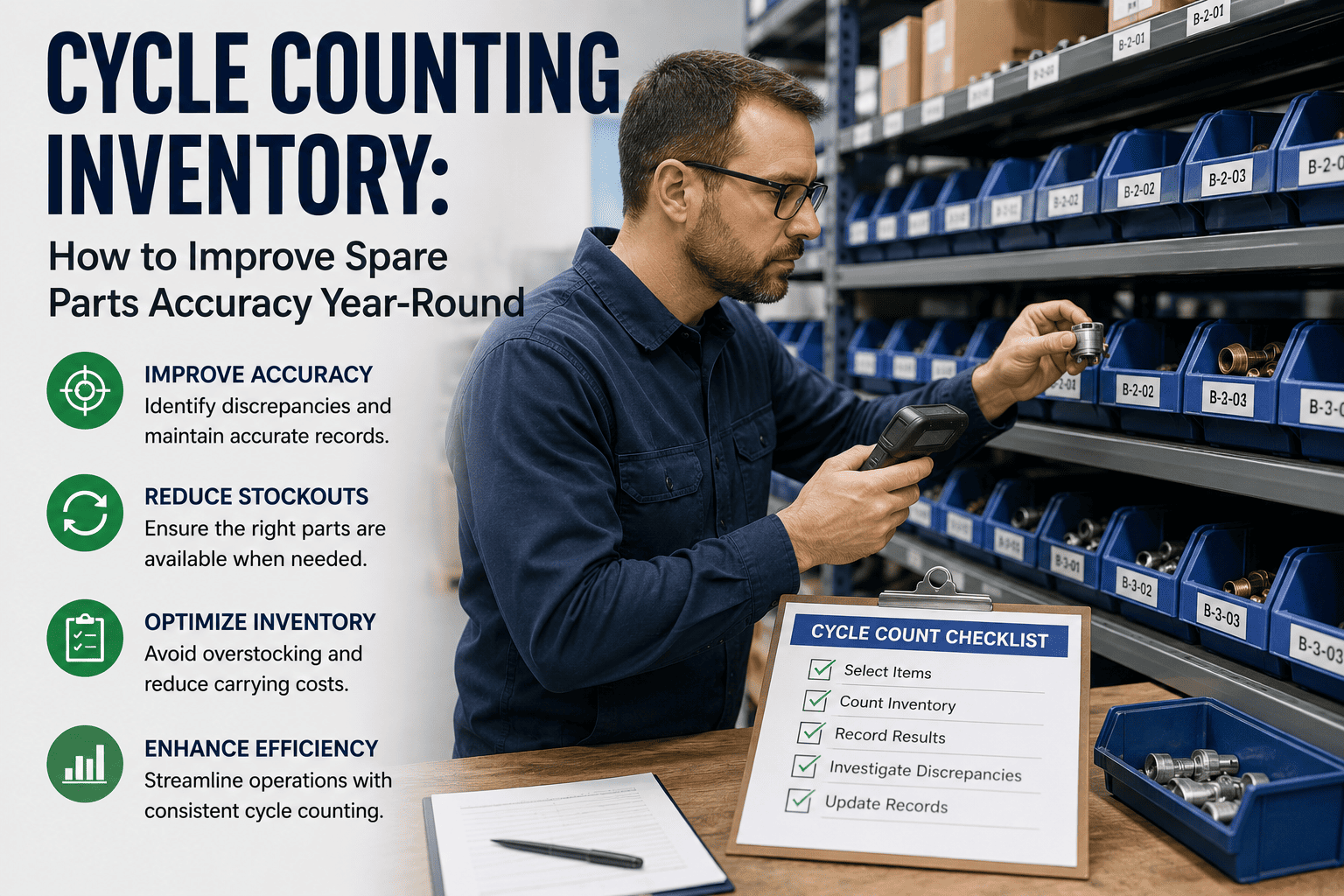
Most plants still run an annual stocktake — shut the warehouse for two days, pull every team off their normal work, and count everything at once. By the time the count is done, half the numbers are already wrong again. Cycle counting replaces that single chaotic event with small, frequent counts spread across the year, so your spare parts data stays accurate every single day instead of just once. Sign up free on OxMaint to run cycle counts directly from your parts inventory module, or book a demo to see it in action.
Never Run a Surprise Stockout Again
OxMaint automates ABC-based cycle counts, flags discrepancies in real time, and keeps your spare parts inventory accurate without ever shutting the warehouse down.
Cycle Counting vs. the Annual Stocktake
An annual stocktake gives you one accurate snapshot a year — and 364 days of guesswork in between. Cycle counting checks a small portion of inventory on a rotating schedule, so discrepancies get caught and corrected within days or weeks of happening, not months later.
ABC Analysis: Count What Matters, More Often
Not every spare part deserves the same counting attention. ABC analysis applies the Pareto principle to your inventory — a small share of parts drives most of your value and risk, so those get counted far more often than everything else. Sign up on OxMaint to auto-classify your parts into A, B, and C tiers based on usage and value.
Three Counting Methods — and When to Use Each
ABC analysis is the most common method, but it is not the only one. The right method depends on how your inventory is structured and what kind of accuracy risk you are trying to catch.
The Five-Step Cycle Count Process
A repeatable process is what separates cycle counting that actually improves accuracy from cycle counting that just adds another task to the schedule. Book a demo to see how OxMaint runs each of these steps from a single mobile screen.
Measuring What Matters: The Accuracy Formula
Cycle counting only works if you are actually tracking whether it is improving anything. Inventory accuracy is a simple ratio, but tracking it consistently over time is what turns counting into a real performance metric.
A food distributor that switched to cycle counting reduced expired inventory by 20% and saved an estimated $50,000 annually in waste management — simply by catching discrepancies early enough to act on them, instead of discovering spoiled stock once a year.
Common Pitfalls That Quietly Undermine Cycle Counting
Cycle counting fails most often not because the method is wrong, but because the execution skips a step. Sign up free on OxMaint to remove these pitfalls with automated scheduling and built-in discrepancy alerts.
How OxMaint Makes Cycle Counting Effortless
Cycle counting should run in the background of normal operations — not feel like a separate project competing for the same hours as maintenance work. OxMaint builds the counting schedule, the classification logic, and the discrepancy tracking directly into your parts inventory.
Stop Closing the Warehouse to Find Out You Were Wrong
OxMaint runs ABC-based cycle counts on autopilot — classification, scheduling, mobile scanning, and discrepancy tracking, all in one parts inventory system. No hardware required to start.
Frequently Asked Questions
What is cycle counting and how is it different from a physical inventory count?
Cycle counting verifies a small, rotating subset of inventory on an ongoing schedule throughout the year, while a full physical inventory count tries to count every single item at once, usually during an annual shutdown. Cycle counting catches discrepancies within days or weeks instead of months, and it does not require halting operations. Most companies running cycle counting consistently see steadier, higher accuracy rates than those relying solely on an annual count. Sign up on OxMaint to start cycle counting without disrupting daily operations.
How does ABC analysis decide how often a part should be counted?
ABC analysis applies the Pareto principle to inventory: roughly 20% of items (Tier A) typically account for 80% of total value or usage, and these are counted monthly to quarterly. Tier B items, around 30% of inventory and 15% of value, are counted two to three times a year. Tier C items, the remaining 50% of SKUs accounting for just 5% of value, are usually counted once annually. Items can be reclassified between tiers as usage patterns and lead times change.
What inventory accuracy rate should a maintenance or MRO operation target?
Inventory accuracy is calculated as (correct items counted ÷ total items counted) × 100. Well-run MRO and spare parts operations typically aim for 95% or higher accuracy on critical A-tier parts, since errors on these items carry the highest risk of production downtime. Lower accuracy targets, often 85–90%, are generally acceptable for low-value C-tier consumables. Book a demo to see how OxMaint tracks accuracy rate trends per tier automatically.
Do I need to stop warehouse operations to perform a cycle count?
No — that is the core advantage of cycle counting over a full physical inventory. Only the specific zone, bin, or SKU group being counted needs a brief pause in transactions to ensure the physical count matches the system snapshot at that exact moment. The rest of the warehouse continues operating normally. This is why cycle counting can be run continuously throughout the year without the operational disruption of an annual stocktake.