Most maintenance teams do not have a procurement problem because they lack good intentions — they have one because the process runs on email threads, verbal approvals, and whoever happens to know a vendor's phone number. Research from the Chartered Institute of Procurement & Supply found that maverick buying can account for up to 80% of all invoices even at organizations with formal procurement departments. A CMMS like OxMaint closes that gap by tying every purchase order to a work order, an asset, and an approval trail — turning maintenance procurement from a guessing game into a controlled, auditable workflow.
Connect Every Purchase Order to a Work Order — Automatically
OxMaint routes requisitions, automates approvals, and tracks every supplier transaction against the asset and maintenance task that triggered it.
Why Maintenance Procurement Breaks Down
Maintenance, repair, and operations purchasing sits in an awkward spot — too operationally urgent to wait on slow approval chains, but too frequent and fragmented to manage with the same rigor as capital purchases. The result is what procurement teams call maverick spend: purchases made outside approved suppliers, contracts, or workflows. Book a demo to see how OxMaint gives maintenance teams a fast purchasing path that still stays inside policy.
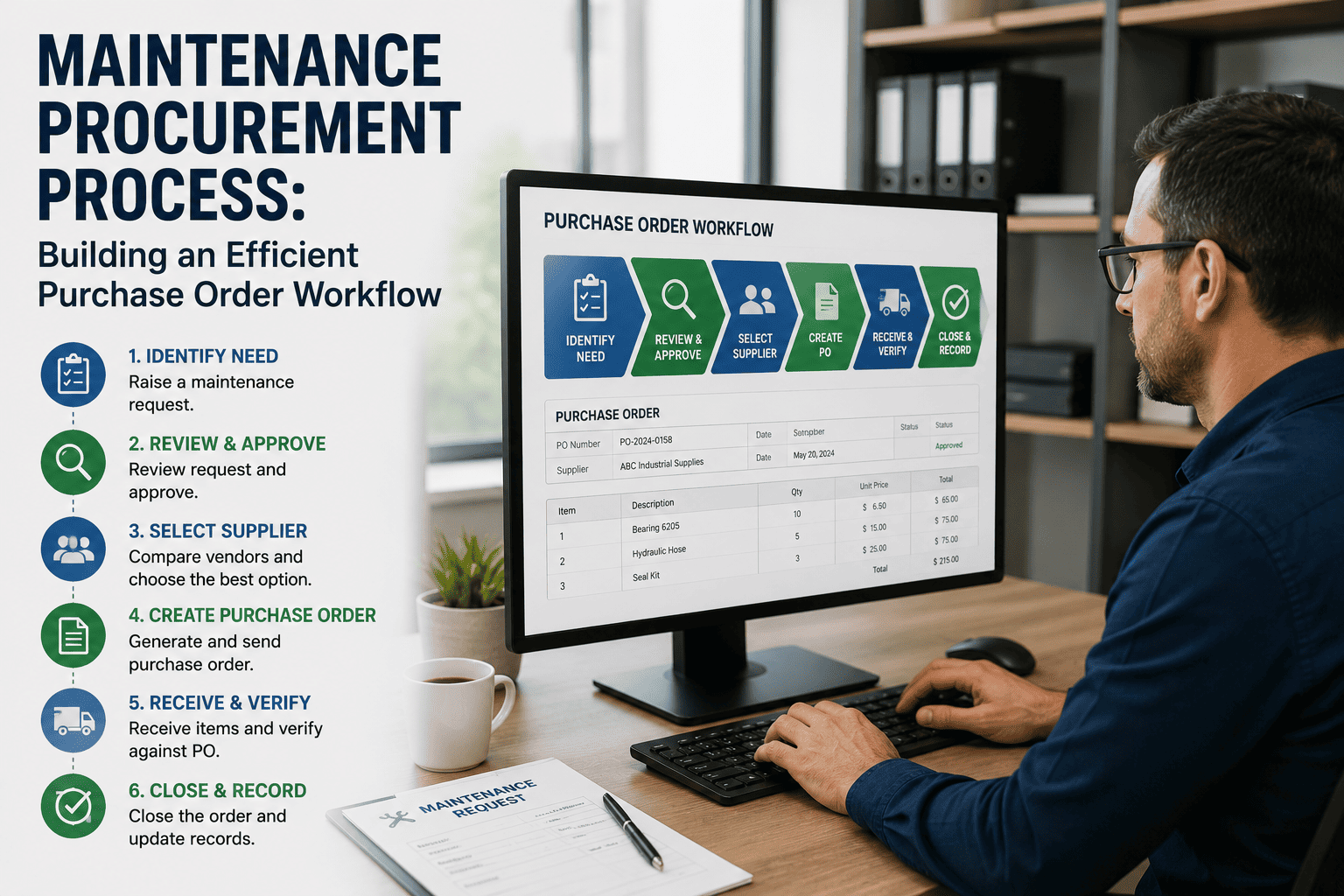
The Maintenance Purchase Order Workflow — Step by Step
An efficient PO workflow is not about adding bureaucracy — it is about routing the right purchases through the right level of scrutiny, fast. Here is the sequence that high-performing maintenance procurement teams follow.
Requisition Triggered by Need
A part shortage flagged during a work order, a scheduled PM task requiring consumables, or an emergency repair generates the initial purchase requisition. Tying the requisition to a specific asset and work order from the start prevents the disconnect that causes untracked spend.
Automated Routing by Rule
The requisition routes to the correct approver based on dollar threshold, asset criticality, and urgency — not based on who happens to be at their desk. Critical spares for production-stopping equipment fast-track; routine consumables follow standard approval.
Approval and Budget Check
The approver reviews against department budget and historical pricing — not from memory, but from a system showing what was paid for the same part last time. Approval or rejection is logged with a timestamp, creating the audit trail.
Purchase Order Generated
An approved requisition becomes a formal purchase order sent to the preferred supplier — not a verbal agreement or an off-contract vendor someone knows personally. The PO number ties directly back to the originating work order and asset.
Supplier Confirmation and Delivery Tracking
The supplier confirms the order and delivery date. Status updates flow back into the system so maintenance planners know exactly when parts will arrive — and can adjust work order scheduling accordingly instead of guessing.
Receiving and Three-Way Match
Goods received are checked against the purchase order and the original requisition before invoice payment is approved. This three-way match is the single control that catches pricing discrepancies, short shipments, and unauthorized substitutions.
Cost Closed Against the Work Order
The final cost is attributed back to the specific asset and work order — not absorbed into a generic maintenance budget line. This is what makes total cost of ownership reporting possible per asset, instead of being a portfolio-wide guess.
Where Procurement Workflows Typically Break
No Link Between PO and Work Order
Purchases get made, but nobody can trace which asset or repair they were for. Finance sees a generic "maintenance supplies" line item with no operational context — and no way to determine if the spend was justified.
Approval Bottlenecks on Urgent Repairs
A critical asset is down and the part needs approval from someone on vacation. Technicians route around the process entirely, buying off-contract from whichever local supplier can deliver fastest — at a price nobody negotiated.
No Visibility Into Historical Pricing
The same part gets purchased repeatedly at different prices from different vendors because nobody can see what was paid last time. Without a centralized purchase history, every requisition starts from zero.
Fragmented Supplier Base
Each technician or site has their own preferred vendor relationships, multiplying the number of suppliers the organization manages and eliminating the volume leverage that would otherwise drive better pricing and faster service.
Approval Workflow Design — Matching Scrutiny to Risk
Not every purchase deserves the same level of review. A workflow that treats a $40 filter order the same as a $15,000 compressor purchase either slows down routine work or lets large spend through too easily. Sign up free and configure tiered approval rules in OxMaint based on cost, urgency, and asset criticality.
| Purchase Type | Typical Threshold | Approval Path | Target Turnaround |
|---|---|---|---|
| Routine consumables | Under $250 | Auto-approved against pre-set catalog | Same day |
| Standard spare parts | $250–$2,000 | Single supervisor approval | 1 business day |
| Critical asset repair parts | Any amount | Fast-tracked, single approver, flagged urgent | Same day or emergency override |
| Major component / capital-adjacent | $2,000–$15,000 | Department head + budget owner | 2–3 business days |
| Large equipment / contracted services | Over $15,000 | Multi-level approval, finance sign-off | 5+ business days |
Supplier Management Essentials
Centralize the Approved Vendor List
When technicians know exactly which suppliers are pre-approved and on contract, they have no reason to source off-policy. A visible, accessible vendor list removes the ambiguity that drives maverick purchasing.
Track Supplier Performance
On-time delivery rate, order accuracy, and price consistency should be tracked per supplier — not just remembered anecdotally. Underperforming vendors get identified and addressed before they cause repeated maintenance delays.
Diversify Critical Part Sources
Single-sourcing a critical spare part creates a supply chain risk that can stall repairs for weeks. Maintaining at least one backup supplier for mission-critical parts protects against lead time surprises.
Consolidate Volume Where Possible
Centralizing purchases across sites and departments through one procurement system improves negotiating leverage with suppliers — turning fragmented, low-volume orders into consolidated purchasing power.
Spend Control Checklist
Document approval thresholds by purchase amount
Define which purchases require a PO before ordering
Communicate the policy clearly to every technician
Link every requisition to a work order and asset
Route approvals automatically by rule, not by memory
Require three-way match before invoice payment
Maintain a single, searchable purchase history
Report spend per asset, not just per department
Review maverick spend monthly to find process gaps
Maintain a centralized, visible approved vendor list
Score suppliers on delivery, accuracy, and pricing
Keep backup sourcing for critical spare parts
How OxMaint Streamlines Maintenance Procurement
PO Tied to Work Orders
Every purchase order generates directly from the work order or PM task that needs it — eliminating the disconnect between maintenance activity and procurement spend that finance teams struggle to reconcile.
Automated Approval Routing
Configure threshold-based approval rules so routine purchases move fast while higher-value or capital-adjacent purchases automatically route to the right level of review.
Supplier and Pricing History
View past pricing per part and supplier before approving a new requisition, ending the guesswork that leads to paying different prices for the same component across different work orders.
Cost Reporting Per Asset
Roll up procurement spend by asset, location, or department — giving facility managers and finance leaders the total cost of ownership data needed for budgeting and capital planning decisions.
Bring Maintenance Purchasing Under One Controlled Workflow
OxMaint connects requisitions, approvals, purchase orders, and asset costs into a single auditable system — so your maintenance spend is visible, controlled, and tied to the work that actually justified it.
Frequently Asked Questions
What is the difference between MRO procurement and CapEx procurement?
MRO (maintenance, repair, and operations) procurement covers the ongoing operational purchases needed to keep equipment and facilities running — spare parts, consumables, tools, and contracted repair services. CapEx procurement involves major asset purchases like new machinery or buildings, typically with longer planning cycles, formal capital budgets, and multi-year depreciation schedules. Sign up free to manage MRO procurement workflows alongside your asset and work order data in OxMaint.
How do I reduce maverick spending in maintenance procurement?
Start by making the approved process the path of least resistance — when technicians can submit a requisition in seconds and get fast approval for urgent repairs, they have no reason to buy off-contract. Centralize your approved supplier list so it is visible and easy to use, communicate policy clearly across the team, and review maverick spend monthly to identify where the process is still pushing people toward workarounds.
What approval workflow works best for emergency maintenance purchases?
Critical, production-stopping repairs need a fast-track path — typically a single-approver emergency override that still requires documentation after the fact, rather than no approval at all. This lets technicians act immediately on urgent failures while preserving the audit trail. Book a demo to see how OxMaint balances speed and control for emergency procurement.
Why should purchase orders be linked to work orders?
Linking POs to work orders gives every purchase operational context — finance and facility managers can see exactly which asset and repair justified the spend, rather than reconciling a generic "supplies" line item after the fact. It also makes total cost of ownership reporting possible per asset, which is essential data for repair-versus-replace and capital planning decisions.
How does a CMMS improve maintenance purchasing?
A CMMS like OxMaint connects the maintenance and procurement workflows that are usually managed in separate systems or not managed at all. Requisitions generate directly from work orders, approvals route automatically by configurable rules, supplier and pricing history is centralized for every part, and final costs roll up against the specific asset — replacing email chains and spreadsheets with a single auditable purchasing process.