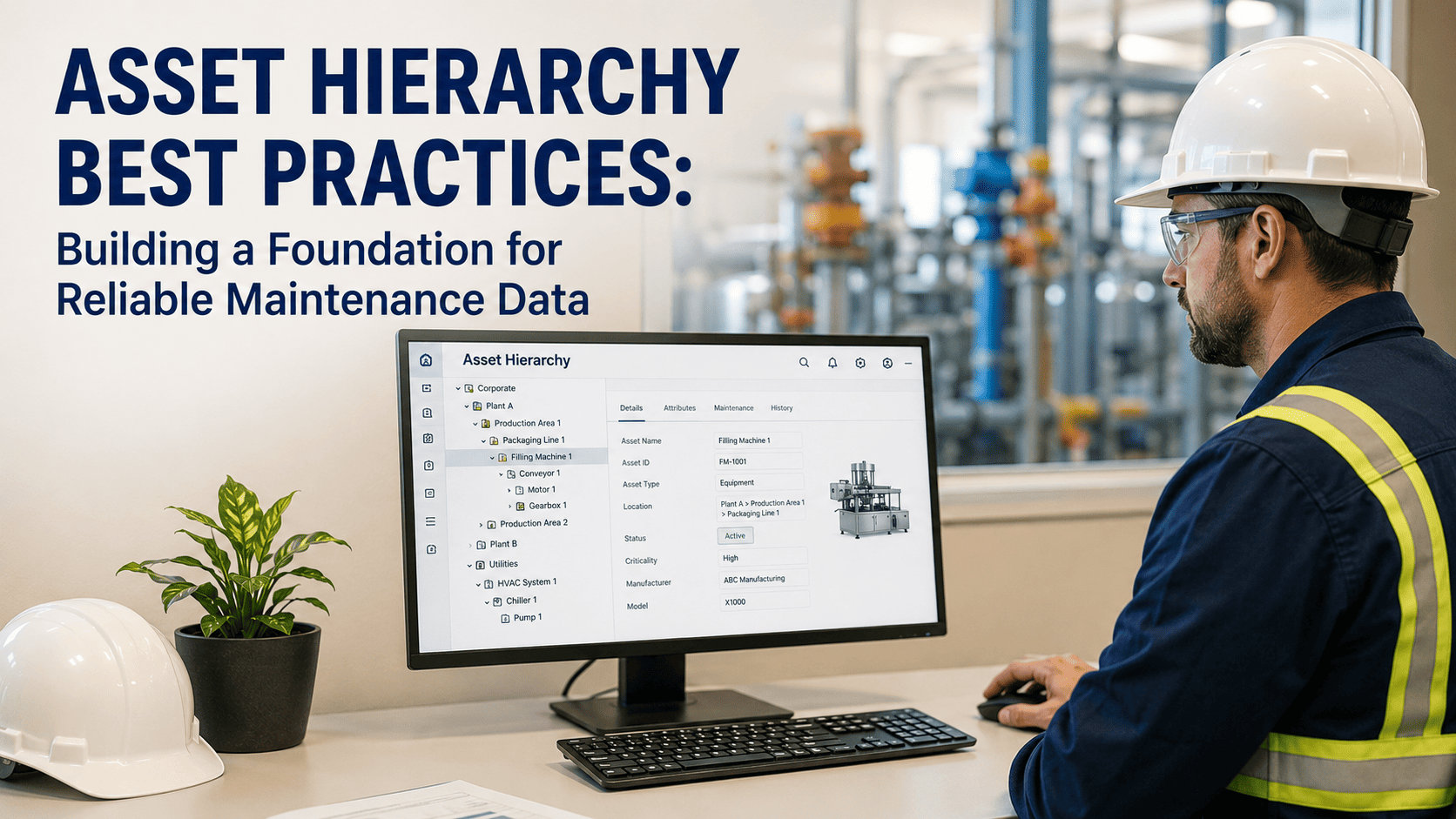
A CMMS holding 5,000 unconnected serial numbers in a flat list cannot tell you anything useful. You cannot tell if Line 1 is profitable because you don't know which machines belong to it. You cannot tell if Motor A is a bad actor because nobody recorded that it was moved from Pump B to Fan C last year. Industry reliability research consistently finds that the majority of asset register entries at organizations without a structured hierarchy are wrong, incomplete, or missing — and flat, undocumented hierarchies are consistently the root cause. A CMMS like OxMaint is built around a structured parent-child asset hierarchy from day one, so your maintenance data means something the moment it's entered.
Stop Collecting Noise. Start Collecting Reliability Data.
OxMaint structures your asset register into a true parent-child hierarchy from setup — so every work order rolls up to the right system, line, and site automatically.
Why a Flat Asset List Fails the Moment You Need to Analyze It
Most CMMS implementations fail for the same structural reason: every asset gets dumped into a single, unrelated list. Without a parent-child relationship connecting components to equipment, equipment to systems, and systems to sites, you cannot track costs accurately, isolate a recurring failure, or tell whether a piece of equipment was ever moved. Book a demo to see how OxMaint builds this structure in from the start.
A Practical Five-Level Hierarchy
ISO 14224 defines a reference taxonomy with up to nine levels, but most organizations only need five to get the analytical power they actually require. Sign up free and configure this structure once inside OxMaint — every site, line, and component inherits it automatically.
What Each Level Actually Answers
Costs, downtime, and reliability roll up to the site, letting leadership compare one location against another on equal footing.
Without knowing which machines belong to a line, you cannot attribute maintenance cost or downtime to that production line at all.
A documented hierarchy tracks an asset even when it's physically relocated — so its full failure history follows it, not the location it used to occupy.
Failure codes attached at the component level reveal whether the real problem is the motor, the belt, or the bearing — not just "the conveyor."
Common Hierarchy Mistakes — and the Structural Fix
Building a hierarchy too deep, with eight or nine levels nobody can navigate or remember
Start with five practical levels — Site, System, Equipment, Component, Part — and only add depth where a real reporting need justifies it
Inconsistent naming — "Pump 1," "P-01," and "Pump One" all referring to the same asset across different records
Adopt one naming convention before data entry begins, and enforce it as a mandatory field format, not a suggestion
Skipping levels — components entered directly under a site with no equipment or system layer in between
Require every asset to have exactly one parent at the level directly above it — no shortcuts, even for "simple" assets
Treating the hierarchy as a one-time setup task instead of an ongoing governance responsibility
Assign hierarchy ownership to a specific role, and require sign-off before any new asset class or naming exception is approved
Hierarchy Quality Audit — Five Questions to Ask Right Now
Does every asset have exactly one parent, with no orphaned components floating outside the structure?
Can you instantly see every machine that belongs to a specific production line, without manual cross-referencing?
If an asset is physically relocated, does its failure history move with it instead of staying behind?
Are naming conventions consistent enough that a search for one asset returns exactly one result, not three near-duplicates?
Can a new hire navigate the hierarchy and correctly classify a new asset without asking a senior engineer first?
How OxMaint Structures Your Asset Hierarchy
True Parent-Child Structure
Every asset is linked to exactly one parent at the level above it, so costs, downtime, and failure data roll up accurately from part to site without manual reconciliation.
Visual Tree Configuration
Build and rearrange your hierarchy with a drag-and-drop visual tree — restructuring a department's assets takes minutes, not a multi-week data migration project.
Asset Relocation History
When an asset moves between systems or sites, its complete maintenance and failure history travels with it — answering "is this a bad actor?" with data, not guesswork.
Enforced Naming Standards
Configure mandatory naming conventions and classification fields so every new asset entered conforms to the same standard, preventing duplicate and inconsistent records.
Give Your Maintenance Data a Real Structure to Stand On
OxMaint builds your asset register as a true hierarchy from the start — so every work order, failure code, and cost rolls up to something that actually means something.
Frequently Asked Questions
How many levels should an asset hierarchy have?
Most practical industrial hierarchies use between three and six levels — a common starting structure is Site, System, Equipment, Component, and Part. The ISO 14224 reference standard defines up to nine levels for highly detailed reliability programs, but the large majority of organizations do not need that granularity and risk building a structure nobody can navigate consistently. Sign up free to configure a practical five-level structure inside OxMaint.
What is ISO 14224 and why does it matter for asset hierarchy design?
ISO 14224 is an international standard originally developed for petroleum, petrochemical, and natural gas industries that provides a reference taxonomy for classifying equipment and structuring reliability data. While it was built for oil and gas, its core parent-child classification principles have been widely adopted across manufacturing, power generation, and other asset-intensive industries because it gives organizations a consistent, comparable framework rather than an ad hoc structure unique to each plant.
What is the difference between a parent asset and a child asset?
A parent asset is the higher-level item that a smaller, more specific asset belongs to — for example, a production line is the parent of the individual conveyors and motors that make it up. A child asset is maintainable and trackable on its own, but its costs, downtime, and failure history also roll up into its parent for higher-level analysis. Book a demo to see how OxMaint manages these relationships automatically.
Why do most CMMS implementations end up with flat, unstructured asset lists?
Many implementations rush data entry without first designing the hierarchy, so assets get added as a single unrelated list rather than nested under the right system and site. This "flat list failure" is one of the most common reasons CMMS rollouts underdeliver — the system technically contains all the data, but none of it can be aggregated meaningfully because there is no structural relationship connecting one record to another.
How does asset hierarchy improve failure analysis?
A structured hierarchy lets engineers isolate a failure to a specific system boundary instead of investigating an entire flat list of unrelated equipment. When failure codes are tied to the correct component level, reliability teams can quickly identify recurring "bad actor" assets, compare performance across identical equipment at different sites, and aggregate failure data meaningfully — turning scattered maintenance records into actual reliability intelligence.