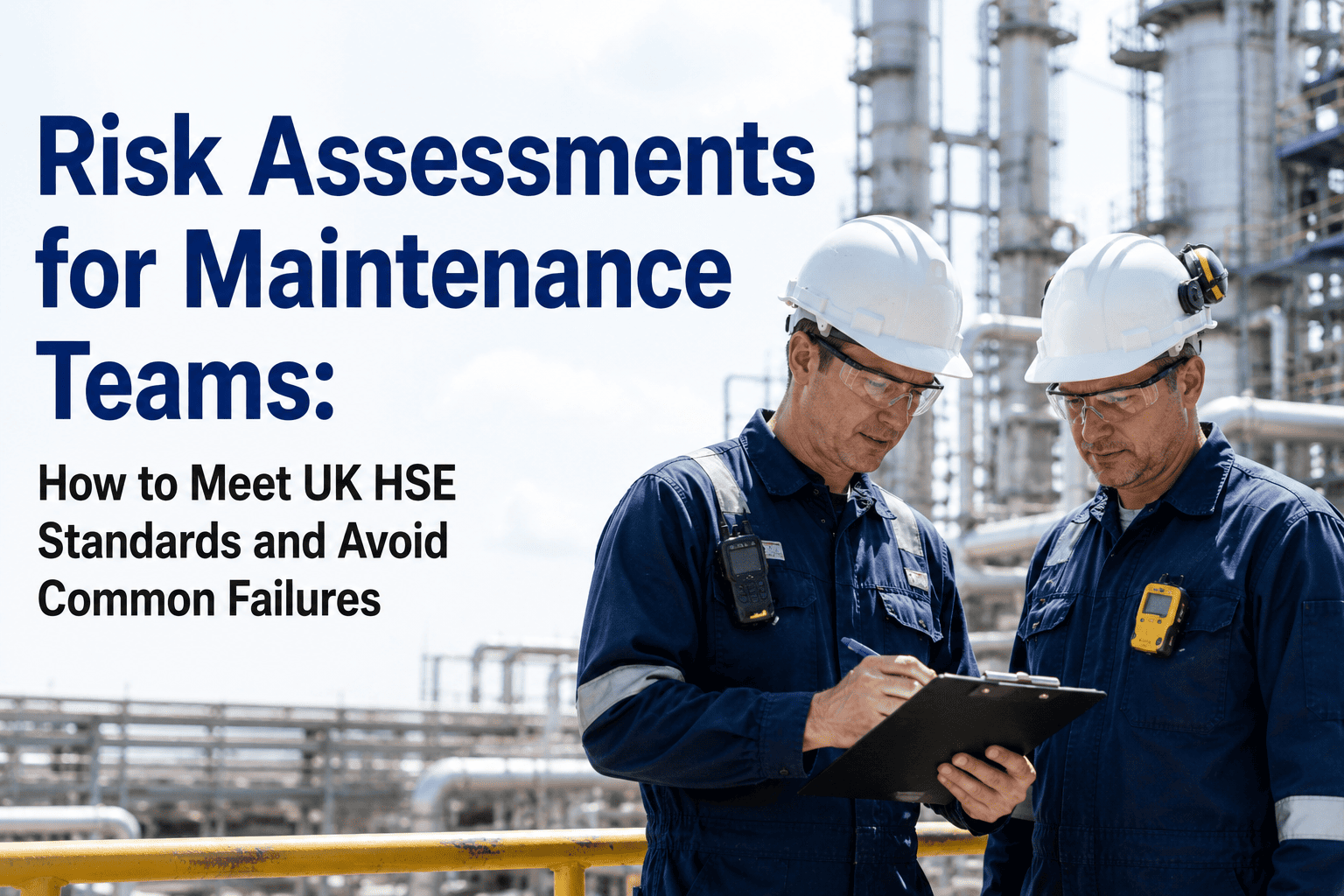
Most maintenance risk assessments fail for the same reason: they were never about the maintenance task in the first place. They were a downloaded template with the company logo dropped in, sitting in a folder, never opened until an inspector — or an accident investigator — asks to see it. Under UK law, that approach has a name: not "suitable and sufficient," and it's the line HSE inspectors are trained to find. A CMMS like OxMaint ties every risk assessment to the actual asset, the actual task, and the actual person doing the work — so what's on paper matches what happens on site.
Build Risk Assessments Inspectors Actually Trust
OxMaint links every maintenance risk assessment to the specific asset and task, with review dates, sign-off, and history all in one record — ready the moment an HSE inspector asks.
"Suitable and Sufficient" Is the Whole Game
Regulation 3 of the Management of Health and Safety at Work Regulations 1999 only asks for two things from a risk assessment: that it's suitable and that it's sufficient. Suitable means it covers the significant risks of the actual task. Sufficient means it's thorough enough to point to real control measures, not vague reassurances. Inspectors aren't grading paperwork for style — they're checking whether the document in front of them could have prevented the accident that hasn't happened yet. Sign up free and let OxMaint hold that evidence against the asset record automatically.
Why Maintenance Risk Assessments Fail Inspection
Inspectors aren't looking for volume — they're looking for relevance to the site in front of them. The most common failure isn't a missing document; it's a generic one. A risk assessment copied from a template, with the company name swapped in but the hazards, controls, and task steps untouched, doesn't describe what your technicians actually do. Book a demo to see how OxMaint pulls real asset data into every assessment instead of relying on a static download.
Generic, Not Site-Specific
Placeholder hazards and "appropriate PPE will be worn" language that doesn't name the actual equipment, location, or control measure in use.
Outdated Against Reality
An assessment that hasn't been touched since new machinery, a process change, or a near-miss — but is still presented as current.
Signed but Not Used
Technicians can't recognise the assessment as describing their actual job, which inspectors treat as proof it was never embedded in practice.
The HSE 5-Step Method, Applied to Maintenance Work
Identify the Hazards on This Asset
Walk the actual job — isolation points, stored energy, moving parts, confined spaces — and pull in maintenance history and near-miss records, since past failures are the strongest predictor of future ones.
Decide Who's Actually Exposed
Name the technician, contractor, lone worker, or bystander who could be harmed by this specific task — not a generic list of "employees and visitors."
Evaluate Risk and Set Real Controls
Score likelihood and severity with a risk matrix, then apply the hierarchy of control — eliminate, substitute, engineer, administer, PPE — in that order, not PPE as the default answer.
Record the Significant Findings
Document hazards, people at risk, and controls in writing — a legal requirement once you employ five or more people, and best practice regardless of headcount.
Review Before It Goes Stale
Revisit at least annually, after any incident or near-miss, and whenever the equipment, process, or task itself changes — a one-off assessment has an expiry date.
Static Assessment vs. Dynamic Assessment: Know the Difference
A downloaded template with placeholder hazards and the company name swapped in — rarely matches the actual site, and is the single most common reason assessments fail inspection.
Built from the actual asset, location, and task — naming real isolation points, real PPE specifications, and real responsible persons rather than vague reassurances.
The risk assessment identifies hazards and controls; the method statement spells out the task step by step — together forming the document contractors are asked for before site access.
An informal, on-the-spot judgement made when circumstances change mid-task — still required to be reported back and reflected in the formal assessment afterward.
What Inspectors Check When They Walk In
| Inspector Checks | What "Pass" Looks Like | What "Fail" Looks Like |
|---|---|---|
| Relevance to site | Names the actual asset, location, and task | Generic template, no site-specific detail |
| Review history | Dated, reviewed at least annually | Signed once, never revisited |
| Staff awareness | Technicians recognise their own job in it | Workers can't identify what it describes |
| Ownership | Named responsible person assigned | No clear owner or accountability |
| Control measures | Specific actions, equipment, and PPE named | Vague language like "take appropriate care" |
The Failures That Cost the Most
Copy-Paste from a Template
HSE has stated plainly that copying an example and swapping in your company name does not satisfy the law. It also doesn't protect anyone, since the hazards described aren't the hazards present.
Vague Control Measures
"Appropriate PPE will be worn" tells a technician nothing. Naming the exact equipment, the exact trigger point, and who's responsible for checking it is what makes a control measure usable.
No Link to Maintenance History
Past breakdowns and near-misses are the clearest signal of what will go wrong next. An assessment written without checking that history is starting from zero unnecessarily.
Treating It as a One-Off
Workplaces are dynamic. New equipment, a process change, or a single incident can make yesterday's assessment obsolete — and inspectors will ask when it was last reviewed.
How OxMaint Builds Inspection-Ready Risk Assessments
Asset-Linked Assessments
Every risk assessment attaches directly to the asset record, pulling in real specifications and history instead of starting from a blank generic form.
Built-In Risk Matrix
Score likelihood and severity per hazard with a structured matrix, so the controls you record are traceable back to a documented evaluation.
Automatic Review Scheduling
Set annual review dates per assessment and trigger an automatic flag after any logged incident, so nothing goes stale without someone noticing.
Named Ownership & Sign-Off
Assign a responsible person to every assessment with a logged sign-off trail — exactly the ownership evidence inspectors ask to see.
Stop Treating Risk Assessments as Paperwork
OxMaint keeps every maintenance risk assessment site-specific, reviewed, and tied to the asset it actually describes — so it holds up the day an inspector asks to see it.
Frequently Asked Questions
What does "suitable and sufficient" actually mean for a maintenance risk assessment?
Suitable means the assessment covers the significant risks of the specific task and asset in front of you. Sufficient means it's thorough enough to identify real, workable control measures — not just acknowledge that a hazard exists. HSE has been explicit that this doesn't need to be a doctoral thesis; it needs to be a practical, proportionate document that reflects how the work is actually done. Sign up free to build assessments tied directly to your asset records rather than a generic download.
Can maintenance teams legally use a downloaded risk assessment template?
A template can be a useful starting structure, but HSE has stated directly that simply copying an example and adding your company name does not satisfy the law. Each assessment needs to be site-specific and task-specific, reflecting the actual equipment, hazards, and working methods present — generic placeholder language like "appropriate PPE will be worn" doesn't meet that bar.
How often does a maintenance risk assessment need to be reviewed?
There's no fixed legal timeframe written into the regulations, but HSE's consistent guidance treats annual review as the minimum standard. On top of that, an assessment should be revisited immediately after any accident or near-miss, and whenever the equipment, process, or task itself changes. Book a demo to see how OxMaint schedules and tracks those review dates automatically.
What's the difference between a risk assessment and a RAMS document?
A risk assessment identifies hazards, who could be harmed, and what controls are needed. A RAMS pairs that risk assessment with a method statement — a step-by-step description of how the task will be carried out safely. RAMS documents are commonly requested by principal contractors before granting site access, particularly for higher-risk maintenance and construction-adjacent work.
What do HSE inspectors actually look for during a site visit?
Inspectors focus on relevance, not volume. They want to see assessments that describe the actual site and activity, evidence of regular review rather than a single signature, named ownership of each assessment, and confirmation that the technicians doing the work recognise it as describing their own job. An assessment that staff can't recognise is treated as evidence it was never genuinely used.