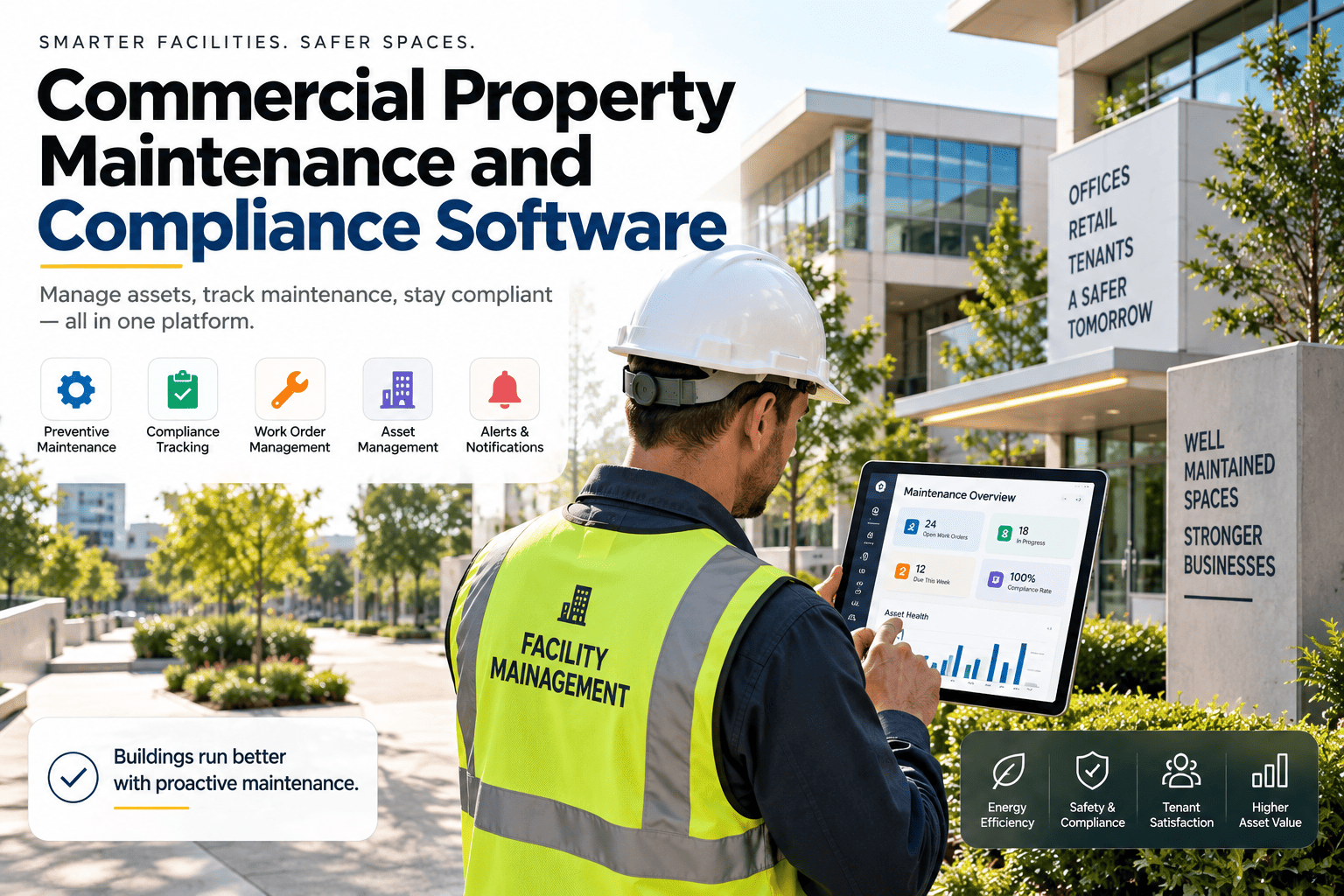
HSE inspectors in 2026 are not checking whether you have a folder of paperwork. They are checking whether risk is being actively managed today — and whether you can prove it with evidence that is current, complete, and linked to how your operation actually works. Many enforcement actions do not happen because risk assessments are missing. They happen because the assessments exist but no longer reflect the business, controls are listed but never verified, and maintenance records sit in spreadsheets that cannot be produced on demand. This playbook is for HSE Managers who want to close those gaps before an inspector arrives — not after. Sign up free on OxMaint to digitise your maintenance compliance evidence, or book a demo to see how inspection-ready records are built from day-to-day operations.
Inspection-Ready Maintenance Records — Built From Every Work Order, Not Assembled at Short Notice
OxMaint logs every maintenance task with date, technician, asset, and regulatory reference — producing the evidence an HSE inspector expects to see, automatically, from your day-to-day maintenance operations rather than a pre-inspection document sprint.
What HSE Inspectors Actually Look For in 2026
The shift in HSE inspection practice is well documented: quality of evidence over quantity of documents. An inspector who arrives at your site and is handed a thick binder of generic templates is not reassured — they are looking for evidence that your safety management system reflects your actual operation, your actual risks, and your actual controls. Understanding what they are looking for is the starting point for any serious inspection preparation.
What passes
Risk assessments that reflect how your site actually operates today — not a template last reviewed in 2021
Maintenance records showing the four W's: what was done, when, by whom, and against which legal or OEM requirement
Named responsibility for each control measure — with evidence the named person acted on it
Statutory examination certificates current and available at point of inspection — not stored in an office drawer
Training records that confirm competence was verified, not just attendance logged
Near-miss and incident records showing they were investigated, actioned, and closed
What triggers enforcement
Generic risk assessment templates reused across multiple sites with no site-specific content
Assessments not updated after changes to staff, layout, equipment, or processes
Controls listed on paper but no evidence they are monitored, checked, or maintained
LOLER or PSSR certificates overdue — equipment in use without a current thorough examination
Maintenance records held in spreadsheets that cannot be produced or filtered quickly during an unannounced visit
Permit-to-work records missing, incomplete, or not linked to the work orders they authorised
The Legal Framework: Key Regulations Maintenance Teams Must Evidence
HSE enforcement is grounded in specific legislation. Understanding which regulations apply to your operation — and what evidence each one requires — is the foundation of structured inspection preparation. The regulations below are the most commonly cited in enforcement actions involving maintenance and facilities operations. Sign up on OxMaint to link your maintenance tasks directly to the regulation they evidence.
Legal Duty
Regulation 5 requires work equipment to be maintained in an efficient state, in efficient working order, and in good repair. Regulation 6 requires inspection at suitable intervals by a competent person, with records kept until the next inspection.
Evidence Required
Maintenance logs showing scheduled PM tasks completed on time, by a competent person
Inspection records with date, findings, and any defects identified and actioned
Defect management records — faults found, risk assessment, and closure dates
Legal Duty
Regulation 9 requires thorough examination at statutory intervals — at least every 6 months for equipment used to lift people, at least every 12 months for other lifting equipment. A written report must be produced by the competent examiner and kept until the next thorough examination report.
Evidence Required
Current thorough examination certificate for every piece of lifting equipment on site
Register of lifting equipment showing next examination due date per item
Previous examination reports showing defects identified and any remedial actions completed
Legal Duty
Requires a Written Scheme of Examination (WSE) for all pressure systems above threshold, and examination in accordance with that scheme by a competent person. Systems must not be operated without a current, valid WSE and examination record.
Evidence Required
Written Scheme of Examination in place, signed, and dated — not a generic document
Examination records current and linked to each pressure system on site
Safe operating limits documented and communicated to operators
Legal Duty
Requires suitable and sufficient risk assessments, reviewed at regular intervals and whenever there is reason to believe they are no longer valid. Controls identified in assessments must be implemented and monitored. Competent persons must be appointed to assist with compliance.
Evidence Required
Risk assessments specific to your site and operations — not adapted generic templates
Review date and reviewer name recorded — with update records showing changes made after each review
Control monitoring evidence — records showing controls listed in the assessment are being checked
Legal Duty
Requires assessment of risks from hazardous substances, implementation of adequate controls, and where relevant, health surveillance and monitoring. LEV (Local Exhaust Ventilation) systems must be thoroughly examined at least every 14 months.
Evidence Required
COSHH assessments for all hazardous substances in use, reviewed and current
LEV examination records — current thorough examination certificate within 14 months
Health surveillance records where required (respiratory sensitisers, dermal exposure, etc.)
Legal Duty
Requires reporting of specified injuries, over-7-day incapacitation injuries, work-related deaths, occupational diseases, and dangerous occurrences to the HSE. Records of all workplace accidents and incidents must be maintained regardless of whether they are reportable.
Evidence Required
Accident book and incident records — complete, legible, with dates and descriptions
RIDDOR report reference numbers for all reportable events — demonstrating reports were submitted on time
Investigation records for reported incidents showing root cause identified and corrective actions closed
The HSE Enforcement Ladder: What Each Level Means
Understanding what an inspector can do when they find a non-compliance determines how seriously your team should treat each gap. Enforcement is not binary — there is a graduated response that starts with informal advice and escalates to prohibition and prosecution. Book a demo to see how OxMaint builds the evidence record that makes the difference between informal advice and formal enforcement.
Level 1
Informal Action or Verbal Advice
For minor issues, the inspector may give verbal or written advice without formal enforcement. This must still be documented and acted upon — inspectors note it in visit reports and expect to see action taken before any follow-up visit. Treating this level as a warning is correct. Ignoring it is not.
No immediate legal obligation, but failure to act creates evidence of knowledge without action — which strengthens the case for formal enforcement on any subsequent visit.
Level 2
Improvement Notice
A formal legal requirement to remedy a contravention within a specified timeframe — minimum 21 days. Failure to comply with an Improvement Notice by the deadline is a criminal offence. The duty holder has the right to appeal to an Employment Tribunal, which can suspend the notice during appeal.
Criminal offence for non-compliance. Unlimited fines on conviction. Published in the HSE enforcement action database — visible to clients, insurers, and the public.
Level 3
Prohibition Notice
Issued where there is a risk of serious personal injury. Stops the specified activity immediately (immediate prohibition) or before it is next carried out (deferred prohibition). Critically: appealing a Prohibition Notice does not suspend it. The activity stops until the notice is lifted by the inspector.
Activity ceases immediately. Production or operational impact is immediate and significant. Lifting a Prohibition Notice requires demonstrated compliance — not just a letter of intent.
Level 4
Prosecution
For serious breaches, persistent non-compliance, or incidents causing death or serious injury. Proceedings in the Magistrates' Court carry unlimited fines and up to 12 months imprisonment. Crown Court proceedings carry unlimited fines and up to 2 years imprisonment for certain offences under the HSWA 1974.
Unlimited fines. Imprisonment. Director disqualification. Reputational damage. Published conviction record. Civil liability exposure in parallel proceedings.
The Maintenance Evidence Checklist: What Must Be Ready at Any Time
An HSE inspection can happen with little notice. The following evidence categories must be retrievable within minutes — not assembled from spreadsheets, filing cabinets, and email threads over two days while an inspector waits. Sign up free on OxMaint to keep all of this in one digital system, accessible from any device, at any time.
PM schedule showing planned maintenance tasks and intervals with regulatory or OEM justification
Completed maintenance records with date, technician name, and task performed
Defect reports and closure records — faults found, risk classification, and remediation dates
LOLER thorough examination certificates current for all lifting equipment on site
PSSR Written Scheme of Examination and current examination records for all pressure systems
LEV examination records within 14 months for all local exhaust ventilation systems
Pre-use inspection records for safety-critical plant and equipment
Site-specific risk assessments for all significant hazards — not generic templates
Review dates and version history showing assessments are kept current
Method statements and safe systems of work for high-risk maintenance activities
Permit-to-work records — issued, signed, and closed — for hot work, confined spaces, work at height, and electrical isolation
COSHH assessments for all hazardous substances in use
Dynamic risk assessment records for non-routine tasks
Training matrix showing required competencies per role and current status for all staff
Certificates for statutory training: confined space entry, working at height, abrasive wheels, forklift, asbestos awareness
Competent person designations — named individuals with documented basis for their competence
Contractor induction records and F10/pre-qualification evidence for all active contractors
Refresher training schedule showing when certifications are due for renewal
Accident book and incident log — complete, with dates, descriptions, and injured party details
RIDDOR report reference numbers for all reportable events showing timely submission
Investigation records for all reported incidents — root cause identified, corrective actions closed
Near-miss records demonstrating proactive hazard reporting culture
Evidence that near-miss findings were fed back into risk assessments and maintenance schedules
Legally required — must be available at inspection
Expected by inspectors as evidence of good management — absence may be questioned
The 5 Most Common Gaps Found During HSE Maintenance Inspections
The same compliance failures appear repeatedly in enforcement action records. Understanding the most common gaps means you can audit against them proactively rather than discovering them during an inspection. Sign up free on OxMaint to remove the most common gap — maintenance records that exist but cannot be produced quickly or filtered by date, asset, or technician.
01
Risk assessments that no longer reflect the operation
The most cited reason for enforcement action is not missing risk assessments — it is existing assessments that have not been updated after changes to staff, layout, processes, or equipment. Inspectors check version history and review dates. An assessment dated 2019 with no review record for a site that has changed significantly is weaker evidence than no assessment at all.
Fix: Assign a named reviewer to each risk assessment with a calendar review cycle. Log review dates and record changes made at each review. Link risk assessments to the maintenance tasks that evidence the controls are working.
02
Statutory examinations overdue or certificates not available
LOLER and PSSR certificates have hard legal deadlines. Equipment in use without a current thorough examination is an immediate Prohibition Notice risk. The common failure is not forgetting the examination — it is that the certificate was renewed but not filed centrally, or that a secondary piece of lifting equipment was overlooked in the register.
Fix: Maintain a register of all lifting equipment and pressure systems with next examination due dates. Store certificates digitally, linked to the asset. Configure automatic reminders at 60 and 30 days before expiry.
03
Permit-to-work records incomplete or not linked to work orders
Permit-to-work systems are frequently described but not evidenced. Inspectors ask to see the permits issued in the last 6 months for hot work, confined space entry, and electrical isolation. If permits are paper-based and not retained, or if they exist but cannot be matched to the work orders that required them, the system is not demonstrably working.
Fix: Issue permits digitally and link each permit to its associated work order. Retain all completed permits for the inspection evidence period. Review permit quality periodically — check they are complete, signed off, and closed on completion.
04
Maintenance records that cannot be produced quickly
Maintenance records often exist but are held in spreadsheets, email chains, or paper logbooks that take hours to compile into a meaningful picture. An inspector who cannot see three years of maintenance history for a specific asset within a few minutes of asking may draw the conclusion that the records do not exist — or that the system is not under control.
Fix: Centralise all maintenance records in a CMMS where records can be filtered by asset, date range, or technician within seconds. Ensure every work order is linked to the specific asset it relates to — not just a location or cost centre.
05
Defects recorded but not closed or risk-assessed
An inspection or PM visit that identifies a defect but has no record of what happened next is worse than no defect record at all — it demonstrates that you found the hazard and did not control it. Inspectors look for open defect records as a direct indicator of whether the maintenance management system is closing loops or just creating documentation.
Fix: Every defect raised must have a risk classification, an assigned owner, and a target closure date. Open defects beyond their closure date should automatically escalate for management review. Closure must be confirmed and recorded — not assumed.
The 30-Day Inspection Readiness Action Plan
If you have 30 days to prepare for an HSE inspection — or to close the gaps you already know exist — this sequence of actions addresses the highest-risk evidence areas first. Book a demo to see how OxMaint accelerates this plan by centralising your maintenance evidence in days, not weeks.
Week 1 — Statutory Examinations
Audit every piece of lifting equipment on site against your LOLER register — confirm current thorough examination certificate is in place and within date
Review PSSR Written Schemes of Examination for all pressure systems — confirm examination records are current and systems are operating within specified safe limits
Check LEV examination records — any LEV system without a thorough examination within the last 14 months requires immediate action
Confirm all statutory certificates are stored centrally and can be produced on demand — not in separate site files, email folders, or individual managers' desks
Week 2 — Risk Assessments and Controls
Review all risk assessments for currency — confirm they reflect current staff, current processes, current equipment, and current site layout
Update any assessment that has not been reviewed in the last 12 months — document the review date and any changes made
Verify that named control owners exist for each significant control measure — assign named responsibility where it is currently unattributed
Review permit-to-work records for the last 6 months — confirm permits are complete, signed, and retained; identify any work types where permits were required but not issued
Week 3 — Maintenance Records and Open Defects
Audit maintenance records for critical and high-criticality assets — confirm PM tasks have been completed on schedule and records show date, technician, and findings
Review all open defect records — any defect beyond its closure date requires immediate risk assessment and either closure or documented deferral rationale
Confirm maintenance records can be filtered and produced by asset, date range, and technician within minutes — test your ability to respond to a specific inspector request
Week 4 — Training, Incidents and Readiness Test
Review training matrix — identify any statutory training that is expired or due within 90 days and schedule renewal before it lapses
Confirm contractor competence records are complete — all active contractors with induction records, relevant certifications, and site-specific risk awareness documented
Review incident and near-miss records — confirm RIDDOR submissions are complete, investigations are closed, and corrective actions are evidenced
Conduct a mock inspection walk — an internal audit against the HSE checklist categories, acting as if you are the inspector arriving unannounced
How OxMaint Builds Inspection-Ready Maintenance Evidence
HSE inspection readiness is not a project you complete before an inspection — it is a by-product of how you run maintenance every day. OxMaint structures maintenance operations so that every work order generates the evidence an inspector expects, automatically and without additional documentation overhead. Sign up free and start building your compliance evidence from your next work order.
WO
Maintenance Records With the Four W's
Every closed work order in OxMaint records what was done, when, by whom, and against which asset and regulatory requirement — the four data points HSE inspectors look for in every maintenance record. Produced as a byproduct of normal operations, not assembled at short notice.
CE
Statutory Examination Tracking
LOLER, PSSR, and LEV examination due dates are tracked per asset with automatic alerts before expiry. Certificates attach to the asset record — so the document is immediately available at the asset level, not buried in a filing system.
DF
Defect Management and Closure Tracking
Defects raised during inspections or PM visits are assigned an owner, risk classification, and closure date — and escalated automatically if they remain open past the target date. No open defect disappears without a documented closure or deferral decision.
AU
On-Demand Compliance Reports
Filter and export maintenance history by asset, site, date range, technician, or work type — within seconds. When an inspector asks for three years of maintenance records for a specific piece of equipment, the answer is a two-minute export, not a two-day search.
Don't Assemble Your HSE Evidence in the Two Days Before an Inspection — Build It Every Day
OxMaint structures your maintenance operations so every work order generates compliant evidence automatically — statutory examination tracking, defect closure management, permit linkage, and on-demand reporting that produces the record an HSE inspector expects without any additional documentation effort.
Frequently Asked Questions
What do HSE inspectors look for in maintenance records in 2026?
In 2026, HSE inspectors are focused on quality and relevance of evidence rather than volume of documentation. For maintenance records specifically, inspectors look for what is often described as the four W's: what was done, when, by whom, and against which regulatory requirement or OEM instruction. They also look for defect management evidence — faults identified and actioned, not just recorded — and for statutory examination certificates that are current for all relevant equipment (LOLER, PSSR, LEV). Records held in spreadsheets or paper files that cannot be quickly filtered and produced are a practical compliance risk even when the underlying maintenance has been completed. Centralising records in a CMMS where they can be produced on demand within minutes is the operational standard inspectors now expect to see. Sign up on OxMaint to build these records from your day-to-day maintenance operations.
What is the difference between an HSE Improvement Notice and a Prohibition Notice?
An Improvement Notice is a formal legal requirement to remedy a contravention within a specified timeframe — the minimum is 21 days, though inspectors can set longer periods. Failure to comply by the deadline is a criminal offence. The duty holder has the right to appeal to an Employment Tribunal, and an appeal suspends the notice while the appeal is heard. A Prohibition Notice is issued where there is a risk of serious personal injury. It stops the specified activity immediately (immediate prohibition) or before it is next carried out (deferred prohibition). Critically, appealing a Prohibition Notice does not suspend it — the activity remains stopped until the notice is formally lifted. Both types of notice are published in the HSE enforcement action database and are visible to clients, insurers, auditors, and the public. Both carry criminal liability for non-compliance. Book a demo to see how OxMaint helps maintain the evidence record that prevents enforcement action in the first place.
How often must lifting equipment be examined under LOLER?
Under LOLER 1998 Regulation 9, lifting equipment must be thoroughly examined at statutory intervals by a competent person. Equipment used to lift people must be examined at least every 6 months. Other lifting equipment — hoists, cranes, eyebolts, slings, chains — must be examined at least every 12 months. These are minimum intervals; your Written Scheme of Examination may specify more frequent examination where risk assessment supports it. The thorough examination must produce a written report, and this report must be kept until the next thorough examination report supersedes it. Equipment must not be used unless the owner knows a thorough examination has taken place within the required interval. HSE inspectors check LOLER compliance routinely and can issue Prohibition Notices on equipment found operating without a current examination certificate.
What are the most common reasons HSE enforcement action is taken against maintenance operations?
Based on HSE enforcement records and industry compliance research, the most common reasons enforcement action follows maintenance inspections are: risk assessments that have not been updated after operational changes, making them generic documents rather than live risk management evidence; statutory examination certificates overdue or unavailable at point of inspection; permit-to-work systems that exist on paper but cannot be evidenced with retained, complete records; maintenance records held in systems that cannot be quickly produced or filtered, creating the impression that records do not exist; and open defect records where faults were identified but no closure evidence exists — which demonstrates that a hazard was known and not controlled. The consistent theme across all five is the gap between having a safety management system and being able to prove it is actively working every day, not just at inspection time.