An auditor walks the floor with last year's fixed asset register and finds a CNC machine that was sold eight months ago still listed as active, fully depreciating on the books. Then they find a forklift physically sitting in the warehouse that exists nowhere in the register at all. These are called ghost assets and unrecorded assets, and they are the single most common reason fixed asset audits fail — 68% of organizations fail their first audit due to exactly this kind of inadequate record-keeping, at an average remediation cost of $5 to $15 million. A CMMS like OxMaint closes that gap between what your books say and what's actually sitting on your floor.
Close the Gap Between Your Books and Your Floor
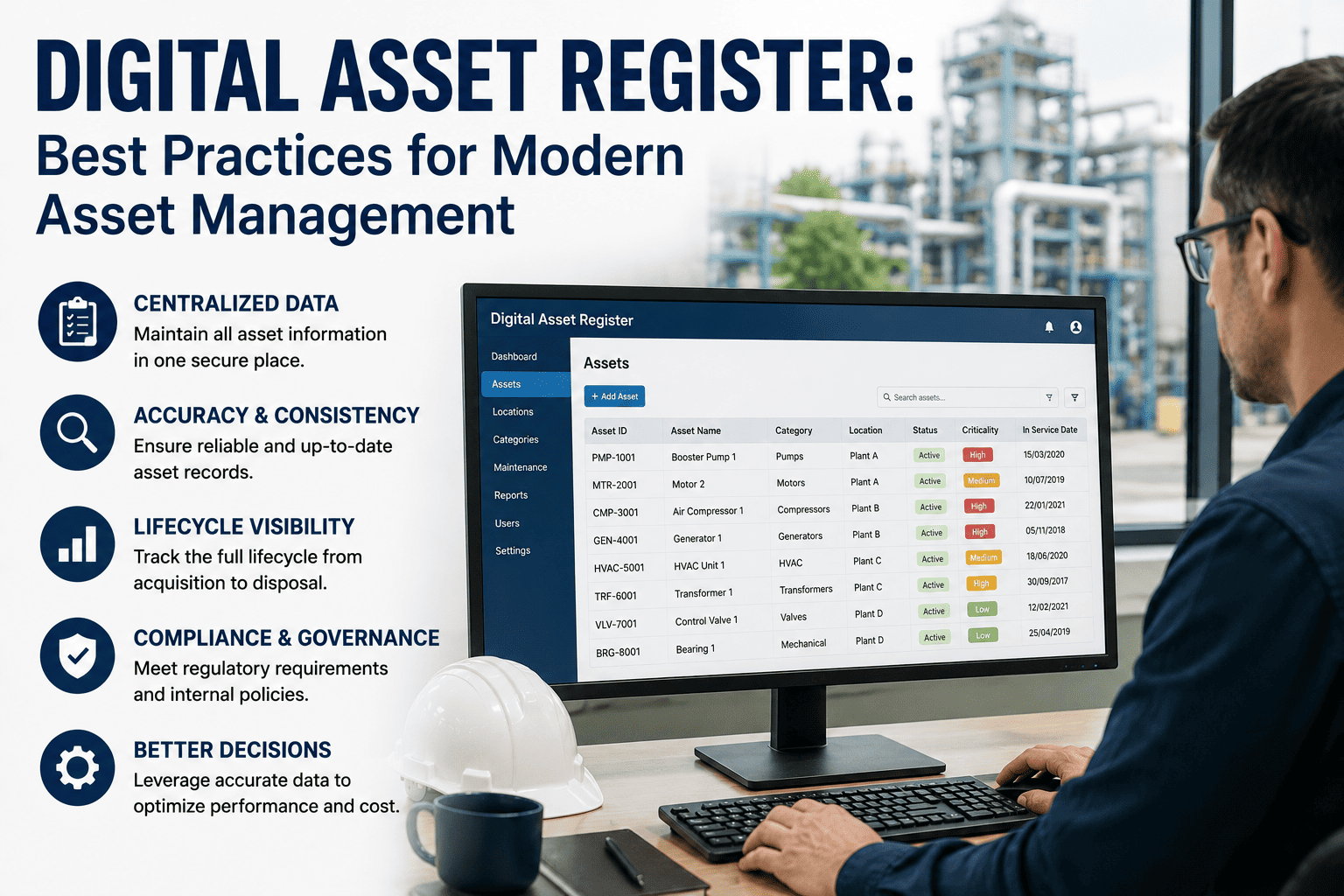
OxMaint gives every asset a complete digital record — financial, operational, and maintenance data in one place, reconciled to physical reality, not a spreadsheet nobody's updated since last year.
The Register Is the Bridge Between Physical Reality and the Books
A digital asset register is the single source of truth that connects what your organization actually owns — sitting on a factory floor, parked in a fleet lot, mounted in a server rack — to what your financial statements and maintenance plans say about it. When that bridge breaks, you get ghost assets that drain depreciation budgets for equipment that no longer exists, and unrecorded assets that nobody is maintaining because nobody knows they're there. Book a demo to see how OxMaint keeps that bridge intact in real time.
What a Complete Asset Record Actually Contains
Too few fields and the register cannot support audit, tax, or maintenance needs. Too many and the data entry burden becomes unsustainable, leading to incomplete records and steady decay. Sign up free and structure every asset record inside OxMaint around these four field categories.
Asset Tagging Methods Compared
| Tagging Method | Best For | Read Range | Relative Cost |
|---|---|---|---|
| Barcode Labels | Indoor equipment, IT assets, general inventory | Direct line of sight, close range | Low |
| QR Codes | Assets needing linked documentation or manuals | Direct line of sight, close range | Low |
| RFID Tags | High-volume inventory, fast bulk scanning | Several feet, no line of sight needed | Moderate |
| GPS / IoT Tags | Mobile equipment, vehicles, high-value assets | Real-time location, unlimited range | Higher |
Five Practices That Keep a Register Accurate Over Time
Tag Every Asset Physically and Digitally
A unique barcode, RFID tag, or numbered label on the physical item, linked directly to its digital record, is the only reliable way to prove an asset exists where the register says it does.
Schedule Recurring Physical Verification
An annual walk-through at minimum, and quarterly for high-turnover categories like IT equipment, catches ghost assets and unrecorded assets before they reach an external auditor.
Use Controlled Fields, Not Free Text
Dropdown menus and standardized categories for asset class, location, and status prevent the same field being entered three different ways across three different records.
Reconcile to the General Ledger Regularly
The register's aggregate value must match the fixed asset line items on the balance sheet — a quarterly reconciliation catches discrepancies while they're still small and explainable.
Record Disposal Immediately, Not Eventually
An asset sold, scrapped, or retired should be marked disposed in the register the same week it happens — delayed disposal entries are the most common source of ghost assets.
Spreadsheet vs. Digital Register: Where Each Breaks Down
- Manual updates mean disposal and transfer entries lag reality by weeks or months
- No link between financial record and maintenance history — two disconnected views of the same asset
- Version conflicts when more than one person edits the file
- No automated depreciation calculation or audit trail
- Status updates in real time from work orders, transfers, and disposal events
- Financial, operational, and maintenance data live on the same asset record
- Single authoritative record accessible to every authorized user simultaneously
- Automatic depreciation tracking and a complete, timestamped audit trail
How OxMaint Structures Your Digital Asset Register
Unified Asset Record
Identification, financial, location, and lifecycle data live on one record per asset — no separate spreadsheet for maintenance history and another for depreciation.
QR & Barcode Tagging
Generate and print asset tags directly from OxMaint, linking every physical label to its complete digital record for instant lookup during audits or repairs.
Scheduled Verification Cycles
Set recurring physical verification tasks by asset class — annual for general equipment, quarterly for high-turnover categories — with built-in reconciliation reporting.
Full Audit Trail
Every change to an asset record — status, location, ownership, disposal — is logged with a timestamp, giving auditors the documentation trail that prevents a failed first audit.
Make Your Next Audit a Formality, Not a Crisis
OxMaint keeps your digital asset register reconciled to physical reality — so the auditor finds exactly what the records say, every time.
Frequently Asked Questions
What is a ghost asset and why does it matter?
A ghost asset is equipment that still appears as active in the asset register and continues depreciating on the books, even though it has been sold, scrapped, or is otherwise no longer in service. Ghost assets distort financial statements, waste insurance premiums on equipment that no longer exists, and are one of the leading causes of fixed asset audit failure. Sign up free to catch these automatically with OxMaint's scheduled verification cycles.
Is a spreadsheet still acceptable for an asset register in 2026?
Spreadsheets remain workable for very small organizations with a handful of assets, but medium and large organizations should move to software-based registers to avoid the manual errors, version conflicts, and lagging updates that spreadsheets cannot prevent at scale. A spreadsheet also has no automated link between financial depreciation data and maintenance history, forcing teams to maintain the same asset's information in two disconnected places.
How often should a physical asset verification be performed?
At minimum once per year for general equipment, with quarterly verification recommended for high-turnover asset classes such as IT hardware, where devices move between users, locations, and disposal far more frequently than industrial machinery. Book a demo to see how OxMaint schedules and tracks these verification cycles automatically.
Is asset tagging actually necessary, or just a nice-to-have?
While not a direct legal requirement in most jurisdictions, asset tagging is strongly recommended by auditors because it is the only reliable way to prove an asset physically exists and matches its corresponding register entry. Without a tag connecting the physical item to its digital record, verification relies entirely on visual identification and institutional memory — both of which fail at scale.
What fields should every asset register include at minimum?
At minimum, a complete record needs identification data (asset tag, serial number, manufacturer), financial data (acquisition cost, date, depreciation schedule, current book value), location and status data (physical location, department, operational status, custodian), and lifecycle data (warranty, maintenance history, disposal information). Industry-specific fields — calibration schedules, license compliance status, condition ratings — can be added on top of this core structure as needed.