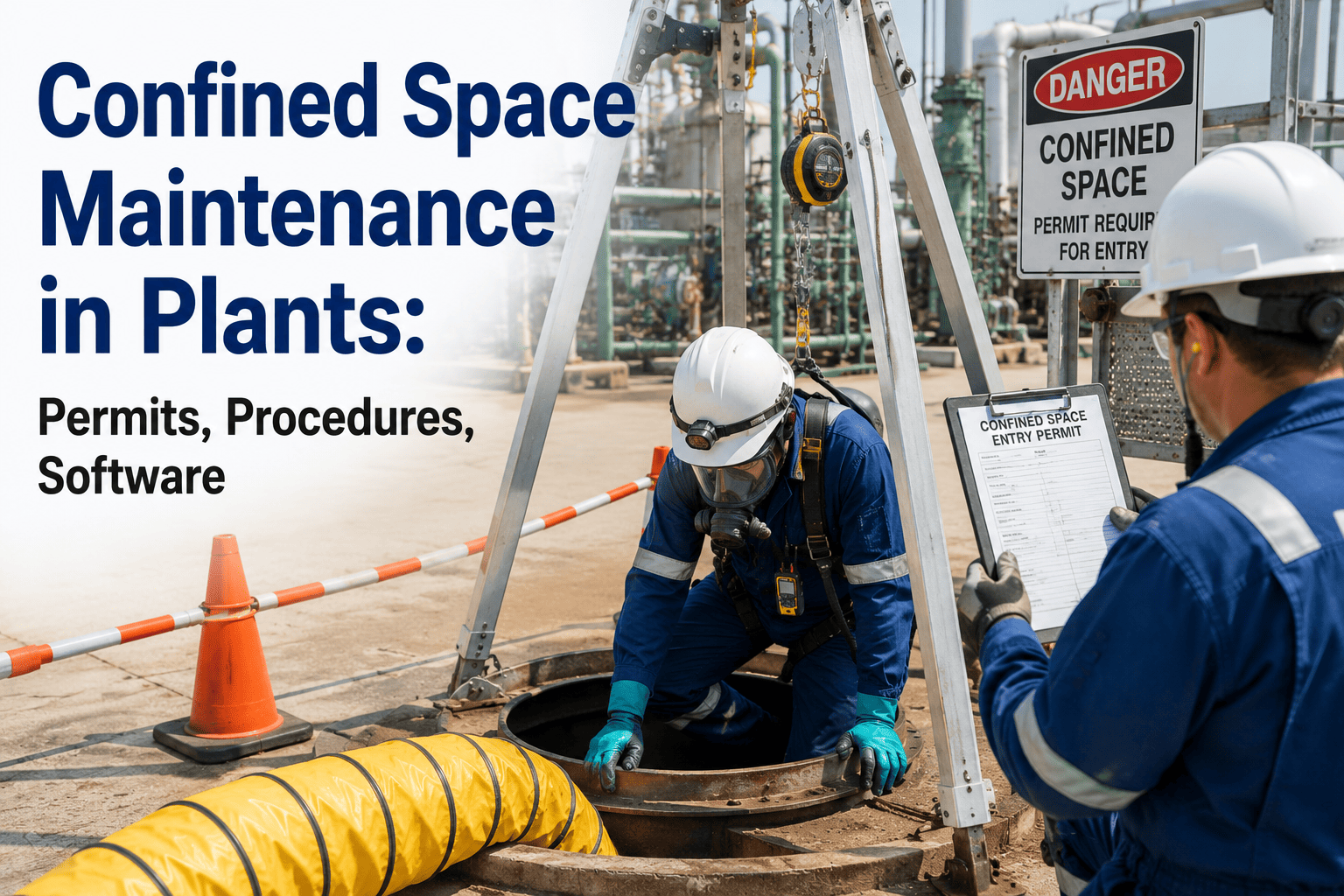
A worker collapses inside a tank. A colleague sees it happen, calls out, gets no answer, and climbs in to help — without checking the air first. Seconds later, the colleague collapses too. This sequence is not rare. Roughly 15 UK workers die in confined spaces every year, and HSE estimates that 40–60% of those deaths are people who went in to rescue someone, not the original casualty. Confined space entry is one of the few jobs where the procedure you skip can kill two people instead of one. A CMMS like OxMaint turns permits, gas readings, and standby logs into one system that nobody can shortcut without it showing.
Turn Every Confined Space Entry Into a Logged, Defensible Process
Digital permits, gas test records, standby attendance, and rescue plans — captured automatically every time an engineer enters a tank, vessel, or pit.
What Actually Counts as a Confined Space
Under the Confined Spaces Regulations 1997, a space only counts as confined if it passes two tests at once: it must be substantially enclosed, and it must carry a reasonably foreseeable specified risk. A storage cupboard is enclosed but usually has no specified risk, so it is not a confined space. A tank that is normally safe but gets purged with nitrogen for cleaning becomes a confined space the moment that risk appears — even temporarily.
Tanks & Vessels
Process vessels, storage tanks, and reactors entered for cleaning, inspection, or repair between production runs.
Silos & Hoppers
Grain, powder, and bulk material storage where engulfment by free-flowing solids is a specified risk on its own.
Pits & Sumps
Below-ground spaces where gas can settle invisibly — often the most underestimated confined spaces on a plant.
Ducts & Flues
Combustion chambers, flues, and ductwork entered for maintenance, frequently with residual heat or combustion gases.
The Three Legal Duties, In Order
Avoid Entry
If the job can be done from outside the space — with a borescope, remote tool, or external repair — entry is not reasonably practicable and must not happen.
Safe System of Work
If entry is unavoidable, a written permit-to-work must define the gas testing, ventilation, PPE, and time limits for that specific space.
Rescue Arrangements
Adequate rescue must be possible without untrained colleagues entering. Calling 999 is not an emergency arrangement on its own.
A casualty in an oxygen-deficient atmosphere has minutes, not the fifteen it typically takes for the fire service to arrive on site. Book a demo to see how OxMaint forces a named, trained rescue team onto every permit before entry is approved.
Atmospheric Testing: The Step That Saves Lives
Atmospheric hazards cause the majority of confined space fatalities, and the air inside a tank can look, smell, and feel completely normal while being lethal. Oxygen, flammability, and toxic gas must all be checked with a calibrated multi-gas monitor before anyone enters — and rechecked continuously while work continues.
| Reading | Safe Range | Below / Above Range | Action Required |
|---|---|---|---|
| Oxygen (O2) | 19.5% – 23.5% | Below 19.5% or above 23.5% | Stop entry, ventilate, retest |
| Flammable Gas | 0% LEL | Any reading above 0% | Stop entry, identify source |
| Carbon Monoxide | Below 35 ppm | Above 35 ppm | Stop entry, ventilate, retest |
| Hydrogen Sulphide | Below 10 ppm | Above 10 ppm | Stop entry, evacuate area |
A single test before entry is not enough. Conditions inside a confined space can change within minutes as work disturbs sediment, welding consumes oxygen, or ventilation fails. Continuous monitoring and a logged retest schedule are what separate a compliant entry from a lucky one. Sign up free to start logging gas readings against every permit automatically.
The Permit-to-Work: Who Signs What
Permit Issuer
A competent person who reviews the risk assessment, confirms gas testing has been done, and authorises entry for a defined time window only.
Entrant
The person inside the space, trained to recognise atmospheric changes and to exit immediately if conditions deviate from the permit.
Standby Attendant
Stationed outside the space at all times, maintaining continuous contact with the entrant and never entering to attempt a rescue themselves.
Where Confined Space Programmes Fail
The pattern behind most confined space fatalities is rarely a missing regulation — it is a permit that was issued from memory, a gas test that was skipped because "it was fine last week," or a standby attendant who stepped away for two minutes. None of these gaps show up until something goes wrong, which is exactly why paper-based permit systems keep failing the same way.
How OxMaint Manages Confined Space Entry
Digital Entry Permits
Build a space-specific permit that requires gas readings, PPE confirmation, and rescue plan sign-off before work can begin.
Gas Testing Log
Record initial and continuous atmospheric readings against each entry, with automatic flags when results fall outside safe range.
Standby & Headcount Tracking
Confirm who is inside, who is on standby, and how long they have been there, with alerts if time limits are approached.
Audit-Ready Records
Every permit, gas reading, and sign-off is timestamped and exportable — the evidence HSE expects if an incident is ever investigated.
Give Every Confined Space Entry a Procedure Nobody Can Skip
Permits, gas testing logs, standby tracking, and rescue plans — built into one system for plant teams who cannot afford a shortcut.
Frequently Asked Questions
What makes a space a "confined space" under UK law?
It must be substantially enclosed and carry a reasonably foreseeable specified risk such as fire, oxygen deficiency, toxic gas, engulfment, or drowning. A space can become confined temporarily if a specified risk only exists during certain tasks.
Is calling the fire service an adequate rescue plan?
No. The Confined Spaces Regulations require rescue to be possible without relying on external emergency services, since a casualty in an oxygen-deficient atmosphere may not survive the response time.
What gas readings are considered safe before entry?
Oxygen should read between 19.5% and 23.5%, with zero flammable gas detected and toxic gases such as carbon monoxide and hydrogen sulphide below their exposure limits, confirmed by a calibrated monitor immediately before entry.
Why do so many confined space deaths involve rescuers?
A colleague who sees someone collapse and enters to help is exposed to the exact same atmosphere that caused the first collapse, often without breathing apparatus or training, which is why untrained rescue attempts account for a large share of fatalities.
Does every confined space job need a permit-to-work?
HSE guidance treats a permit-to-work as the standard way of meeting the safe system of work duty wherever entry carries a foreseeable risk of serious injury, even for routine inspection or cleaning tasks.