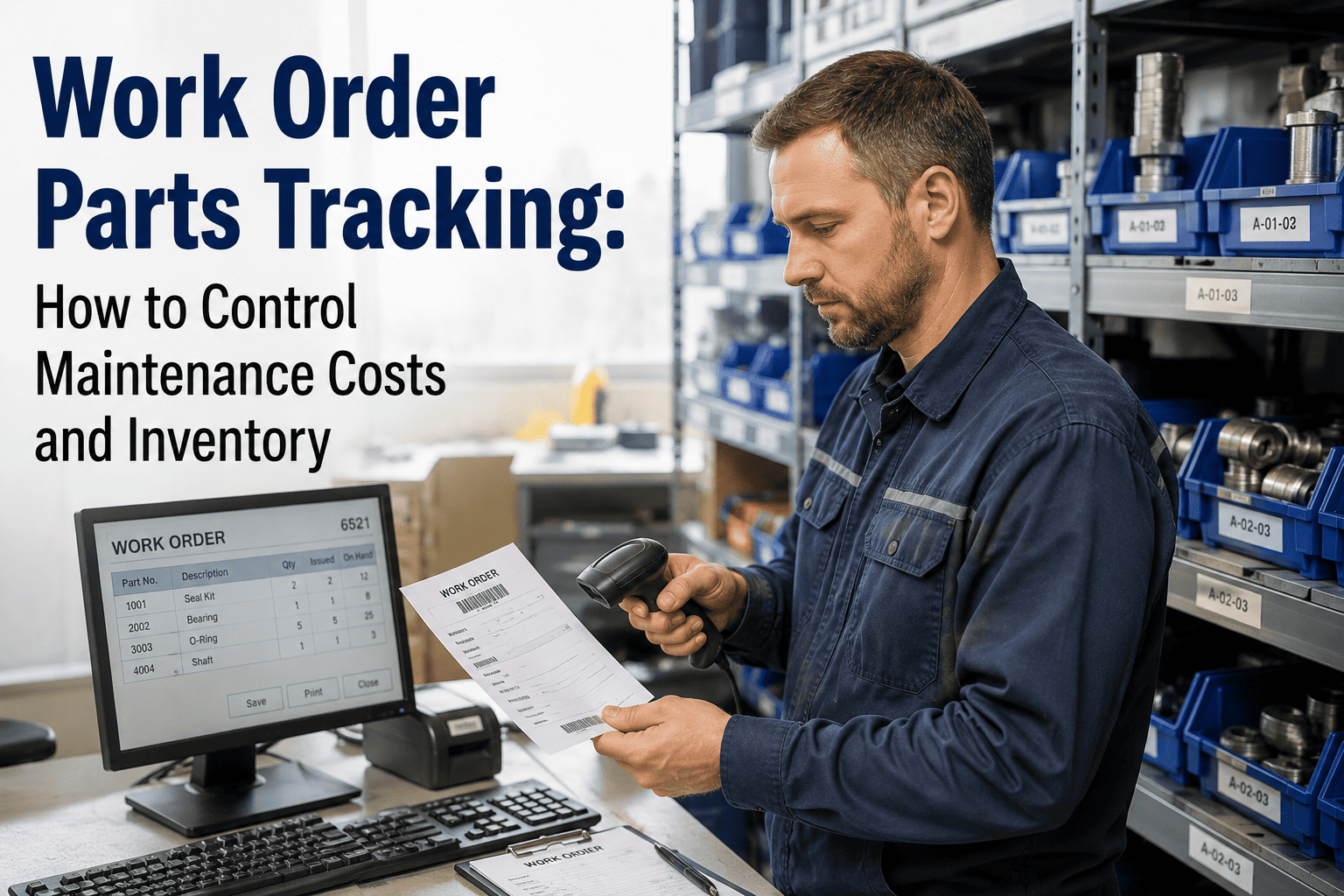
MRO inventory accounts for 40–50% of the total maintenance budget in most facilities — yet 15–25% of that inventory sits obsolete on shelves while technicians wait on emergency orders for parts that should have been stocked. The root problem is almost never insufficient inventory. It is insufficient intelligence. Without work order parts tracking, there is no way to know which assets consume the most parts, which part categories are burning budget, or whether the same failure is triggering repeat orders every 90 days. Sign up free on OxMaint to connect every part consumed directly to the work order, asset, and cost center — so your maintenance data finally tells you where money is going.
Connect Every Part to Every Work Order in OxMaint
Parts consumption logged at the work order level. Automatic inventory deduction. Per-asset cost history. Reorder triggers before stockouts. Budget reporting by cost center, asset class, or location — one CMMS built for complete parts and cost traceability.
What Work Order Parts Tracking Actually Means
Parts tracking at the work order level means every component, consumable, and material issued against a maintenance task is recorded against that specific work order — capturing the part number, quantity, unit cost, and total cost at the moment of use. This single data connection unlocks everything maintenance managers need but rarely have: true cost-per-asset reporting, parts consumption trends by failure mode, budget variance analysis, and the inventory history to make accurate replenishment decisions. Without it, maintenance cost reports are estimates at best and guesswork at worst. Book a demo to see how OxMaint links your parts catalog to every work order in real time.
Parts costs buried in blanket purchase orders — no visibility by asset or failure type
Inventory counts updated manually — or not at all — between physical counts
Stockouts discovered at breakdown — not during planning
Repeat failures on the same asset go undetected because no consumption history exists
Budget overruns identified only at month-end close — too late to course correct
Asset replacement decisions made on intuition, not documented total cost of ownership
Every part cost tied to the work order, asset, technician, and cost center that consumed it
Inventory levels deducted automatically on work order close — real-time storeroom accuracy
Reorder alerts triggered before stockout — based on actual consumption velocity, not guesswork
Repeat part consumption on the same asset flags chronic failure — driving root cause action
Parts spend tracked in real time against budget — by asset, location, or cost center
Asset lifecycle cost built from actual part and labor history — replacement decisions grounded in data
The Five Cost Problems Parts Tracking Solves
Invisible Cost Accumulation on High-Failure Assets
Without parts tracking per work order, the maintenance team may service the same pump 11 times in a year — each time consuming a seal kit, a bearing, and lubricant — without anyone ever seeing the cumulative spend. The pump that looks like a $400 repair is actually a $4,400-per-year liability. Parts tracking surfaces this pattern within the first 2–3 service events, enabling a replacement decision before the next breakdown.
Emergency Purchase Premiums from Poor Stockout Prediction
Emergency orders for parts cost 20–40% more than planned purchases — adding expedited shipping, spot pricing, and administrative overhead. The cause is almost always a failure to observe consumption velocity. When parts usage is recorded against work orders, reorder points can be set to reflect actual demand patterns rather than calendar intervals — eliminating the stockout conditions that force emergency buys in the first place.
Storeroom Bloat from Obsolete Inventory
Industry data shows 30–50% of MRO parts in most facilities have not moved in 24 months. Carrying costs on that inventory run 20–30% of value annually — meaning a $200,000 storeroom with 40% obsolete stock is spending $16,000–$24,000 per year storing parts that will never be used. Parts tracking reveals zero-movement items by cross-referencing storeroom stock against actual work order consumption records.
Budget Overruns from Unattributed Spend
When parts are purchased against department budgets rather than individual work orders and assets, there is no way to enforce cost accountability or identify which asset classes or locations are consuming budget disproportionately. Work order-level parts attribution enables true cost center reporting — so facility managers can see that one building or one equipment class is responsible for 60% of parts spend and act on it before year-end.
Inaccurate Asset Lifecycle Cost for Replacement Decisions
Replacing an asset requires justifying the capital expenditure against continued maintenance cost. Without parts tracking, that justification relies on estimates. With it, the total lifecycle cost — parts plus labor, work order by work order — is a documented number that operations and finance teams can act on. Assets that have consumed more than 80% of replacement cost in maintenance spend over 5 years are objectively retirement candidates.
How Work Order Parts Tracking Works in Practice
Work Order Created with Parts Reservation
When a PM or corrective work order is opened, the technician or planner selects the parts required from the storeroom catalog. OxMaint reserves those items against the work order — preventing another job from issuing the same stock and creating a storeroom conflict. The estimated parts cost is visible on the work order before any labor begins.
Parts Issued and Inventory Deducted in Real Time
When the technician collects parts from the storeroom — or logs them from a mobile device in the field — OxMaint deducts the quantity from live inventory immediately. No batch updates. No manual storeroom reconciliation at month end. Inventory accuracy reflects actual consumption as it happens, not as someone remembers to record it.
Actual vs Estimated Cost Captured on Close
When the work order closes, OxMaint captures the variance between estimated and actual parts cost. Parts substituted in the field — different brand, different grade, different supplier — are logged as actually consumed, not as originally specified. This real-world consumption data feeds directly into future PM planning and reorder point calculations.
Reorder Triggers Fire Before Stockout
Each parts issue updates the running consumption velocity for that part number. When stock drops to the reorder point — calculated from actual velocity, not an arbitrary number — OxMaint generates a purchase request. The storeroom manager approves and issues the PO before the next scheduled use, not after the emergency breakdown that discovers the shelf empty.
Cost Reporting Surfaces Insights at Every Level
Closed work orders feed the reporting layer: cost per asset, cost per asset class, cost per location, cost per failure mode, parts spend by cost center, and budget variance by month. Every data point is traceable back to an individual work order and part transaction — giving maintenance managers and finance teams the same source of truth for the first time.
Key Metrics Unlocked by Work Order Parts Tracking
| Metric | What It Measures | Why It Matters | Without Parts Tracking |
|---|---|---|---|
| Cost Per Work Order | Total parts + labor for each closed WO | Baseline for PM vs corrective cost comparison | Labor only — parts invisible |
| Cost Per Asset (LTM) | 12-month rolling parts + labor per asset | Drives repair vs replace decisions | Estimated from memory or spreadsheets |
| Parts Consumption Velocity | Units consumed per 30/60/90 days | Sets accurate reorder points by demand | Not calculable — reorders by gut feel |
| Emergency Order Rate | % of POs triggered by stockout vs planned | Quantifies cost premium from poor planning | Not visible until invoice arrives |
| Inventory Accuracy | System count vs physical count variance | Indicates unrecorded consumption or theft | Requires full physical count to detect |
| Obsolete Inventory % | Parts with zero WO consumption in 24 months | Targets carrying cost reduction | Only visible in annual physical count |
| Repeat Parts on Same Asset | Same part number issued 3+ times per year | Flags chronic failure — root cause signal | Not calculable without WO linkage |
| Budget Variance by Cost Center | Actual parts spend vs approved budget | Enables mid-year cost corrections | Only visible after month-end close |
Parts Tracking by Maintenance Type: What Changes
Planned Parts Consumption
PM work orders carry a pre-defined parts list — filters, lubricants, belts, seals — with expected quantities and costs. Parts are reserved in advance and the actual cost is confirmed on close. Variance between planned and actual consumption reveals unanticipated wear or incorrect BOM specifications. Over time, PM parts lists become increasingly accurate, reducing both over-ordering and mid-job stockouts.
Breakdown Parts Traceability
Corrective work orders capture which parts were required to restore function after a failure. Repeat corrective WOs consuming the same parts on the same asset are the most reliable indicator of a root cause that PM has not addressed. Parts tracking on corrective work makes the chronic failure pattern visible and quantifiable — triggering engineering review instead of a repeat repair order.
Budget vs Actual Parts Cost
Capital projects — equipment overhauls, installations, upgrades — involve large, multi-line parts orders that must be tracked against a project budget. Work order parts tracking at the project level provides a running budget-vs-actual view throughout execution, flagging scope creep or substitution costs before the project closes over budget and after the fact.
Performance Benchmarks: Tracked vs Untracked Programs
| Performance Metric | Untracked (Spreadsheet/Manual) | CMMS Work Order Parts Tracking | Improvement Range |
|---|---|---|---|
| Inventory Accuracy | 65–78% (requires physical count) | 95–99% (real-time deduction) | 20–30 point gain |
| Stockout Frequency | 12–20% of critical parts requests | 2–5% of critical parts requests | 60–75% reduction |
| Emergency Purchase Rate | 25–40% of parts orders | 5–12% of parts orders | 60–70% reduction |
| Obsolete Inventory % | 25–40% of storeroom value | 5–10% of storeroom value | 40% reduction in dead stock |
| MRO Carrying Cost | 20–30% of inventory value/year | 12–18% of inventory value/year | $40K–$60K saved per $500K inventory |
| Repeat Failure Detection | Detected after 4–6 events (intuition) | Flagged after 2–3 events (data trigger) | Root cause found 50% faster |
How OxMaint Manages Work Order Parts Tracking
Searchable Storeroom Linked to Every Work Order
OxMaint maintains a centralized parts catalog with part numbers, descriptions, storeroom locations, unit costs, min/max quantities, and preferred suppliers. Technicians search the catalog directly from the work order — selecting parts, logging quantities, and issuing stock in a single step without leaving the task view.
Real-Time Inventory Deduction on Issue
Every part issued against a work order instantly reduces storeroom count. Every part received against a purchase order instantly increases it. No batch reconciliation. Inventory levels at any moment reflect the actual state of the storeroom — not a count from last month's physical audit.
Consumption-Based Reorder Triggers
OxMaint calculates reorder points from actual consumption velocity per part number — not arbitrary minimum quantities. When stock drops to the reorder point, a purchase request is automatically generated for storeroom manager approval. Parts arrive before the next scheduled use, not after the stockout is discovered mid-repair.
Parts Cost Reporting by Asset, Location, and Cost Center
Every closed work order contributes to cumulative parts cost reporting: cost per asset over 12 months, spend by location, parts budget variance by cost center, and top-consuming assets ranked by parts value. Finance teams and maintenance managers share the same data without manual reconciliation between systems.
Asset Lifecycle Cost Built from Actual History
OxMaint accumulates parts and labor costs from every work order across an asset's life. The resulting lifecycle cost report — updated after every closed work order — gives operations managers the documented cost basis to justify equipment replacement over continued maintenance, grounded in real numbers rather than estimates.
Frequently Asked Questions
What is the difference between inventory management and work order parts tracking?
Inventory management tracks what you have in the storeroom. Work order parts tracking records what was consumed and why — linking each issue to a specific work order, asset, failure mode, and cost center. Inventory management without work order linkage tells you stock levels but cannot tell you which assets are consuming which parts, at what rate, for what reasons. Both are necessary, but the work order connection is what turns storeroom data into maintenance intelligence.
How does parts tracking help identify chronic failures?
When the same part number is issued against the same asset on multiple work orders within a defined period — typically 3 or more times in 12 months — that pattern is a repeat failure signal. Without work order linkage, this pattern is invisible because each repair appears as a standalone event. With tracking, OxMaint surfaces the pattern automatically, giving maintenance engineers the data to investigate root cause rather than continuing to replace the same part indefinitely.
How accurate is inventory without real-time work order parts deduction?
Facilities relying on periodic physical counts or manual update processes typically achieve 65–78% inventory accuracy between count cycles. With real-time deduction at the work order level, accuracy rises to 95–99%. That gap — 20–30 percentage points — is the source of most stockout surprises and most overstocking decisions, both of which have direct and measurable cost consequences.
Can parts tracking support asset replacement decisions?
Yes — and this is one of its most financially valuable uses. When total parts cost per asset is accumulated from actual work order history, maintenance managers can calculate a documented lifetime maintenance cost and compare it directly against replacement cost. Assets that have consumed 70–80% of their replacement value in maintenance spend over 5 years are objectively retirement candidates, and that case can be made to finance with real numbers rather than estimates.
How does OxMaint handle parts tracking across multiple storeroom locations?
OxMaint supports multi-location storerooms — parts can be issued from the nearest or most appropriate location, with inventory tracked separately per location. Transfers between storerooms are logged as transactions. Reporting can be run per location or consolidated across all sites, giving facility and portfolio managers a single view of spare parts availability and consumption regardless of where assets or storerooms are physically located.
Stop Guessing Where Your Maintenance Budget Goes
Work order parts tracking, real-time inventory deduction, consumption-based reorder triggers, lifecycle cost reporting, and per-asset budget visibility — OxMaint connects every part to every work order so your maintenance data finally drives decisions. Start your free trial or book a demo to see full parts and cost traceability built into your operation.