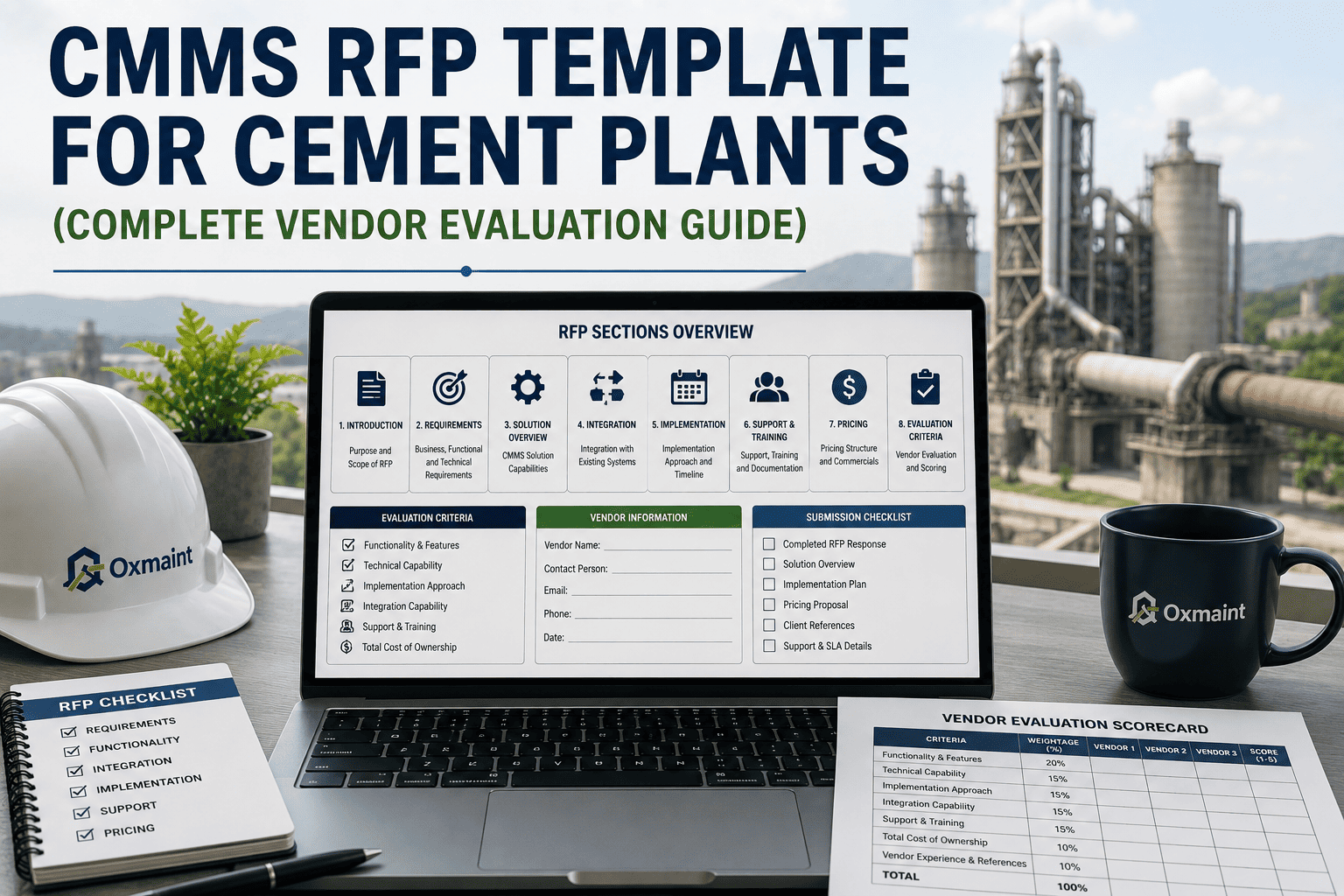
Most CMMS selection projects don't fail at implementation — they fail at the RFP stage, months before a vendor is even chosen. A requirements list copied from a generic template misses what actually matters for a cement plant: kiln and mill asset hierarchies, offline access at the quarry, integration with your ERP, and a spare parts module that can handle real inventory volume. This guide breaks down how to run a CMMS RFP that surfaces the right vendor, and gives you a ready-to-use template with evaluation criteria, scoring matrix, and implementation checklist. Start your free trial on Oxmaint or book a live demo to see how a CMMS built for cement plants stacks up against your requirements.
54%
of CMMS selections are re-run within three years due to a poor initial vendor fit
38%
of RFPs use a generic requirements list that never accounts for plant-specific workflows
6-9
months average delay when implementation support isn't evaluated during the RFP stage
85%
vendor-fit accuracy achievable with a structured, weighted scoring matrix
The 4 Gaps That Derail a CMMS RFP
Before you send an RFP to a single vendor, it helps to know why most CMMS selections go wrong. These four gaps show up across cement plant procurement projects of every size, and each one is avoidable with the right process.
01
Generic Requirements List
The RFP is built from a template that never accounts for kiln and mill asset hierarchies, quarry offline access, or plant-specific PM workflows.
02
No Weighted Scoring Matrix
Vendors are compared informally in a meeting instead of against a scored matrix, so the decision rests on impressions, not evidence.
03
Implementation Support Overlooked
The RFP focuses entirely on features and price, leaving data migration, training, and rollout timeline unasked until after the contract is signed.
04
Integration Requirements Underspecified
ERP, SCADA, and spare parts integration needs are mentioned vaguely, leading to a costly custom integration discovered mid-implementation.
See how a cement-plant-built CMMS scores against your RFP
Oxmaint is purpose-built for kiln, mill, and quarry operations — request your evaluation copy today.
How a CMMS RFP Process Comes Together: The Full Evaluation Workflow
A CMMS selection that holds up isn't decided in a single demo. It moves through a structured sequence, with each stage narrowing the field on evidence instead of a sales pitch.
1
Requirements Gathering
Document functional needs directly from maintenance, reliability, and procurement teams — asset hierarchy, PM workflows, spare parts, and mobile access.
Stakeholder interviews
Asset hierarchy needs
Mobile and offline needs
▼
2
Vendor Shortlisting
Narrow the field to vendors with demonstrated cement or heavy-industry experience, not general-purpose software adapted after the fact.
Industry experience
Reference customers
Initial fit screen
▼
3
Functional and Technical Evaluation
Score each vendor against the RFP's functional requirements, integration capability, and technical architecture in a live demo, not a slide deck.
Live demo scoring
Integration capability
Data migration approach
▼
4
Scoring and Reference Checks
Apply the weighted scoring matrix and call reference customers running similar plants to confirm the vendor delivers what the demo promised.
Weighted scoring
Reference calls
Support responsiveness check
▼
✓
Contract and Implementation Plan
The selected vendor's implementation timeline, training plan, and support model are finalized before the contract is signed, not after.
Implementation timeline
Training plan
Support SLA
What a Complete CMMS RFP Actually Evaluates
A CMMS is judged on more than its feature list. These four areas determine whether the software actually works for a cement plant once the sales team leaves the room.
F
Functional Fit
Asset hierarchy, PM scheduling, work order flow, and spare parts management matched against how your plant actually operates.
I
Implementation Support
Data migration approach, training plan, and rollout timeline, scored with the same weight as the software's feature set.
D
Data and Integration
ERP, SCADA, and sensor integration capability, along with offline access for quarry and remote plant areas.
T
Total Cost of Ownership
Licensing, implementation, training, and support cost over three to five years, not just the first-year quote.
Score your RFP against a CMMS built for cement plants
See how Oxmaint's asset hierarchy, offline access, and integration model stack up against your requirements.
Book a Demo
CMMS RFP Readiness: The Checklist
Before the RFP goes out to vendors, these six items should be locked down. If any box is open, the responses you get back won't be comparable to each other.
Functional Requirements Documented by Team
Requirements are gathered directly from maintenance, reliability, and procurement, not written by a single department alone.
Asset Hierarchy and Workflow Needs Specified
Kiln, mill, cooler, and quarry asset structures are described specifically, not left for the vendor to interpret.
Integration Requirements Defined
ERP, SCADA, and any sensor or automation integration needs are stated clearly, with expected data flow described.
Weighted Scoring Matrix Built
Evaluation criteria are weighted in advance across function, implementation, integration, and cost before any demo happens.
Implementation and Support Questions Included
Data migration approach, training plan, and support SLA are asked in the RFP itself, not discovered after signing.
Reference Customers Identified
Each shortlisted vendor is required to provide reference customers running comparable cement or heavy-industry plants.
Before vs. After: Running the RFP Process
Without a Structured RFP Process
Requirements copied from a generic software checklist
Vendors compared informally after separate, inconsistent demos
Implementation and support questions asked only after signing
Integration needs discovered mid-implementation, not upfront
Selection re-run within three years due to poor fit
With a Structured CMMS RFP
Requirements built from actual plant workflows and asset hierarchy
Vendors scored against the same weighted matrix in live demos
Implementation timeline and support model confirmed before contract
Integration needs specified and validated during evaluation
Vendor fit holds up well beyond the first year of use
Where CMMS RFPs Go Wrong
| RFP Problem |
Root Cause |
Fix |
| Vendor doesn't fit plant workflows |
Requirements copied from a generic template, not built from actual asset and PM workflows |
Requirements gathered directly from maintenance and reliability teams before drafting the RFP |
| Decision hard to defend to leadership |
Vendors compared informally instead of against a documented, weighted scoring matrix |
Weighted scoring matrix applied consistently across every vendor demo |
| Rollout delayed six months or more |
Implementation approach and timeline never asked about during the RFP stage |
Data migration, training, and rollout plan required as part of every vendor response |
| Costly custom integration discovered late |
ERP and SCADA integration needs stated vaguely in the original requirements |
Specific integration requirements and expected data flow documented upfront |
| Selection re-run within a few years |
Vendor chosen on price or a strong demo alone, without reference validation |
Reference calls with comparable plants required before final vendor selection |
Key Metrics That Strengthen Your CMMS Evaluation
F
Functional Fit Score
How closely each vendor's demo matches your documented workflow requirements, scored consistently across every vendor.
I
Implementation Timeline
Realistic go-live timeline based on data volume and integration complexity, not a vendor's best-case estimate.
T
Total Cost of Ownership
Full three to five year cost including licensing, implementation, training, and support, not just the initial quote.
R
Reference Satisfaction
Direct feedback from comparable plants on support responsiveness and whether the software held up post-implementation.
85%
vendor-fit accuracy achievable with a structured, weighted scoring matrix
6-9
months of implementation delay avoided when support is evaluated during the RFP stage
54%
fewer re-run selections when requirements are built from actual plant workflows, not a template
How Oxmaint Powers Your CMMS RFP Evaluation
Cement plants evaluating general-purpose CMMS platforms often spend months discovering gaps a purpose-built system would have covered from day one. Oxmaint is built around kiln, mill, cooler, and quarry asset structures, with offline access and integration designed for heavy-industry operations. Start for free and score Oxmaint against your own RFP requirements.
Cement-Specific Asset Hierarchy
Pre-built structures for kiln, mill, cooler, and quarry assets, matched to how cement plants actually organize equipment.
Offline Mobile Access
Shift and quarry teams can log inspections and work orders without connectivity, syncing automatically once back online.
ERP and SCADA Integration
Built-in integration pathways for common ERP and automation systems, reducing the custom integration work vendors often underquote.
Spare Parts and Inventory Management
Parts tracked against asset history and lead times, built to handle real cement plant inventory volume.
Guided Implementation and Data Migration
A defined migration and training plan is scoped before contract signing, not discovered during rollout.
Reference Customers in Cement and Heavy Industry
Speak directly with plants running comparable operations before you finalize your vendor decision.
Stop Guessing. Start Scoring Vendors on Evidence.
Oxmaint gives cement plant procurement teams a CMMS built for kiln, mill, and quarry operations, ready to be scored directly against your RFP's functional, integration, and implementation requirements.
Frequently Asked Questions
What should a CMMS RFP for a cement plant include?
A complete RFP includes functional requirements built from actual plant workflows, asset hierarchy needs for kiln, mill, cooler, and quarry, integration requirements for ERP and SCADA systems, a weighted vendor scoring matrix, and implementation questions covering data migration, training, and support SLA.
Why do so many CMMS selections get re-run within a few years?
Most re-run selections trace back to requirements copied from a generic template rather than built from actual plant workflows, and to vendors chosen without a weighted scoring matrix or reference validation from comparable operations.
How important is implementation support in a CMMS RFP?
Very. Implementation delays of six to nine months are common when data migration approach, training plan, and support responsiveness aren't evaluated during the RFP stage. These should be scored with the same weight as functional features.
Does Oxmaint provide reference customers for CMMS evaluation?
Yes. Oxmaint can connect you with reference customers running comparable cement and heavy-industry operations so you can validate functional fit, implementation experience, and support responsiveness directly before finalizing your vendor decision.