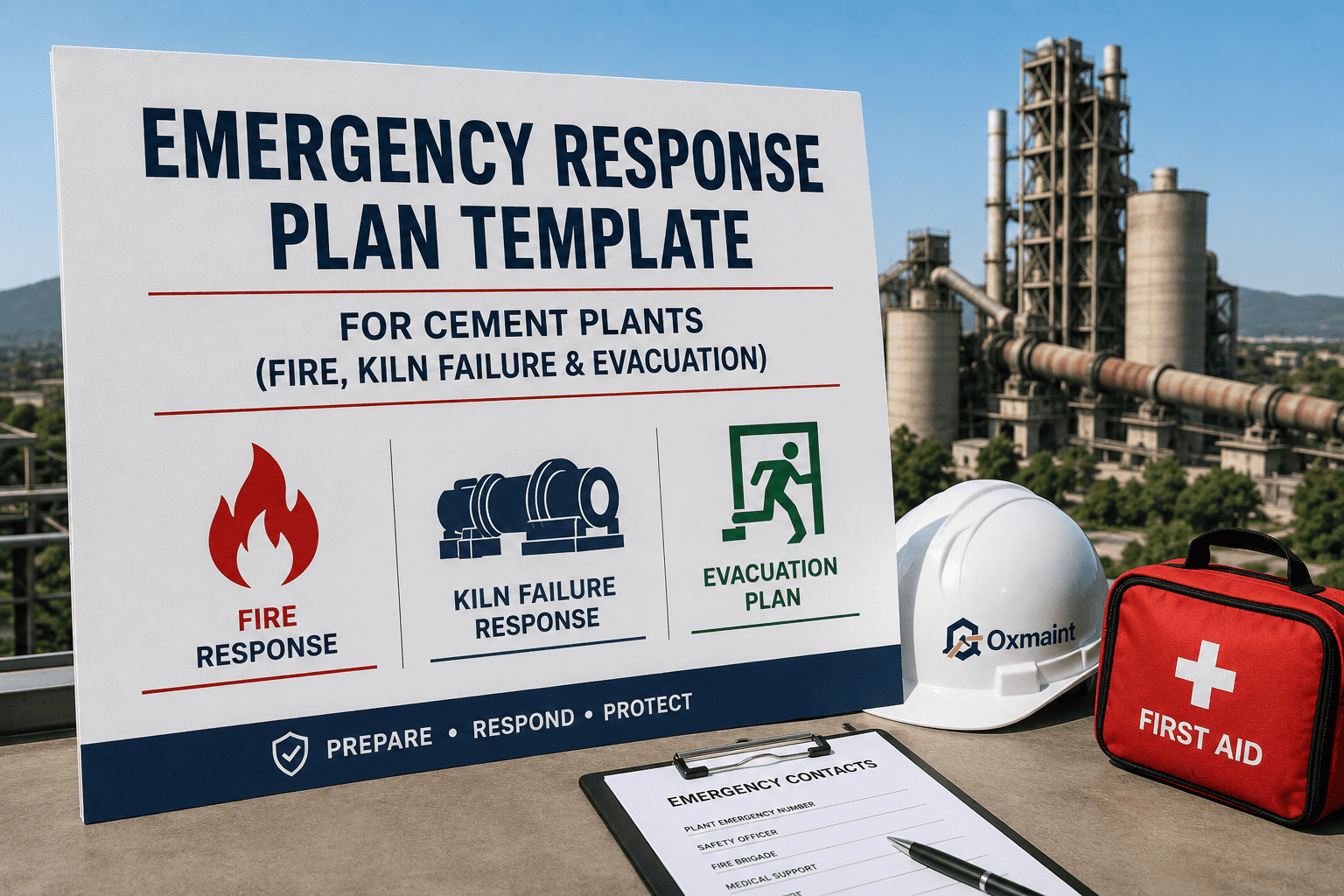
Coal handling systems and electrostatic precipitators account for roughly 68% of industrial fires in the cement sector, kilns run above 1,450°C, and SNCR systems store ammonia as a toxic-inhalation hazard just steps from the control room. A generic "in case of emergency" binder with one evacuation map doesn't match that hazard profile. This template names each scenario separately — fire, kiln emergency stop, ammonia release, and full-site evacuation — with its own trigger, response sequence, and drill cadence, so the plan actually gets followed on the day it matters. Sign up for a free trial or book a demo to see how Oxmaint keeps emergency SOPs, on-call rosters, and drill records tied to your plant's actual assets.
68%
of cement-sector industrial fires trace back to coal handling systems and electrostatic precipitators
1,450°C
the temperature rotary kilns operate above, driving distinct emergency stop and cool-down procedures
18 → 4 min
average emergency response time improvement plants report after moving from paper to digital-tracked procedures
4
distinct scenarios every cement plant ERP needs — fire, kiln stop, ammonia release, and evacuation — each drilled separately
Why a Generic Emergency Plan Doesn't Hold Up
A single "call 911 and evacuate" page looks complete until the actual incident is a kiln shell distortion at 2 a.m. or an ammonia release near the SNCR skid. Each hazard on a cement site needs its own logic, not a shared paragraph.
01
One Procedure for Every Hazard
Fire, toxic release, and mechanical failure get the same generic steps, when each demands a different immediate response and evacuation logic.
02
No Named Chain of Command
Roles are described by title only, with no backup or shift-coverage plan, so a night-shift incident stalls waiting for someone to make the call.
03
Plan Lives in a Binder, Not in Practice
The document is written once for compliance and never drilled, so the first real test of the plan is the actual emergency.
04
No Link to Equipment or SOPs
The emergency stop sequence for the kiln isn't connected to the asset's actual lockout/tagout plan or spare parts list.
Dispatch the right SOP the moment an alarm fires
See how Oxmaint auto-attaches the emergency SOP, spare parts list, and lockout plan to the asset that's failing.
The Four Scenarios This Template Names Separately
Each of these has a distinct trigger and a distinct first five minutes. The template gives each one its own page instead of folding them into one generic procedure.
F
Fire Response
Coal mill, conveyor, and ESP fire triggers, suppression system activation, area isolation, and fire brigade coordination.
K
Kiln Emergency Stop
Shell distortion, cooler grate failure, or emission-limit breach triggers a controlled stop, fuel cut-back, and clinker diversion sequence.
A
Ammonia Release
SNCR ammonia or urea leak response, including isolation distance, ventilation, and toxic-inhalation protective measures.
E
Site Evacuation
Full-site evacuation routes, muster points, headcount procedure, and coordination with quarry and remote plant areas.
Building the Plan: A Four-Step Workflow
1
Map the Hazards by Area
Identify fire, toxic release, mechanical, and confined-space hazards specific to the kiln, mill, storage, and quarry zones.
Hazard mapping
Zone-by-zone review
Confined space check
▼
2
Write the Scenario-Specific Sequence
Document the exact trigger, immediate response, and escalation path for each scenario, not a shared generic checklist.
Trigger conditions
Response sequence
Escalation path
▼
3
Assign Roles With Backups
Name a primary, backup, and deputy for every emergency role, so coverage holds across every shift.
Primary and backup
Shift coverage
Contact roster
▼
✓
Drill, Record, and Improve
Run each scenario as a scheduled drill, log the response time and gaps, and feed corrective actions back into the plan.
Drill cadence
Response time log
Corrective actions
What Belongs in Every Emergency Response Plan
Scenario-Specific Response Sequences
Fire, kiln stop, ammonia release, and evacuation each documented with their own trigger and steps.
Named Chain of Command
Every emergency role assigned a primary, backup, and deputy, covering every shift.
Evacuation Routes and Muster Points
Routes mapped for the plant, storage areas, and quarry, with a headcount procedure at each muster point.
Equipment-Linked Lockout/Tagout Plans
Kiln, mill, and mechanical emergency stops tied to the asset's specific lockout and isolation procedure.
Drill Schedule and Cadence
Each scenario drilled on a defined interval, not left untested until a real incident occurs.
Post-Incident Reporting Fields
Response time, deviations from plan, and corrective actions logged after every drill or real event.
Turn drill results into a plan that actually improves
Oxmaint logs every drill and real incident against the asset, so response times and gaps are tracked over time.
Book a Demo
Binder Plan vs. Connected Emergency Response
Paper Emergency Response Plan
One generic procedure covers fire, leak, and mechanical failure alike
Roles listed by title, with no backup for night or weekend shifts
Plan reviewed once a year and rarely drilled in between
Emergency stop steps disconnected from the asset's actual SOP
Response time and gaps go unrecorded after an incident
Connected Emergency Response
Fire, ammonia release, kiln stop, and evacuation each get a distinct sequence
Every role has a named primary, backup, and deputy for shift coverage
Scenarios drilled on a set cadence with results logged automatically
Emergency SOP, spare parts, and lockout plan attached to the asset itself
Response time and deviations tracked to drive plan improvements
Where Emergency Response Plans Fall Short
| ERP Gap |
Root Cause |
Fix |
| Response delayed in the first critical minutes |
Generic procedure doesn't match the actual hazard, so the crew loses time figuring out the right steps |
Scenario-specific sequence written and drilled for fire, kiln stop, ammonia release, and evacuation separately |
| No one available to make the call |
Emergency roles named by title only, with no backup for off-shift hours |
Primary, backup, and deputy assigned to every role, covering every shift |
| Plan fails during the actual event |
Procedures never tested outside of a paper review |
Each scenario drilled on a defined cadence, with gaps fed back into the plan |
| Kiln stop takes longer than it should |
Emergency stop sequence isn't linked to the asset's lockout/tagout plan or spare parts list |
Emergency SOP and parts list attached directly to the asset record |
| Same gap shows up in every drill |
Drill results recorded informally and not reviewed against prior incidents |
Drill and incident data logged consistently and reviewed for recurring gaps |
How Oxmaint Supports Your Emergency Response Plan
An emergency plan is only as fast as the information behind it. Oxmaint keeps SOPs, spare parts, and lockout procedures attached to the actual asset, so the right instructions surface the moment an alarm fires. Sign up to connect your emergency procedures to your plant's live asset data.
Asset-Linked Emergency SOPs
Kiln, mill, and mechanical emergency procedures attached directly to the equipment they apply to, ready the moment an alarm fires.
On-Call Roster and Auto-Dispatch
Primary, backup, and deputy roles tracked and notified automatically when a critical asset triggers an emergency event.
Drill and Incident Logging
Every drill and real event logged with response time and deviations, building a record you can act on over time.
Spare Parts and Lockout Plans Attached
Emergency stop sequences paired with the exact spare parts list and lockout/tagout plan for that asset.
Turn Your Emergency Plan Into a Practiced Response
Oxmaint keeps emergency SOPs, on-call rosters, and drill records tied to your kiln, mill, and quarry assets, so the plan works when it's actually needed.
Frequently Asked Questions
What scenarios should a cement plant emergency response plan cover?
At minimum, fire response, kiln emergency stop, ammonia or urea release from SNCR systems, and full-site evacuation, each with its own trigger, response sequence, and drill schedule rather than one shared procedure.
Why is ammonia release treated as a separate scenario from fire?
SNCR systems store ammonia or urea as a toxic-inhalation hazard, which requires isolation distances, ventilation, and protective measures that differ significantly from a fire response, so the two need distinct procedures.
How often should emergency scenarios be drilled?
Each scenario should run on its own defined cadence rather than a single annual review, with response times and gaps logged after every drill so the plan improves between real incidents.
Can Oxmaint help during an actual emergency, not just planning?
Oxmaint attaches emergency SOPs, spare parts lists, and lockout/tagout plans directly to the asset involved, so the right procedure and on-call roster are available immediately when an alarm triggers.