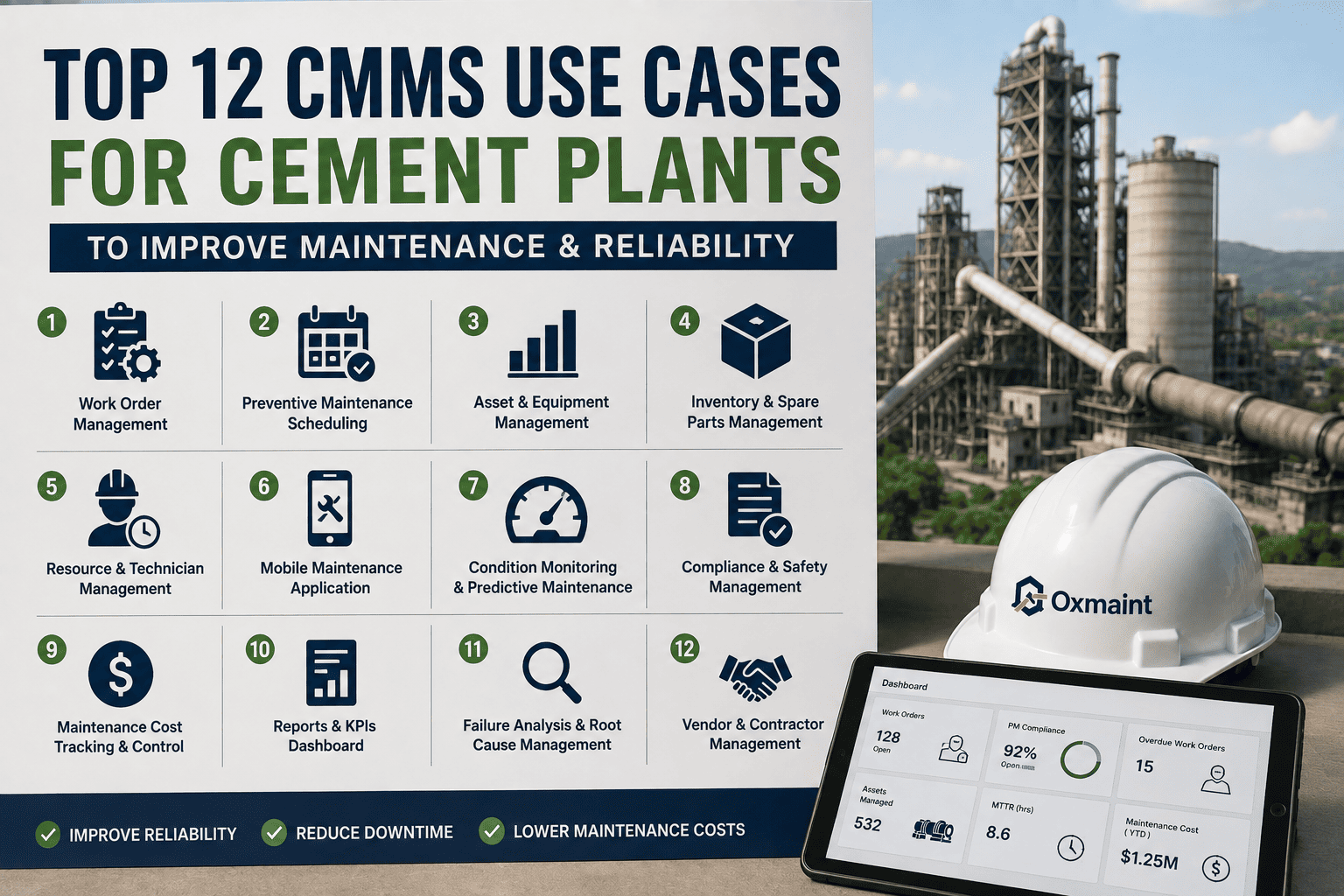
A cement plant CMMS earns its keep in more places than most teams realize when they first sign up. Beyond the obvious preventive maintenance calendar, it becomes the system tracking kiln bearing vibration, dispatching a technician the moment a mill gearbox trends hot, and holding the audit trail an ISO inspector will ask for. Plants running CMMS-driven predictive maintenance typically cut unplanned downtime by 30-50% in the first year, and most recover the cost of the platform in 90 to 120 days through avoided kiln downtime alone. Here are the 12 use cases doing that work across a real cement operation. Sign up for a free trial or book a demo to see how many of these already fit your plant.
The 12 CMMS Use Cases, Ranked by How Plants Actually Use Them
These aren't features on a spec sheet — they're the day-to-day jobs a CMMS is doing across the kiln, mill, quarry, and back office of a working cement plant.
PM tasks triggered by calendar, operating hours, or throughput for the kiln, mill, and crusher, instead of running until something breaks.
Vibration, thermal, and oil analysis data streamed into the CMMS, opening a work order the moment a reading crosses threshold.
Paper job cards and verbal handovers replaced with tracked, assigned, and auditable digital work orders from creation to close-out.
Every kiln, mill, cooler, and quarry asset registered with specs, failure modes, and full maintenance history in one record.
Stock levels, reorder points, and critical spares tracked against actual usage, so a kiln bearing isn't on backorder mid-repair.
Field technicians scan an equipment tag and complete inspection checklists on a phone, offline at the quarry if needed.
Every breakdown logged against the asset, building the failure history that reveals a bearing failing early or a recurring root cause.
ISO, environmental, and safety checklist results, evidence, and corrective actions stored against the asset for audit readiness.
Fuel, electricity, and run-hour data captured at the asset level, feeding both maintenance decisions and carbon reporting.
OEM service contracts, contractor work, and warranty claims tracked alongside internal maintenance for a complete asset record.
Critical asset alarms auto-dispatch the on-call technician with the emergency SOP, spare parts list, and lockout plan attached.
Plant-wide KPIs — OEE, downtime cost, PM compliance — visible in one dashboard instead of reconstructed from spreadsheets each month.
Which Use Cases Deliver the Fastest Payback
Not every use case pays back on the same timeline. These four tend to show measurable results first, which is why most plants start here.
Vibration and thermal alerts on the kiln drive and shell prevent the single most expensive downtime event in the plant.
Critical spares tracked against usage cut the repair delays caused by waiting on backordered parts.
Automated PM scheduling closes the gap between planned and completed maintenance, the leading cause of preventable failures.
Auto-dispatched SOPs cut response time and reduce how long a critical asset stays down once it fails.
Reactive Maintenance vs. a Connected CMMS
How Oxmaint Powers These Use Cases
These 12 use cases work best when they share the same asset data instead of living in separate systems. Oxmaint is built to run all of them from one plant-wide asset record. Sign up to see how it maps onto your kiln, mill, and quarry operations.
Pre-built structures for kiln, mill, cooler, and quarry assets, ready to load with specs and failure modes on day one.
Sensor thresholds and PM triggers generate prioritized work orders automatically, with parts and scheduling guidance attached.
Field and quarry teams complete inspections and work orders without connectivity, syncing automatically once back online.
OEE, downtime cost, PM compliance, and MTBF/MTTR visible in one place, built from the same live asset data.