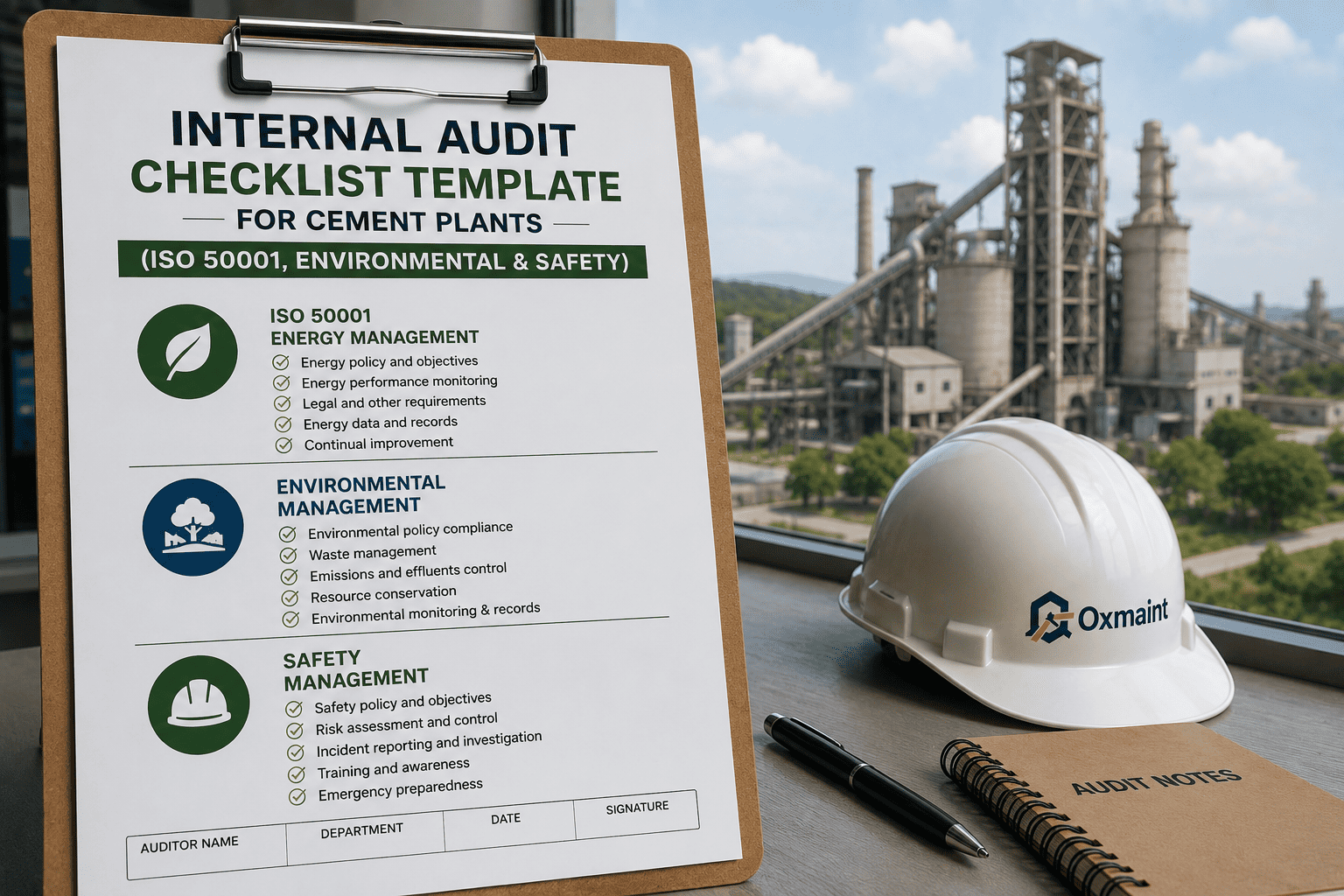
An internal audit is only as good as the checklist behind it. Most cement plants run three audits in parallel — ISO 50001 energy management, environmental compliance, and safety — often on three separate spreadsheets, with three different people chasing corrective actions afterward. The result is duplicate site walks, inconsistent evidence, and a management review that starts with "let me find last quarter's file." This template puts all three under one structure: clause-by-clause questions, evidence to capture, and a corrective action log that closes the loop. Sign up for a free trial or book a demo to see how Oxmaint keeps every audit finding tied to the asset it came from.
9.2
the ISO 50001 clause that makes internal audits a mandatory, planned-interval requirement, not optional
3
audit types most cement plants run separately — energy, environmental, and safety — that a shared checklist consolidates
1 yr
minimum recommended interval for a full internal audit cycle across all EnMS and compliance processes
100%
of findings should trace back to a corrective action with an owner and a due date before the audit is closed
Why One Audit Checklist Beats Three
Energy, environmental, and safety audits ask overlapping questions — is the equipment maintained, is the process documented, is the record on file. Running them separately means three site visits and three sets of findings that never talk to each other.
01
Duplicate Site Walks
The same kiln, compressor room, or storage area gets inspected three times a year by three different audit teams asking similar questions.
02
Findings Live in Different Files
An energy finding sits in one spreadsheet, a safety finding in another, so a recurring root cause across audit types goes unnoticed.
03
Corrective Actions Fall Through
Without a shared tracker, a finding gets logged, discussed once, and forgotten until the next audit surfaces it again.
04
Evidence Isn't Reusable
Photos, meter readings, and maintenance logs collected for one audit aren't structured to be pulled into the next one.
Run one audit, capture evidence once
See how Oxmaint links audit findings directly to the asset and work order history behind them.
The Three Audit Areas This Template Covers
Each area has its own clause structure and evidence requirements, but they share the same site, the same equipment, and often the same finding.
E
ISO 50001 Energy
Energy policy, baseline, EnPIs, significant energy uses, and objectives checked against Clause 6 planning and Clause 9.2 audit requirements.
V
Environmental Compliance
Emissions permits, waste handling, water discharge, and legal register items verified against current regulatory requirements.
S
Safety
PPE compliance, permit-to-work records, equipment guarding, and incident log review across kiln, mill, and quarry areas.
A
Corrective Action Log
Every finding across all three areas logged once, with an owner, due date, and closure evidence in a single tracker.
Running the Audit: A Four-Step Workflow
1
Plan the Audit Scope
Select the clauses, areas, and equipment in scope for this cycle, based on risk, previous findings, and time since last audit.
Clause selection
Risk-based scope
Prior findings review
▼
2
Walk the Site and Interview Staff
Work through the checklist question by question, capturing photo evidence, meter readings, and staff awareness responses on the spot.
Photo evidence
Meter readings
Staff interviews
▼
3
Log Findings and Severity
Record each non-conformity with its clause reference, severity, and supporting evidence, separating observations from major findings.
Non-conformity log
Severity rating
Evidence attached
▼
✓
Assign and Track Corrective Actions
Every finding gets an owner and a due date, tracked to closure and reviewed at the next management review meeting.
Action owner
Due date
Closure verification
What Belongs in Every Audit Checklist Section
Clause or Regulation Reference
Every checklist item tied to its specific ISO 50001 clause or environmental and safety regulation.
Question or Item to Verify
A clear, specific question an auditor can answer with evidence, not a vague topic heading.
Evidence Field
Space to attach a photo, document, meter reading, or record confirming the response given.
Conformity Rating
Conform, observation, minor non-conformity, or major non-conformity, rated consistently across all three audit areas.
Corrective Action Owner and Due Date
Every non-conformity assigned to a named owner with a realistic closure date, not left open-ended.
Previous Audit Comparison
A field showing whether this finding is new or a repeat from a prior audit cycle.
Stop chasing corrective actions in spreadsheets
Oxmaint tracks every finding back to the asset, the work order, and the person responsible for closing it.
Book a Demo
Spreadsheet Audits vs. Connected Audits
Spreadsheet-Based Audits
Energy, environmental, and safety audits run as separate exercises
Findings recorded in isolated files with no link to asset history
Corrective actions tracked by email and forgotten between cycles
Evidence photos stored locally, hard to retrieve for the next audit
Repeat findings go unnoticed across audit types
Connected, CMMS-Linked Audits
One checklist structure covers energy, environmental, and safety scope
Findings linked directly to the asset and its maintenance record
Corrective actions tracked to an owner and due date until closed
Evidence stored against the asset, searchable for future audits
Repeat findings flagged automatically across audit cycles
Where Internal Audits Break Down
| Audit Problem |
Root Cause |
Fix |
| Same non-conformity keeps recurring |
Corrective actions closed on paper without verifying the root cause was fixed |
Closure evidence required before a finding is marked resolved |
| Audit findings scattered across teams |
Energy, environmental, and safety audits tracked in separate spreadsheets |
All findings logged in one shared checklist and action tracker |
| Certification body flags missing evidence |
Photos and records collected during the walk never attached to the finding |
Evidence field required alongside every checklist item, captured on the spot |
| Management review runs on outdated data |
Audit results compiled manually weeks after the site walk |
Findings and action status available in real time from a shared system |
| New auditors miss context |
No visibility into prior findings for the same asset or area |
Previous audit history attached to each asset for quick comparison |
How Oxmaint Keeps Your Audits Connected
An audit finding is only useful if it's tied to the equipment it came from and the work that fixes it. Oxmaint keeps that link intact — from the checklist item, to the asset record, to the corrective work order. Sign up to run your next audit cycle with everything in one place.
Findings Linked to Asset Records
Every non-conformity tied directly to the equipment involved, with full maintenance history visible alongside it.
Corrective Action Work Orders
Findings convert directly into a tracked work order with an owner and due date, closing the loop without a separate system.
Evidence Storage by Asset
Photos, meter readings, and documents attached to the asset record, searchable across every past audit cycle.
Repeat Finding Alerts
Recurring non-conformities on the same asset flagged automatically, so root causes get addressed instead of re-logged.
Run Every Audit From One Connected System
Oxmaint keeps your ISO 50001, environmental, and safety audit findings tied to the assets, work orders, and people responsible for closing them.
Frequently Asked Questions
What does an ISO 50001 internal audit actually check?
It verifies that the energy management system conforms to ISO 50001:2018, covering the energy policy, baseline, significant energy uses, objectives and targets, and whether energy performance is genuinely improving, as required under Clause 9.2.
Can one checklist really cover energy, environmental, and safety audits?
Yes, as long as each item is tagged to its specific clause or regulation. The site, equipment, and much of the evidence overlap, so a shared structure avoids duplicate site walks while keeping each audit type's requirements distinct.
How often should a cement plant run internal audits?
ISO 50001 requires internal audits at planned intervals, with a full cycle typically covering all EnMS processes at least once a year. Environmental and safety audits are often run on a similar or more frequent cycle depending on regulatory requirements.
Does Oxmaint replace a dedicated audit management tool?
Oxmaint doesn't replace your audit methodology, but it keeps findings, evidence, and corrective actions linked to the actual asset and maintenance history behind them, so nothing gets lost between the audit and the fix.