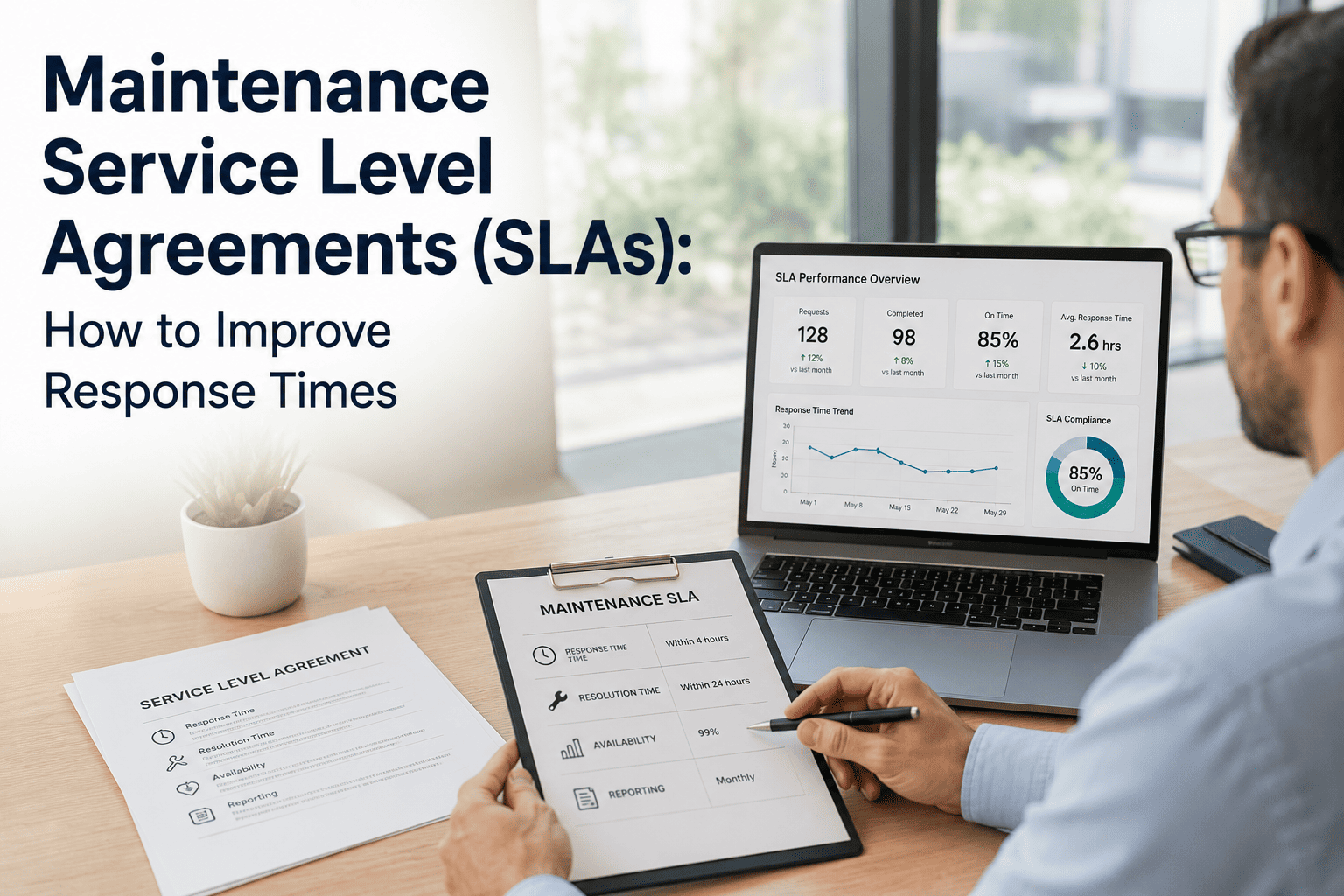
A work order is submitted. Three days pass. Nobody knows who picked it up, whether it is in progress, or when it will be done. The requester follows up by email. Then by phone. Eventually, the repair happens — but the experience damages trust between operations and maintenance more than any equipment failure could. This is what happens when maintenance teams operate without service level agreements. SLAs are not bureaucracy. They are the framework that converts maintenance requests into commitments with defined response windows, clear accountability, and measurable outcomes. This guide covers exactly how to build and run them. Sign up free on OxMaint to track SLA performance across every work order, or book a demo to see how it works in a live environment.
Track Every Work Order Against Its SLA — In Real Time, Not in a Spreadsheet
OxMaint automatically assigns SLA response and resolution targets to every incoming work order based on priority, location, and asset type — then tracks compliance in real time so managers see breaches before they happen, not after they are logged in a monthly report.
What a Maintenance SLA Is — and What It Is Not
A maintenance service level agreement is a formal commitment — between a maintenance team and the people who depend on their services — that defines what service will be delivered, within what timeframe, and how performance against those commitments will be measured. It is not a wish list. It is not a vague promise that issues will be handled "as soon as possible." Every target in an SLA must be specific, measurable, and achievable given your resources and constraints.
A maintenance SLA is
A defined response time commitment per priority level (e.g. critical faults acknowledged within 1 hour)
A resolution time target per work order category (e.g. HVAC faults resolved within 24 hours)
A measurable compliance rate tracked against every work order processed
An escalation path that activates when response or resolution windows are missed
A performance reporting framework reviewed on a regular cadence with stakeholders
A maintenance SLA is not
A promise to fix everything as quickly as possible
A single response window applied uniformly to all types of work
A document filed at contract start and reviewed only when something goes wrong
A performance framework that exists only for external contractor relationships
A reporting exercise that runs on monthly spreadsheets nobody reads until an incident occurs
The Two Core Time Commitments in Every Maintenance SLA
Every maintenance SLA is built on two time-based commitments. Both matter. Confusing them — or setting one without the other — is one of the most common structural weaknesses in maintenance SLA design. Sign up on OxMaint to track both response and resolution time against every incoming work order automatically.
Time Commitment 1
Response Time
The time from when a maintenance request is submitted to when it is formally acknowledged and accepted by the maintenance team. Acknowledgment means a qualified person has reviewed the request, confirmed it is understood, and assigned it for action.
Counts as response: Work order assigned to a technician and status updated to "In Progress" or "Acknowledged"
Does not count: Auto-confirmation email or system receipt notification — these are not human acknowledgments
vs
Time Commitment 2
Resolution Time
The time from when a maintenance request is submitted to when the fault or request is fully resolved and confirmed closed. Resolution means the asset is operational, the work is verified, and the requester is notified — not when the technician leaves the site.
Counts as resolved: Work order closed with verified completion, requester notified, asset confirmed operational
Does not count: Technician attendance or partial repair — a follow-up visit required means the clock is still running
Priority Tiers: The Foundation of Any Workable SLA
Applying a single response window to every maintenance request is not a service level agreement — it is an average. Critical safety faults and non-urgent aesthetic repairs require fundamentally different commitments. Priority tiering is how you build response differentiation into the SLA so that resources are deployed where they matter most. Book a demo to see how OxMaint assigns priority tiers automatically based on asset criticality and request type.
P1
Critical
Response:Within 1 hour
Resolution:Within 4–8 hours
Safety hazards, complete system failures, production line stoppages, fire or life-safety system faults, total HVAC failure in occupied critical spaces
P2
High
Response:Within 4 hours
Resolution:Within 24 hours
Significant operational impact, asset degradation that will worsen without prompt attention, partial system failures affecting a subset of users or production areas
P3
Standard
Response:Within 8 hours
Resolution:Within 3–5 business days
Standard corrective maintenance, non-urgent breakdowns, comfort issues without operational impact, planned minor repairs
P4
Low
Response:Within 2 business days
Resolution:Within 10–15 business days
Cosmetic repairs, general improvement requests, non-urgent preventive work items, requests with no operational impact if deferred
These are reference benchmarks — the right targets for your operation depend on asset criticality, team capacity, site coverage hours, and the nature of your business. What matters is that the tiers are defined, communicated, and enforced consistently.
The 7 Elements Every Maintenance SLA Must Contain
A maintenance SLA that leaves any of these elements undefined will produce disputes, missed expectations, and accountability gaps. Each element earns its place by removing a specific category of ambiguity. Sign up free on OxMaint to manage all of these in one system for every site and every work order type.
01
Scope of Services
Define exactly which assets, systems, and request types are covered. Explicitly list what is excluded. If HVAC is covered but specialist contractor callouts are not, say so. Scope ambiguity is the source of most SLA disputes and most disappointments about what "the SLA covers."
02
Priority Definitions and Classification Criteria
Define what qualifies as P1 versus P2 versus P3. Include examples. The classification decision happens at the point of request — if criteria are ambiguous, requesters will over-classify to get faster service, which degrades response time data and dilutes the meaning of critical priority designation.
03
Response and Resolution Time Targets per Priority
The core commitments. State them as binding targets, not aspirational guidelines. Define exactly what constitutes "response" — a human acknowledgment with assignment, not a system auto-reply. Define exactly what constitutes "resolved" — confirmed operational, not technician departure.
04
Coverage Hours and Exclusions
State the hours within which SLA clocks run. A 4-hour response target during business hours is a different commitment to a 4-hour response target on a 24/7 basis. Define bank holidays, out-of-hours coverage tiers, and whether on-call arrangements apply to P1 requests outside standard hours.
05
Escalation Procedures
Define what happens when a response or resolution window is about to be missed. Who is notified? At what point before the breach? Who has authority to re-prioritize or add resource? A well-designed escalation path converts SLA monitoring from a reporting exercise into a real-time management tool.
06
Measurement Method and Reporting Frequency
Define the metrics, how they are calculated, and how often performance is reported. SLA compliance rate, mean time to respond (MTTR), and mean time to resolve (MTTRes) per priority tier are the standard measures. Define reporting cadence — weekly dashboards for operations, monthly summaries for management, quarterly reviews with stakeholders.
07
Remedies for Consistent Breaches
For external contractor SLAs, define service credits or contractual remedies when compliance falls below agreed thresholds. For internal team SLAs, define the review and improvement process triggered when compliance dips — resource review, root cause analysis, target recalibration. SLAs without consequences for failure are not agreements — they are aspirations.
KPIs to Track SLA Performance
Defining SLA targets is the first step. Measuring whether you are meeting them — and understanding why when you are not — requires a small set of metrics tracked consistently across every work order. Book a demo to see how OxMaint generates these metrics automatically from your maintenance data.
SLA-C
SLA Compliance Rate
Work orders resolved within SLA target ÷ Total work orders × 100
Target: 90%+ overall; 98%+ for P1
Primary health metric for the entire SLA program. Track per priority tier, per site, and per asset category to identify where compliance is weakest.
MTTR
Mean Time to Respond
Sum of all response times ÷ Total number of work orders in period
Target: Below SLA threshold per priority tier
Measures acknowledgment speed across the full volume of requests. Rising MTTR signals staffing gaps, notification failures, or routing delays before they become compliance breaches.
MTTRes
Mean Time to Resolve
Sum of all resolution times ÷ Total number of closed work orders
Target: Below SLA threshold per priority tier
Measures total cycle time from request to close. The delta between MTTR and MTTRes reveals where time is being lost — in diagnosis, parts sourcing, or technician scheduling.
FTR
First-Time Resolution Rate
Work orders closed without repeat visit ÷ Total work orders closed × 100
Target: 80%+ for all priorities
Tracks whether repairs are genuinely resolving faults on the first visit. Low FTR masks compliance rate performance — a work order closed within SLA but reopened the next day is not a resolved fault.
ESC
Escalation Rate
Work orders that triggered escalation ÷ Total work orders × 100
Target: Under 5% of total volume
Measures how frequently the escalation path is activated. A rising escalation rate is a leading indicator of capacity problems or resource constraints before they surface in compliance data.
BRK
SLA Breach Count by Cause
Categorized count of breaches by root cause: parts delay, staffing gap, access denied, scope unclear
Target: Trend declining month over month
The most actionable SLA metric. Knowing why you breached identifies the fix — parts availability, technician scheduling, request routing, or escalation path gaps — rather than just confirming that a breach occurred.
Why Maintenance SLAs Fail — and How to Fix Each One
Most SLA failures trace back to a small number of structural problems that are predictable and fixable. Understanding them before you design the SLA prevents building failure into the framework from the start. Sign up free on OxMaint to build SLA tracking into your work order process from day one — removing the most common failure points automatically.
Targets set without capacity data
Response times defined by what looks good in the SLA, not what the team can actually achieve with current headcount and asset volume
Run work order volume analysis before setting targets. 4-hour P2 response is unachievable if average daily demand exceeds available technician hours by 30%.
No real-time SLA tracking
SLA performance only reviewed in monthly reports — breaches are identified after they happen, not in time to intervene and prevent them
Automate SLA timers in your work order system. Managers need to see which work orders are approaching breach before it happens — not after.
Inconsistent priority classification
No clear criteria for P1 vs P2 vs P3 — requesters over-classify to get faster service, skewing compliance data and depleting P1 response capacity
Publish classification criteria with examples. Configure request forms so priority selection is guided, not free-text. Review classification accuracy monthly.
SLA applies to contractor, not team
External contractor SLAs are actively managed, but internal team performance has no equivalent accountability framework — creating a two-tier standard
Apply the same SLA framework to internal teams as an Operational Level Agreement (OLA). Internal accountability is as important as contractor accountability.
SLA never reviewed after launch
Targets set at contract start remain unchanged for years — even as team size, asset base, and operational demands shift significantly
Schedule quarterly compliance reviews with stakeholders. Annual recalibration of targets based on actual performance data and capacity changes.
Internal SLAs vs. Contractor SLAs: Key Differences
The structure of a maintenance SLA differs depending on whether it governs an internal maintenance team or an external contractor. Both need the same core elements — but the accountability mechanisms differ meaningfully.
Internal Team SLA
(Operational Level Agreement)
Agreed between maintenance manager and operations or facilities leadership
Accountability through performance reviews, not contract penalties
Breach remedies: resource review, workload rebalancing, root cause analysis
Flexible revision cycle — can be adjusted quarterly without contract renegotiation
Builds internal team ownership of service quality and response performance
External Contractor SLA
(Contractual Commitment)
Legally binding — forms part of the service contract and is enforceable
Accountability through service credits, financial penalties, or termination clauses
Breach remedies defined in contract: credit percentage per missed hour or per incident
Revision cycle tied to contract renewal — mid-term changes require mutual agreement
Requires verified measurement — contractor cannot self-report SLA compliance
How OxMaint Manages Maintenance SLAs
SLA management fails when response time tracking lives in a spreadsheet, priority classification happens informally, and compliance data only surfaces in monthly reports. OxMaint embeds SLA management into the work order process — so the clock starts automatically, escalations fire before breaches happen, and compliance data is available in real time. Sign up free — no hardware required to get started.
WO
Automatic SLA Assignment
Every work order is automatically assigned a response and resolution target when it is created — based on priority tier, asset type, and site configuration. No manual SLA tracking. The clock starts the moment the request is submitted.
ES
Escalation Alerts Before Breach
Managers receive automatic alerts when a work order is approaching its SLA window — not after it has been breached. Configurable warning thresholds let teams intervene in time to re-assign, expedite, or escalate before the commitment is missed.
DH
Live SLA Dashboard
SLA compliance rate, MTTR, and MTTRes are visible in real time by priority tier, site, asset category, and technician. Stakeholders have access to live performance data rather than waiting for a monthly report that is already weeks out of date.
RP
Performance Reports for Reviews
Exportable SLA performance reports covering compliance rate, breach count by cause, response time trends, and first-time resolution rate — structured for quarterly stakeholder reviews and contractor performance conversations.
Stop Finding Out About SLA Breaches in the Monthly Report
OxMaint tracks every work order against its SLA target in real time — automatic assignment, pre-breach escalation alerts, live compliance dashboards, and performance reports ready for every stakeholder review. Sign up free and run your first SLA compliance report within a week.
Frequently Asked Questions
What is a maintenance SLA?
A maintenance service level agreement (SLA) is a formal commitment that defines what maintenance service will be delivered, within what timeframe, and how performance will be measured. It sets response time targets — how quickly the maintenance team acknowledges a request — and resolution time targets — how quickly the fault or request is fully resolved — for each priority tier of work. SLAs apply to both internal maintenance teams (where they are often called Operational Level Agreements or OLAs) and external contractors (where they form part of the service contract). The goal is to convert maintenance requests into commitments with defined accountability, clear escalation paths, and measurable performance outcomes. Sign up on OxMaint to track SLA compliance across every work order automatically.
What are typical maintenance SLA response times?
SLA response times vary by priority tier and operational context. Typical benchmarks are: critical faults (P1) — acknowledged within 1 hour, resolved within 4–8 hours; high priority (P2) — acknowledged within 4 hours, resolved within 24 hours; standard (P3) — acknowledged within 8 hours, resolved within 3–5 business days; low priority (P4) — acknowledged within 2 business days, resolved within 10–15 business days. These are reference benchmarks, not universal standards. The right targets for your operation depend on asset criticality, team capacity, site coverage hours, and the nature of your business. What matters is that targets are achievable given actual resources, clearly defined, and consistently enforced across all request types. Book a demo to see how OxMaint assigns these targets per work order automatically.
What KPIs should you use to measure maintenance SLA performance?
The core maintenance SLA KPIs are SLA compliance rate (percentage of work orders resolved within the defined target — target 90% overall, 98% for P1), mean time to respond (average time from request submission to acknowledgment), mean time to resolve (average time from request submission to confirmed close), first-time resolution rate (percentage of work orders closed without a repeat visit — target 80% or higher), escalation rate (percentage of work orders triggering escalation — target under 5%), and SLA breach count categorized by root cause. The most actionable metric is breach cause analysis — knowing whether breaches are driven by parts delays, staffing gaps, access issues, or routing failures identifies the specific fix required rather than simply confirming that performance fell short.
What is the difference between response time and resolution time in a maintenance SLA?
Response time is the time from when a maintenance request is submitted to when it is formally acknowledged and accepted by the maintenance team — meaning a qualified person has reviewed the request and assigned it for action. An automated system receipt notification does not constitute a response. Resolution time is the time from request submission to when the fault or request is fully resolved — the asset is operational, the work is verified, and the requester is notified. Technician arrival or partial repair does not constitute resolution; if a follow-up visit is required, the resolution clock is still running. Both commitments must appear separately in every maintenance SLA because they measure fundamentally different stages of the service delivery process, and managing one without the other creates gaps in accountability.