Every manufacturing plant has assets that simply cannot fail. When a pressure vessel, overhead crane, or conveyor belt goes down unexpectedly, the cost is not just the repair — it is lost production, safety liability, and regulatory scrutiny. Yet the most common question maintenance managers still ask is: how often should we actually be inspecting this equipment? The answer depends on risk, regulation, and asset history — not gut feeling. Sign up free on OxMaint to build inspection schedules per asset, or book a demo to see risk-based inspection in action.
Schedule Smarter. Inspect Fewer Times. Miss Nothing.
OxMaint builds risk-based inspection intervals per asset — so your team inspects the right equipment at the right time, with auto-generated checklists and work orders.
Why Inspection Frequency Is Not One-Size-Fits-All
Not all equipment carries the same risk. A conveyor belt in a dry warehouse behaves very differently from one in a chemical processing environment. Risk-based inspection (RBI) is the methodology that bridges this gap — it evaluates failure probability combined with the consequence of that failure to determine how often each asset needs eyes on it.
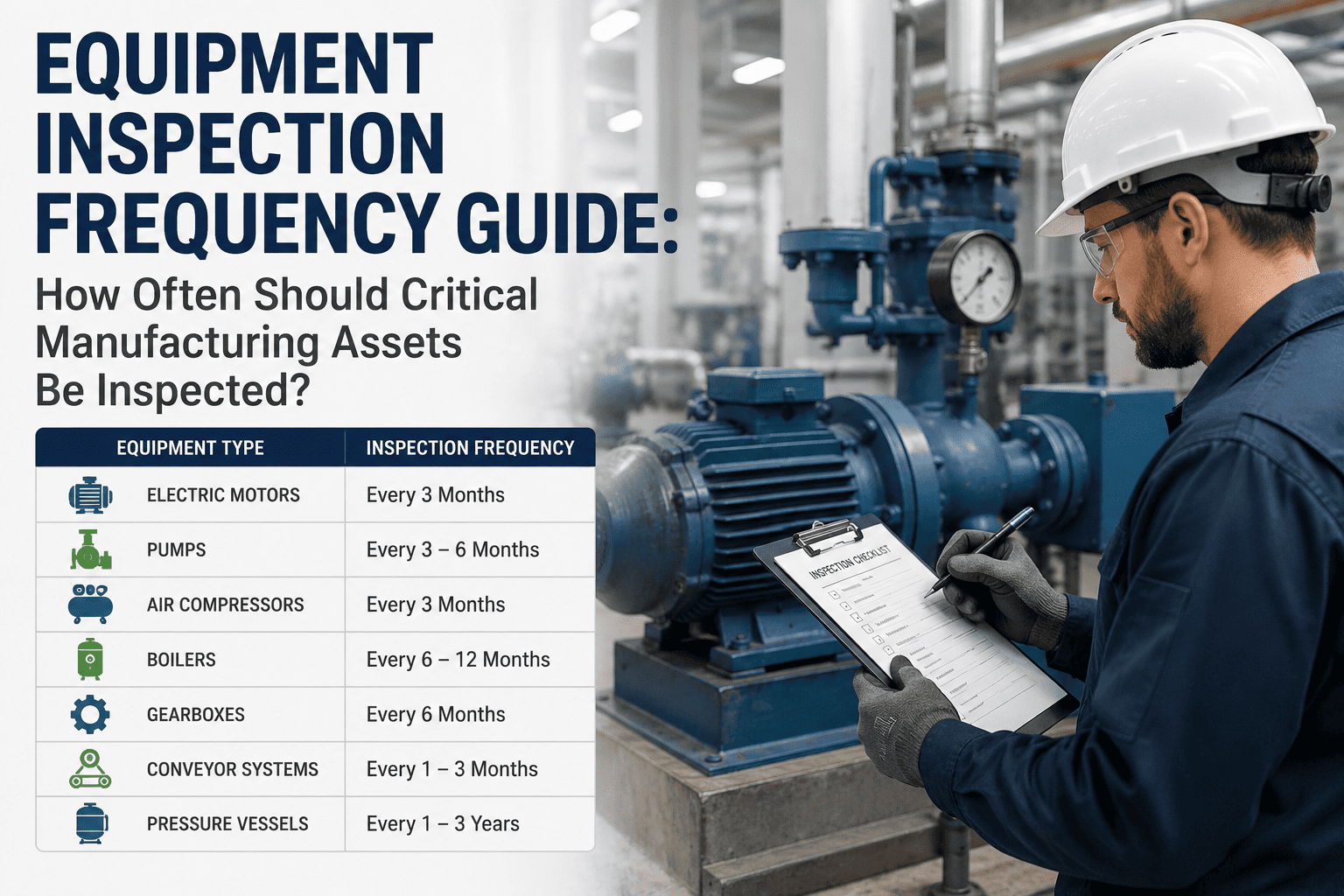
Inspection Frequency by Asset Type: The Reference Guide
These intervals reflect OSHA standards, ASME codes, and established industry practice. They represent minimums — your site conditions, failure history, and regulatory jurisdiction may require shorter intervals. Sign up on OxMaint to map these intervals directly to your asset register.
Pressure Vessels: What the Regulations Actually Require
Pressure vessels are among the most heavily regulated assets in any manufacturing plant. Under ASME Section VIII and API 510, a comprehensive internal inspection is required every 3 to 5 years. External inspections — visual and ultrasonic wall thickness checks — should happen annually. In harsh chemical or high-temperature environments, the interval shortens. Book a demo to see how OxMaint tracks inspection due dates per vessel automatically.
Cranes: Two-Tier Inspection Is Non-Negotiable
OSHA 1910.179 is explicit: crane inspections come in two tiers — frequent (daily to monthly) and periodic (monthly to annually). The tier that applies depends on duty classification and operating conditions. Heavy-duty cranes in demanding environments may require daily checks. Standby cranes need inspection at minimum every six months before returning to service. Sign up free to assign duty-based inspection tiers to each crane in your plant.
The Risk Matrix: Where to Start When You Have Limited Resources
When you cannot inspect everything at the same frequency, the risk matrix tells you where to spend your hours. Plot each asset on consequence of failure versus probability of failure. High consequence and high probability assets demand the shortest inspection intervals — and the most detailed checklists.
What a Compliant Inspection Record Must Include
Running inspections is only half the compliance equation. If you cannot prove it happened, it did not happen. OSHA audits and insurance claims both require documentation that holds up under scrutiny. Sign up free on OxMaint to capture every required field from the field — no paperwork, no after-the-fact data entry.
OSHA's current penalty structure reaches $16,550 per serious violation and $165,514 per willful violation. Incomplete records — missing inspector credentials, undocumented findings, or no follow-up work orders — are treated as documentation failures, not minor oversights. The gap between running an inspection and proving it was done correctly is where most enforcement actions begin.
How OxMaint Eliminates the Compliance Gap
Most inspection programs fail not because technicians skip inspections, but because the documentation never catches up with the field work. OxMaint puts the inspection requirement inside the work order — so every check, every finding, and every follow-up is captured in one place before the technician leaves the asset.
Stop Managing Inspection Schedules in Spreadsheets
OxMaint tracks inspection due dates per asset, auto-generates checklists, converts findings to work orders, and stores audit-ready records — all from a phone in the field. No hardware required to start.
Frequently Asked Questions
How often should pressure vessels be inspected in a manufacturing plant?
Under ASME BPVC and API 510, pressure vessels require external inspection annually (or quarterly in corrosive environments) and internal inspection every 3 to 5 years. OSHA and state codes may impose shorter intervals for specific applications. When wall thickness readings show a declining trend, the internal inspection interval shortens accordingly. Sign up on OxMaint to track thickness measurement history per vessel and receive automated interval recommendations.
What is the OSHA requirement for crane inspection frequency?
OSHA 1910.179 divides crane inspection into frequent inspections (daily to monthly) and periodic inspections (monthly to annually), with the specific interval driven by duty classification, service severity, and environment. Standby cranes must be inspected at least semi-annually before returning to active service. A single annual inspection does not satisfy OSHA, ASME B30.2, or CMAA requirements for cranes in regular service. Book a demo to see how OxMaint assigns duty-tier inspection schedules to each crane automatically.
What is risk-based inspection and how does it apply to manufacturing assets?
Risk-based inspection (RBI) is a methodology standardized under API 581 and ASME PCC-3 that uses failure probability and consequence of failure to set inspection intervals for each asset. Instead of applying a uniform schedule to all equipment, RBI concentrates inspection resources on assets where the combination of likelihood and impact is highest. In practice, a critical pressure vessel in a corrosive environment gets inspected far more frequently than a low-duty conveyor in a controlled environment — both on evidence, not assumption.
How long must equipment inspection records be kept?
OSHA generally requires inspection and maintenance records to be retained for the lifetime of the equipment, with some standards specifying minimum periods of 3 to 5 years. For assets regulated under specific codes — boilers, pressure vessels, cranes — the record must be accessible on request and include the inspector's credentials, findings, and any corrective actions taken. Electronic storage is fully acceptable and strongly recommended for multi-site operations. Sign up free on OxMaint for cloud-based inspection records with automatic retention management.