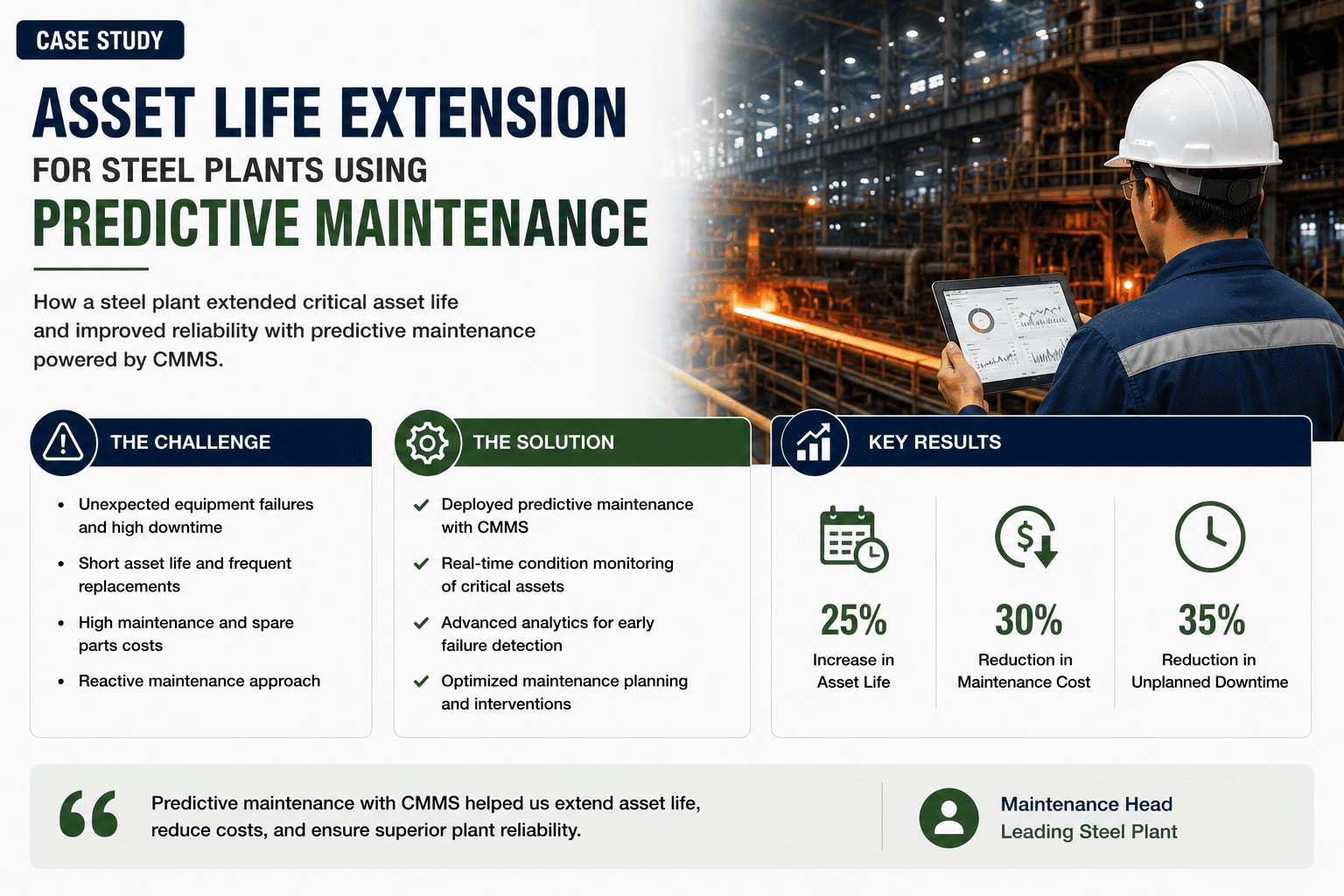
Capital budgets for steel plant equipment tend to follow a familiar rhythm, replace it when it fails, or replace it on a fixed schedule that assumes the worst-case wear rate. Neither approach asks the more useful question, how much life is actually left in this asset right now. One plant switched to condition-based monitoring on its highest-value equipment and found it could safely run assets meaningfully longer, deferring millions in planned capital spend without adding risk. Sign up to see how much life might be left in your own critical assets.
+30% Asset Life
Extension in operating life on monitored critical assets
$2.4M Deferred
Annual capital expenditure delayed through condition-based life extension
97% Availability
Uptime on monitored assets, up from the reactive-era baseline
The Problem
Major assets were replaced on fixed capital cycles set years earlier, built around a worst-case wear assumption. Some equipment was pulled and replaced with real life still left in it, while other assets ran past safe limits between scheduled reviews, and nobody had the data to tell which was which.
Where Asset Life Was Extended
Rolling Mill Rolls
Vibration and surface wear trending replaced fixed-interval swaps
Crane Wire Ropes
Condition inspections extended safe service beyond the calendar-based cycle
Drive Motor Insulation
Thermal and electrical signature monitoring caught degradation early, without early replacement
Furnace Refractory
Lining thickness modeling let campaigns run longer than conservative time-based reline schedules
Know How Much Life Is Really Left In Your Assets
Oxmaint tracks condition data against each asset's actual wear, not just a fixed replacement calendar. Sign up for a free trial to see it against your own critical assets, or book a demo to walk through your capital planning.
Asset Strategy Before And After
| Metric |
Before |
After |
| Replacement decisions |
Fixed calendar cycles based on worst-case wear |
Timed to each asset's actual measured condition |
| Capital expenditure timing |
Locked years in advance, hard to defer |
Backed by condition data, deferrable where safe |
| Asset availability |
Lower, with unplanned failures between reviews |
Higher, with degradation caught before failure |
| Reliability evidence for audits |
Limited to periodic inspection reports |
Continuous condition record between inspections |
The Results
Extending asset life didn't mean pushing equipment past its limits, it meant replacing the worst-case assumption with real condition data. That shift let the plant defer capital spend where it was genuinely safe to do so, while catching the assets that needed attention sooner than the old schedule assumed.
Frequently Asked Questions
Q
How does predictive maintenance actually extend asset life?
It replaces fixed replacement schedules with real condition data, so equipment is serviced or replaced based on its actual wear rather than a conservative worst-case estimate.
Q
Does deferring capital expenditure increase the risk of failure?
Not when it's backed by continuous condition data, deferral only happens on assets where the measured wear shows genuine remaining life, not on assets already trending toward failure.
Q
Which assets benefit most from condition-based life extension?
High-value, high-wear equipment like rolling mill rolls, crane wire ropes, drive motors, and refractory linings tend to show the largest returns, since even small extensions defer significant capital cost.
Get More Life Out Of The Assets You Already Have
Oxmaint turns condition data into a clear picture of how much life is left in your critical equipment, so capital decisions aren't guesswork. Sign up for a free trial to see it against your own critical assets, or book a demo to walk through your capital planning.