Brakes are the single most-cited defect at UK roadside stops and the largest category of mechanical out-of-service violations across commercial fleets. They rarely fail all at once — air leaks, slack adjuster drift, and lining wear build in stages over weeks, quietly stretching stopping distances until a laden vehicle can no longer stop the way it should. For any operator running under an O-licence, the DVSA expects a documented brake performance assessment at every safety inspection, records retained for at least 15 months, and a system that proves it. OxMaint maintenance management software turns that obligation into an automated, audit-ready schedule across your whole fleet. Start a free OxMaint trial or book a 30-minute demo to see brake compliance run itself.
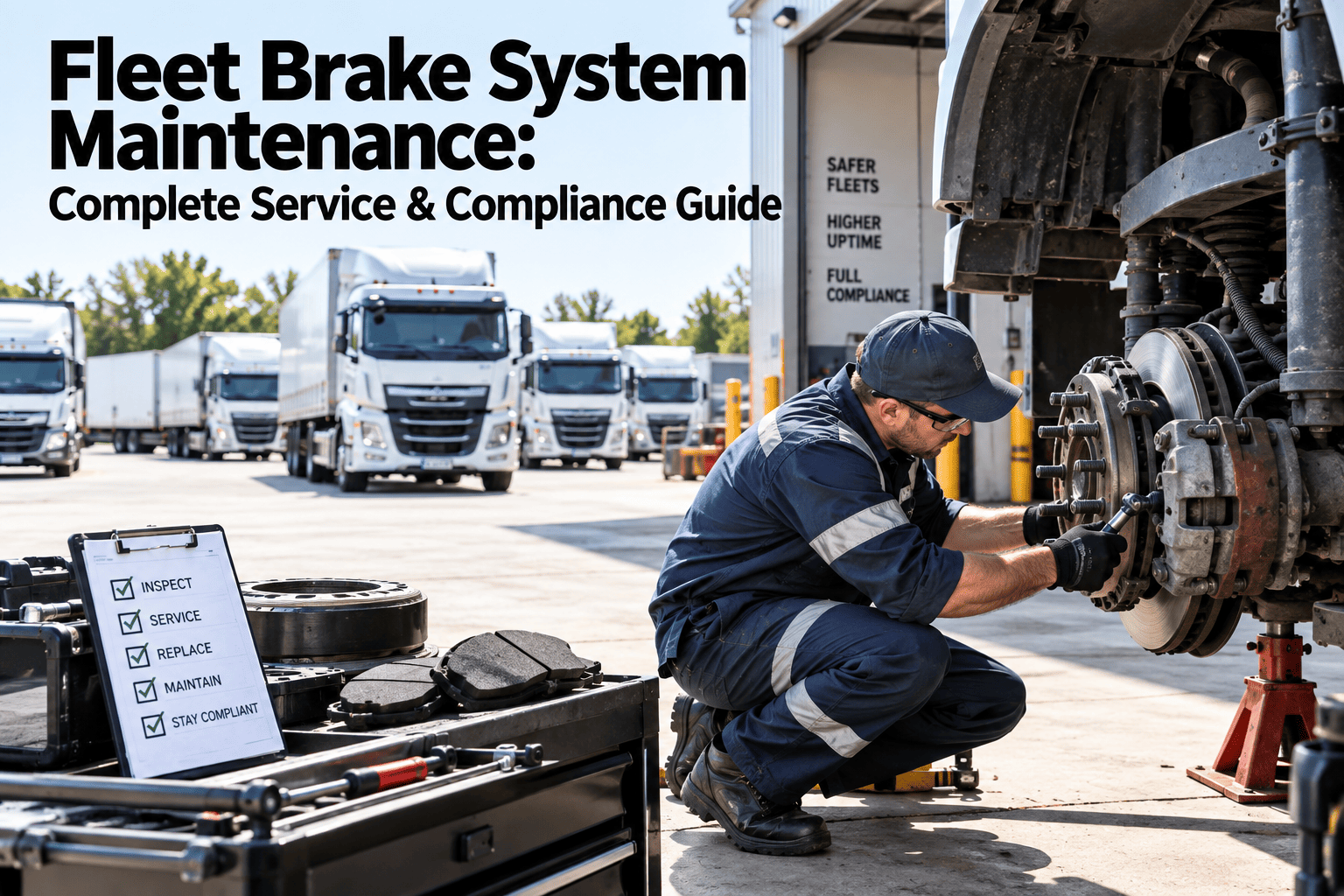
Fleet Brake System Maintenance: Complete Service & Compliance Guide
Optimal service intervals, DVSA-aligned inspection records, and predictive brake maintenance for UK HGV, PSV, and van fleets — automated end to end by OxMaint CMMS.
Brakes Fail in Stages — and Every Stage Is Detectable
Commercial brakes almost never fail without warning. Air systems lose capacity gradually, linings thin on a measurable curve, and slack adjusters drift out of range between service intervals on high-mileage vehicles. The good news for fleet managers is that pad wear, adjuster drift, and air leaks all follow predictable patterns — which means every one of them can be caught on a schedule rather than at a roadside prohibition. The failures that halt a vehicle and dent your Operator Compliance Risk Score are the same ones a disciplined PM programme would have flagged weeks earlier. What separates a compliant fleet from a stopped one is simply whether the measurements are captured, trended, and acted on. A brake test printout attached to a PMI record is only as good as the system that scheduled the inspection, chased the defect, and proved the repair was closed — and that full chain of evidence is exactly what a DVSA examiner or Traffic Commissioner looks for.
The Chain From Pedal to Wheel — and Where It Breaks
Most HGVs and trailers run air brakes, where braking force depends on a mechanical chain that only works if every link is in tolerance. Understanding the sequence shows exactly why a single worn component quietly steals stopping power long before a driver feels it.
If several brakes across an axle are out of adjustment, the remaining brakes carry more work, generate more heat, and fade faster — turning one neglected wheel-end into a whole-vehicle stopping problem.
OxMaint schedules every slack adjuster check, pushrod stroke measurement, and air leak test, captures the readings digitally, and flags any vehicle drifting toward an OOS threshold — so brake faults surface in your workshop, not on a DVSA examiner's report.
The Six Component Areas Every Brake Inspection Must Cover
A complete brake inspection touches six core areas. Miss any one and you leave both a safety risk and a compliance gap that an examiner will find first. OxMaint builds each of these into a repeatable PM template so nothing is skipped between intervals.
The Five Brake Failures That Stop Commercial Vehicles
Commercial brake failure is almost never a single dramatic event. It is the predictable end of a chain that began weeks earlier with a reading nobody captured. These five failure modes account for the bulk of preventable brake defects found at UK roadside stops — and each one broadcasts a measurable signal long before it becomes a prohibition.
As linings wear, pushrod stroke lengthens until the chamber moves without applying full force at the drum. Out-of-adjustment brakes are the single most common OOS-triggering defect, and they develop quietly between service intervals on high-mileage vehicles. Automatic adjusters help but can mask the problem when neglected — only a measured stroke at every service confirms the brake is genuinely in range.
A line, valve, or chamber that develops a leak drops system pressure and forces the compressor to work overtime, accelerating wear everywhere. A hissing sound or lengthening stopping distance are late symptoms; a static leak rate trending above threshold is the early one. If pressure falls too far, the fail-safe spring brakes engage on their own — a valuable safety net that can also cause an abrupt, unplanned stop.
Sustained downhill braking or heavy loads drive lining temperature past the point where friction holds, and braking effectiveness collapses just when it is needed most. Thin, worn linings run hotter and fade sooner. When several brakes on an axle are out of balance, the healthy ones absorb more energy, heat faster, and reach fade earlier — turning a single wheel-end fault into a whole-vehicle safety event.
Drums wear beyond their maximum inside diameter and rotors thin below minimum thickness, while heat checking and scoring reduce friction area. Oil or grease reaching the shoes from a leaking wheel-end seal sharply cuts braking effectiveness — exactly the contamination a thorough inspection is meant to catch before the vehicle leaves the yard. Measuring against OEM minimums at every service prevents machine-to-scrap surprises.
A ruptured diaphragm, cracked chamber housing, or corroded mounting hardware degrades a wheel-end without any dashboard warning, while a dormant ABS fault code sits unread until an inspection or an emergency stop exposes it. Spring brake chambers store dangerous energy and must be tagged out before disassembly. Scanning for fault codes and inspecting chambers at every service keeps both the mechanical and electronic sides honest.
Brake Service Intervals by Vehicle Class
Intervals vary by vehicle class, brake system type, and operating environment. The table reflects UK DVSA practice and common fleet benchmarks — but the right interval is always the one a risk assessment supports for your mileage and duty cycle. Operators who stretched intervals too far have seen defect and prohibition rates climb, then settled back on a tighter cycle once the data showed the true cost of waiting. OxMaint automates whichever schedule you set and adjusts triggers as your fleet's real defect history builds.
| Vehicle / Item | Brake System | Interval | Key Check | OxMaint Action |
|---|---|---|---|---|
| HGV / PSV | Air | 4-13 wks (most 6 wks) | Laden roller brake test at PMI | Auto-schedule PMI plus RBT record |
| Trailer | Air / EBPMS | Per PMI cycle | EBPMS reviewed and signed | WO with EBPMS data attached |
| Commercial Van | Hydraulic | 6-12 mo or mileage | Pad thickness and fluid condition | Mileage or date-triggered WO |
| Slack Adjusters | Air | Every service | Pushrod stroke in tolerance | Mandatory line on brake template |
| Hydraulic Fluid | Hydraulic | ~2 years calendar | Moisture and boiling point | Calendar WO regardless of mileage |
| Daily Walkaround | All | Before every shift | Air build, leaks, brake feel | Driver defect report into CMMS |
What Planned Brake Maintenance Recovers
Brake upkeep is not just a legal box to tick — it is a cost lever and a licence protector. Reactive brake work carries the full weight of breakdown recovery, lost revenue, and prohibition risk, while planned maintenance turns those events into scheduled, low-cost interventions. For a fleet running under an O-licence, a single prohibition can ripple into a Traffic Commissioner review, a curtailed licence, and lost customer confidence that costs far more than any repair. The return on a structured programme shows up across three fronts.
Frequently Asked Questions
How often should fleet brakes be tested for DVSA compliance?
Why is hydraulic brake fluid changed by calendar, not mileage?
Do automatic slack adjusters remove the need for inspection?
How long must brake and inspection records be kept?
How quickly can OxMaint be set up across a mixed fleet?
Your Next Brake Prohibition Is Still Preventable. Put Every Check on a Schedule That Runs Itself.
OxMaint gives UK fleet operators automated brake PM schedules, digital pushrod and air-leak records, driver defect capture, and audit-ready 15-month retention — closing the gap between a slack adjuster drifting out of range and a DVSA examiner finding it. Get your whole fleet on a compliant brake programme in days, not months.