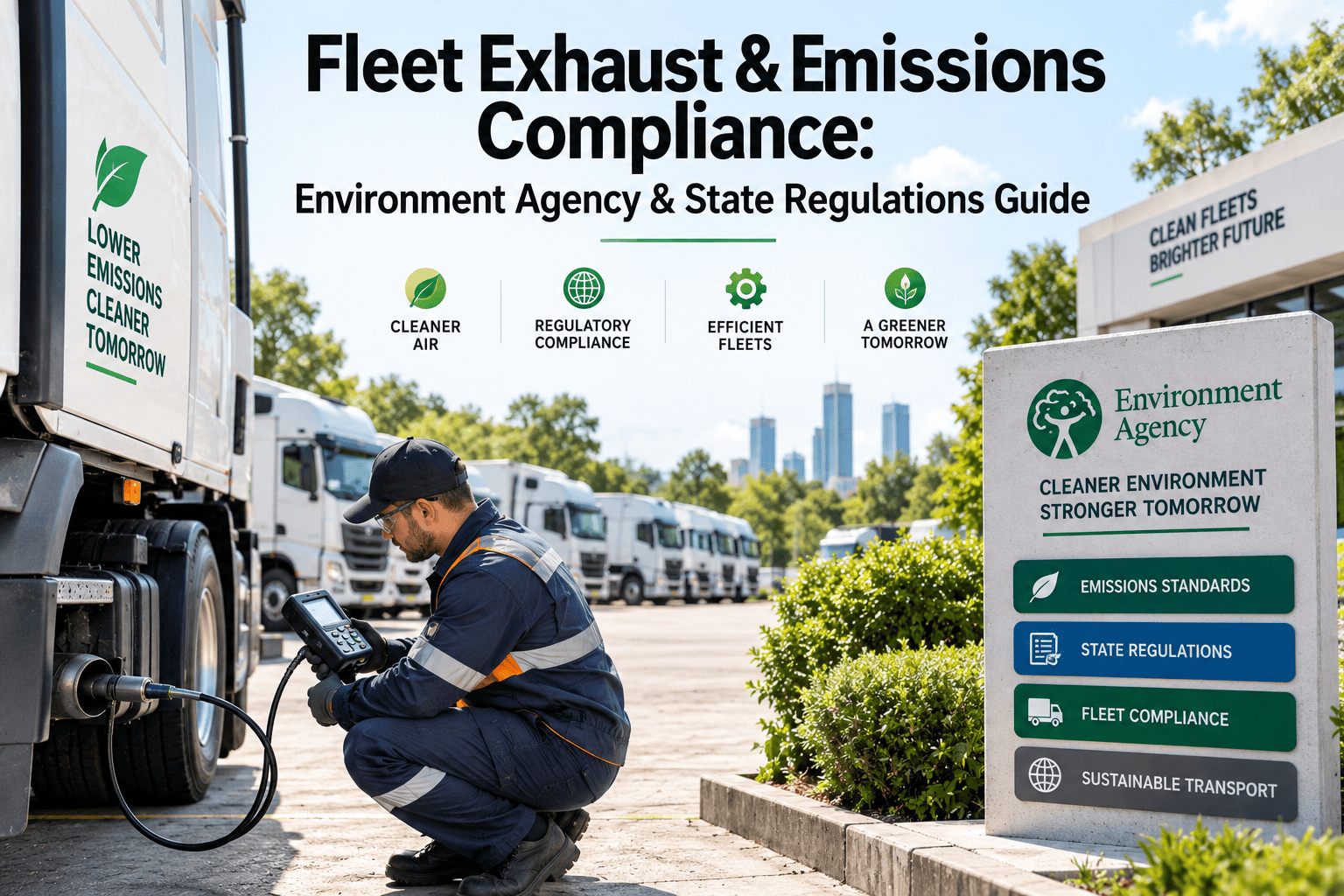
For UK fleet operators, emissions compliance has stopped being a background concern and become a daily operational cost. Clean Air Zones now ring most major cities, London's ULEZ and LEZ run 24/7, and a single non-compliant HGV making regular deliveries can rack up hundreds of pounds in charges a month while quietly losing access to routes as more zones appear. Behind the charges sits the harder truth: a Euro VI vehicle only stays compliant if its DPF, SCR, and EGR systems are actually maintained — neglect the aftertreatment and even a "clean" truck fails. OxMaint maintenance management software tracks every emission-system service, sensor check, and DEF interval so compliance is proven, not assumed. Start a free OxMaint trial or book a 30-minute demo to see it in action.
Fleet Exhaust & Emissions Compliance: Environment Agency & Regulations Guide
Navigate Clean Air Zone, ULEZ, and Euro VI requirements with DPF, SCR, and EGR maintenance tracking, emission testing schedules, and audit-ready records — automated by OxMaint CMMS.
Why Emissions Compliance Now Runs Every Delivery Route
Road vehicles are the single biggest source of urban air pollution, producing nearly half of all nitrogen oxides, and regulators have responded with a widening web of zones. Across the UK, Clean Air Zones use a common framework of Euro emission standards, though which vehicles fall in scope is set locally. London's ULEZ now covers every borough, and experts expect further expansion through 2026 as authorities chase air-quality targets. For a mixed fleet, that means two live pressures at once: the direct cost of daily charges on non-compliant vehicles, and the shrinking set of routes those vehicles can run at all. Compliance is no longer a paperwork exercise — it decides where your fleet can earn. And the deeper risk is that a vehicle registered to the right standard can still fall out of compliance in service if its emission systems are neglected, so the question managers face is not just "is this truck Euro VI?" but "can I prove it is still performing to that standard today?"
How EGR, DPF, and SCR Keep a Diesel Compliant
Euro VI compliance depends on three aftertreatment systems working as one linked chain, controlled by the engine ECU. They are not independent boxes — a fault in one cascades into the others, which is exactly why maintenance has to treat them as a system, not a set of parts.
The interaction is the risk: a failing EGR makes the DPF clog faster, a blocked DPF raises backpressure that disturbs AdBlue dosing, and a bad NOx sensor can trick the ECU into the wrong strategy entirely. Fix one symptom in isolation and the pile-up continues — which is why fleets that track the whole chain avoid the expensive guesswork of swapping one costly component after another. The only reliable defence is a maintenance record that shows the state of every system on every vehicle, so a single warning light can be traced to its true root cause instead of the nearest expensive part.
OxMaint schedules DPF, SCR, and EGR service, logs NOx sensor checks and DEF quality, tracks regeneration frequency per vehicle, and stores a complete emissions maintenance history — so compliance is documented for every Clean Air Zone audit and every fault is caught before it becomes a derate.
From Euro Standard to Zone Access: What Actually Governs Your Fleet
Euro emission standards set the pollutant limits that decide where a vehicle can operate without charge. For diesel HGVs the practical dividing line is Euro VI — and understanding how the standards tightened explains why modern trucks carry the complex aftertreatment they do, and why maintaining it is now central to keeping the fleet earning.
The Emission-System Failures That Derate a Fleet
Aftertreatment faults rarely announce themselves politely — they escalate from a warning message to reduced power to a 5 mph limp mode that strands the vehicle. Each of these follows a detectable pattern, and each is far cheaper to catch on a schedule than at the roadside. The recurring trap is treating the symptom: teams replace an expensive DPF or NOx sensor only to find the real cause sat upstream, so the fault — and the cost — returns within weeks.
Short routes, a failed exhaust-temperature or pressure sensor, or a clogged dosing injector stop regens completing, so soot loads climb and backpressure triggers a derate. Repeated forced regens on the same vehicle are a diagnostic signal, not a driver problem — the real fault sits upstream and needs finding, not more regens.
Catalyst degradation, a clogged DEF injector, contaminated or expired AdBlue, or a failed NOx sensor drops conversion below threshold and triggers a staged derate down to limp mode. DEF quality causes more SCR failures than mechanical breakdowns, so fluid checks matter as much as hardware inspection.
Carbon builds up until the valve sticks, driving low power, sluggish throttle, and black smoke, while raising combustion temperature and NOx. That forces the SCR to dose more DEF and the DPF to regen more often — one neglected valve quietly overloads the entire aftertreatment chain and lifts fuel consumption.
NOx and temperature sensors drift or fail, feeding the ECU bad data that changes emission strategy or blocks regeneration outright. An EGR cooler leak lets coolant into the exhaust, where glycol poisons the SCR catalyst and blocks DPF channels — small internal leaks destroy expensive components long before any visible coolant loss.
Fleet Emission-System Maintenance & Testing Schedule
Keeping a Euro VI fleet compliant means treating the aftertreatment as scheduled, tracked maintenance rather than break-fix. The intervals below reflect fleet aftertreatment best practice — always confirmed against manufacturer guidance for each engine. OxMaint automates the cadence and holds the records.
| System / Item | Focus | Interval | Catches | OxMaint Action |
|---|---|---|---|---|
| DEF / AdBlue quality | Concentration and contamination | Monthly check | SCR efficiency loss | Recurring WO with quality log |
| DPF condition | Soot, ash, backpressure | Per service / on alert | Failed regen, clogging | Regen frequency tracked per asset |
| EGR valve | Carbon buildup, actuation | Scheduled cleaning | Sticking, NOx rise | PM template line with history |
| NOx & temp sensors | Reading accuracy | Per service scan | Bad data, blocked regen | Fault-code scan logged to vehicle |
| DEF tank & line heaters | Winter operation | Before cold season | Frozen DEF, dosing fault | Seasonal WO pre-winter |
| Emission compliance status | Euro VI / zone eligibility | Continuous record | Charge and access risk | Audit-ready compliance report |
What Tracked Emissions Compliance Protects
Emission-system maintenance is one of the clearest cost cases in a modern fleet: the interventions are routine, while the avoided costs — daily charges, lost routes, derated vehicles, and failed audits — are large and immediate. A monthly DEF quality check costs almost nothing next to a limp-mode recovery and a missed delivery; a scheduled EGR clean is a fraction of a poisoned SCR catalyst. Put on a tracked programme, the return lands across three fronts.
Frequently Asked Questions
What emission standard do HGVs need for UK Clean Air Zones?
Can a Euro VI truck still fail emissions compliance?
Why does one truck need forced DPF regens so often?
How important is AdBlue (DEF) quality for compliance?
Can OxMaint prove compliance across a mixed fleet?
Compliance You Can Prove Beats Compliance You Assume. Put Every Emission System on a Tracked Schedule.
OxMaint gives UK fleet operators automated DPF, SCR, and EGR maintenance schedules, per-vehicle regeneration and DEF tracking, sensor-scan logging, and audit-ready emissions records — closing the gap between a Euro VI badge and genuine, documented Clean Air Zone compliance. Get your whole fleet on a proactive emissions programme in days.