Electrical faults have quietly become the leading cause of roadside breakdowns in modern commercial fleets, overtaking tyres in vehicles built from 2020 onward. The reason is complexity: a typical modern truck carries dozens of electronic control modules and wiring that now moves multiplexed data as well as power, so a single chafed wire or weak ground can throw phantom fault codes across the whole system. The frustrating part for fleet managers is that most of these failures were foreseeable — the majority of electrical breakdowns had a fault code sitting unread in the vehicle's history for two weeks before the vehicle actually stopped. OxMaint maintenance management software captures that signal, trends charging health, and schedules harness and battery checks so the root cause gets fixed, not the symptom patched. Start a free OxMaint trial or book a 30-minute demo to see how.
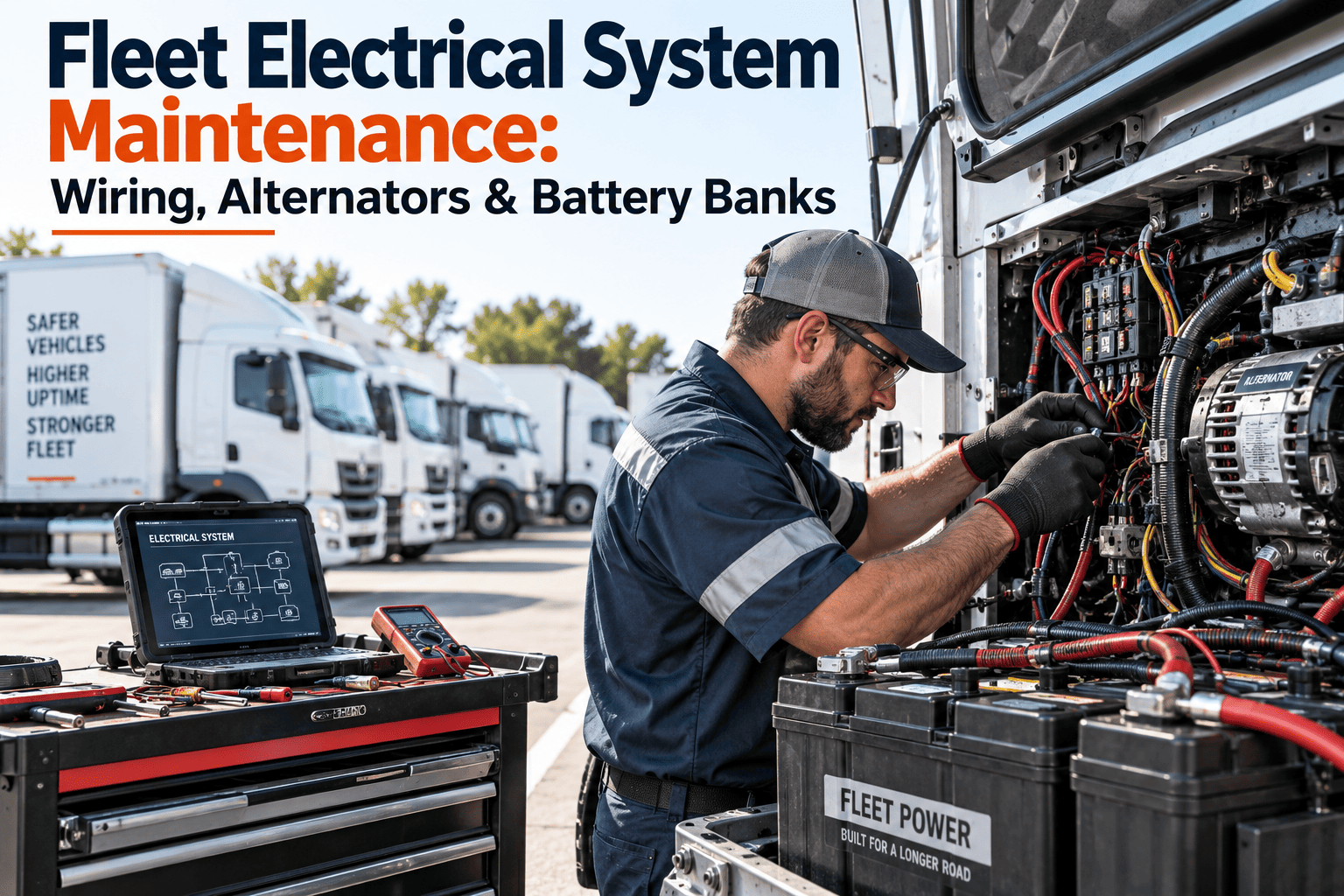
Fleet Electrical System Maintenance: Wiring, Alternators & Battery Banks
Maintain wiring harnesses, alternators, battery banks, and ECU systems across your fleet with charging-system trending, fault-code history, and predictive inspection scheduling in OxMaint CMMS.
The Failure Class Traditional PM Programmes Weren't Built For
Fleet vehicles endure more starts and stops, heavier loads, and tighter schedules than any private car, and every year they carry more electronics doing more jobs — ignition, fuel injection, lighting, safety systems, and charging all run through one interconnected network. That demand places extraordinary strain on the electrical system, yet most maintenance programmes were designed around mechanical wear, not diagnostic complexity. The result is a category of failure that is intermittent, hard to reproduce, and invisible to a trouble code that only ever sees the symptom. Managing it well means shifting from reacting to warning lights toward trending the readings that expose a fault while it is still cheap to fix. A single damaged wire can derail a delivery schedule, and low battery charge or a poor connection can throw faults across every computer on the vehicle at once — so the electrical system is no longer a set of isolated parts but a network where one weak link degrades the whole.
The Four Electrical Systems That Strand a Vehicle
Fleet electrical reliability comes down to four interlinked systems, each with its own failure pattern and its own early signal. OxMaint builds each into a unified electrical programme so faults are resolved at the root, not patched at the symptom. The systems are not independent: a weak battery makes an alternator work harder, a failing alternator flattens the battery, corroded grounds mimic module faults, and a parasitic draw undoes an otherwise healthy charge — so a programme that treats them together catches problems a single-component check would miss.
Harnesses fail where vibration abrades insulation and where water enters connectors and corrodes pins — along frame rails hit by road spray, at firewall openings exposed to heat, and behind the cab under vibration stress. Because corrosion resistance changes with movement, gauges and modules cut in and out, and the fault is often a bad ground, not a failed part.
A slipping belt cuts charging before it ever squeals, and failing diodes or a weak voltage regulator let output drift low — draining the battery and destabilising every module that depends on clean power. A failing alternator can even mimic a battery fault, generating recurring, time-wasting service calls until output is actually measured under load.
In a multi-battery bank, a single weak cell quietly drags down the others and shortens the whole bank's life — which is why each battery must be tested individually, not as a combined voltage reading. Sulfation from chronic undercharging on short runs is the most preventable killer, and terminals are the most common single point of failure across the system.
Hidden power draws are among the most insidious causes of fleet downtime, quietly flattening a battery overnight into a missed route. Trailer ABS or EBS modules that stay energised, a module that won't sleep, aftermarket dash cams and trackers, or corrosion backfeeding through a connector all draw current key-off — faults that only show up after the vehicle has sat, and only under proper load testing that simulates real operating demand.
OxMaint trends alternator output across services, tests each battery in a bank individually, keeps a searchable DTC fault-code history, and schedules harness and ground inspections — so recurring electrical faults get traced to the chafed wire or weak ground behind them, not patched with another new part.
How OxMaint Trends Charging Health Before a No-Start
A charging fault is rarely sudden — output drifts down over consecutive services until the battery can no longer hold up the electronics. The defence is measurement across a consistent set of load points, trended over time, so degradation is visible long before depletion.
The same principle applies to batteries: boost-charging during service and taking rested voltage on each battery in a bank exposes the inconsistent cell that is dragging the others down — replacing on condition rather than on a fixed calendar cuts total battery spend while preventing surprise no-starts. Keeping every battery above half state of charge is the single most effective defence against the sulfation that quietly ends most battery lives early.
The Symptoms Drivers See Before an Electrical Failure
Most electrical failures give a driver visible warning first — but only if the fleet trains crews to report them and gives them somewhere to log it. Captured in the maintenance record, these early symptoms turn a vague "the truck feels off" into a scheduled diagnosis before the vehicle strands mid-route. The habit costs nothing and saves the most expensive failures a fleet ever pays for.
Fleet Electrical Maintenance & Inspection Schedule
Electrical reliability is built from consistent, tracked checks rather than reactive diagnosis. The schedule below reflects common commercial-vehicle practice — always confirmed against manufacturer guidance for each vehicle. OxMaint automates the cadence and holds every reading against the asset.
| System / Item | Focus | Interval | Catches | OxMaint Action |
|---|---|---|---|---|
| Battery bank | Per-cell rested voltage | Every PM / pre-winter | Weak cell, sulfation | Individual test logged per battery |
| Alternator output | Voltage at idle and load | Every PM service | Charging degradation | Trend tracked across services |
| Drive belt | Tension and wear | ~30,000 miles | Slipping, lost charge | Mileage-triggered WO |
| Wiring harness | Chafe, corrosion, grounds | Scheduled inspection | Intermittent faults | Inspection WO with photo log |
| Parasitic draw | Key-off current | On repeat no-start | Overnight drain | Load-test WO with results |
| Fault-code history | DTC trend | Every service scan | Unread early warnings | Searchable DTC history per vehicle |
What Structured Electrical Maintenance Recovers
Electrical maintenance is one of the highest-return programmes a fleet can run, because the checks are quick and the avoided costs — roadside recovery, missed routes, and repeat diagnostics chasing the wrong part — are large. An alternator replacement costs far more in downtime and lost delivery than the few minutes of output testing that would have flagged it, and a battery swapped on condition beats a fleet-wide calendar replacement every time. Put on a tracked schedule, the return shows up across three fronts.
Frequently Asked Questions
Why are electrical faults now the top fleet breakdown cause?
Why test each battery in a bank separately?
What causes an overnight battery drain on a parked vehicle?
Why do gauges and lights cut in and out intermittently?
Can OxMaint manage electrical maintenance across a mixed fleet?
The Warning Light Arrives Two Weeks Early. Make Sure Something Is Reading It.
OxMaint gives UK fleet operators charging-system trending, individual battery-bank testing, searchable fault-code history, and scheduled harness and ground inspections — closing the gap between an unread early fault and a roadside no-start. Get your whole fleet on a proactive electrical programme in days, not months.