Every fleet manager knows the exact moment inventory failure hits: a vehicle rolls into the bay with a broken alternator, the technician walks to the parts cage, and the bin is empty. What follows is a rush order, hours of downtime, and a driver pulled from a paying route. The same failure plays out on the roadside, where a snapped belt or blown fuse strands a vehicle for want of a part that costs a few pounds. Strategically built emergency road kits turn many of those events into a ten-minute driver fix — but only if the kits are stocked correctly and, crucially, replenished the moment they are used. OxMaint maintenance management software handles the kitting, tracks every part, and automates replenishment so the kit is never empty when it matters. Start a free OxMaint trial or book a 30-minute demo to see it work.
OxMaint Parts & Inventory · Emergency Road Kits
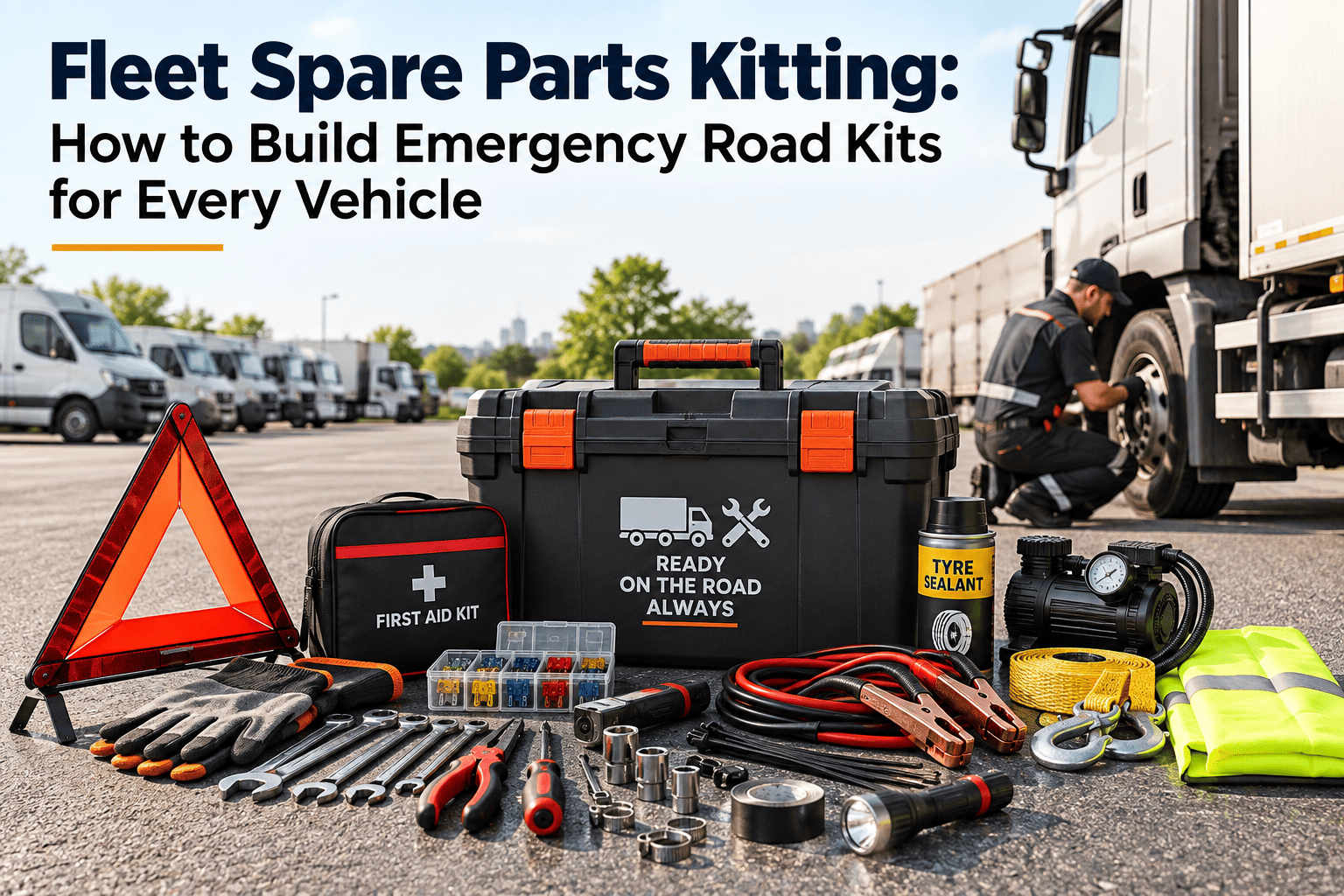
Fleet Spare Parts Kitting: How to Build Emergency Road Kits for Every Vehicle
Design vehicle-specific kits, stock them correctly, and use OxMaint CMMS to keep them replenished automatically — cutting roadside breakdown time and rush-order spend across your fleet.
11x
a modest emergency kit pays for itself against one roadside repair call
19-24%
of the average parts budget lost to rush orders and dead stock
2.4
self-recoverable roadside events per 100,000 miles on a typical tractor
60-90
days for a full kit programme rollout across an entire fleet
The Cost Case
Why Emergency Kits Are the Best Return in the Parts Budget
Finance teams often file emergency parts kits under discretionary spend — the first line cut when budgets tighten. The ROI maths says the opposite. A complete road kit for a typical heavy commercial vehicle is a small parts cost plus a one-time case investment, while the single roadside event it prevents runs into the thousands once recovery, lost revenue, and driver downtime are counted. With a typical tractor seeing more than two self-recoverable roadside events per 100,000 miles, the question was never whether to invest in kits. It is which parts belong in them, and how to keep them stocked without someone manually checking every case. Get those two answers right and the kit stops being a cost and becomes one of the cleanest savings on the fleet. The maths is stark when you set it against the alternative: an empty parts bin means a rush order at several times the standard price, a vehicle sitting idle in the bay for hours, and a driver taken off a route that was meant to be earning — a chain of costs that a few pounds of pre-staged spares would have broken before it started.
11x
Return per kit
A modest per-vehicle kit pays for itself roughly eleven times over on the very first roadside event it prevents, once average repair cost and lost driver hours are included.
3-5x
Rush shipping premium
Emergency overnight freight costs several times the standard rate. Every kit-enabled roadside fix is one rush order avoided — and planned bulk buying cuts per-unit cost further still.
19-24%
Budget waste
The average fleet loses roughly a fifth of its parts budget to rush orders, duplicate stock, and obsolete inventory sitting in storerooms — waste that structured kitting and tracking directly reverse.
60-70%
Fixed roadside
A well-designed kit lets drivers and mobile technicians resolve the majority of breakdowns at the roadside, cutting tow costs and turning hours of downtime into a short delay.
Kit Contents
The Five Categories Every Emergency Road Kit Needs
A strong kit is built by category, not by guesswork — each group targeting a specific slice of self-recoverable events and matched to what a driver can realistically install. OxMaint holds the bill of materials for each kit type so every vehicle carries exactly the right contents for its class and route. The categories below are ranked by how often they resolve a self-recoverable event and by how much skill they demand — so a fleet can scale kit ambition to driver capability, from simple fluid top-ups anyone can manage up to air-line repairs for trained hands.
Engine oil, coolant, DEF/AdBlue, brake fluid, and washer fluid. These cover the largest share of self-recoverable events and need zero training to use — a driver simply tops up and moves on.
Zero training · largest event share
Belts, hoses, clamps, fuses, bulbs, air filter, and glad-hand/air-line seals. Most drivers can fit these with basic instructions and tools, turning a stranding into a short roadside job.
Basic tools · driver-fittable
Tools
Hand Tools & Diagnostics
Wrench set, pliers, screwdrivers, multimeter, tyre pressure gauge, code reader, and flashlight. A one-time investment that unlocks the use of every other category in the kit.
One-time cost · enables all
Legal
Safety & Compliance
Reflective warning triangles, hi-vis vest, first-aid kit, and fire extinguisher. This category is about driver and public safety and meeting roadside legal requirements, not vehicle recovery.
Legally required · perishable dates
Air-line repair kit, glad-hand seals, tyre plug kit, and a compact inflator. A damaged air brake line or slow puncture is a common stranding that these items turn into a quick temporary fix.
Common failure · fast fix
OxMaint Parts Inventory for Fleets
Stop Discovering an Empty Kit at the Next Breakdown. Start Replenishing It the Moment a Part Is Used.
OxMaint links every kit part to the vehicle and the work order, so using a spare belt on Tuesday triggers a replenishment task automatically — the part is flagged for restock at the next yard return, not left as a gap that only the next roadside event reveals.
The Replenishment Loop
How OxMaint Keeps Every Kit Stocked Without Manual Checking
The single biggest reason parts kits fail is not poor design — it is the failure to replenish after use. A driver uses the spare belt, returns the vehicle, and the kit sits empty until the next breakdown reveals the gap. OxMaint closes that loop automatically.
1
Part Used & Logged
A driver or technician records the part pulled from the kit against the vehicle and event — a scan or a tap, building a complete audit trail of what was consumed and where.
›
2
Stock Drop Detected
The inventory count falls below the kit's minimum threshold, and OxMaint raises a procurement work order automatically — no one has to notice the gap or remember to reorder.
›
3
Replacement Flagged
The replacement part is flagged for installation at the vehicle's next yard return, so the kit is topped back up during planned downtime rather than in a scramble.
›
4
Kit Restored
The part is refitted, the count resets, and the kit is verified complete — every vehicle back on the road carrying a full, ready kit for the next event.
Perishable items — DEF, premixed coolant, fire extinguishers, first-aid components — carry expiry dates too. OxMaint runs quarterly audit work orders that surface expiring items before they fail a compliance check, replacing them and rotating older units through yard inventory to avoid waste. The result is a kit that is not just full but current: every part in date, accounted for, and ready to use the moment a driver reaches for it on the hard shoulder.
Stocking Strategy
Right-Sizing Kits With ABC Criticality and Reorder Points
Kitting is only half the job — stocking the right quantities is the other half. The proven approach is to classify parts by criticality and set data-driven reorder points, so critical spares are always protected while slow movers do not tie up cash. Right-sizing this way typically trims a chunk of on-hand value without exposing the fleet to stockouts on the parts that matter. OxMaint applies these rules per part automatically.
A
High Criticality
High-value or high-consequence parts that stop a vehicle when missing. Stocked to cover a couple of emergencies and given the tightest control, because a stockout here is the most expensive kind.
B
Moderate Priority
Important to vehicle function but slower to wear. Kept on hand in smaller quantities than A-parts, with usage tracked so levels flex with real demand rather than a fixed guess.
C
Low Frequency
Rarely needed items — specialised sensors, rare components — that can cause serious downtime when absent. Often best ordered as needed against a known lead time rather than stocked deep.
RP
Reorder Point
Set as average daily usage multiplied by supplier lead time, plus safety stock — so a replacement is ordered before the shelf runs dry. OxMaint sets and monitors this threshold per part.
Building the Programme
From First Kit to Fleet-Wide in Four Phases
A kit programme is not a one-off purchase — it is a repeatable process that scales from a pilot vehicle to the whole fleet. Reviewing breakdown history by route first means each kit is built around the failures that actually happen, not a generic list. OxMaint configures asset records in parallel so tracking is live before the first kit ships. Done well, the whole rollout takes 60 to 90 days from first design to the first audit cycle, and the discipline it builds — reviewing failures, sourcing ahead, standardising contents — keeps paying off long after the last kit is installed.
1
Design by Vehicle Class & Route
Start from breakdown history. A long-haul tractor, an urban delivery van, and a refrigerated unit each face different failure patterns, so kit contents flex by class, climate, and distance from support rather than a single catch-all list.
2
Source Parts & Cases
Procure the bill of materials in planned bulk — cutting per-unit cost against rush pricing — and standardise on a durable case per vehicle so contents stay organised, protected, and quick to inventory at audit.
3
Assemble & Install
Kits are built to the standard bill of materials, labelled, and installed in each vehicle. Every part is registered in OxMaint against the vehicle so the moment one is used, the system already knows what to replace.
4
Train & Audit
Drivers get hands-on training matched to what they are expected to fix, and the first audit cycle confirms every kit is complete. Recurring audits then keep contents and expiry dates in check for good.
The Payback
What CMMS-Driven Kitting Delivers
When kitting, tracking, and replenishment run through one system, the gains compound: fewer strandings, less budget waste, and a parts operation that runs on data instead of memory. Because every part is tied to a vehicle and a work order, the same records that keep kits full also power warranty claims, reman-versus-OEM decisions, and stock right-sizing — one dataset doing several jobs. The return lands across three fronts.
Downtime Slashed
Kits that are always stocked turn breakdowns into short roadside fixes instead of tows and lost shifts — and a CMMS that pre-stages parts against upcoming PM stops the empty-bin scramble in the workshop too.
Budget Recovered
Right-sizing stock trims dead inventory while auto-reorder ends rush freight, clawing back the fifth of the parts budget most fleets quietly lose to emergencies, duplicates, and obsolescence.
Full Audit Trail
Every part scanned against a vehicle and work order builds a complete history — feeding warranty recovery, reman-versus-OEM decisions, and compliance evidence from one accurate, searchable record.
FAQ
Frequently Asked Questions
How quickly can a kit programme roll out across a fleet?
Most fleets complete a full rollout in 60-90 days: kit design and sourcing first, then assembly and installation, then driver training and the first audit cycle. CMMS setup runs in parallel.
Start a free trial to begin.
Should drivers be trained to make roadside repairs from the kit?
Basic tasks — fluid top-ups, belt changes, tyre plugs, fuse swaps — pay for themselves on the first event each driver handles. Complex jobs should be left to drivers with mechanical aptitude or mobile technicians, so kit design should match capability.
What happens when a perishable kit item passes its expiry?
OxMaint tracks expiry dates on items like DEF, coolant, extinguishers, and first-aid components, and raises quarterly audits that surface expiring stock before it fails compliance — replacing it and rotating older units through yard inventory.
Book a demo to see it.
How does OxMaint stop kits sitting empty after use?
Using a part logs it against the vehicle, drops the stock count below threshold, and auto-generates a replenishment work order flagged for the next yard return — closing the replenishment gap that causes most kit programmes to fail.
Can OxMaint manage kits across a mixed fleet and multiple depots?
Yes. OxMaint holds a bill of materials per vehicle class, maintains live stock across depots and mobile units, and links every part to work orders and PM schedules.
Start free to load your fleet.
OxMaint AI — Fleet Parts & Inventory
A Full Kit Is Only Full Until It's Used. Make Sure Something Refills It Every Time.
OxMaint gives UK fleet operators vehicle-specific kit design, part-to-work-order tracking, automatic replenishment, ABC criticality stocking, and expiry auditing — closing the gap between a spare pulled at the roadside and an empty case at the next breakdown. Get your whole fleet on a managed kit programme in weeks.