Every facility manager has heard the same instruction from above: cut the maintenance budget without anyone noticing. In practice, most attempts at this backfire, because the easiest costs to cut — inspection frequency, parts stock, preventive tasks — are exactly the ones that protect against the most expensive outcomes: emergency repairs, compliance fines, and equipment failing years before its expected lifespan. The facilities that actually reduce costs without a drop in service quality do it by attacking waste, not standards. Most of that waste sits in one place — the ratio of planned work to reactive firefighting — and the same records that prove a job was done properly are the ones that keep a facility off an inspector's watch list. Start a free trial or book a demo to see how Oxmaint turns that ratio around without adding headcount.
Facility Management · Cost Control · Compliance
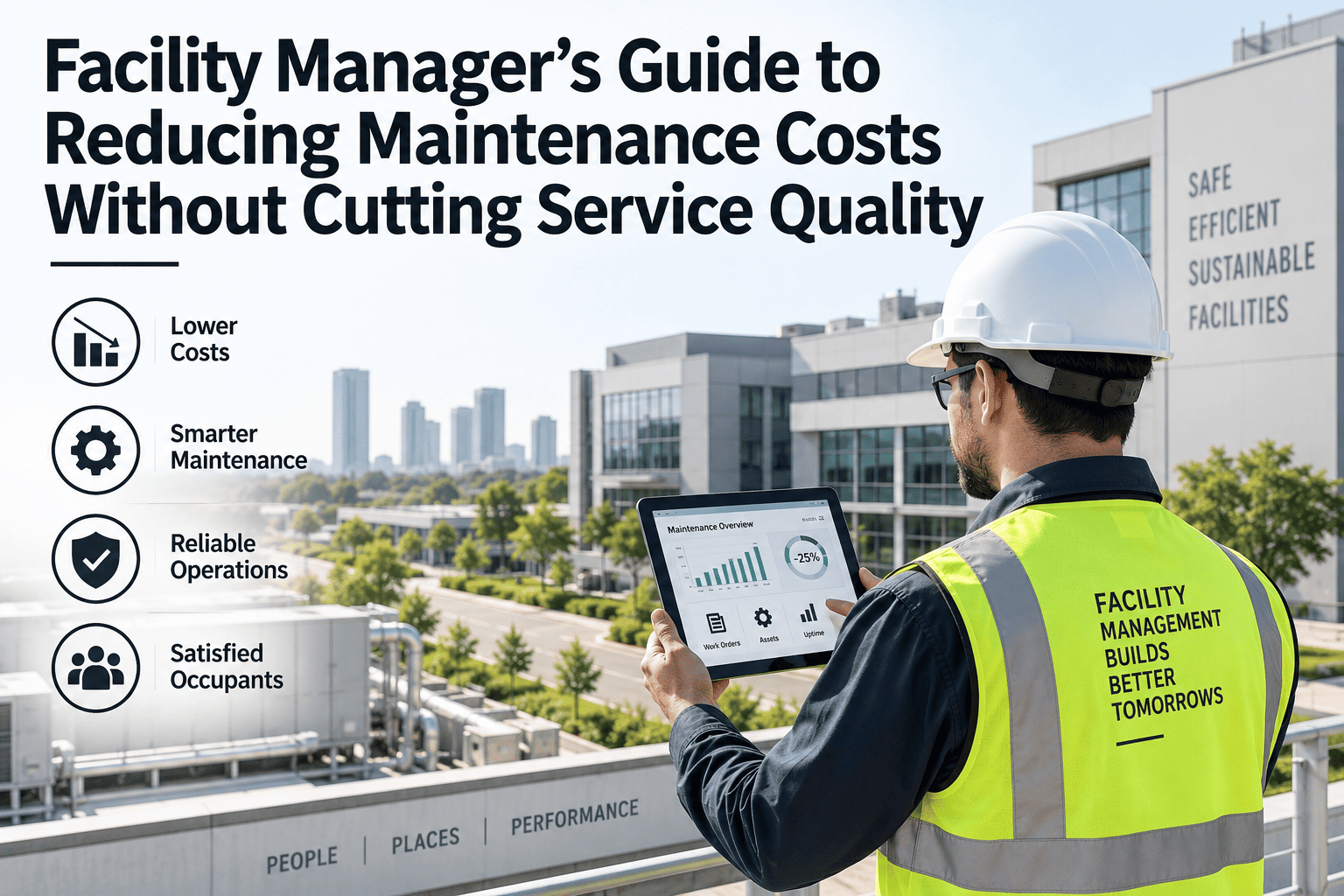
Facility Manager's Guide to Reducing Maintenance Costs Without Cutting Service Quality
Cutting a maintenance budget the wrong way trades a small saving today for a much larger bill later — in emergency repairs, in fines, or in equipment replaced early. Here is the structured, data-driven approach that lowers cost while keeping every statutory record audit-ready.
3–5x
Higher cost of an emergency repair compared to the identical job completed on a planned schedule
12–18%
Average reduction in total maintenance spend reported after adopting a structured preventive programme
80:20
Planned-to-reactive work ratio that defines a best-in-class facility maintenance operation
96%
Less time spent on audit preparation once records are captured digitally as work happens
Where the Money Actually Goes
The Four Places Facility Budgets Leak Without Anyone Noticing
Most facility managers can point to their biggest single repair of the year. Far fewer can point to where their budget is leaking steadily, month after month, in ways that never show up as one dramatic line item. These four categories are where structured facilities consistently find the most recoverable spend.
An after-hours callout with rush-ordered parts routinely costs three to five times what the identical repair would cost scheduled during normal working hours with parts already in stock.
Ordering at the last minute at a premium price, rather than stocking ahead based on a planned schedule, quietly inflates parts spend across an entire year of reactive work.
A missing statutory record or an overdue inspection does not just risk a fine — it triggers remedial work, legal review, and reputational cost that dwarfs the original maintenance task.
Equipment maintained reactively fails and gets replaced years before its designed lifespan, turning what should have been a maintenance cost into an unplanned capital expense.
Find Out Exactly Where Your Budget Is Leaking
Oxmaint calculates your planned-to-reactive ratio directly from your existing work order data, showing you precisely where reactive spend is draining the budget before you commit to a single change.
The One Number That Matters
Where Does Your Facility Sit on the Reactive-to-Planned Scale?
Planned maintenance percentage is the single number that tells you whether your team is managing the building or being managed by it. It is the share of maintenance labour hours spent on scheduled work rather than emergency callouts and breakdown response, and it predicts your cost base more reliably than almost any other metric available.
20–40%
Reactive Facility
Most work is firefighting. Budgets are unpredictable and emergency premiums dominate spend.
60–65%
Improving
PM schedules exist but compliance is still recovering ground lost to breakdown response.
80%
Best-in-Class
The accepted benchmark that separates ordinary facilities from well-run ones.
85–90%
World-Class
Reactive work is the exception, not the routine, and every record is audit-ready by default.
Where Cost and Compliance Overlap
Cutting Costs Without Cutting Corners: Why the Two Goals Are the Same Data
Facility managers often treat cost reduction and compliance as competing priorities — one about spending less, the other about doing more paperwork. In practice, the record that proves a statutory task was completed on time is the exact same record that proves the budget wasn't cut by skipping it. A well-run preventive programme produces both outcomes from a single source of truth, without requiring separate effort for either one.
Digital logs of storage, handling, and disposal checks double as both the evidence an inspector requests and the proof that a task wasn't quietly skipped to save time.
A timestamped permit record shows exactly who authorised high-risk work and when, protecting both compliance standing and the budget from repeat incidents caused by unauthorised shortcuts.
Tracking corrective actions to closure, rather than leaving them open on a spreadsheet, is what turns a risk assessment from a paperwork exercise into a genuine cost and safety control.
A planned preventive maintenance schedule with a visible completion rate is simultaneously your strongest audit evidence and your clearest lever for reducing reactive spend.
Side by Side
Reactive-Heavy Facility vs Data-Driven Facility — The Practical Difference
| Factor |
Reactive-Heavy Facility |
Data-Driven Facility |
| Maintenance Cost Base |
Unpredictable, dominated by emergency premiums |
Predictable, budgeted around planned PM work |
| Audit Preparation |
Days spent compiling records before an inspection |
Records exported in minutes, ready at any time |
| Compliance Risk |
Gaps discovered only when an inspector asks |
Overdue tasks flagged automatically before they lapse |
| Asset Lifespan |
Equipment run to failure, replaced early |
Assets serviced on schedule, reaching designed lifespan |
| Parts Procurement |
Rush-ordered at a premium during emergencies |
Stocked ahead based on the planned schedule |
| Team Morale |
Constant firefighting, reactive to every alarm |
Predictable workload, planned around real priorities |
Making the Shift
The Four-Step Path to Lower Costs Without Lower Standards
Shifting a facility from reactive to planned work is not a one-off project — it is a sequence most successful facility managers follow in roughly the same order, adjusting pace to match the size of the reactive backlog they are starting from.
01
Establish Your Current Reactive Ratio
Before changing anything, calculate the real split between planned and reactive labour hours from existing work order data, so every improvement afterward is measured against a real baseline.
02
Prioritise PM by Failure Consequence
Not every asset needs the same attention. Ranking assets by guest, safety, and compliance impact ensures the first planned schedules target the equipment where a failure actually costs the most.
03
Automate the Compliance Evidence Trail
Every completed inspection, permit, and corrective action should generate its own timestamped record automatically, so audit readiness stops depending on someone remembering to file paperwork.
04
Track Every Corrective Action to Closure
An open risk assessment action with no completion date is both a compliance liability and a cost waiting to happen. Closing the loop on every flagged item is what keeps the ratio moving in the right direction.
What It Delivers
What Facilities Typically See After Structuring Their Maintenance Programme
12–18%
Lower Total Maintenance Spend
The documented average reduction once reactive work is brought under a structured preventive schedule.
50–60%
Of the Reactive Premium Recovered
Facilities moving reactive ratio from the high 30s to the high teens typically recover this share of the reactive premium within the first year.
96%
Less Time on Audit Prep
Records exported in minutes rather than compiled manually over days ahead of an inspection.
100%
Of Completed Inspections Timestamped
Every inspection logged on a mobile device automatically creates a signed, dated, audit-ready record.
Lower Your Maintenance Spend Without Lowering Your Standards
Oxmaint gives you the same data that proves compliance to an inspector and proves the budget wasn't cut by skipping a task — captured automatically, exported in minutes, and ready whenever it's requested.
Common Questions
Reducing Maintenance Costs — What Facility Managers Ask
How do I know if my facility's reactive maintenance ratio is actually a problem?
+
If reactive work accounts for more than about 40% of maintenance labour hours, the facility is likely paying a significant emergency repair premium without realising it.
Start a free trial to calculate your real ratio from existing work order data.
Does cutting maintenance spend always mean skipping tasks?
+
No. Most recoverable spend sits in the emergency repair premium and rushed parts procurement caused by reactive work, not in the preventive tasks themselves — cutting the wrong side of that equation is what causes standards to slip.
How long does it typically take to shift a facility from reactive to planned work?
+
Most facilities see a meaningful shift in their planned-to-reactive ratio within the first twelve months, with the largest gains typically appearing once PM schedules are prioritised by asset criticality.
Book a demo to map a realistic timeline for your facility.
Can the same records that satisfy an HSE inspection also help control costs?
+
Yes. A completed, timestamped PM or inspection record is simultaneously your compliance evidence and the proof that a task wasn't skipped to save money, which is why structured facilities treat the two goals as one dataset rather than separate efforts.
What happens to open risk assessment actions that never get formally closed?
+
They sit as both a compliance liability and a cost waiting to happen, since an unresolved flagged risk is exactly the kind of gap an auditor or an incident tends to expose eventually.
Start a free trial to see how corrective actions are tracked to closure automatically.
The Facilities Spending Less Are the Ones Managing the Data Better
Oxmaint gives you the visibility to find where your budget is leaking, the structure to prioritise the fix, and the audit-ready records to prove your standards never slipped along the way.