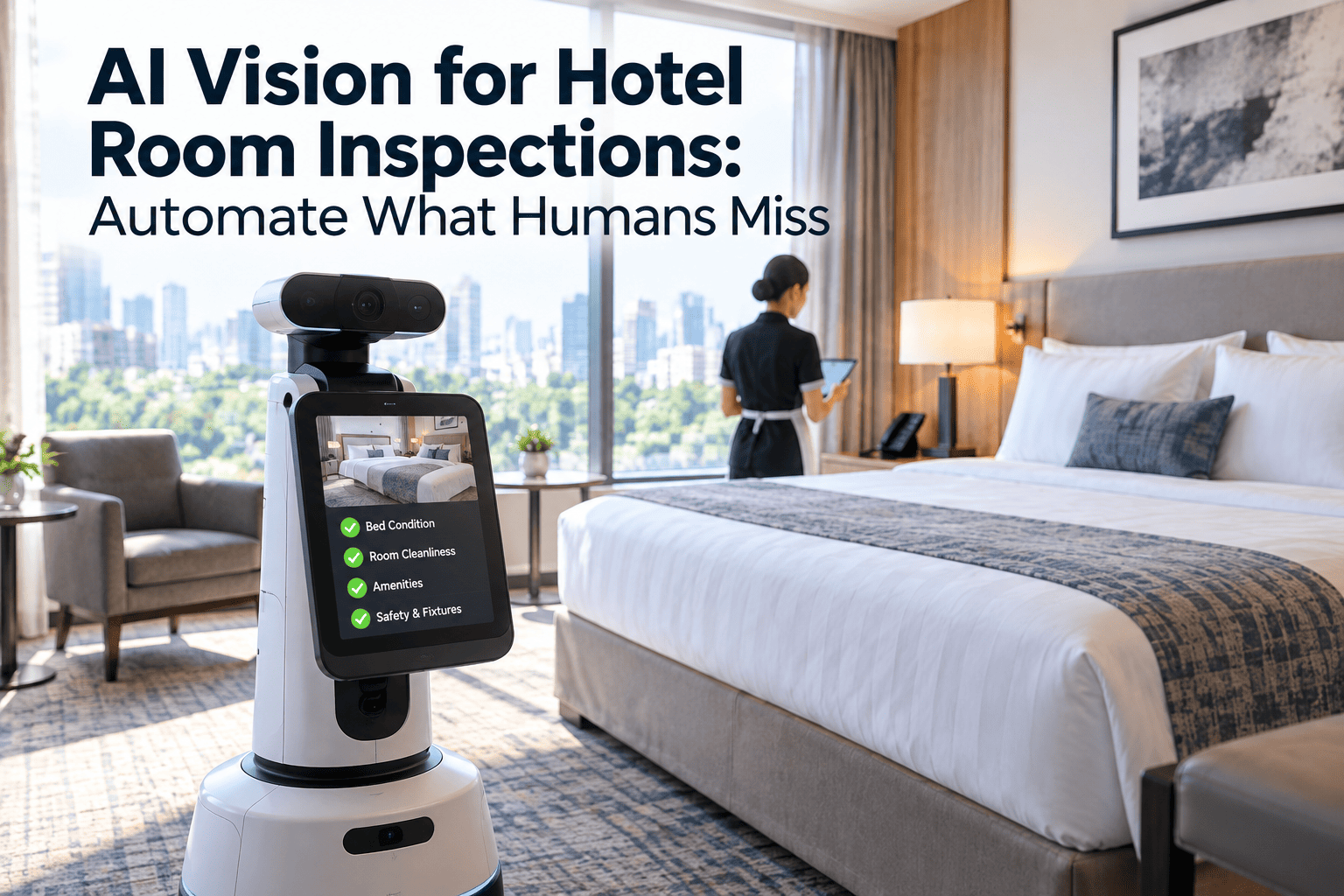
A housekeeping supervisor covering 180 rooms a day has roughly ninety seconds to inspect each one — enough time to glance at the bed and check the bathroom, not enough to catch a cigarette burn on a nightstand, a cracked towel rail bracket, or a flickering light that will become a guest complaint within hours. This is not a staffing problem that more training can fix. It is a physics problem: there simply is not enough time in a turnover window to catch everything a rushed human eye might miss, no matter how experienced or conscientious the inspector is. AI computer vision solves this by scanning a room in seconds, classifying every surface, fixture, and fitting against what a properly maintained room should look like, and flagging anything that does not match. Oxmaint connects that detection directly into the maintenance workflow, so a flagged defect becomes an assigned work order before the room is ever released back into inventory. Start a free trial or book a demo to see AI vision inspection working alongside your housekeeping team.
Hospitality · Computer Vision · Room Inspection
AI Vision for Hotel Room Inspections: Automate What Humans Miss
Ninety seconds is not enough time to catch everything wrong in a guest room, and it never was, no matter how good the housekeeping team is. Oxmaint's AI vision layer scans every checkout room in seconds, flags real defects with photographic evidence, and turns them into work orders automatically, closing a gap that manual inspection was never built to close.
90 sec
Average time a manual inspector has per room, versus roughly 8 seconds for an AI vision scan
34%
Of guest complaints cite a maintenance or cleanliness defect that passed a manual pre-arrival check, according to hospitality operations data
92%
AI defect detection accuracy confirmed against a manual inspector baseline in hotel environments
Zero
Manual triage steps between AI defect detection and a work order reaching a technician's queue
The 90-Second Problem
Why Manual Room Inspection Was Never Going to Catch Everything
A room checks out at 10:47 in the morning. A housekeeper is inside two minutes later, but she has fourteen more rooms on her list and sixty percent of the property checking out in the next ninety minutes. She cleans, she glances, she moves on. The burn mark on the nightstand goes unnoticed. The cracked bracket on the towel rail is not something she was trained to flag as a maintenance item. By the time that room is assigned to the next guest, nobody in the building knows those issues exist — until a guest finds them first, usually in the worst possible moment of their stay. High staff turnover in housekeeping roles makes the problem worse, since inspection consistency depends heavily on individual experience that keeps walking out the door and starting over with a new hire who has not yet learned what to look for.
Most checkout-to-check-in turns run twenty to thirty minutes, which is simply not enough time for a thorough surface-by-surface, fixture-by-fixture audit on top of the actual cleaning work that still needs to happen.
Given real staffing levels, supervisors typically only manage to spot-check a small share of rooms in detail, leaving most of the property unverified before the next guest ever walks through the door.
Housekeeping roles see some of the highest turnover in hospitality, meaning the experience needed to reliably catch subtle defects is constantly being retrained from scratch with every new hire who joins the team.
A missing USB port cover or a loose cabinet hinge is not something every housekeeper has been trained to recognise as a maintenance item worth logging, even though a guest will notice it within seconds of walking in.
Let AI Catch What a Ninety-Second Inspection Cannot
Oxmaint's AI vision integration scans every checkout room, classifies what it finds, and creates a prioritised work order automatically — before the room ever re-enters inventory and before a guest has any reason to notice something was missed.
What Gets Caught
What AI Vision Actually Detects in a Guest Room Scan
An AI vision scan does not just check whether a room looks clean. It reads the full condition of every surface and fixture against a trained model of what a well-maintained room should look like, catching categories of defect that a rushed manual pass routinely misses entirely, from small cosmetic issues that add up over time to safety risks that genuinely cannot wait.
01
Surface Damage
Burn marks on furniture and nightstands, scratches on hardwood and tile, carpet stains and fraying, wall scuffs and paint damage — all flagged with photographic evidence attached and ready for a technician to review immediately.
02
Missing or Displaced Items
Missing remote controls, amenity kits, hangers, or safety equipment identified against a standard room inventory, so nothing quietly disappears between guests unnoticed and unreplaced before the next arrival.
03
Fixture and Fitting Integrity
Cracked brackets, loose cabinet hinges, damaged outlet covers, and worn upholstery — the kind of maintenance items a housekeeper is rarely trained to identify on sight, let alone log consistently across a full shift.
04
Safety and Compliance Risks
Exposed wiring, malfunctioning smoke detectors visible in frame, and other hazards flagged as priority items rather than routine maintenance notes waiting in a general queue.
The Complete Loop
From Photo to Work Order: How the AI Vision Loop Closes Automatically
Detection without action is just a dashboard nobody checks. Oxmaint connects every stage of the process so a defect goes from being photographed to being repaired without a person having to manually review, triage, and assign it along the way, which is exactly the step where most inspection tools quietly stop delivering value.
01
Room Is Photographed at Checkout
A housekeeper or fixed camera captures the room, either through a quick guided photo pass or continuous capture, depending on the property's setup and how each area of the room is typically accessed.
02
AI Vision Classifies Every Defect
The model analyses surfaces, fixtures, and fittings against a trained baseline, classifying each finding by defect type and confidence level in seconds, well before the next guest is anywhere near the door.
03
Severity Is Scored Automatically
Each defect is prioritised by type and guest impact, so a safety hazard is never sitting in the same queue as a minor cosmetic scuff waiting equal attention from a stretched maintenance team.
04
A Work Order Is Created With Evidence Attached
Oxmaint generates a prioritised work order, assigns the right trade, and attaches the photographic evidence, ready to track through to closure with a full audit trail that stands up to later review.
The Practical Difference
Manual Inspection vs AI Vision — What Actually Changes
The comparison below is not about replacing housekeeping judgment with a machine. It is about giving every single room the same consistent inspection standard, regardless of how busy the shift is, how experienced the housekeeper on duty happens to be, or how many other rooms are competing for attention at the same moment.
| Factor |
Manual Inspection |
Oxmaint AI Vision |
| Time per Room |
Roughly 90 seconds, competing with cleaning duties |
Roughly 8–60 seconds, dedicated purely to inspection |
| Room Coverage |
Only a fraction of rooms get a detailed check |
Every checkout room scanned, every time |
| Consistency |
Varies with individual experience and fatigue |
Same detection standard applied to every room |
| Evidence Trail |
Rarely documented beyond a verbal note |
Photographic evidence attached to every flagged defect |
| Path to Repair |
Requires manual reporting and follow-up |
Work order generated and assigned automatically |
| Staffing Sensitivity |
Coverage drops sharply during turnover or shortages |
Detection quality stays constant regardless of staffing levels |
What It Delivers
What Properties Typically See After Adding AI Vision Inspection
92%
Detection Accuracy
Confirmed against a manual inspector baseline across common hotel room defect categories, from surface damage to missing amenities and fixture wear.
100%
Room Coverage
Every checkout room scanned to the same standard, instead of a fraction receiving a detailed manual check while the rest go back into inventory unverified.
4x
Cheaper to Catch Early
A defect flagged before a room re-enters inventory is consistently far less costly to fix than one discovered after a guest complaint, a comp night, or a negative review.
Full
Audit Trail for Every Claim
Photographic evidence attached to every finding supports warranty claims, insurance documentation, and dispute resolution without any extra paperwork for the engineering team.
The Real Cost
What a Missed Defect Actually Costs Once a Guest Finds It First
A defect caught before a room re-enters inventory is a maintenance line item. The same defect found by a guest becomes something far more expensive, and the cost rarely stops at the repair itself. Understanding the full chain of downstream cost is what makes the case for catching issues at the door rather than after check-in, and it is why properties that adopt AI vision inspection tend to measure the return not just in repair costs avoided but in complaints, reviews, and disputes that never happen at all.
A guest who discovers damage or a maintenance issue after checking in is often owed a comp night, a partial refund, or a room move — costs a caught-early defect never generates in the first place.
A single negative review mentioning a maintenance defect can influence booking decisions for months, long after the original issue has been repaired and forgotten internally by everyone except the prospective guest reading it.
A defect reported by a guest at 11 PM often becomes an after-hours callout, costing several times what the same repair would cost if it had been scheduled during normal working hours instead.
Without photographic evidence from before the guest checked in, it becomes far harder to prove whether damage was pre-existing or caused during the stay, weakening any claim against a guest, a contractor, or a warranty provider down the line.
Stop Letting the Next Guest Be the Inspector
Every room that goes back into inventory unverified is a bet that nothing was missed. Oxmaint's AI vision layer removes that bet entirely, catching what a rushed ninety-second check simply cannot, and turning every finding into a tracked, assigned repair.
Common Questions
AI Vision Room Inspection — What Hospitality Teams Ask
Does AI vision replace housekeeping staff, or work alongside them?
+
It works alongside them. Housekeepers still clean and prepare the room; AI vision adds a consistent inspection layer that catches maintenance-specific defects most staff are not trained to spot, freeing them up to focus on cleaning quality rather than trying to double as a maintenance auditor.
Start a free trial to see it running alongside your existing workflow.
How does the system tell the difference between normal wear and an actual defect?
+
The model is trained against what a well-maintained room in your property should look like, so it flags meaningful deviations — new damage, missing items, safety risks — rather than every minor sign of normal use, which is what keeps the alert volume manageable for a maintenance team.
What happens after a defect is detected — does someone have to review it first?
+
No manual triage step sits between detection and action. Oxmaint automatically generates a prioritised work order with photographic evidence attached and assigns it to the right trade, so nothing waits in a shared inbox for someone to notice and forward it along.
Book a demo to see the full loop in action.
Can AI vision inspection work with cameras a property already has installed?
+
Yes, in many cases. Existing CCTV or dedicated inspection cameras can feed the same computer vision layer, though a guided photo pass on a mobile device is also a common setup for guest room checks specifically, since it gives more consistent, close-up coverage of surfaces a fixed camera might not reach.
Does this help with insurance or warranty claims for guest-caused damage?
+
Yes. Every flagged defect keeps a photographic evidence trail attached to the work order, which is exactly the kind of documentation insurers and warranty providers typically request, and it removes the ambiguity that comes from a dispute resting only on someone's memory of the room.
Start a free trial to see how evidence is captured and stored.
Give Every Room the Same Inspection Standard, Every Time
Oxmaint's AI vision layer scans every checkout room to a consistent standard, flags what a rushed manual check would miss, and turns each finding into a tracked work order automatically, so nothing depends on how busy the shift was.