Legionella control is unlike almost every other compliance duty an estates team carries, because the hazard is invisible, the consequences are severe, and the defence rests entirely on paperwork created weeks or months before anything went wrong. A temperature not taken, a little-used outlet not flushed, a calorifier not drained — none of them announce themselves, and all of them appear in the record only as a blank. Investigators do not ask whether you intended to control the risk; they ask for the written scheme, the monitoring log and the evidence that every remedial action was closed. OxMaint maintenance management software turns your water risk assessment into scheduled, timestamped, auditable tasks with readings captured at the tap. Start a free OxMaint trial or book a 30-minute demo to see your compliance position live.
OxMaint Compliance — Water Hygiene and Legionella
Water Hygiene and Legionella Compliance Software
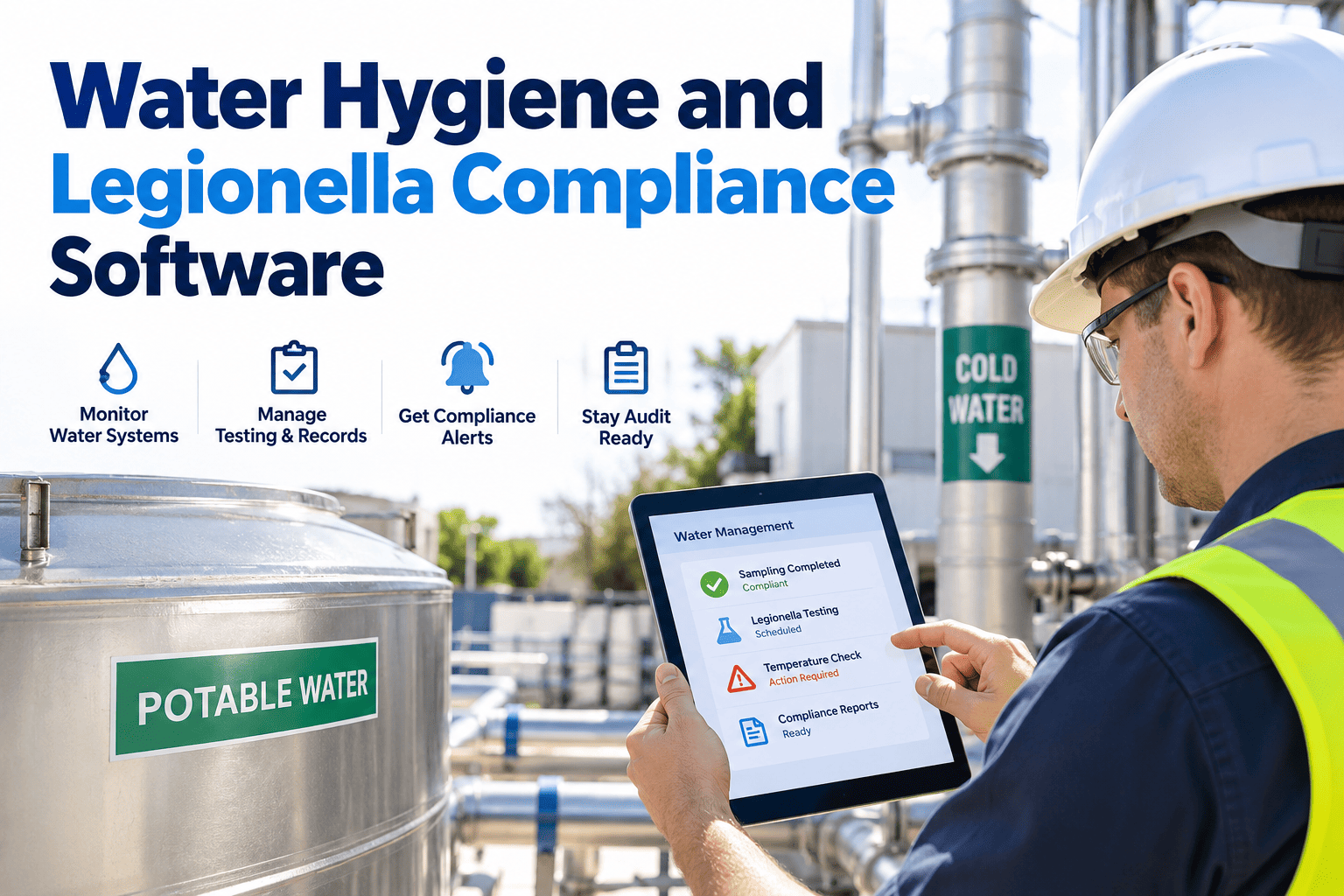
Turn your written scheme into live monitoring: temperature logs, flushing regimes, tank and calorifier inspections, sampling and remedial actions — all scheduled, captured on mobile and exportable as a complete evidence pack for any inspection.
20-45
the degree range in which legionella bacteria multiply most readily in water systems
Weekly
flushing expected on outlets that are not used regularly enough to turn over water
5 years
the retention period commonly applied to water monitoring and treatment records
Unlimited
the fine a court can impose where health and safety duties are seriously breached
The Duty Chain
Five Obligations That Sit With the Duty Holder, Not the Contractor
Water hygiene is governed in the UK by general health and safety law, given practical shape by the Approved Code of Practice on legionnaires' disease and the accompanying technical guidance. Together they place responsibility on the duty holder — the employer, landlord or person in control of the premises — to identify and assess the risk, prepare a written scheme, appoint a competent responsible person, implement controls and keep records. What trips organisations up is not ignorance of these duties but the assumption that engaging a specialist contractor discharges them. It does not. The contractor performs tasks; the duty holder must be able to demonstrate that the right tasks were performed, at the right frequency, by competent people, and that everything the results revealed was acted upon.
01
Identify and assess the risk
A suitable and sufficient legionella risk assessment must cover the whole water system: incoming supply, cold water storage, hot water generation and distribution, dead legs, little-used outlets, showers, spa pools, evaporative cooling and any process water. It has to be reviewed regularly and whenever the system, its use or the occupancy changes — a refurbishment, a floor taken out of service, or a long shutdown all reset the risk picture.
02
Prepare and maintain a written scheme
The scheme sets out how the risk will be controlled in practice: the schematic of the system, the control measures chosen, the monitoring frequencies, the parameters to be achieved and the actions to take when they are not. A scheme that exists as a document but never drives a task list is the most common weakness found in enforcement — it describes an intention rather than an operating routine.
03
Appoint a competent responsible person
A named individual with sufficient authority, training and knowledge must be responsible for implementing the scheme, with a deputy for absence. Competence needs to be evidenced through training records, and the appointment needs to be current — a responsible person who left the organisation two years ago is a finding waiting to be written up.
04
Implement, monitor and act on results
Controls only work if they are performed and verified. Temperatures must be measured and recorded, not assumed. Out-of-specification readings must trigger investigation and corrective action, and that action must be closed and re-verified. A monitoring log full of failing readings with no corresponding remedial trail is significantly worse evidence than no log at all.
05
Keep records and make them available
Risk assessments, schemes, monitoring results, sampling certificates, cleaning and disinfection records, training evidence and remedial closures all need retaining and producing on request. When these live across contractor portals, shared drives, email and clipboard sheets, assembling a defensible history for a specific building and period becomes a multi-day exercise.
Monitoring Regime
The Task Calendar That Underpins a Defensible Scheme
Every water hygiene programme reduces to a repeating set of checks at set intervals, each with a target parameter and a defined action when that parameter is missed. The difficulty is volume and dispersion: a single site may have hundreds of sentinel and rotational outlets, several calorifiers, multiple tanks and dozens of showers, all on different cycles, monitored by different people. The table below sets out the pattern most written schemes follow. In OxMaint each line becomes a recurring work order tied to the specific asset or outlet, with the acceptance limit built into the checklist so a failing reading escalates automatically.
| Control task |
Typical frequency |
Target parameter |
Action if outside limits |
| Sentinel hot outlet temperature |
Monthly |
Hot reaching target within one minute at the tap |
Investigate distribution, raise remedial, retest |
| Sentinel cold outlet temperature |
Monthly |
Cold below target within two minutes |
Check for warming, insulation, proximity to heat |
| Rotational outlet checks |
Representative sample annually |
Same as sentinel outlets |
Extend sampling across the affected branch |
| Flushing of little-used outlets |
Weekly, or as scheme dictates |
Run to temperature, full turnover of water |
Record omission, consider removing dead leg |
| Calorifier flow and return |
Monthly |
Stored and returned water within scheme limits |
Review heating capacity and circulation |
| Calorifier drain and inspection |
Annually, or by condition |
Absence of significant sediment or debris |
Clean, disinfect, record and re-inspect |
| Cold water storage tank inspection |
Annually |
Clean, lidded, insulated, screened, no ingress |
Clean and disinfect, repair lid or screen |
| Shower head and hose descale |
Quarterly |
Free of scale and biofilm |
Descale, disinfect or replace the fitting |
| Thermostatic mixing valve service |
Annually |
Correct blend, fail-safe operating |
Service or replace, verify performance |
| Microbiological sampling |
As risk assessment directs |
Within accepted count thresholds |
Escalate, resample, disinfect as indicated |
Frequencies and parameters must follow your own risk assessment and written scheme, which may be more demanding in healthcare, care homes, leisure facilities and residential blocks than in a low-occupancy office. The point of a system is not to choose your regime — it is to guarantee that the regime you chose is executed and evidenced without depending on anyone's memory.
OxMaint for Water Hygiene Teams
A Missed Flush Is Not a Missed Task. It Is a Gap in the Only Defence You Have.
OxMaint schedules every outlet, tank, calorifier and valve as its own tracked asset, captures the reading at the point of work with a timestamp, escalates every out-of-limit result into a corrective job, and holds the whole chain of evidence in one exportable record.
The Control Loop
From Written Scheme to Closed Evidence, Every Cycle
The value of software here is not that it replaces expertise. Your risk assessor, water treatment specialist and responsible person still make the judgements. The software's job is to ensure that the judgements they made are executed reliably, that the results feed back, and that nothing ever falls between two organisations. Four stages repeat continuously.
1
Scheme becomes schedule
Every outlet, tank, calorifier, TMV and shower is registered as an asset with its location and reference. The written scheme's frequencies and acceptance limits are configured against those assets, so the abstract document becomes a concrete stream of dated, assigned tasks with the right checklist attached.
2
Readings captured at the tap
The operative scans the outlet, enters the temperature or result on a phone, and the record is filed instantly with a timestamp and a user. There is no transcription step, no clipboard to lose, and no possibility of a month's readings being written up from memory on the last day.
3
Exceptions escalate automatically
A reading outside the configured limit raises a linked corrective work order there and then, with an owner, a priority and a target date. It stays visible on the compliance dashboard until it is resolved and re-verified, which converts the most dangerous kind of finding into a managed item.
4
Evidence assembles itself
Because every result is already attached to an asset, a date and a person, the logbook exists as a live consequence of the work rather than a document someone has to compile. Filter by building and period, and the pack is ready for an auditor, an insurer or an environmental health officer.
The same structure handles the events that traditionally break a scheme: a building reopening after closure, a wing taken out of use, a new extension brought online, or a change of contractor. Assets and history stay with the building, so continuity survives the handover instead of walking out of the door with the outgoing provider's files.
Sector Pressure
Where the Stakes Rise Sharply
The baseline duty applies everywhere water is stored, heated or aerosolised. But the consequences of failure, and the level of scrutiny applied, vary enormously by setting — and the systems most likely to be complex are frequently the ones with the most vulnerable occupants.
Healthcare and care homes
Susceptible occupants, augmented care requirements, extensive outlet counts and intensive sampling regimes. Scrutiny from regulators and infection prevention teams is continuous rather than periodic, and augmented care areas typically demand tighter monitoring and documented outlet management than the general estate.
Education and student accommodation
Long vacation shutdowns create stagnation across entire blocks, followed by mass reoccupation in a single week. Pre-reopening flushing and disinfection programmes are enormous logistical exercises that must be evidenced room by room, and are close to impossible to manage credibly on spreadsheets.
Housing and residential blocks
Communal systems, void properties, high turnover and limited access to individual dwellings. Void flushing and reletting checks are a persistent weak point, because the units most likely to stagnate are exactly the ones nobody is visiting routinely until a new tenant moves in.
Leisure, hotels and industry
Spa pools, showers, evaporative cooling and process water introduce aerosol-generating risks with high exposure to the public. Seasonal occupancy patterns and plant that runs intermittently make disciplined scheduling and documented disinfection far more important than in a steadily occupied building.
FAQ
Frequently Asked Questions
Does OxMaint carry out the legionella risk assessment?
No. The risk assessment and written scheme remain competent-person work. OxMaint executes them — converting each control into scheduled tasks, capturing results and tracking remedials to closure.
Book a demo to see how.
Can our water treatment contractor record directly in the system?
Yes. Contractors can be assigned tasks, complete checklists and upload certificates against the specific asset, so results land in your log at the time of the visit instead of arriving weeks later as a PDF report.
How are failed temperature readings handled?
Acceptance limits sit inside the checklist. A reading outside them immediately raises a linked corrective work order with an owner and target date, which stays flagged until the fault is fixed and a satisfactory retest is recorded.
Will it cope with hundreds of outlets across multiple sites?
That is exactly the case it is built for. Outlets are registered individually with rotational sampling supported, and dashboards roll compliance up by building and portfolio.
Start free to load your first site.
How quickly can we move off paper logbooks?
Most teams register assets and schedules for one building within days and roll out progressively. Historic certificates and assessments can be attached to assets so old evidence sits alongside new records from the start.
OxMaint AI — Water Hygiene and Legionella Compliance
The Bacteria Do Not Wait for the Audit. Neither Should Your Monitoring.
OxMaint gives UK duty holders a live water asset register, scheme-driven scheduling, mobile temperature and flushing capture, automatic escalation of every out-of-limit result, contractor visibility and a complete exportable evidence pack for every building. Replace the clipboard, close the remedial gap, and know your position at any moment.