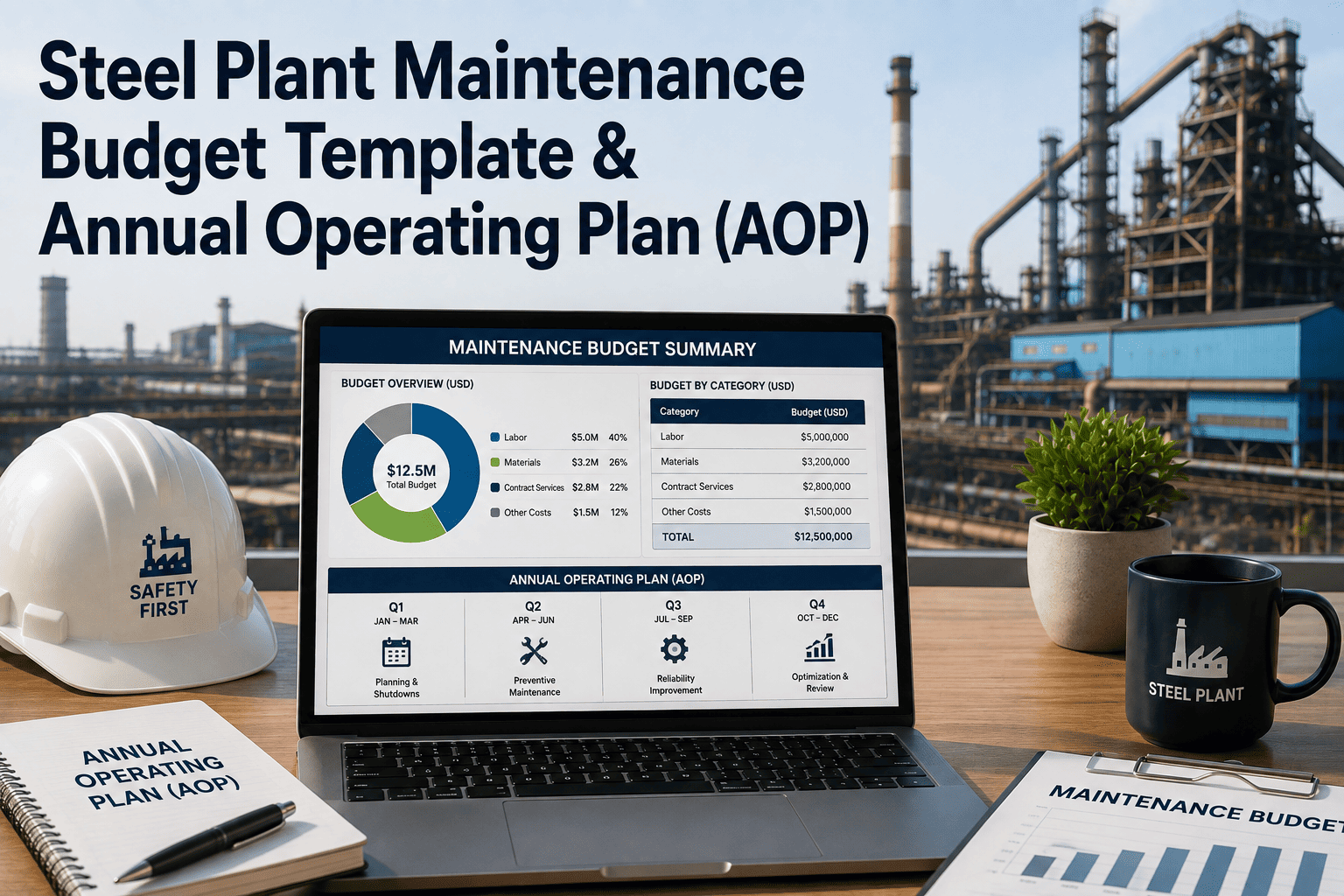
A maintenance budget built on last year's number plus ten percent looks fine in January and falls apart by August, because it was never actually built from what the plant spends money on. OpEx, CapEx, labor, and spare parts each move on their own pattern, and a single lump budget line can't catch a spike in any one of them until the overrun is already booked. This guide breaks down what a steel plant's annual operating plan needs to track, and how to catch variance before it becomes a year-end surprise. Start your free trial on Oxmaint or book a live demo to see a maintenance budget built from real work order cost history.
The 4 Cost Categories Every Maintenance AOP Needs
A budget line that just says "maintenance" hides where the money is actually going. These four categories, tracked separately, are what make a variance report useful instead of a mystery.
Operating expenses covering routine repairs, consumables, and contracted services that keep the plant running day to day.
Capital expenditure for major replacements, upgrades, and asset additions planned as part of the year's investment.
Wages, overtime, and contractor costs tied directly to the maintenance work actually performed each month.
Inventory carrying cost and consumption of parts stocked to support both planned and unplanned maintenance work.
Budget Variance: Where Does Your Plant Sit?
A monthly variance check placed against a defined scale is what turns a budget from a document you review once a year into something you can act on today.
Maintenance Budget Readiness: The Checklist
Before an AOP goes in front of finance, these five conditions should hold true. If any box is open, the plan is likely to miss its own targets by mid-year.
Where Maintenance Budgets Go Wrong
| Budget Problem | Root Cause | Fix |
|---|---|---|
| Overrun discovered only at year-end close | Variance isn't tracked against actual spend on a monthly basis | Monthly budget-vs-actual tracking with variance visible in real time |
| Labor costs blur together with spare parts spend | Cost categories aren't separated in the budget or the tracking | OpEx, CapEx, labor, and spare parts tracked as distinct budget lines |
| Forecast misses a seasonal spike in repair activity | The budget was built on a flat estimate instead of historical trend data | Forecast built from actual historical cost patterns by month |
| CapEx projects compete with emergency repair funds | Capital and operating spend aren't planned or tracked separately | CapEx and OpEx budgets separated and monitored independently |
| No one notices overspend until the quarter closes | There's no threshold that flags when actual spend departs from plan | Automatic reforecast trigger when variance crosses a defined threshold |
Before vs. After: Managing the Maintenance Budget
How Oxmaint Powers Your Maintenance Budget & AOP
A budget built in a spreadsheet is only as accurate as whoever updates it, and usually nobody does until it's too late. Oxmaint tracks every maintenance cost by category as work orders close, so the AOP stays current automatically. Start for free and build next year's budget from this year's real spend.
Every cost is categorized as it's logged, giving a clean breakdown with no manual sorting.
Spend is compared against plan continuously, not reconciled once at the end of the period.
Labor hours and parts consumed are captured directly from the work order that generated the cost.
Parts spend and carrying cost are tracked separately, showing their true impact on the budget.
Next year's plan is built on actual monthly spend patterns instead of a flat estimate.
A defined variance threshold prompts a review before overspend has a chance to compound.