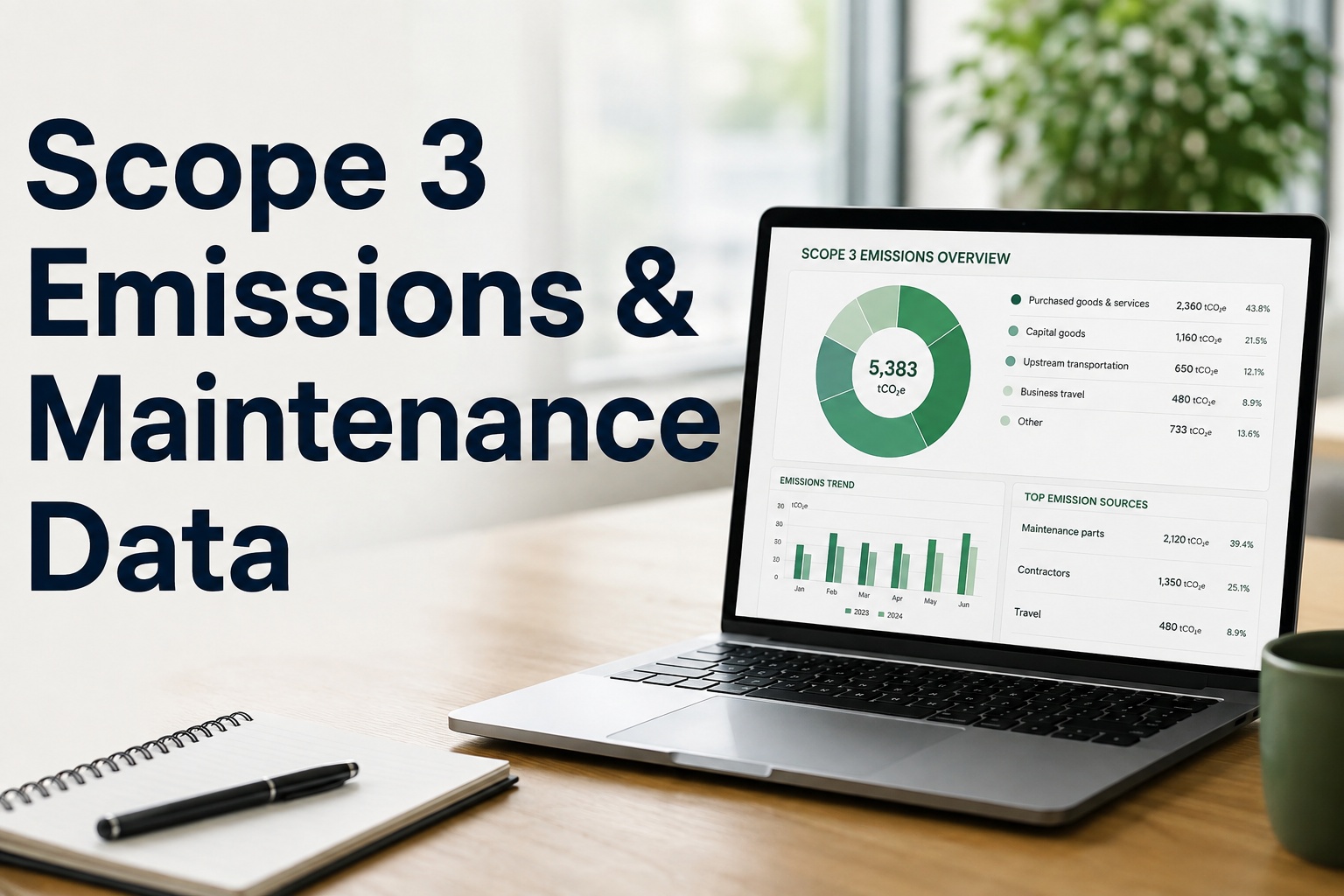
Most sustainability teams building a Scope 3 inventory hit the same wall: they need supplier-specific data across thousands of purchases a year. Their maintenance department records every part they buy, every contractor they engage, every fuel they burn — and stores it in a CMMS the sustainability team never opens. That gap is the point. Oxmaint captures MRO, contractor and asset-life data that maps directly onto GHG Protocol categories 1, 2, 4 and 6 — supporting your Scope 3 methodology, not replacing it. Book a demo to see maintenance data in your Scope 3 workflow.
~22%
of upstream Scope 3 attributable to maintenance, spare parts and capex in typical manufacturing (McKinsey semiconductor benchmarks)
15
GHG Protocol Scope 3 categories — maintenance data touches at least 4 of them meaningfully
90%
upper-bound share of total corporate emissions represented by Scope 3 across manufacturing sectors
Where Maintenance Data Actually Sits in the Scope 3 Framework
The GHG Protocol Scope 3 Standard divides upstream and downstream value-chain emissions into 15 categories. Maintenance activity does not map to a single one — it touches several, and different maintenance data feeds different categories. Understanding which CMMS field feeds which Scope 3 category is what makes the data useful for sustainability reporting rather than just interesting to maintenance managers. The matrix below shows the direct relevance mapping.
Maintenance Data → Scope 3 Category Mapping
Under the GHG Protocol Corporate Value Chain (Scope 3) Standard
| Scope 3 Category | Maintenance data source | Typical materiality |
|---|
| Cat 1 · Purchased Goods & Services | Spare parts purchases, MRO consumables, contractor service invoices, lubricants and chemicals | High · often the single largest maintenance-derived category |
| Cat 2 · Capital Goods | Major asset replacements, refurbishment programmes, equipment upgrades captured as capex | Medium-high · significant in capex-heavy years |
| Cat 4 · Upstream Transportation | Freight for spare parts, contractor mobilisation, courier deliveries linked to work orders | Medium · varies by supplier geography |
| Cat 5 · Waste Generated in Operations | Waste oils, filters, packaging from parts, decommissioned assets, contaminated absorbents | Medium · underestimated in most inventories |
| Cat 6 · Business Travel | Engineer travel, contractor mobilisation, mileage for own service fleet where captured | Low-medium · material for FM operators |
Scope 3 methodology remains the sustainability team's remit — Oxmaint provides the raw operational data, not the emissions calculation. Sign up free to review your MRO data structure against your existing Scope 3 methodology.
The Data Hierarchy — Why Activity Data Beats Spend Data
The GHG Protocol data-quality hierarchy is explicit: supplier-specific emissions data ranks highest, activity-based data ranks second, and spend-based data (converting pounds spent to emissions using industry-average emission factors) ranks lowest. Most Scope 3 inventories today rely heavily on spend-based data for maintenance activity, because the underlying activity data is trapped in a CMMS that isn't connected to sustainability reporting. Every CMMS field you can promote from spend-based to activity-based improves your inventory quality.
GHG Protocol Data Quality Hierarchy
Best
Supplier-specific data
Direct emissions data provided by the specific supplier for the specific product or service purchased. Highest primary-data quality — increasingly requested from Tier 1 MRO suppliers.
Better
Activity-based data
Physical activity data (kg of steel, litres of oil, kWh of electricity, kilometres of freight) multiplied by an appropriate emission factor. Most CMMS data can support this level.
Fallback
Spend-based data
£ spent × industry-average emission factor per £. Widely used but blunt — a £500 emergency freight cost and a £500 planned bulk order carry very different real emissions.
Asset Life Extension — The Carbon Lever Nobody Counts
Every year an asset stays in productive service is a year the replacement asset's embedded carbon doesn't have to be manufactured. For high-embodied-carbon assets — chillers, compressors, motors, pumps, HVAC plant — that avoided emissions can dwarf the operational energy of the maintenance itself. This is where maintenance quality genuinely becomes a sustainability strategy: a well-maintained motor lasting 15 years instead of 10 avoids the full manufacturing footprint of a replacement unit. Oxmaint tracks asset install date, service history and remaining-useful-life estimates so life extension becomes measurable, not just anecdotal.
Extended lifecycle tracking
Install date, cumulative runtime, service events and refurbishment cycles captured per asset — the base data for any life-extension carbon claim.
Refurbishment vs replacement
Refurb history logged as an alternative to replacement. Sustainability team can compare embodied carbon avoided vs replacement footprint.
Predictive maintenance impact
Condition-based maintenance extending mean time between overhaul directly reduces the frequency of major refurbishment or replacement — reduction claim substantiated by service records.
See Maintenance Data Feeding Your Scope 3 Workflow
Walk through the MRO data model, contractor-emissions capture, asset-life extension tracking and how the data connects to your ESG reporting platform — configured against your specific site set. Thirty minutes with the Oxmaint team.
UK Regulatory Pressure That's Making This Urgent
The regulatory landscape has moved decisively. UK-listed companies fall under Streamlined Energy and Carbon Reporting (SECR) with Scope 3 reporting increasingly expected as good practice. Companies in scope of the Task Force on Climate-related Financial Disclosures (TCFD) framework are effectively required to report material Scope 3 categories. The upcoming UK Sustainability Reporting Standards (UK SRS) — modelled on IFRS S2 — will bring Scope 3 into mandatory reporting for many large UK entities from the second half of this decade. For UK subsidiaries and suppliers to EU customers, the CSRD sweep pulls in another cohort. The direction of travel is clear. Sign up free to prepare your CMMS data for upcoming disclosure requirements.
Expert Perspective — Why Maintenance Sits at the Data Bottleneck
Every material Scope 3 inventory eventually runs into the same bottleneck: getting activity data out of the operational systems that hold it. Finance can produce the spend-based numbers quickly, but spend-based estimates are the weakest data class in the hierarchy — and increasingly the class that assurance providers, investors and regulators are pushing back on. The organisations that will produce credible, defensible Scope 3 disclosures are those that can pull activity data out of the systems where it already lives — CMMS included — and hand it to the sustainability platform as quantified inputs to the emissions calculation, not as invoices.
Physical quantities, not just costs
Kilograms of steel, litres of oil, kilometres of freight — the units emission factors are built for. Cost is a distant fallback.
Supplier attribution on every line
Vendor-specific data outranks industry-average. Consistent supplier identification per part and per WO enables supplier-specific factor use.
Life extension as a reduction lever
Extending a chiller from 10 to 15 years is genuine avoided emissions. Requires disciplined service history to substantiate the claim.
Boundary discipline
Not all maintenance data is Scope 3-relevant. Clear category mapping stops sustainability teams importing noise alongside signal.
Who Uses Oxmaint Alongside Their Scope 3 Programme
The platform is used by the specific UK operational roles bridging maintenance and sustainability: sustainability managers assembling Scope 3 inventories who need activity data from operational systems, ESG reporting leads producing SECR, TCFD and UK SRS submissions, carbon managers building supplier-emissions engagement programmes with Tier 1 MRO suppliers, EHS directors integrating sustainability metrics with existing HSE compliance workflows, engineering directors making the business case for asset life extension against replacement capex, and FM contractors reporting emissions performance to client organisations. Each role sees the MRO, contractor and asset data filtered to their view — Scope 3 data export, supplier engagement list or life extension dashboard. Sign up free to scope your Scope 3 data extraction.
Getting Scope 3 Data Flowing
Integration starts by mapping the CMMS data model to your existing Scope 3 methodology — which fields feed Cat 1, which fields feed Cat 6, which are out of scope. Supplier master and part master are enriched with any existing supplier emissions data (from EcoVadis, CDP responses or direct supplier disclosure). Data extracts are scheduled to your sustainability platform (Persefoni, Watershed, Sphera, Sweep, Salesforce Net Zero Cloud, or internal spreadsheet) at whatever cadence supports your reporting cycle. Most single-tenant configurations move from initial scoping to first data export inside 30-45 days. Book a walkthrough to see live UK Scope 3 integrations.
Turn Your CMMS Into a Scope 3 Data Source
Oxmaint captures the MRO, contractor and asset-life data that supports GHG Protocol Scope 3 reporting — activity-based inputs replacing spend-based estimates, ready to feed the sustainability platform you already run.
Frequently Asked Questions
Does Oxmaint calculate a company's Scope 3 emissions?
No — and it isn't intended to. Emissions calculation under the GHG Protocol requires a defined organisational and reporting boundary, a chosen consolidation approach, emission factor selection per category, and methodology consistency with your wider inventory. All of that sits with the sustainability team and their chosen accounting platform. What Oxmaint provides is the activity data — spare parts consumed, contractors engaged, refurbishments completed, service travel captured — that feeds those calculations. The division of labour matters: Oxmaint captures maintenance operational reality, your Scope 3 platform performs the emissions accounting.
Which Scope 3 categories does maintenance data most commonly feed?
Four categories dominate: Category 1 (Purchased Goods and Services) via spare parts and contractor service purchases, Category 2 (Capital Goods) via major asset replacements and refurbishments, Category 4 (Upstream Transportation and Distribution) via parts freight and contractor mobilisation, and Category 6 (Business Travel) via engineer and contractor travel. Category 5 (Waste Generated in Operations) is also fed by maintenance data through waste oils, filters, packaging and end-of-life asset disposal. Categories 3, 7-15 are typically outside the maintenance scope.
How does asset life extension actually reduce emissions?
Every capital asset carries embodied carbon from its manufacture — the emissions from steel, aluminium, plastics, semiconductors, transport and assembly that occurred before the asset arrived on your site. Extending an asset's productive life delays the manufacturing footprint of its replacement. For high-embodied-carbon assets (chillers, compressors, motors, HVAC plant), that avoided emissions can be substantial. Oxmaint tracks install date, cumulative service, refurbishment cycles and remaining-useful-life estimates so life extension becomes a substantiated claim in your Category 2 (Capital Goods) analysis rather than an untracked assumption.
Can contractor emissions be tracked separately from in-house maintenance?
Yes. Contractor work orders carry the specific contractor identifier, service scope, travel where captured, and any materials or subcontractor charges. This separation matters for Scope 3 because contractor activity typically feeds different categories (Cat 1 for the service purchase, Cat 4 for parts freight, Cat 6 for travel where captured under the reporting boundary). Contractor engagement patterns also identify Tier 1 suppliers where supplier-specific emissions data should be requested to move the analysis up the data-quality hierarchy.
Does the platform integrate with sustainability reporting software?
Yes. Standard integrations include exports to established Scope 3 accounting platforms (Persefoni, Watershed, Sphera, Sweep, Salesforce Net Zero Cloud), enterprise ERP systems where Scope 3 modules are deployed (SAP Green Ledger, Microsoft Cloud for Sustainability), and structured CSV/API exports for internal reporting workflows. Data extracts are scheduled to align with your reporting cycle — monthly for operational tracking, quarterly or annually for formal disclosure. Data mapping to your specific Scope 3 methodology is agreed during deployment scoping.