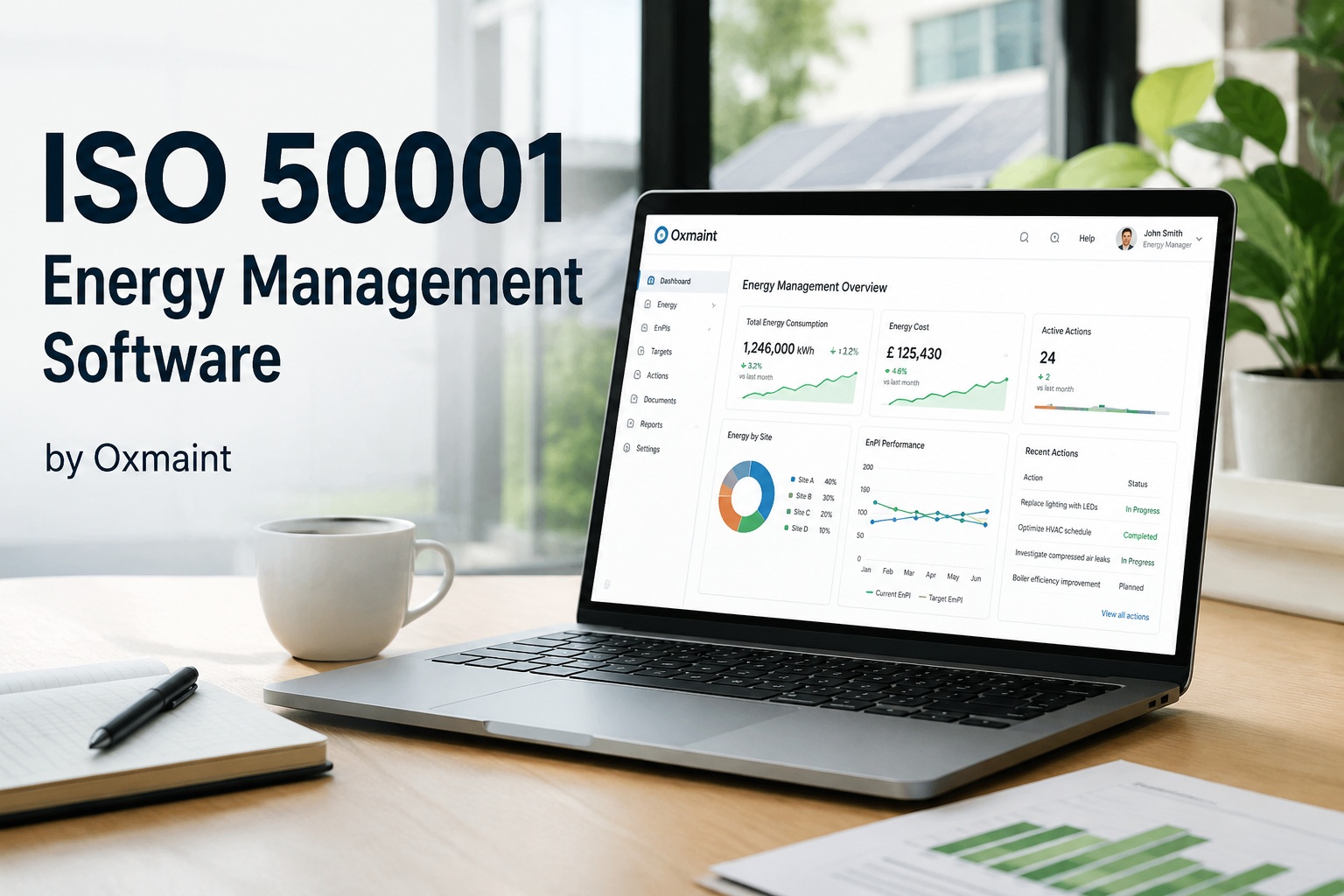
ISO 50001 is not a tool for watching your electricity bill. It's a management-system standard — Annex SL structure, PDCA cycle, third-party audit pathway — requiring organisations to systematically identify, measure and improve energy performance. For UK operators it carries a specific bonus: a certified ISO 50001 system covering 100% of energy use removes the ESOS lead-assessor sign-off entirely. Oxmaint provides the data spine — asset-level energy capture, EnPI tracking, SEU monitoring — that turns an EnMS from documents into a system auditors can verify. Book a demo to see ISO 50001 workflows in action.
10-30%
typical energy performance improvement reported by organisations 3-5 years into a certified ISO 50001 EnMS
100%
energy-use coverage required for ISO 50001 certification to exempt the organisation from ESOS lead-assessor sign-off
3-yr
certification cycle — initial audit, annual surveillance visits, full recertification every three years
The PDCA Engine — Where an EnMS Actually Lives
ISO 50001:2018 is built entirely on the Plan-Do-Check-Act continual-improvement cycle. Every clause of the standard maps to one of the four PDCA quadrants, and the loop never ends: each cycle raises the organisation's baseline of energy performance. Understanding which quadrant your current activity sits in is what separates an EnMS being genuinely implemented from an EnMS being managed as a folder of policies for the certification body.
ISO 50001:2018 PDCA Cycle · Clause Mapping
Plan
Energy review, baseline, SEUs, EnPIs, objectives. Establish reference period, quantify current consumption, identify significant energy uses.
Do
Competence, communication, operational controls. Implement action plans, train personnel, run daily energy management activity.
Check
Monitoring, measurement, internal audit. Track EnPIs against baseline, verify performance improvement, evidence for audit.
Act
Management review, corrective action, improvement. Review results, close nonconformities, feed next cycle's objectives.
The Measurement Backbone — SEU, EnPI, EnB
The three concepts that define ISO 50001 measurement live in Clauses 6.3, 6.4 and 6.5. Get them right and the rest of the standard flows; get them wrong and every subsequent audit finds the same non-conformities. They are hierarchical: Significant Energy Uses (SEUs) come first, EnPIs are defined against them, and the Energy Baseline (EnB) is the reference against which every EnPI improvement is measured.
1
SEU · Significant Energy Use
Clause 6.3
Any use accounting for substantial energy consumption and/or offering considerable potential for energy performance improvement. Compressed air, HVAC plant, process heating, refrigeration — typically the top 80% of consumption identified in the energy review.
2
EnPI · Energy Performance Indicator
Clause 6.4
Quantitative measure of energy performance defined against each SEU. Examples: kWh per tonne of finished product, kWh per m² of building conditioned area, kWh per production hour. Must be trackable and traceable.
3
EnB · Energy Baseline
Clause 6.5
Fixed reference point representing normal energy performance before improvement actions began. Every claim of improvement measured against it. Normalised for production volume, weather and other relevant variables.
Oxmaint holds SEU tagging on every asset, calculates EnPIs from live meter and production data, and locks the EnB as a fixed reference — so the "before vs after" comparison auditors need is one screen, not a spreadsheet reconstruction. Sign up free to configure SEUs and EnPIs against your existing energy review.
ISO 50001 as an ESOS Exemption Pathway
For UK organisations in scope of the Energy Savings Opportunity Scheme (ESOS), ISO 50001 offers a specific compliance advantage: a certified ISO 50001 system covering 100% of the organisation's energy use satisfies ESOS entirely — no lead-assessor sign-off, no separate ESOS audit, no parallel evidence trail. This is a legitimate route many large UK organisations have taken to consolidate two overlapping regulatory obligations into a single management system.
01
ESOS scope defined
All UK operations meeting the ESOS undertaking threshold identified — buildings, transport, industrial processes.
02
EnMS covers 100%
ISO 50001 boundary extended to cover every energy use within the ESOS-obligated scope — no gaps.
03
Certification maintained
Annual surveillance audits by UKAS-accredited certification body confirm ongoing compliance and improvement.
04
ESOS notified
Environment Agency notified of ISO 50001 route — lead-assessor sign-off requirement removed for the compliance period.
See a Live ISO 50001 EnMS in Oxmaint
Walk through SEU tagging, EnPI calculation from live data, baseline reference, action-plan tracking and the audit-ready evidence pack — configured against your specific energy scope. Thirty minutes with the Oxmaint team.
ISO 50001 certification bodies find non-conformities in the same handful of places on almost every audit. The standard itself is well-written; the failure pattern is operational, not conceptual. Sites lose points where the documented EnMS doesn't match the observed reality — EnPI records that can't be reproduced, action plans without close-out evidence, or a management review that hasn't actually reviewed anything the standard requires. Sign up free to close common audit finding gaps before your next surveillance visit.
EnPI traceability
EnPI values need to be reproducible from documented raw data. "Trust me, this is the right number" doesn't survive a Stage 1 audit.
Action plan close-out
Every objective and action plan needs documented evidence of implementation and effect. Open items past target date are the most common finding.
Baseline normalisation
Baselines must be normalised for relevant variables (production, weather, occupancy). Unnormalised baselines invalidate improvement claims.
Management review coverage
Clause 9.3 lists specific inputs and outputs a management review must cover. Skipping any is a straightforward major non-conformity.
Expert Perspective — Why ISO 50001 Fails Without Operational Data
The organisations that succeed with ISO 50001 are those that build the EnMS on live operational data, not on annual retrospective spreadsheets. The standard doesn't require the sophisticated data infrastructure — but the audit pattern rewards it heavily. When an auditor asks "show me last month's EnPI trace against your baseline", the organisation with live data pulls it up in seconds. The organisation running annual reconstructions from utility bills spends the next hour rebuilding it from scratch, hoping the numbers reconcile. Both organisations pass the standard on paper. Only one is doing genuine energy management.
Live data over annual reconstruction
Continuous EnPI calculation beats yearly spreadsheet exercises for both audit readiness and genuine performance improvement.
Asset-level SEU tagging
SEUs at asset level, not "the boiler house". Granular tagging enables per-asset EnPI and targeted action plans.
Action plan discipline
Every energy objective becomes a linked action plan with owner, target, evidence. No orphan objectives in the system.
Integration with maintenance
Energy performance and maintenance activity are inseparable. One CMMS covering both makes the audit trail defensible.
Who Uses Oxmaint for ISO 50001
The platform is used by the specific UK operational roles that carry EnMS accountability: energy managers running EnPI tracking and SEU inventory across single or multi-site portfolios, sustainability leads assembling audit evidence for surveillance and recertification visits, facilities directors managing ISO 50001 alongside ISO 9001 and ISO 14001 under an integrated management system, maintenance managers whose asset servicing feeds directly into energy performance evidence, compliance officers coordinating ESOS exemption via 50001 certification, and estates leads across NHS trusts, higher education, local authorities and manufacturing sites operating certified EnMS as part of their public sustainability commitments. Each role sees the same data filtered to their view — EnPI dashboard, action plan backlog, audit evidence pack. Sign up free to configure roles for your energy team.
Getting an ISO 50001 EnMS Live in Oxmaint
Deployment starts by importing your existing energy review — asset inventory, energy consumption baselines, SEU classifications, action plans. EnPIs are configured against each SEU with the correct normalisation variables. Live meter integration is added where AMR data is available; manual meter reads captured on mobile where it isn't. Action plans link to work orders in the CMMS so implementation activity generates its own evidence trail. Management review calendar, internal audit schedule and surveillance visit preparation all sit inside one platform. Most single-site deployments move from initial scoping to live EnMS operation inside 45-60 days. Book a walkthrough to see live UK ISO 50001 deployments.
Turn Your EnMS Into a Live Operational System
Oxmaint gives ISO 50001 organisations one platform for SEU tagging, EnPI calculation, baseline management, action plans and audit evidence — replacing spreadsheets with live operational data ready for surveillance any day of the year.
The certification granted under ISO 50001 belongs to the organisation implementing the EnMS, not to the software supporting it — ISO does not certify products, only management systems. Oxmaint provides the operational data infrastructure that supports an ISO 50001-compliant EnMS: asset-level energy capture, EnPI calculation, baseline management, action plan tracking, audit evidence retention. The organisation retains its EnMS scope, methodology and certification body relationship; Oxmaint provides the tooling that makes daily operation manageable and audit response fast.
Does the platform support the full PDCA cycle?
Yes. Plan-phase activities (energy review, SEU identification, baseline reference, EnPI definition, objective setting) are configured at deployment. Do-phase activities (operational controls, competence records, communication logs) are captured through normal daily use. Check-phase activities (EnPI trending, internal audit records, management review inputs) are supported through the reporting layer. Act-phase activities (corrective actions, opportunity identification, next-cycle objectives) close the loop back into planning. Each phase's evidence is tagged to the relevant ISO 50001 clause for direct audit response.
Can it integrate with our existing energy monitoring systems?
Yes. Standard integrations include AMR data loggers via Modbus, MQTT and REST APIs, half-hourly settlement data from UK utility supplier portals, sub-metering platforms (Elcomponent Energy Pro, Coherent Group, StruxureWare) and BMS platforms (Trend, Priva, Siemens Desigo, Johnson Controls Metasys). Where instrumentation gaps exist, mobile-based manual meter reads captured against a scheduled route give sufficient data quality for many ISO 50001 use cases. The mix of methods is scoped during deployment against your existing metering estate.
How does ISO 50001 relate to ESOS in the UK?
The Energy Savings Opportunity Scheme (ESOS) is a UK mandatory scheme requiring qualifying large undertakings to carry out energy audits every four years. Organisations holding a certified ISO 50001 EnMS covering 100% of their energy use — buildings, industrial processes and transport within the ESOS scope — are exempt from the ESOS lead-assessor audit requirement. The organisation still notifies the Environment Agency of the ISO 50001 route each compliance period, but does not need to commission a separate ESOS lead-assessor sign-off, which typically represents significant cost saving for organisations already running an EnMS.
What audit evidence does Oxmaint retain for surveillance visits?
Every EnMS clause supported by the platform generates its own evidence trail: energy review records (6.3), SEU register (6.3), documented EnPIs with calculation traceability (6.4), baseline records with normalisation methodology (6.5), objectives and action plans (6.2), operational control records (8.1), monitoring and measurement records (9.1), internal audit records (9.2), management review inputs and outputs (9.3), nonconformity and corrective action records (10.2). Audit-pack export bundles the relevant evidence by clause reference into a single PDF ready for surveillance visits or Stage 2 certification audit.