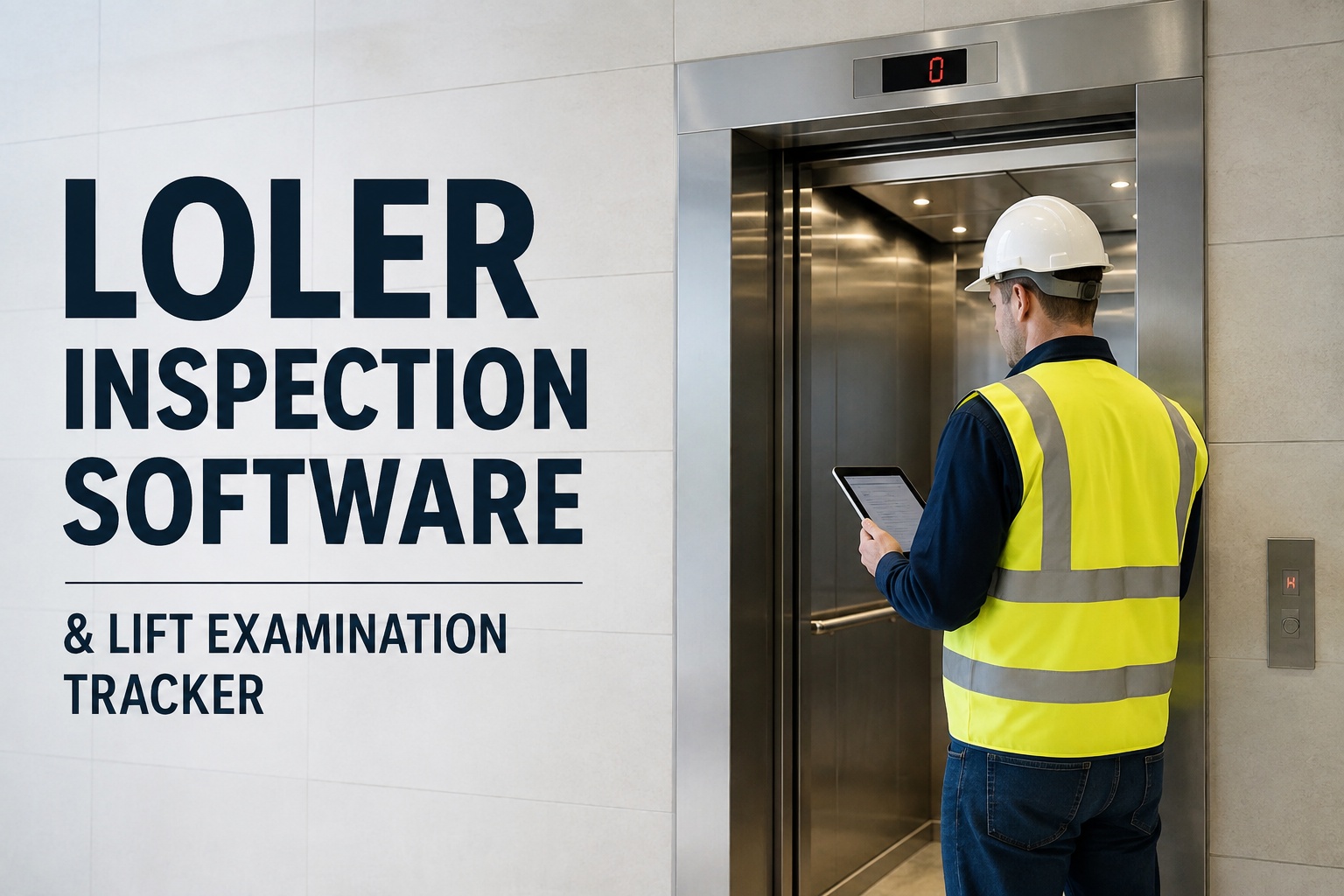
Every workplace lift in the UK sits under one legal duty: thorough examination by a competent person, at prescribed intervals, with a Schedule 1 report retained as evidence. Under Regulation 9 of LOLER 1998, passenger lifts and any lift carrying people go every six months. Goods-only lifts go every twelve. Miss either interval and the duty holder — not the contractor — carries the enforcement risk. Oxmaint gives duty holders one platform for the lift register, examination schedule, Schedule 1 retention, defect classification and remedial tracking. Book a demo to see LOLER workflows in action.
6 mo
thorough examination interval for passenger lifts and any lift carrying people under LOLER Regulation 9
12 mo
interval for goods-only lifts — provided the "goods only" status is genuinely enforced in practice
2 yrs
minimum Schedule 1 retention period after equipment decommissioning — full life records recommended
Six Months or Twelve? The Question That Trips Duty Holders
The most common LOLER compliance failure isn't missing an examination — it's applying the wrong interval. Duty holders assume a "goods lift" qualifies for 12-month intervals, when in practice staff occasionally ride it to speed up loading. Under LOLER, if there's any chance a person could be lifted, the six-month rule applies. When in doubt, treat the lift as subject to the shorter interval — the HSE consistently sides with the more conservative reading.
LOLER Interval Decision · By Lift Type & Use
6M
Passenger lift
Any lift carrying people between floors — offices, hospitals, retail, residential. Six-month interval, no exceptions.
6M
Platform lift & stairlift
Accessibility lifts and stairlifts carrying people. Six-month interval regardless of low usage frequency.
6M
Combined goods-and-passenger lift
Mixed-use lifts default to the shorter interval. If a person could ride it, the six-month rule applies.
6M
Patient hoist & bath hoist
All lifting equipment used to move people — six-month interval under Regulation 9. Covers healthcare and care home settings.
12M
Goods-only lift & dumbwaiter
Twelve-month interval, but only if "goods only" is genuinely enforced with signage, access controls and documented procedures preventing person carriage.
12M
Vehicle lift & freight hoist
Twelve-month interval for equipment that lifts loads only. Scheme of examination by competent person may set alternative periods.
The Schedule 1 Report — Nine Fields Every Report Must Contain
The Schedule 1 report (also referenced as Form 80 by some inspection bodies) is the statutory output of every LOLER thorough examination. It's not optional formatting — every field below must be completed or the report is a compliance failure. Duty holders relying on paper reports lose them; duty holders relying on spreadsheets can't produce them fast enough for HSE inspection. Digital retention against the specific lift asset removes both failure modes.
Owner's name and address
Duty holder identification — the legal responsible person, not the maintenance contractor or FM provider.
Equipment description & unique identifier
Lift make, model, type (passenger/goods/platform) and unique asset ID enabling one-to-one match with the physical lift.
Date of examination
Actual date of the physical thorough examination — not the date the report was written up or countersigned.
Safe Working Load (SWL)
Rated maximum load — must match the physical cabin plate. Discrepancies signal either mis-rating or plate replacement without record update.
Defects found & category
Every defect classified: Immediate, Within Timeframe, or Observation. Classification drives the mandatory remedial timeline.
Remedy dates for defects
Date by which each defect must be remedied — the examiner's judgment, binding on the duty holder unless successfully challenged.
Date of next examination
Next statutory examination date — locked to the 6 or 12-month interval or to the written examination scheme where one applies.
Competent person name & signature
Named engineer performing the examination, plus signature confirming personal accountability for the findings.
Inspection body details
Name and address of the employer of the competent person — the inspection body carrying the underlying insurance and accreditation.
See Live LOLER Compliance Workflows
Walk through the lift asset register, examination scheduling per lift type, Schedule 1 report upload against specific assets, defect classification with remedial deadlines, and audit-pack export — configured against your specific building portfolio. Thirty minutes with the Oxmaint team.
Defect Classification — The Three Categories That Set the Clock
Every defect noted in a Schedule 1 report carries a category, and each category triggers a specific remedial timeline the duty holder is legally bound to meet. Missing the timeline is not just a maintenance backlog — it's a documented failure to control identified risk, exactly the pattern HSE inspection cases turn on when something goes wrong.
Immediate
Defect requiring immediate action
Lift must be taken out of service until the defect is remedied. Examiner sends a copy of the report to the enforcing authority (HSE) under Regulation 10. No exceptions, no negotiation.
Within Timeframe
Defect requiring action by specified date
Lift may continue in service but must be remedied by the date specified by the competent person. Missing the deadline moves the defect to Immediate status.
Observation
Observation not yet requiring action
Noted for monitoring at next examination. Not a mandatory remedial, but ignored observations tend to become "within timeframe" defects at the following visit.
Oxmaint links every defect to a work order with the correct remedial timeline built in and escalation triggers if deadlines approach without close-out. Sign up free to configure your defect-to-work-order workflow.
Duty Holder and Competent Person — Two Roles, Two Duties
LOLER splits accountability between two named parties. The duty holder — the employer, building owner or operator with control of the lift — carries the legal duty for the equipment being safe. The competent person — the independent examiner — carries the professional accountability for the findings in the Schedule 1 report. Outsourcing the maintenance contract does not transfer the duty holder's obligation. The competent person cannot be the same engineer who routinely services the lift. Oxmaint holds both roles explicitly against each lift record and produces the evidence trail proving both parties met their duties. Sign up free to assign duty-holder and competent-person accountability across your lift estate.
Expert Perspective — Where LOLER Enforcement Actually Bites
The enforcement pattern for LOLER is remarkably consistent. HSE inspectors don't typically start by asking to see this quarter's PPM records. They ask for the last two Schedule 1 reports on a specific lift, the defect close-out evidence for anything raised at the last examination, and the evidence that the duty holder — not just the contractor — has read and acted on the findings. When something goes wrong, the case rarely turns on whether the examination was carried out; it turns on whether the duty holder actioned what the competent person found. Digital records that link defects to closed work orders with sign-off evidence are exactly what turns a defensible position into a documented one.
Duty holder ≠ contractor
The duty holder — building owner or employer — carries the legal duty. Outsourcing maintenance doesn't outsource the accountability.
Competent person independence
The competent person must be sufficiently independent from the routine service provider. An engineer inspecting equipment they service isn't independent.
Defect close-out is the evidence
A defect noted is a defect the duty holder now knows about. Closed work orders with sign-off evidence prove the duty was discharged.
Report retention beyond decommissioning
Two-year minimum retention post-decommissioning is the floor. Full-life records reduce future ambiguity when questions arise years later.
Who Uses Oxmaint for LOLER Lift Compliance
The platform is used by the specific UK operational roles that carry LOLER duty holder accountability: facilities managers running lift compliance across single-building and multi-building portfolios, estates directors managing large lift estates across NHS trusts, universities and local authorities, health and safety leads producing evidence for HSE inspection or insurer audit, property managers with commercial and residential lift stock under enhanced tenant safety obligations, FM contractors coordinating lift examinations on behalf of client organisations, and building managers under Building Safety Act 2022 requirements for higher-risk residential buildings. Each role sees the same underlying data filtered to their view — lift asset register, upcoming examination schedule, defect remedial backlog or audit evidence pack. Sign up free to configure roles for your lift compliance team.
Getting a LOLER Deployment Live
Deployment starts with importing your existing lift register — asset make, model, SWL, location, current examination status — into the Oxmaint LOLER module. Each lift is tagged by type (passenger / goods / platform / patient hoist) so the correct 6 or 12-month interval is applied automatically. Inspection bodies are given scoped access to upload Schedule 1 reports directly against the specific lift, and defect classifications automatically generate remedial work orders with the correct deadline. Most single-site deployments move from initial scoping to live LOLER schedule inside 30 days. Book a walkthrough to see live UK lift compliance deployments.
Turn Lift Compliance Into a Live Daily Record
Oxmaint gives LOLER duty holders one platform for the lift asset register, examination schedule, Schedule 1 report retention, defect classification and remedial action tracking — audit-ready for HSE inspection every day of the year.
Frequently Asked Questions
What is a LOLER thorough examination and how does it differ from routine maintenance?
A LOLER thorough examination is a statutory inspection under Regulation 9 of the Lifting Operations and Lifting Equipment Regulations 1998, carried out by a competent person to detect any defects that are — or might become — dangerous. It is entirely distinct from routine maintenance. Maintenance keeps the lift operating; thorough examination independently verifies its safety and produces a legally binding Schedule 1 report. The competent person must be sufficiently independent from the routine service provider — an engineer inspecting equipment they service is not considered independent.
How often do lifts need thorough examination?
Six months for passenger lifts and any lift used to carry people (including platform lifts, stairlifts, patient hoists and mixed goods-and-passenger lifts). Twelve months for lifts used only to move goods — but only where "goods only" is genuinely enforced with signage, access controls and documented procedures preventing person carriage. A written examination scheme drawn up by a competent person may set alternative intervals, but the six/twelve rule is the statutory default. When in doubt, the shorter interval applies.
Can Schedule 1 reports be stored digitally against each lift?
Yes — that's the specific design of the Oxmaint LOLER module. Each lift asset holds its complete examination history: uploaded Schedule 1 reports, dates, competent person details, defect classifications and close-out evidence. Inspection bodies can be given scoped access to upload reports directly against the correct lift — no manual transcription, no lost paper copies. Retention is indefinite by default with the 2-year post-decommissioning minimum met automatically. HSE inspection response becomes a filtered export rather than a document hunt.
How does the platform handle Immediate defects requiring lift withdrawal?
Immediate defects (Category 1) automatically raise a priority alert to the duty holder and named responsible person, generate a work order with immediate withdrawal-from-service instruction, and flag the lift as out of service across all views until remedial close-out is documented. Because Regulation 10 requires the examiner to notify the enforcing authority for Immediate defects, the audit trail is critical — Oxmaint holds the timestamped defect record, the withdrawal-from-service confirmation and the remedial evidence in one linked record.
Does the platform integrate with third-party inspection bodies?
Yes. Third-party inspection bodies (TÜV SÜD, BSI, LECS, Zurich, independent competent persons) can be given scoped access to upload Schedule 1 reports directly against the correct lift on the register. This avoids the multi-day gap between examination and record availability that paper and email-based workflows create. Report uploads automatically trigger defect classification, remedial work order generation, next-examination date locking and duty holder notification — closing the loop between examination and action inside the same platform.