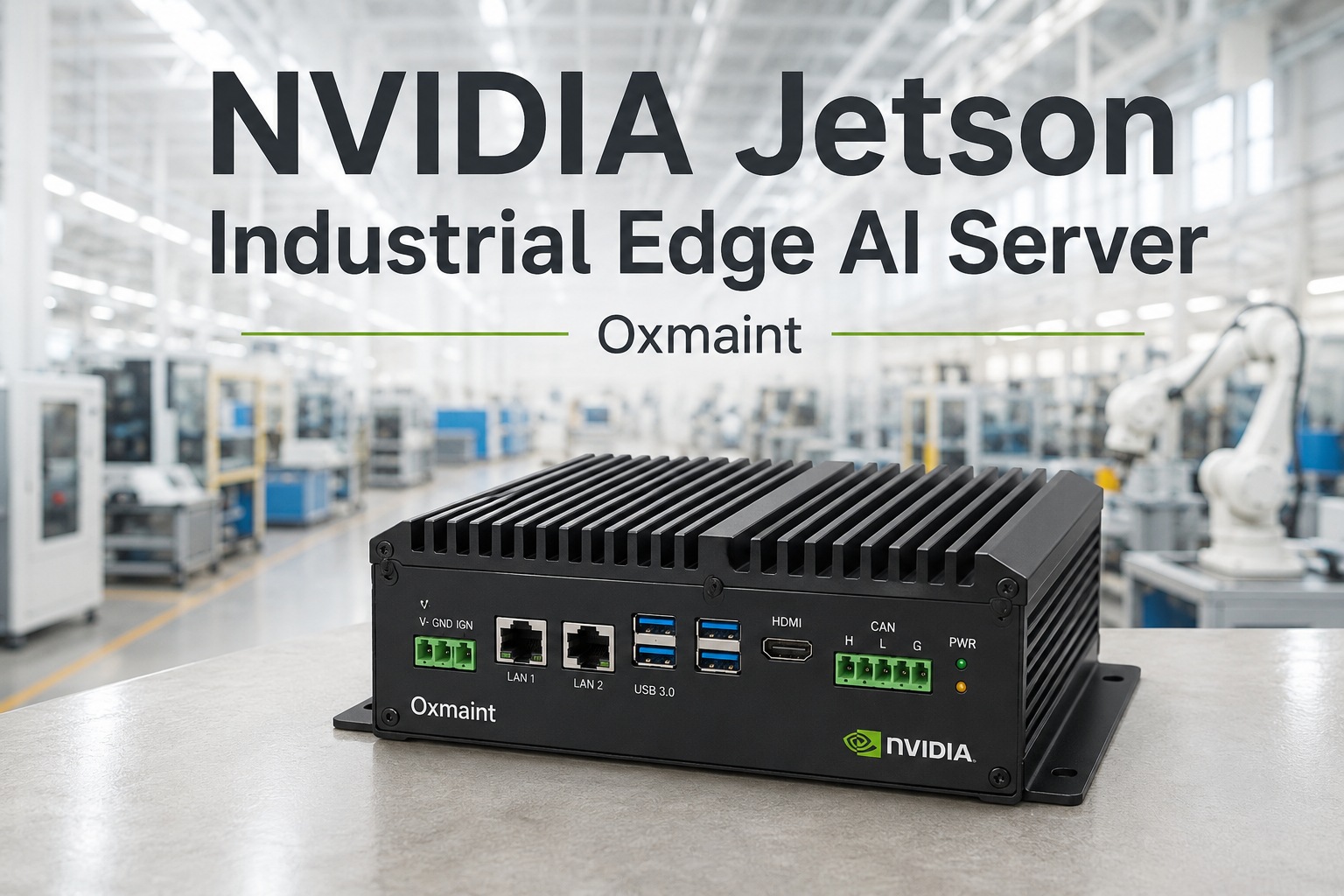
Industrial AI has a deployment problem, not a capability problem. The models exist. The cameras exist. What most manufacturers don't have is the six-month integration project it takes to specify hardware, install networking, wire up cameras and PLCs, harden the OS, deploy the AI stack, and connect it to a maintenance platform. Oxmaint's turnkey NVIDIA Jetson industrial edge AI server ships pre-loaded and pre-integrated: connect power and Ethernet, plug in your cameras and PLCs, and industrial AI runs on-premises. Book a demo to see turnkey edge AI deployment.
275
TOPS peak AI performance on Jetson AGX Orin — 8× the previous Xavier generation
-20/+70°C
operating range on industrial Jetson variants — built for plant floor and outdoor conditions
<50ms
typical inference latency for on-premises vision AI — vs 200-500ms cloud round-trip
Why Edge AI, Not Cloud AI, for the Plant Floor
Cloud AI is superb for training models on historical data. It is a poor fit for real-time industrial inference. Every frame from every camera would have to leave the site, be processed remotely, and return a decision — over a network that in most UK plants ranges from patchy to non-existent in the areas the cameras actually sit. Edge deployment eliminates the round trip. The AI runs where the data is generated, decisions land in milliseconds, and no production data leaves the site — which is exactly what most industrial cybersecurity and data-sovereignty policies require.
Cloud AI
Latency200-500ms round trip
Network dependencyRequires stable uplink 24/7
Bandwidth costEvery frame uploaded
Data sovereigntyProduction data leaves site
Downtime riskInternet outage = AI outage
Best forModel training, historical analysis
Edge AI (Jetson)
Latency<50ms local inference
Network dependencyRuns offline if needed
Bandwidth costOnly alerts & summaries uploaded
Data sovereigntyVideo stays on-premises
Downtime riskSite outage isolated from AI
Best forReal-time vision, PLC integration
The Jetson Orin Module Tiers — and What Each One Handles
The Jetson Orin family spans three module tiers with the same underlying architecture but very different compute ceilings. Choosing the right tier for the workload matters — under-specify and the model won't run in real time; over-specify and you pay for capacity that sits idle. The table below is the plain-English mapping of module → workload → typical industrial use case, and it's what an Oxmaint deployment engineer sizes against before shipping the appliance.
Nano
Up to 67 TOPS
Power7-25W
Best forSingle-camera vision, entry-level PdM
Use caseQA on one production line, single-asset PdM
NX
Up to 157 TOPS
Power10-40W
Best forMulti-camera, multi-model concurrent AI
Use caseCell-level QA, safety monitoring, PdM aggregation
AGX Orin
Up to 275 TOPS
Power15-75W
Best forFull-plant vision, sensor fusion, LLM inference
Use caseLine-wide QA, robotics, multi-plant edge hub
The right tier depends on how many camera feeds, which AI models, and what latency the process demands. Sign up free to scope the right Jetson tier for your specific workload.
What's Actually Inside the Turnkey Appliance
The point of a turnkey delivery is that the customer opens the enclosure, connects two cables, and starts running AI. What Oxmaint pre-integrates before shipping is everything a systems integrator would otherwise need weeks to assemble: the Jetson module in a rugged enclosure, industrial-grade networking, hardened OS, the Oxmaint AI stack, PLC and camera drivers, and the connection back to the CMMS platform. The stack below is what arrives fully assembled.
Oxmaint Turnkey Edge AI Stack
CMMS layer
Alerts, work orders, asset records, audit trail — live sync to Oxmaint cloud or self-hosted
Oxmaint AI applications
Vision QA · PdM analytics · thermal & vibration fusion · anomaly detection · dashboards
AI runtime
NVIDIA CUDA · TensorRT · DeepStream · pre-loaded and optimised for the Jetson tier shipped
Integration layer
PLC drivers (Modbus, OPC-UA, EtherNet/IP) · ONVIF camera integration · MQTT event bus
Hardened OS
Ubuntu LTS with security hardening · read-only root · automated patching · TPM-backed identity
Physical & network
Rugged fanless enclosure · dual GbE · CAN · GPIO · industrial power · DIN-rail / rack mount
See Turnkey Edge AI Deployed in a Real Plant
Walk through an actual Oxmaint Jetson deployment — unbox, connect power & Ethernet, integrate an existing camera and PLC, and see vision AI running with alerts flowing into work orders. Thirty minutes.
Where Jetson Edge AI Actually Earns Its Keep
The technology is impressive on paper — but where does it produce measurable ROI on an industrial site? The applications below are the ones Oxmaint deploys most often, and they share a common pattern: they need real-time inference on high-volume sensor or video data, they need to work reliably regardless of internet connectivity, and they need to trigger action inside the maintenance and operations workflow rather than just producing dashboards.
Vision QA on production lines
Real-time inspection
Defect detection at line speed. Rejects flagged, images archived, root-cause data fed to reliability. Runs offline through internet outages.
Safety & PPE monitoring
Continuous vision
PPE compliance, exclusion-zone breach, forklift proximity — with alerts landing on the shift supervisor's screen in under a second.
Thermal AI hotspot detection
Sensor fusion
Fixed thermal cameras on switchgear and MCCs, AI-classified anomalies, NETA severity thresholds, auto work orders in the CMMS.
Predictive maintenance aggregation
Multi-signal PdM
Local aggregation of vibration, oil analysis, thermal and load-current data. Fault classification runs on-appliance, work orders sync to CMMS.
PLC-integrated process AI
Deterministic control
AI inference feeding OPC-UA/Modbus to existing PLCs. Recipe optimisation, quality prediction, condition-based process adjustment.
Multi-site edge intelligence
Distributed reliability
One Jetson per plant, central Oxmaint dashboard, alerts and KPIs roll up across sites — even where local connectivity is unreliable.
Expert Perspective — What "Turnkey" Actually Has to Mean
The reason most edge AI pilots stall is that "turnkey" gets stretched to mean anything from a bare development kit to a fully integrated appliance. The distinction is not a marketing detail — it is the difference between a six-week pilot and a six-month integration project. Real turnkey means the customer's team connects power and Ethernet, plugs in existing cameras and PLCs, and the system starts working. Everything else — OS hardening, driver stack, AI runtime, CMMS connection — is done before the box ships.
Hardware & software integrated
A Jetson dev kit plus a fresh Ubuntu install is not turnkey. Pre-loaded AI runtime, drivers and CMMS connection is.
Industrial environment ready
Fanless enclosure, extended temperature, shock/vibration rating, industrial I/O — for plant floor deployment, not lab prototyping.
Security hardened
OS hardening, TPM identity, automated patching, network segmentation — meeting IEC 62443 industrial cybersecurity expectations.
Sized to workload
Nano, NX or AGX Orin — matched to camera count, model complexity and latency requirements before the appliance ships.
Who Deploys Turnkey Jetson Edge AI
The appliance is used by the specific roles that own industrial AI outcomes without wanting to build the underlying platform: operations directors who need AI vision on production lines without a data science team, maintenance managers extending predictive maintenance beyond what cloud-only solutions can support in poorly-connected plants, IT and OT leads carrying industrial cybersecurity obligations who need on-premises deployment for data sovereignty, and systems integrators standardising on a common edge AI platform across customer sites. Each role sees the same underlying appliance filtered to their view — operations dashboard, CMMS work orders, security posture, or fleet management. Sign up free to scope your edge AI requirement, or book a walkthrough to see the turnkey appliance in action.
Getting Your First Appliance Live in 30 Days
Deployment is scoped and shipped inside a month. A 30-minute call confirms your camera count, model requirements and PLC integrations. The appliance is built to the right Jetson tier, pre-loaded with your specific AI applications, and shipped configured. On-site installation is measured in hours — connect power, connect Ethernet, plug in cameras and PLCs, run through the checklist. First AI inferences and CMMS work orders typically fire the same day. Sign up free to start the scoping conversation and get your appliance quote inside the first week.
Get Industrial AI Running in Weeks, Not Quarters
Oxmaint's turnkey NVIDIA Jetson appliance ships pre-integrated — hardware, OS, AI runtime, PLC drivers and CMMS connection all in one enclosure. Connect two cables and your plant floor is running edge AI.
Frequently Asked Questions
Do we need any AI or GPU expertise in-house to run the appliance?
No. The appliance ships with the AI runtime pre-installed and pre-configured, and Oxmaint's applications run on it out of the box — vision QA, thermal analysis, predictive maintenance aggregation and the CMMS integration are all packaged. Your team needs the skills to connect power and Ethernet, plug in cameras and PLCs, and use the Oxmaint platform. GPU tuning, model deployment and driver management are handled by Oxmaint remotely under the maintenance contract.
Can it run without an internet connection?
Yes — that's a core benefit of the edge deployment model. AI inference, PLC integration, camera analysis and local dashboards all run on the appliance regardless of internet connectivity. When a connection is available, alerts, work orders and summary telemetry sync to the Oxmaint cloud or your self-hosted instance. If connectivity drops, the appliance continues operating and syncs when connection is restored — no lost data, no interruption to production monitoring.
Which Jetson tier is right for our plant?
Sizing depends on three factors: how many concurrent camera feeds, which AI models you plan to run, and what latency the process requires. As a rough guide: single-line entry-level vision or single-asset PdM fits comfortably on Jetson Orin Nano (up to 67 TOPS). Multi-camera cell-level inspection or multi-signal PdM aggregation sits well on Orin NX (157 TOPS). Full-plant vision, robotics or LLM inference at the edge calls for AGX Orin (275 TOPS). Oxmaint's team scopes the right tier before you quote — usually inside a 30-minute conversation.
How does this handle industrial cybersecurity requirements?
The appliance ships hardened for industrial deployment — OS lockdown per CIS benchmarks, TPM-backed device identity, network segmentation between OT and IT interfaces, automated patching under a maintenance contract, and audit logging aligned with IEC 62443 expectations. Because inference runs locally, no production video or PLC data has to traverse public internet — a significant advantage for sites under NIS Regulations or sector-specific cybersecurity obligations.
Can it integrate with our existing cameras and PLCs?
Yes. ONVIF-compliant IP cameras connect directly — including most FLIR, Axis, Hikvision and Bosch industrial models. PLC integration covers OPC-UA, Modbus TCP/RTU, EtherNet/IP and Profinet, so mainstream Siemens, Rockwell, Mitsubishi and Schneider controllers are supported without middleware. For non-standard hardware, Oxmaint's team confirms compatibility during scoping. The whole point of the turnkey model is that integration is done before the appliance ships, not after.