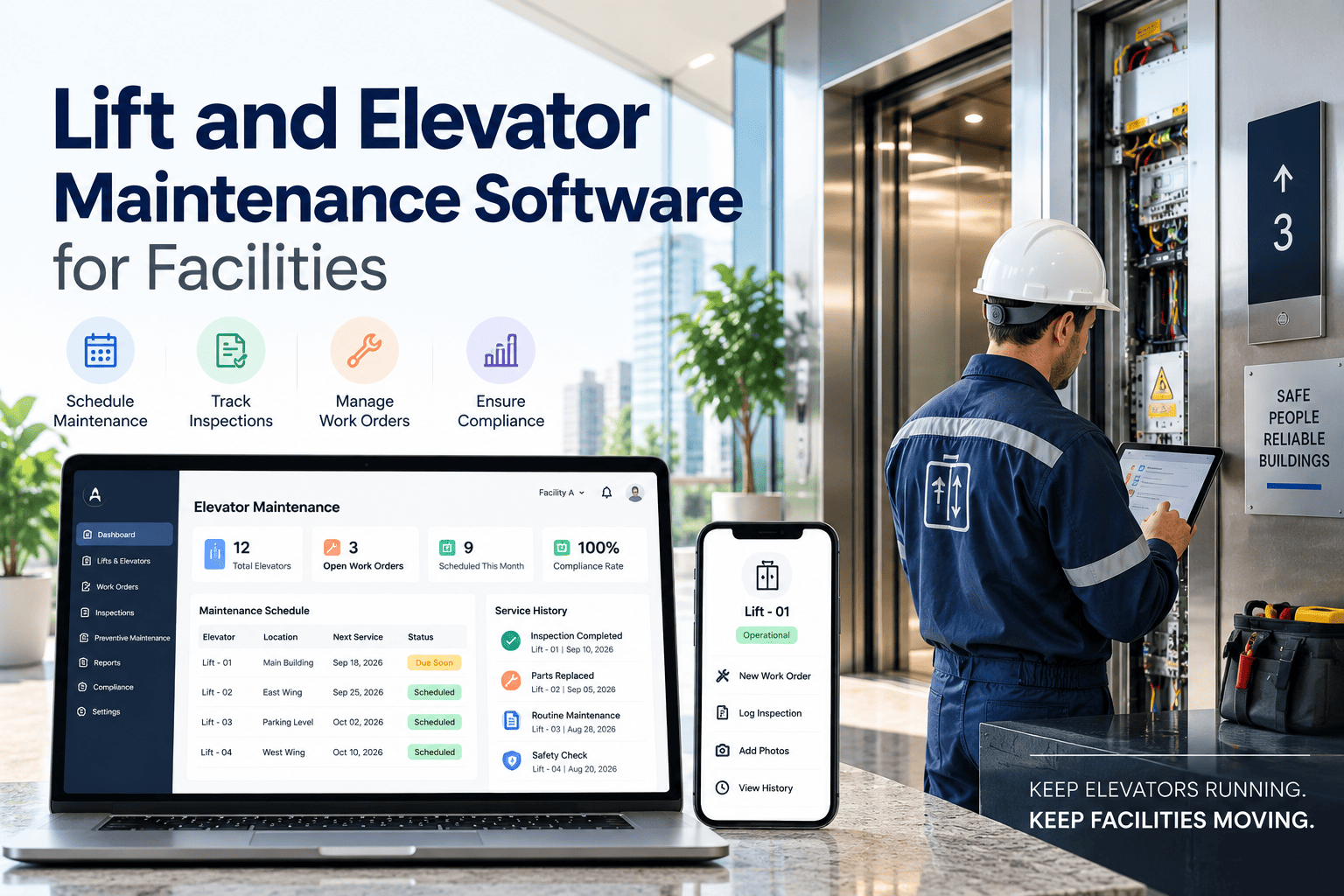
Lifts are the asset a facilities team hears about only when they stop. The rest of the time they sit quietly consuming a service contract, generating callouts nobody counts, and accumulating statutory examination reports that live in a contractor's portal rather than yours. Then a defect notice arrives, or a tenant is trapped for forty minutes, and somebody has to produce the last two years of records from memory. Lift maintenance software puts servicing, thorough examinations, callouts and defect closure on one record per lift. To see how that looks across your buildings, start a free trial.
Lift and elevator maintenance software
Who holds the evidence for your lifts — you, or your contractor?
Most facilities managers can name their lift contractor. Far fewer can produce, on the spot, the last thorough examination report for a specific lift, the defects it raised, the date each was closed, and the callout history for that unit over the past year. That evidence is a duty holder responsibility, and it does not transfer with the service contract. OxMaint keeps every lift in your portfolio on one record so the answer takes seconds rather than a week of emails.
The three layers of lift compliance, and why they get confused
Lift obligations are often collapsed into a single idea called the lift contract, which is where most compliance gaps begin. There are three distinct layers, each with a different purpose, a different competent party and a different record. Treating them as one is how a building ends up with a full maintenance file and no valid examination report.
Layer one
Routine maintenance
Planned servicing carried out by the lift contractor to keep the equipment operating safely and reliably: adjustment, lubrication, door operation, brake checks, controller and drive attention. It is preventive work, and it is what most of the contract value pays for.
Layer two
Thorough examination
An independent, systematic inspection by a competent person, carried out at statutory intervals for lifting equipment carrying people. It exists to verify safety, not to perform servicing, and it produces a report the duty holder must hold and act on.
Layer three
Defect closure and evidence
The part that is most often missing. Every defect raised by either layer needs a tracked remedy with a date, a responsible party and proof of completion. An examination report with open items and no closure trail is a liability rather than a compliance record.
A facilities team that can demonstrate all three layers for every lift in the portfolio is in a fundamentally different position from one that can only produce invoices. The difference is rarely about spending more on maintenance. It is about who is holding the record and whether defects are being chased to closure.
What belongs on a lift record
A lift is a long-lived asset with a service life measured in decades, and its history is what tells you whether it needs a modernisation, a new contractor or simply a door adjustment. Most portfolios hold fragments of that history across three systems and two inboxes. The table below is the complete picture a single lift record should carry.
| Record | What it captures | Why it matters later |
|---|---|---|
| Asset identity | Unit number, building, installation date, manufacturer, capacity, travel, drive type | Underpins every spares, modernisation and insurance conversation |
| Maintenance visits | Date, engineer, work carried out, parts fitted, time on site | Shows whether the contract is being delivered as specified |
| Thorough examination reports | Date, competent person, findings, defect categories, next due date | The primary statutory evidence for that lift |
| Defect register | Each defect, severity, owner, target date, completion proof | Turns findings into a closed loop rather than an open exposure |
| Callouts and entrapments | Time reported, attendance time, cause, resolution, recurrence | Reveals whether a lift is unreliable or simply misused |
| Downtime | Out-of-service periods with duration and reason | The metric tenants and occupiers actually experience |
| Spend history | Contract cost, chargeable repairs, parts, modernisation works | The repair-versus-replace case, built from real numbers |
Anatomy of a lift callout, and where time is lost
Callout performance is the part of lift management that tenants judge you on, and it is almost never measured properly. Breaking a callout into its stages shows exactly where the delay sits, which is usually not where people assume.
Fault reported
A user, a concierge or the lift's own monitoring reports the fault. If this arrives by phone call or informal message, the clock starts unrecorded and everything downstream becomes unmeasurable.
Logged and classified
Entrapment, safety-related fault or out-of-service. Classification drives response priority, and getting it wrong at this point is the single largest cause of a slow attendance on a trapped passenger.
Contractor dispatched
The contract response time starts here, not when the fault occurred. Recording both timestamps is what allows you to see whether delays are contractor performance or internal reporting lag.
Attendance and diagnosis
The engineer arrives and identifies the cause. Capturing the cause in a consistent way is what makes repeat-fault analysis possible across a portfolio rather than a judgement about one lift.
Return to service or hold
Either the lift is returned to service or it waits on a part. The waiting period is where most reported downtime actually accumulates, and it is invisible unless it is logged separately.
Recurrence review
A third callout for door faults on the same unit is not three incidents, it is one unresolved problem. Without recurrence tracking, that pattern is invisible and the same fault is paid for repeatedly.
Once these six stages are timestamped, a service review stops being a discussion about impressions. You can show how long faults sat before dispatch, how long attendance took, and which units generate a disproportionate share of the portfolio's callouts.
See every lift in your portfolio on one screen
Book a 30-minute walkthrough and we will build a live example with your buildings and lift units — examination due dates, open defects, callout history and contractor performance in one view, so you can see which lift needs attention before anyone reports it.
Running lifts across a multi-building portfolio
Managing one lift is an administrative task. Managing sixty across twenty buildings, with three contractors and different examination dates, is an entirely different problem — and it is the point at which spreadsheets stop working. The failure mode is consistent: nothing goes badly wrong, but nobody has a reliable view of what is due, what is open and what is costing too much.
Examination due tracking
Every unit carries its own next-due date. A single view of what falls due in the next sixty days removes the risk of a lift running past its examination because a date lived in an email thread.
Open defect visibility
Defects raised across all units, sorted by severity and age, so the oldest unresolved safety item in the portfolio is obvious rather than buried in an individual building file.
Contractor comparison
Attendance times, repeat callouts and chargeable repair spend compared across contractors, which turns contract renewal from a price negotiation into a performance conversation.
Reliability ranking
Units ranked by callout frequency and downtime, identifying the small number of lifts generating most of the portfolio's disruption and cost.
Modernisation planning
Age, spend history and reliability together, giving a defensible case for which units need investment in the next capital cycle and which have life left in them.
Tenant-facing reporting
Availability and response performance per building, ready to share with occupiers, so service charge conversations are evidenced rather than defended from memory.
How OxMaint manages lifts and elevators
OxMaint is maintenance management software for organisations running equipment across multiple buildings. For lift portfolios, it brings the statutory record, the contractor's work and your own defect tracking into one place that you own.
One record per lift unit
Each unit is an asset with its identity, building, contract, examination schedule, documents and full history, so the complete picture for any lift is one search away.
Evidence you hold yourself
Statutory schedule with alerts
Thorough examination dates are tracked per unit with advance warning, so nothing runs past its interval because of a diary gap or a contractor changeover.
No missed examinations
Defect to closure tracking
Every finding becomes a tracked item with severity, owner, target date and completion proof, so open safety items cannot quietly age in a file.
Closed loop on every finding
Callout and entrapment logging
Reported time, dispatch, attendance and resolution are captured as separate timestamps, making contractor response measurable against the contract rather than assumed.
Response times you can prove
Document store per asset
Examination reports, service sheets, risk assessments and modernisation records attach to the unit, retrievable by date range when an auditor or insurer asks.
Records in minutes, not days
Portfolio dashboards
Due dates, open defects, downtime and spend across every building and contractor, filtered by site so each building manager sees their own position clearly.
One view across all buildings
Four signs your lift records will not survive scrutiny
Lift compliance problems are quiet until they are urgent. These four patterns are the most reliable indicators that the evidence base is thinner than it looks.
Reports live in a contractor portal
If the only copy of an examination report sits with a third party, a contract change or a portal outage takes your compliance evidence with it.
Nobody can count last year's callouts
Without a count per unit, there is no way to identify which lift is failing repeatedly or to challenge a chargeable repair pattern at renewal.
Defects have no closure date
An examination finding with no recorded remedy is an open item regardless of whether the work was done. Proof of completion is the record that matters.
Due dates are tracked in a spreadsheet
Manually maintained date lists drift as units are added, contracts change and dates shift. The first sign of drift is usually a lift found to be overdue.
Lift maintenance software questions, answered
What does lift maintenance software actually manage?
It holds each lift as an asset with its servicing schedule, thorough examination dates, defect register, callout history and documents, all owned by you rather than a contractor. Start a free trial to load your units.
Does routine servicing satisfy the thorough examination requirement?
No. They are separate obligations with different purposes and different records. Servicing keeps the lift running, while thorough examination independently verifies its safety at statutory intervals.
Can it track several contractors across different buildings?
Yes. Each unit carries its own contractor, contract terms and response targets, and performance can be compared side by side across the portfolio. Book a demo to see the comparison view.
How does it help with entrapment response?
Entrapments are logged as a distinct callout type with separate timestamps for report, dispatch, attendance and release, giving a complete and defensible record of each incident.
How long does it take to set up a lift portfolio?
Most facilities teams have units, buildings, contracts and examination dates loaded within two to three weeks. Callout and defect data becomes useful for contractor reviews after a full quarter.
Own your lift records, not just your lift contract
Put every unit, examination date, defect and callout into one system you control, and answer any question about any lift in your portfolio in seconds instead of chasing a contractor for a report.
Free 14-day trial. No credit card required.