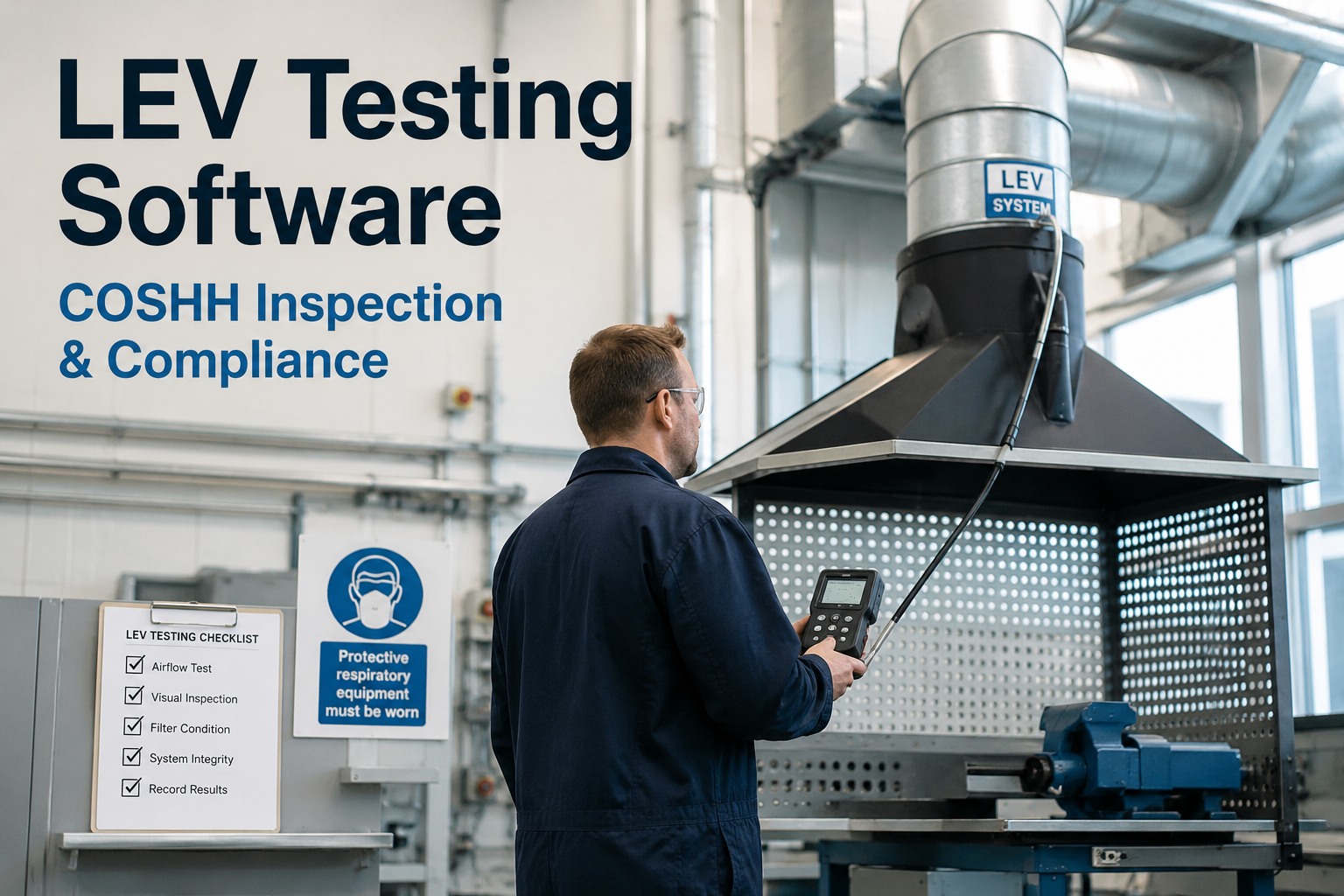
LEV Testing Software | COSHH Inspection & Compliance
By Riley Quinn on August 25, 2026
Every year, over 12,000 UK workers die from workplace lung disease — silicosis, occupational asthma, COPD, mesothelioma, welder's lung. Local exhaust ventilation is the primary engineering control between people and the dust, fume and mist that kills them. COSHH Regulation 9 makes maintenance and testing a legal duty. HSG258 is the technical benchmark. Every LEV system needs a Thorough Examination and Test at least every 14 months by a competent person, records retained five years minimum. Miss it and the system is legally out of compliance. Book a demo to see LEV workflows in action.
◆ COSHH REGULATION 9 · HSG258 · TExT MANAGEMENT
LEV isn't ventilation. It's the last engineering barrier between your workforce and 12,000 preventable deaths a year.
Every hood. Every duct. Every filter. Documented, evidenced, defensible.
12,000+
UK deaths per year from occupational lung disease
14mo
Maximum TExT interval — not the target
£∞
Unlimited fines for Reg 9 breach
What Your LEV Is Actually Fighting — And Why It Matters
The workforce doesn't feel occupational lung disease when it starts. It develops over years — dust particles below 5 microns bypassing every natural defence, welding fume oxidising in lung tissue, silica scarring the alveoli, isocyanates triggering asthma that never resolves. LEV is the engineering control that stops the exposure at source. The categories below are what UK inspectors ask about when they arrive on site. Sign up free to structure LEV compliance across every hazard category.
DUST
Silica · Wood · Metal
Silicosis · Nasal cancer · COPD
Cutting, grinding, blasting, woodworking
FUME
Welding · Soldering · Metal
Welder's lung · Metal fume fever
MMA, MIG, TIG, brazing, casting
MIST
MWF · Paint · Solvents
Occupational asthma · HP
CNC coolant, spraying, degreasing
VAPOUR
Solvents · Isocyanates
Asthma · Neurological · CNS
Spray booths, laminating, PU foams
The Anatomy of a TExT — Three Stages, One Report, One Verdict
The Thorough Examination and Test is a specific procedure defined by HSG258 — not one measurement but three sequential stages, each producing evidence the HSE inspector will ask to see. Understanding the anatomy is how duty holders judge whether their examiner's report actually meets the standard.
TExT PROCESS
HSG258 · 3-Stage Structure
1
Visual Examination
Physical condition of every component — hoods, ducting, filter housings, fans, discharge points, airflow indicators, signage. Wear, damage, corrosion, obstruction documented per component with photographic evidence.
Evidence · Photos per hood + condition record
▼
2
Technical Performance Test
Numeric measurements — airflow at hoods, capture velocity, duct velocity, differential pressure across fans and filters, filter condition, fan performance. Compared against original commissioning data to identify degradation.
Evidence · Measurements vs commissioning benchmark
▼
3
Control Effectiveness Assessment
Does the system actually control operator exposure under real working conditions? Observation of the process in use, correlation with exposure risk. Final overall verdict and remedial action list with priorities.
Evidence · Verdict + prioritised remedial actions
The Schedule 4 Trap — Where 14 Months Is Illegal
Defaulting every LEV system to a 14-month interval is one of the most common HSE enforcement findings. COSHH Schedule 4 lists specific processes that legally require monthly or six-monthly examination — not because of paperwork but because the contaminant profile is severe enough to demand tighter surveillance. If your site runs any of the processes below, the 14-month default is illegal for those systems.
Statutory maximum for other systems (subject to risk)
M
Blasting of castings in enclosures
High-consequence dust with acute lung damage risk
M
Beryllium or beryllium-compound processes
Chronic beryllium disease — no safe exposure floor
M
Jute cloth manufacture
Legacy specific Schedule 4 listing
6
Grinding of metals with 5%+ chromium
Hexavalent chromium — Group 1 carcinogen
6
Non-ferrous metal casting fettling
Silica and metal fume compound exposure
HSG258 additionally requires shorter intervals wherever site-specific risk assessment identifies higher exposure potential, or where wear and tear would degrade performance between tests. Interval-setting is a documented decision — not a spreadsheet default.
◆ LEV COMPLIANCE DEMO
See the Full LEV Cycle in 30 Minutes
Per-hood asset registers, 14-month TExT scheduling with automatic Schedule 4 flagging, remedial action tracking, photographic evidence capture, Regulation 8 logbook automation and HSG258-aligned evidence packs — configured against your systems.
The Real Failure Point — The Remediation Loop Nobody Closes
Ask the HSE inspector what actually triggers LEV enforcement action, and the answer isn't the missed TExT. It's the completed TExT whose remedial findings never got done. The examiner identifies three defects in August. The report arrives with 30-day remediation deadlines. By the following August, those same three defects appear on the new report because nobody actioned them. That pattern is the strongest possible evidence of "known but ignored" — and it's what enforcement notices are built on. The remediation loop is the whole game.
01
TExT report received
Competent examiner delivers report with defects listed and priorities assigned.
→
02
Actions auto-created
Every remedial becomes a tracked work order with owner, deadline, evidence field.
→
03
Work completed & evidenced
Photograph, sign-off, materials cert. Closure blocked without evidence.
→
04
Logbook updated
Regulation 8 record populates automatically. Loop closed, ready for next cycle.
Oxmaint runs this loop by default so the next TExT arrives to a system where every previous finding is either closed or actively in progress. Sign up free to close every LEV remedial cycle.
Expert Perspective — Why LEV Is a Workflow Problem, Not a Testing Problem
"
Every UK duty holder gets the TExT bit right — they book a competent examiner, the test happens, the report arrives. Where LEV compliance actually fails is everything wrapped around that examination. Interval-setting defaulted to 14 months without considering Schedule 4 or HSG258 risk factors. Remedial actions from previous TExTs sitting open six months later. Regulation 8 logbooks reconstructed from paper reports the week before an HSE visit. Daily user checks that should be running through the operator population but never actually reach a system of record. None of these are testing failures — they're workflow failures. And they're what enforcement action arises from. The platform capability that matters isn't the report ingestion; it's the discipline that runs the six weeks after every report to make sure the remediation cycle actually closes.
— Occupational Hygiene & LEV Compliance Practice
01
Per-hood asset register
Every hood, duct, filter and fan individually registered. TExT data attaches per component.
02
Schedule 4 flagging
Systems serving listed processes auto-flagged for monthly/6-monthly cycles. No default mistakes.
03
Remedial actions live
Every TExT finding becomes a tracked action. Overdue items structurally visible.
04
Reg 8 logbook auto-build
Every workflow action populates the logbook. Continuous record, not pre-inspection reconstruction.
Who Uses Oxmaint for LEV Compliance in the UK
The platform is used by the UK operational roles that actually own LEV duty: HSE and SHEQ managers coordinating COSHH programmes across manufacturing sites, maintenance managers running LEV asset registers alongside general PPM, engineering managers scheduling TExT with third-party P601 examiners, occupational hygienists interpreting TExT reports and defining remedial actions, production managers responsible for daily and weekly LEV user checks on the shop floor, welding and machining department leads managing LEV serving specific processes, and QSHE directors producing evidence packs for HSE inspections and insurance audits. Sign up free to configure LEV compliance for your team.
Getting LEV Compliance Live in 30-45 Days
Deployment starts by importing the LEV asset register — every system, every hood, every filter with commissioning data where available. TExT scheduling configures per system with Schedule 4 flagging and site-risk-based tighter intervals where HSG258 factors demand. Third-party P601/P602 competent examiner records tie to scheduled examinations. Daily and weekly user check templates deploy for shop-floor operators. TExT report ingestion captures findings, and every remedial becomes a tracked work item with owner, deadline and evidence field. Regulation 8 logbook builds automatically from workflow. Most manufacturing sites see LEV register, TExT scheduling and remedial workflow live within 30-45 days; portfolio deployments inside two quarters. Book a walkthrough to see live UK LEV deployments.
◆ TURN LEV DUTY INTO STRUCTURAL COMPLIANCE
One Platform. Every Hood. Every Cycle.
Oxmaint gives UK duty holders the full LEV cycle in one platform — per-hood asset registers, 14-month TExT scheduling with Schedule 4 flagging, remedial action tracking, Regulation 8 logbook automation and HSG258-aligned evidence packs ready for HSE.
What is LEV testing and who is legally required to do it?
LEV testing — formally the Thorough Examination and Test (TExT) — is the statutory examination of every local exhaust ventilation system required under COSHH Regulation 9. Any UK employer operating LEV to control airborne contaminants (dust, fume, mist, vapour) has a legal duty to arrange TExT at least every 14 months, carried out by a competent person, with records retained five years minimum. The regulation applies regardless of whether the system runs frequently or occasionally. HSG258 is the HSE technical benchmark inspectors use to judge whether a duty holder is meeting the standard. HSE estimates over 12,000 UK workplace deaths per year from occupational lung disease driven by exactly the exposures LEV is designed to prevent.
What does a TExT actually involve?
HSG258 structures the Thorough Examination and Test in three sequential stages. Stage 1 is thorough visual examination — physical condition and integrity of hoods, ducting, filter housings, fans, discharge points, airflow indicators and signage. Stage 2 is technical performance test — airflow measurements at hoods, capture velocity, duct velocity, differential pressure across fans and filters, filter condition, fan performance, all compared against original commissioning data. Stage 3 is control effectiveness assessment — does the system actually control operator exposure to the intended level under real working conditions. The output is a TExT report with numeric measurements, photographic evidence and a defect list with remedial priorities.
When is a shorter interval than 14 months required?
Two triggers apply. First, COSHH Schedule 4 lists specific processes requiring monthly (blasting of castings in enclosures, beryllium processes, jute cloth manufacture) or six-monthly intervals (grinding of metals containing 5%+ chromium, non-ferrous metal casting fettling). Second, HSG258 requires shorter intervals wherever site-specific risk assessment identifies higher exposure potential, or where wear and tear would degrade performance between scheduled tests. Defaulting every system to 14 months regardless of process is a recurring HSE enforcement finding. Interval-setting should be a documented, evidenced decision on the LEV register rather than an unexamined spreadsheet default.
What are the P601 and P602 competence standards?
P601 and P602 are competence standards from the British Occupational Hygiene Society (BOHS). P601 covers the Thorough Examination and Test itself — the competent person qualification HSE expects TExT examiners to hold. P602 covers LEV commissioning and design competence. HSG258 identifies these as the recognised competence framework, though the underlying legal test is broader — a "competent person" is one with sufficient training, experience and knowledge to carry out the specific task safely and to the required standard. Duty holders should verify the P601/P602 status of any third-party examiner they engage and record that verification as part of the competent person appointment.
What is the Regulation 8 logbook?
COSHH Regulation 8 requires the employer to maintain an LEV logbook covering the whole system lifecycle — commissioning data, ongoing user checks (daily/weekly), defect reports raised between formal examinations, TExT reports with all findings and remedial actions, closure evidence for remedials, and re-test records. The logbook is a continuously populated operational record, not something reconstructed before an HSE visit. Sites where the logbook exists as scattered paper reports typically struggle to demonstrate active LEV management. Oxmaint's LEV workflow builds the logbook automatically from every workflow action — inspection scheduling, user check completion, TExT report ingestion, remedial work orders and closure — so the record is always current and always retrievable.